1

Poetry Teaching Jobs (NOW HIRING)

Poetry Club Reports to: Director of Athletics and Activities; Activities Facilitator; Building ... D ("Stipends") of the Proviso Teachers Union Collective Bargaining Agreement (July 1, 2024 - June ...

Poetry Club Reports to: Director of Athletics and Activities; Activities Facilitator; Building ... D ("Stipends") of the Proviso Teachers Union Collective Bargaining Agreement (July 1, 2024 - June ...

next page

Showing results 1-20

Poetry Teaching information

See salary details

$10

$23

$36

How much do poetry teaching jobs pay per hour?

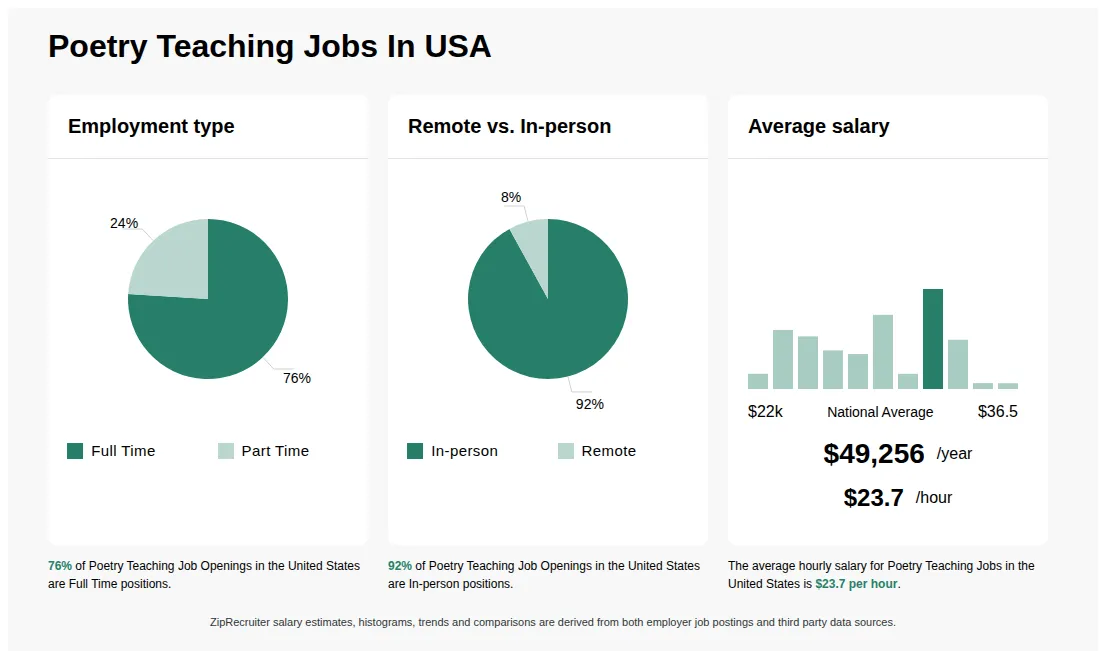
As of Sep 3, 2026, the average hourly pay for poetry teaching in the United States is $23.68, according to ZipRecruiter salary data. Most workers in this role earn between $16.83 and $28.85 per hour, depending on experience, location, and employer.

What is poetry teaching?

A Poetry Teaching job involves educating students about poetry, including its forms, techniques, and history. Teachers guide students in analyzing poems, developing their own writing skills, and appreciating poetic expression. This role may be found in schools, universities, or community programs. Responsibilities often include lesson planning, workshop facilitation, and providing feedback on student work.

What are the typical daily responsibilities of poetry teaching?

As a Poetry Teacher, your typical day involves preparing lesson plans, leading discussions or workshops, and guiding students in both the analysis and creation of poems. You will review student work, provide constructive feedback, and adapt lessons to accommodate different learning styles and abilities. Collaboration with fellow teachers, participation in school events, and organizing poetry readings or contests may also be part of your responsibilities. Effective time management and ongoing communication with parents or guardians are key aspects of the job.

What are the key skills and qualifications needed for poetry teaching?

To thrive in Poetry Teaching, you typically need deep knowledge of poetry analysis, creative writing, and educational pedagogy, often backed by a degree in English, Literature, or Education. Familiarity with online learning platforms, classroom management systems, and curriculum design tools is valuable. Outstanding soft skills include strong communication, encouragement, and an ability to inspire creativity in diverse learners. These competencies are essential for effectively engaging students, fostering a love for poetry, and successfully managing varied classroom environments.

More about Poetry Teaching jobs

What cities are hiring for Poetry Teaching jobs?

Cities with the most Poetry Teaching job openings:

What are the most commonly searched types of Poetry Teaching jobs?

The most popular types of Poetry Teaching jobs are:

What states have the most Poetry Teaching jobs?

States with the most job openings for Poetry Teaching jobs include:

Infographic showing various Poetry Teaching job openings in the United States as of August 2026, with employment types broken down into 1% As Needed, 56% Full Time, 40% Part Time, 1% Temporary, and 2% Contract. Highlights an 79% Physical, and 21% Remote job distribution, with an average salary of $49,256 per year, or $23.7 per hour.

Chapter 510 - Poet Teaching Artist → Oakland

Caforthearts

Oakland, CA • On-site

$68.88 - $89.54/hr

Other

Posted 2 days ago

New


Job description

Classification: Part-Time (up to 182 hours per contract, hours per week may vary- see schedule section below), Non-exempt, At-Will

Compensation: USD$50 - $65 / hour

Start Date: August 1, 2026–June 18, 2027

OVERVIEW

Chapter 510 is seeking an experienced Poet Teaching Artist to be the lead teacher in residence for our Young Oakland Poets Expedition, a poetry writing and publishing program for 4th graders across Oakland Unified School District. This is an excellent opportunity for individuals who have passion for and experience with poetry, literary arts education and youth.

CULTURALLY RESPONSIVE TEACHING APPROACH

Our programs are grounded in a Culturally Responsive Teaching Approach inspired by Zaretta Hammond and our pedagogy partners, Studio Pathways. All curriculum centers the work of writers of color and integrates arts-based frameworks to support diverse learning styles and ways of knowing.

ABOUT THE POSITION

Teaching Artist Duties

Teaching & Facilitation

  • Lead in-person writing workshops at OUSD elementary schools.
  • Collaborate with OUSD elementary school teachers to support student and classroom goals.
  • Debrief with staff after each workshop to discuss needs, insights, and seek support.
  • Perform and present poetry to elementary students across OUSD.
  • Facilitate creative writing professional development workshops for teachers in collaboration with OUSD.
  • Ensure students complete and submit final drafts for publication.
  • Design curriculum aligned with Chapter 510 pedagogy and present teaching plan and list of technology requests to supervisor for approval prior to teaching.
  • Documents each weekly lesson plan in a designated folder on 510 Google shared drive.
  • Provides Program Coordinator a list of needed supplies and other items.
  • Meet and communicate with all project partners in order to include all the guest artists, volunteers/mentors, advisors and community partners in the program.

Final culmination - publication and celebration

  • Ensure that students complete work and that work is ready for exhibit and/or publication.
  • Prepare students for their final presentations, gallery walks, and exhibits.
  • Attend all presentations and exhibits.
  • Write the introduction for any book from the workshop going to publication.
  • Makes sure their student writers’ work is in final draft form for the publisher, providing any developmental editing support needed.
  • Supports supervisor and other staff in curating the order of student pieces in an anthology.

Reporting/Evaluation

  • Ensure that the following reports/documents are submitted to Chapter 510 ten days after the conclusion of the workshops:Reimbursement with original receipts.
  • All documentation collected, including photos (labeled appropriately), videos, writing samples, etc.
  • Final teacher evaluation if in your first year with Chapter 510.
#J-18808-Ljbffr