1

Plant Pathologist Jobs (NOW HIRING)

PLANT ADMINISTRATOR

Minneapolis, MN · On-site

$18 - $20/hr

Summary : Administers and performs the assigned Millwood standard operating procedures in a manner that is within the company's strategic plan guidelines utilizing a positive attitude. For the full ...

Entomology and Plant Pathology houses the Plant Disease and Insect Clinic, the Larry Grand Mycological Herbarium, Micropropagation and Repository Unit, Structural Pest Management Training Facility ...

You bring: • A degree in Arboriculture, Urban Forestry, Horticulture, Plant Science, Plant Pathology, Environmental Sciences, Landscape Management, Turfgrass--or related experience (preferred) • ...

You bring: • A degree in Arboriculture, Urban Forestry, Horticulture, Plant Science, Plant Pathology, Environmental Sciences, Landscape Management, Turfgrass--or related experience (preferred) • ...

next page

Showing results 1-20

Plant Pathologist information

See salary details

$39.5K

$82.6K

$116K

How much do plant pathologist jobs pay per year?

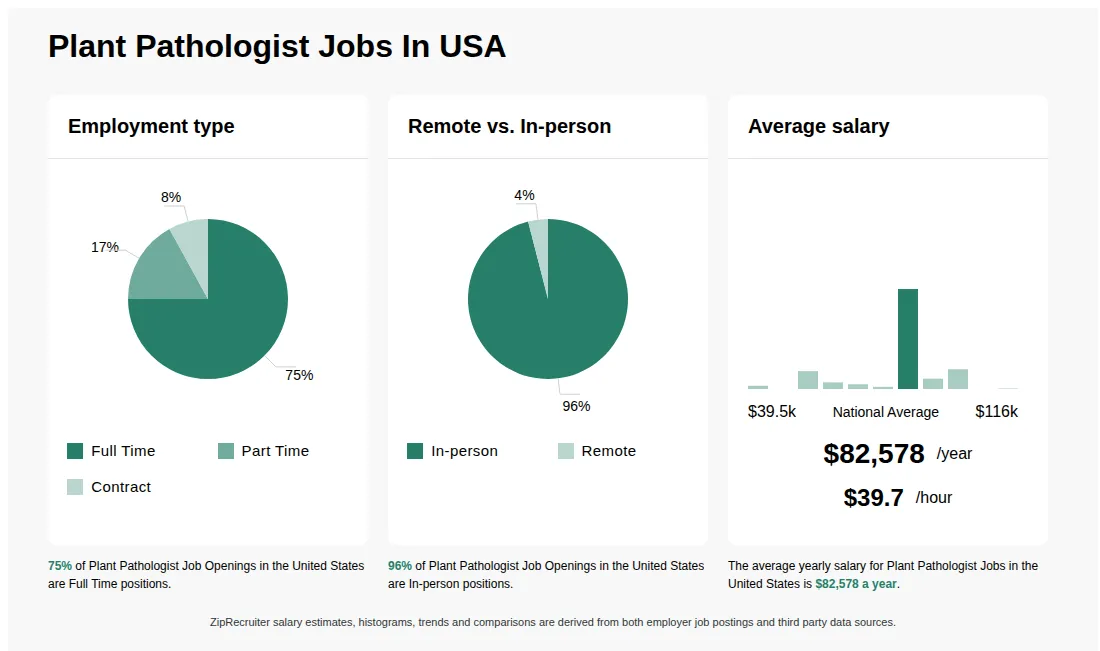
As of Jul 21, 2026, the average yearly pay for plant pathologist in the United States is $82,578.00, according to ZipRecruiter salary data. Most workers in this role earn between $82,500.00 and $83,000.00 per year, depending on experience, location, and employer.

What are the key skills and qualifications needed to thrive as a Plant Pathologist, and why are they important?

To excel as a Plant Pathologist, you need a strong background in plant biology, microbiology, and disease diagnostics, typically supported by a degree in plant pathology or a related field. Familiarity with laboratory equipment, molecular diagnostic tools, and data analysis software such as PCR systems and GIS applications is essential. Strong analytical thinking, attention to detail, and effective communication skills help in problem-solving and collaborating with agricultural stakeholders. These abilities are vital for accurately identifying plant diseases, developing effective management strategies, and supporting sustainable agricultural production.

What is the difference between Plant Pathologist vs Plant Biologist?

AspectPlant PathologistPlant Biologist
CredentialsBachelor's or Master's in Plant Pathology, Ph.D. often preferredBachelor's or Master's in Botany, Plant Science, or related field; Ph.D. for advanced roles
Work EnvironmentResearch labs, agricultural settings, plant disease diagnosticsResearch labs, academic institutions, field studies, conservation areas
Industry UsageAgriculture, plant disease management, research institutionsResearch, academia, conservation, biotechnology

While both roles focus on plants, a Plant Pathologist specializes in diagnosing and managing plant diseases, often working in agricultural and research settings. A Plant Biologist studies plant functions, growth, and development, with broader research interests. The roles overlap in education and research but differ in their specific focus areas and applications.

What are plant pathologists?

Plant pathologists are scientists who study plant diseases, including their causes, effects, and management. They investigate how pathogens such as fungi, bacteria, viruses, and nematodes affect plant health, and develop methods to prevent and control plant diseases. Plant pathologists work in various settings, including agriculture, research institutions, government agencies, and universities. Their work is essential for ensuring healthy crops, food security, and sustainable agricultural practices.

What Is a Plant Pathologist?

Plant pathologists are scientists who work in agriculture and related fields. As a plant pathologist, you work both in a laboratory setting and out in the field to monitor the conditions that affect plant and crop health. In the laboratory setting, you analyze samples of plants, microorganisms, and other aspects of the natural environment. When there are soil problems or a crop disease, you make onsite visits to determine the cause of the problem and recommend best solutions to treat or eradicate the issue. You must keep up to date with the latest research and innovations in biological and agricultural sciences related to diseases or pathogens that may plague plants. Working closely with biologists, farmers, breeders, and botanists at farms, you create quality control measures and improve practices for maintaining safe environments for the plants and find ways to increase crop yields or develop disease resistance.

What are some common challenges plant pathologists face when diagnosing plant diseases in the field?

Plant pathologists often encounter challenges such as distinguishing between similar disease symptoms, environmental stresses, and pest damage, which can all present similar signs in plants. Limited access to advanced diagnostic tools in field settings can make accurate identification more difficult, requiring strong observational skills and sometimes sending samples to a laboratory for further analysis. Additionally, keeping up with emerging diseases and adapting to new pathogens can be demanding, but collaboration with other scientists and ongoing professional development help address these challenges.
What cities are hiring for Plant Pathologist jobs? Cities with the most Plant Pathologist job openings:
What are the most commonly searched types of Plant Pathologist jobs? The most popular types of Plant Pathologist jobs are:
Who are the top companies hiring for Plant Pathologist jobs? The top employers for Plant Pathologist jobs are:
What states have the most Plant Pathologist jobs? States with the most job openings for Plant Pathologist jobs include:
What job categories do people searching Plant Pathologist jobs look for? The top searched job categories for Plant Pathologist jobs are:
What are popular job titles related to Plant Pathologist jobs? For Plant Pathologist jobs, the most frequently searched job titles are:
Infographic showing various Plant Pathologist job openings in the United States as of July 2026, with employment types broken down into 5% As Needed, 62% Full Time, 15% Part Time, and 18% Contract. Highlights an 97% Physical, 1% Hybrid, and 2% Remote job distribution, with an average salary of $82,578 per year, or $39.7 per hour.

Plant Health Care Manager

Emerald Tree Care & Shrub

New Rochelle, NY • On-site

$75K - $125K/yr

Full-time

Medical, Retirement

Re-posted 25 days ago


Job description

Are you an experienced Arborist who has a love of trees, enjoys working outdoors with people. If you have experience in plant health care and are looking to take the next step toward advancing your Arboricultural Career, your journey begins here!
Emerald Tree and Shrub Care is at forefront of industry standards and practices. Our Arborists are certified experts in tree care to residential, commercial, government and other customers and prospects. If you are looking to be part of a team that is committed to being the best in every market it serves.
Contact us ASAP
Responsibilities:
• Meet with clients/prospects to evaluate, monitor and diagnose landscape conditions
• Design treatment and maintenance plans for plant health care
• Monitor, diagnose and treat insect, disease, physiological and cultural conditions
• Complete diagnostic reports and provide comprehensive information for creating an ideal environment for optimum health of landscapes including monitoring, diagnosing and treating
insect, disease, other conditions for client trees and shrubs
• Schedule and route services
• Provide training and guidance for Plant Health Care crews
• Review daily reports/meet with arborists
• Review state and federal laws and regulations with crews
• Manage client concerns
• Perform Training to field personnel
Skills:
• Good plant identification skills, personal skills and communication skills. Experience with arboriculture.
• Must be physically fit to work outdoors
Education:
Education Level Required: Field related degree ISA certification
Work Experience: 2 to 4 years
Certification as an ISA Arborist
College level course work in entomology, plant pathology, plant ecology, and soil science is preferred.
Compensation based upon qualifications and experience
We offer:
• One of the best equipped and trained teams in the industry, with an emphasis on quality and safety
• Competitive compensation ranging from $75,000-$125,000 annually
• Bonus Eligibility
• 401(K) Savings Plan
• Health Care Benefits
• Excellent Continuing Education