The primary duties of this position are to maintain a vigorous, creative, externally funded research program, teach physiology to medical, dental, and graduate students, and provide service to the ...
The primary duties of this position are to maintain a vigorous, creative, externally funded research program, teach physiology to medical, dental, and graduate students, and provide service to the ...
Responsibilities The primary duties of this position are to maintain a vigorous, creative, externally funded research program, teach physiology to medical, dental, and graduate students, and provide ...
Responsibilities The primary duties of this position are to maintain a vigorous, creative, externally funded research program, teach physiology to medical, dental, and graduate students, and provide ...

Knowledge of anatomy and physiology. * Graduate of accredited radiology school-RT (R). * LIC IDNS * REG ARRT * CERT BLS * Physical Demands Requirement : * Physical demands required for this role ...
Knowledge of anatomy and physiology. * Graduate of accredited radiology school-RT (R). * LIC IDNS * REG ARRT * CERT BLS * Physical Demands Requirement : * Physical demands required for this role ...
Knowledge of anatomy and physiology. * Graduate of accredited radiology school-RT (R). * LIC IDNS * REG ARRT * CERT BLS * Physical Demands Requirement : * Physical demands required for this role ...
Knowledge of anatomy and physiology. * Graduate of accredited radiology school-RT (R). * LIC IDNS * REG ARRT * CERT BLS * Physical Demands Requirement : * Physical demands required for this role ...

The Department of Physiology in the College of Graduate Studies at Midwestern University in Glendale Arizona invites applications for a full-time, tenure-track faculty position in physiology at the ...
The Department of Physiology in the College of Graduate Studies at Midwestern University in Glendale Arizona invites applications for a full-time, tenure-track faculty position in physiology at the ...
The Department of Physiology in the College of Graduate Studies at Midwestern University in Glendale Arizona invites applications for a full-time, tenure-track faculty position in physiology at the ...
The Department of Physiology in the College of Graduate Studies at Midwestern University in Glendale Arizona invites applications for a full-time, tenure-track faculty position in physiology at the ...
The Department of Physiology in the College of Graduate Studies at Midwestern University in Glendale Arizona invites applications for a full-time, tenure-track faculty position in physiology at the ...
The Department of Physiology in the College of Graduate Studies at Midwestern University in Glendale Arizona invites applications for a full-time, tenure-track faculty position in physiology at the ...
Faculty Anatomy & Physiology
Texas City, TX · On-site
$48 - $72/hr
... graduate level hours in anatomy and physiology OR MD, DO, DDS , DVM , DC, DPT , PharmD, OD with graduate level hours in anatomy and physiology. Preferred Education/Training/Experience * M.S. or Ph.D ...
Faculty Anatomy & Physiology
Texas City, TX · On-site
$48 - $72/hr
... graduate level hours in anatomy and physiology OR MD, DO, DDS , DVM , DC, DPT , PharmD, OD with graduate level hours in anatomy and physiology. Preferred Education/Training/Experience * M.S. or Ph.D ...

Kinesiology - Clinical Exercise Physiology and/or Functional Anatomy
Fresno, CA · On-site
$75.89 - $79.24/hr
The Assistant Professor will primarily teach undergraduate and graduate classes in the Department ... Clinical exercise physiology and/or cardiovascular physiology * Functional anatomy * General ...
Kinesiology - Clinical Exercise Physiology and/or Functional Anatomy
Fresno, CA · On-site
$75.89 - $79.24/hr
The Assistant Professor will primarily teach undergraduate and graduate classes in the Department ... Clinical exercise physiology and/or cardiovascular physiology * Functional anatomy * General ...
Knowledge of anatomy and physiology. * Graduate of accredited radiology school-RT (R). * LIC IDNS * REG ARRT * CERT BLS Preferred: * One year of Interventional Lab experience. Additional Information ...
Knowledge of anatomy and physiology. * Graduate of accredited radiology school-RT (R). * LIC IDNS * REG ARRT * CERT BLS Preferred: * One year of Interventional Lab experience. Additional Information ...
Interventional Radiology Technologist - Full Time Days
Mchenry, IL · On-site
$38.84/hr
Knowledge of anatomy and physiology. * Graduate of accredited radiology school-RT (R). * LIC IDNS * REG ARRT * CERT BLS * Physical Demands Requirement : * Physical demands required for this role ...
Interventional Radiology Technologist - Full Time Days
Mchenry, IL · On-site
$38.84/hr
Knowledge of anatomy and physiology. * Graduate of accredited radiology school-RT (R). * LIC IDNS * REG ARRT * CERT BLS * Physical Demands Requirement : * Physical demands required for this role ...
Knowledge of anatomy and physiology. * Graduate of accredited radiology school-RT (R). * LIC IDNS * REG ARRT * CERT BLS * Physical Demands Requirement : * Physical demands required for this role ...
Knowledge of anatomy and physiology. * Graduate of accredited radiology school-RT (R). * LIC IDNS * REG ARRT * CERT BLS * Physical Demands Requirement : * Physical demands required for this role ...

Assistant Professor, Physiology
Murray, KY · On-site
$53K/yr
There will be opportunities to teach other upper level courses and graduate level courses in the successful applicant's area of expertise. The research area within physiology is open, but preference ...
Assistant Professor, Physiology
Murray, KY · On-site
$53K/yr
There will be opportunities to teach other upper level courses and graduate level courses in the successful applicant's area of expertise. The research area within physiology is open, but preference ...

Tenure Track Position - Physiology
San Luis Obispo, CA · On-site
$97.79 - $107.63/hr
... physiology. The position is for an Assistant Professor, beginning approximately August 12, 2027 ... The successful candidate will teach a variety of undergraduate and graduate biology courses, design ...
Tenure Track Position - Physiology
San Luis Obispo, CA · On-site
$97.79 - $107.63/hr
... physiology. The position is for an Assistant Professor, beginning approximately August 12, 2027 ... The successful candidate will teach a variety of undergraduate and graduate biology courses, design ...

Faculty Anatomy & Physiology
Texas City, TX · On-site
$61K - $73K/yr
... graduate level hours in anatomy and physiology OR MD, DO, DDS, DVM, DC, DPT, PharmD, OD with graduate level hours in anatomy and physiology. Preferred Education/Training/Experience M.S. or Ph.D. in ...
Faculty Anatomy & Physiology
Texas City, TX · On-site
$61K - $73K/yr
... graduate level hours in anatomy and physiology OR MD, DO, DDS, DVM, DC, DPT, PharmD, OD with graduate level hours in anatomy and physiology. Preferred Education/Training/Experience M.S. or Ph.D. in ...

Anatomy and Physiology Instructor
Chicago, IL · On-site
$61K - $65K/yr
... and Physiology Instructor Category Full-Time Faculty Position Number Posting Number F0000277 ... graduate courses as appropriate. • Incorporating evidence-based teaching methods that enhance ...
Anatomy and Physiology Instructor
Chicago, IL · On-site
$61K - $65K/yr
... and Physiology Instructor Category Full-Time Faculty Position Number Posting Number F0000277 ... graduate courses as appropriate. • Incorporating evidence-based teaching methods that enhance ...

Tenure Track Position - Physiology
San Luis Obispo, CA · On-site
$97.79 - $107.63/hr
... physiology with appointment beginning approximately August 12, 2027. The department seeks an ... Candidates must be committed to high‑quality undergraduate and graduate education and be ...
Tenure Track Position - Physiology
San Luis Obispo, CA · On-site
$97.79 - $107.63/hr
... physiology with appointment beginning approximately August 12, 2027. The department seeks an ... Candidates must be committed to high‑quality undergraduate and graduate education and be ...
Knowledge of anatomy and physiology. * Graduate of accredited radiology school-RT (R). * LIC IDNS * REG ARRT * CERT BLS * Physical Demands Requirement : * Physical demands required for this role ...
Knowledge of anatomy and physiology. * Graduate of accredited radiology school-RT (R). * LIC IDNS * REG ARRT * CERT BLS * Physical Demands Requirement : * Physical demands required for this role ...
Interventional Radiology Technologist Cardiology Full Time Sign On Bonus Eligible
Palos Heights, IL · On-site
$40/hr
Knowledge of anatomy and physiology. * Graduate of accredited radiology school-RT (R). * LIC IDNS * REG ARRT * CERT BLS Preferred: * One year of Interventional Lab experience. Additional Information ...
Interventional Radiology Technologist Cardiology Full Time Sign On Bonus Eligible
Palos Heights, IL · On-site
$40/hr
Knowledge of anatomy and physiology. * Graduate of accredited radiology school-RT (R). * LIC IDNS * REG ARRT * CERT BLS Preferred: * One year of Interventional Lab experience. Additional Information ...
Interventional Radiology Technologist Cardiology Full Time Sign On Bonus Eligible
Palos Heights, IL · On-site
Knowledge of anatomy and physiology. * Graduate of accredited radiology school-RT (R). * LIC IDNS * REG ARRT * CERT BLS Preferred: * One year of Interventional Lab experience. Additional Information ...
Interventional Radiology Technologist Cardiology Full Time Sign On Bonus Eligible
Palos Heights, IL · On-site
Knowledge of anatomy and physiology. * Graduate of accredited radiology school-RT (R). * LIC IDNS * REG ARRT * CERT BLS Preferred: * One year of Interventional Lab experience. Additional Information ...
Physiology Graduate information
See salary details
$17.79 - $18.42
4% of jobs
$18.42 - $19.06
6% of jobs
$19.06 - $19.69
11% of jobs
$19.91 is the 25th percentile. Wages below this are outliers.
$19.69 - $20.32
11% of jobs
$20.32 - $20.96
11% of jobs
The median wage is $21.59 / hr.
$20.96 - $21.59
7% of jobs
$21.59 - $22.22
11% of jobs
$22.22 - $22.86
11% of jobs
$23.08 is the 75th percentile. Wages above this are outliers.
$22.86 - $23.49
11% of jobs
$23.49 - $24.13
7% of jobs
$24.13 - $24.76
11% of jobs
$17
$21
$24
How much do physiology graduate jobs pay per hour?
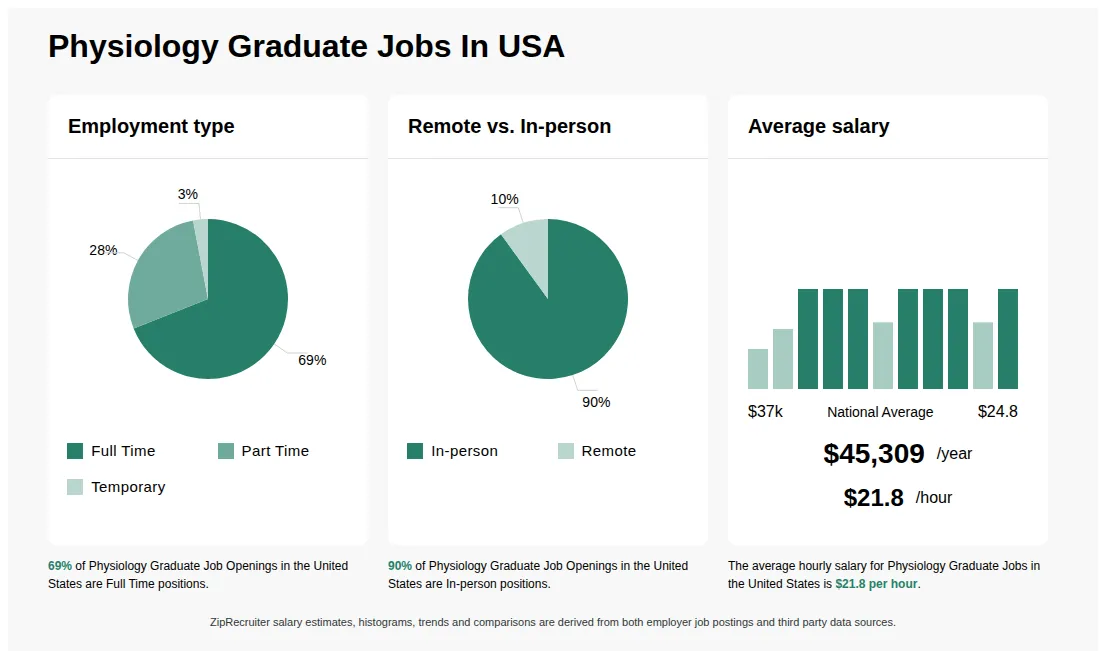
As of Sep 7, 2026, the average hourly pay for physiology graduate in the United States is $21.78, according to ZipRecruiter salary data. Most workers in this role earn between $19.95 and $23.56 per hour, depending on experience, location, and employer.
What is a physiology graduate?
Physiology graduates are individuals who have completed a degree in physiology, the scientific study of how the human body and other organisms function. These graduates have a strong foundation in biological sciences, with knowledge of cellular processes, organ systems, and how organisms respond to various stimuli. Physiology graduates can pursue careers in research, healthcare, pharmaceuticals, education, or continue with further studies such as medical school or specialized postgraduate programs. Their training equips them with analytical, laboratory, and problem-solving skills highly valued across many scientific and health-related fields.
What are some typical career paths and advancement opportunities for physiology graduates?
Physiology graduates often begin their careers in research, healthcare, or education roles, such as laboratory technicians, research assistants, or clinical support staff. With experience, many advance to positions like research scientist, clinical trial coordinator, or pursue postgraduate study for specialized roles in medicine, physiotherapy, or academia. Networking, ongoing professional development, and obtaining relevant certifications can significantly enhance career growth. Many employers value the strong analytical and laboratory skills physiology graduates possess, enabling them to transition into roles in pharmaceuticals, biotechnology, or public health.
What are the key skills and qualifications needed to thrive as a physiology graduate, and why are they important?
To thrive as a Physiology Graduate, you need a solid understanding of human biology, research methodologies, and data analysis, typically grounded in a relevant degree. Familiarity with laboratory equipment, statistical software (such as SPSS or R), and scientific databases is often required. Strong communication, problem-solving, and teamwork skills help you interpret results and collaborate effectively in research or healthcare environments. These abilities are vital for advancing scientific knowledge, ensuring accurate data interpretation, and contributing meaningfully to interdisciplinary projects.
What is the difference between Physiology Graduate vs Exercise Physiologist?
| Aspect | Physiology Graduate | Exercise Physiologist |
|---|---|---|
| Required Credentials | Bachelor's degree in physiology or related field | Bachelor's degree + certification (e.g., ACSM, NSCA) |
| Work Environment | Research labs, healthcare settings, academia | Clinics, fitness centers, rehabilitation facilities |
| Employer & Industry Usage | Universities, research institutions, healthcare providers | Hospitals, sports teams, wellness centers |
| Common Search & Comparison | Yes | Yes |
In summary, a Physiology Graduate typically has a bachelor's degree focused on physiology and works in research or academic settings. An Exercise Physiologist, while also holding a relevant degree, often requires additional certification and works directly with clients to improve physical health and fitness. Both roles share a foundation in physiology but differ in their work environment and professional focus.
More about Physiology Graduate jobs
What cities are hiring for Physiology Graduate jobs?
Cities with the most Physiology Graduate job openings:
What states have the most Physiology Graduate jobs?
States with the most job openings for Physiology Graduate jobs include:

Full-time
Re-posted 9 days ago
Job description
Candidates for this Tenure-track Associate Professor position are expected to have an active research program that complements existing departmental strengths in cardiac and vascular diseases, diabetes, ion channel physiology, and mitochondrial biology. The qualified candidates should have an excellent record of research accomplishments and national funding.
Applicants must have a PhD, MD, or equivalent degree. The qualified candidates should have an excellent record of research accomplishments and national funding.
To apply, applicants should submit a cover letter of interest, complete CV, summary of research accomplishments and goals, and names and contact information of three references. Please direct any questions to the Search Committee Chair, Dr. Zheng Fan (zfan@uthsc.edu). The position will remain open until filled.
The primary duties of this position are to maintain a vigorous, creative, externally funded research program, teach physiology to medical, dental, and graduate students, and provide service to the university and communities. Performs cutting-edge research in the cardiovascular field, secure national funding, and teach physiology to medical, dental and graduate students.
This position comes with a competitive start-up package. The successful candidate will be in an outstanding position to take advantage of the exceptional opportunities and excellent resources available in the Department of Physiology, division of cardiology, UTHSC campus, and local and statewide hospitals to develop collaborative research programs.

About University of Tennessee at Martin
Sourced by ZipRecruiter
Industry
Colleges, universities, and professional schools
Company size
1,001 - 5,000 Employees
Headquarters location
Martin, TN, US
Year founded
1900