
Oceanography and Meteorology Officers eventually earn a dual master's degree in meteorology and physical oceanography at Naval Postgraduate School (NPS) in Monterey, CA. There are opportunities to ...
Oceanography and Meteorology Officers eventually earn a dual master's degree in meteorology and physical oceanography at Naval Postgraduate School (NPS) in Monterey, CA. There are opportunities to ...
Oceanography and Meteorology Officers eventually earn a dual master's degree in meteorology and physical oceanography at Naval Postgraduate School (NPS) in Monterey, CA. There are opportunities to ...
Oceanography and Meteorology Officers eventually earn a dual master's degree in meteorology and physical oceanography at Naval Postgraduate School (NPS) in Monterey, CA. There are opportunities to ...

Geophysical Oceanographer
Gulfport, MS · On-site
D. from an accredited college oruniversity in Geophysical Oceanography, Physical Oceanography, Geophysics,Hydrography, or a related field and four (4) years of related experience. U.S.Citizenship ...
Geophysical Oceanographer
Gulfport, MS · On-site
D. from an accredited college oruniversity in Geophysical Oceanography, Physical Oceanography, Geophysics,Hydrography, or a related field and four (4) years of related experience. U.S.Citizenship ...
... physical oceanography at Naval Postgraduate School (NPS) in Monterey, CA. There are opportunities to receive informal business training in areas such as budget/finance, manpower and research and ...
... physical oceanography at Naval Postgraduate School (NPS) in Monterey, CA. There are opportunities to receive informal business training in areas such as budget/finance, manpower and research and ...
... physical oceanography at Naval Postgraduate School (NPS) in Monterey, CA. There are opportunities to receive informal business training in areas such as budget/finance, manpower and research and ...
... physical oceanography at Naval Postgraduate School (NPS) in Monterey, CA. There are opportunities to receive informal business training in areas such as budget/finance, manpower and research and ...
... physical oceanography at Naval Postgraduate School (NPS) in Monterey, CA. There are opportunities to receive informal business training in areas such as budget/finance, manpower and research and ...
... physical oceanography at Naval Postgraduate School (NPS) in Monterey, CA. There are opportunities to receive informal business training in areas such as budget/finance, manpower and research and ...
... physical oceanography at Naval Postgraduate School (NPS) in Monterey, CA. There are opportunities to receive informal business training in areas such as budget/finance, manpower and research and ...
... physical oceanography at Naval Postgraduate School (NPS) in Monterey, CA. There are opportunities to receive informal business training in areas such as budget/finance, manpower and research and ...
... physical oceanography at Naval Postgraduate School (NPS) in Monterey, CA. There are opportunities to receive informal business training in areas such as budget/finance, manpower and research and ...
... physical oceanography at Naval Postgraduate School (NPS) in Monterey, CA. There are opportunities to receive informal business training in areas such as budget/finance, manpower and research and ...
... physical oceanography at Naval Postgraduate School (NPS) in Monterey, CA. There are opportunities to receive informal business training in areas such as budget/finance, manpower and research and ...
... physical oceanography at Naval Postgraduate School (NPS) in Monterey, CA. There are opportunities to receive informal business training in areas such as budget/finance, manpower and research and ...
... physical oceanography at Naval Postgraduate School (NPS) in Monterey, CA. There are opportunities to receive informal business training in areas such as budget/finance, manpower and research and ...
... physical oceanography at Naval Postgraduate School (NPS) in Monterey, CA. There are opportunities to receive informal business training in areas such as budget/finance, manpower and research and ...
... physical oceanography at Naval Postgraduate School (NPS) in Monterey, CA. There are opportunities to receive informal business training in areas such as budget/finance, manpower and research and ...
... physical oceanography at Naval Postgraduate School (NPS) in Monterey, CA. There are opportunities to receive informal business training in areas such as budget/finance, manpower and research and ...
... physical oceanography at Naval Postgraduate School (NPS) in Monterey, CA. There are opportunities to receive informal business training in areas such as budget/finance, manpower and research and ...
... physical oceanography at Naval Postgraduate School (NPS) in Monterey, CA. There are opportunities to receive informal business training in areas such as budget/finance, manpower and research and ...
... physical oceanography at Naval Postgraduate School (NPS) in Monterey, CA. There are opportunities to receive informal business training in areas such as budget/finance, manpower and research and ...
... physical oceanography at Naval Postgraduate School (NPS) in Monterey, CA. There are opportunities to receive informal business training in areas such as budget/finance, manpower and research and ...
... physical oceanography at Naval Postgraduate School (NPS) in Monterey, CA. There are opportunities to receive informal business training in areas such as budget/finance, manpower and research and ...
... physical oceanography at Naval Postgraduate School (NPS) in Monterey, CA. There are opportunities to receive informal business training in areas such as budget/finance, manpower and research and ...
... physical oceanography at Naval Postgraduate School (NPS) in Monterey, CA. There are opportunities to receive informal business training in areas such as budget/finance, manpower and research and ...
... physical oceanography at Naval Postgraduate School (NPS) in Monterey, CA. There are opportunities to receive informal business training in areas such as budget/finance, manpower and research and ...
... physical oceanography at Naval Postgraduate School (NPS) in Monterey, CA. There are opportunities to receive informal business training in areas such as budget/finance, manpower and research and ...
... physical oceanography at Naval Postgraduate School (NPS) in Monterey, CA. There are opportunities to receive informal business training in areas such as budget/finance, manpower and research and ...
... physical oceanography at Naval Postgraduate School (NPS) in Monterey, CA. There are opportunities to receive informal business training in areas such as budget/finance, manpower and research and ...
... physical oceanography at Naval Postgraduate School (NPS) in Monterey, CA. There are opportunities to receive informal business training in areas such as budget/finance, manpower and research and ...
... physical oceanography at Naval Postgraduate School (NPS) in Monterey, CA. There are opportunities to receive informal business training in areas such as budget/finance, manpower and research and ...
... physical oceanography at Naval Postgraduate School (NPS) in Monterey, CA. There are opportunities to receive informal business training in areas such as budget/finance, manpower and research and ...
... physical oceanography at Naval Postgraduate School (NPS) in Monterey, CA. There are opportunities to receive informal business training in areas such as budget/finance, manpower and research and ...
... physical oceanography at Naval Postgraduate School (NPS) in Monterey, CA. There are opportunities to receive informal business training in areas such as budget/finance, manpower and research and ...
... physical oceanography at Naval Postgraduate School (NPS) in Monterey, CA. There are opportunities to receive informal business training in areas such as budget/finance, manpower and research and ...
... physical oceanography at Naval Postgraduate School (NPS) in Monterey, CA. There are opportunities to receive informal business training in areas such as budget/finance, manpower and research and ...
Physical Oceanography information
See salary details
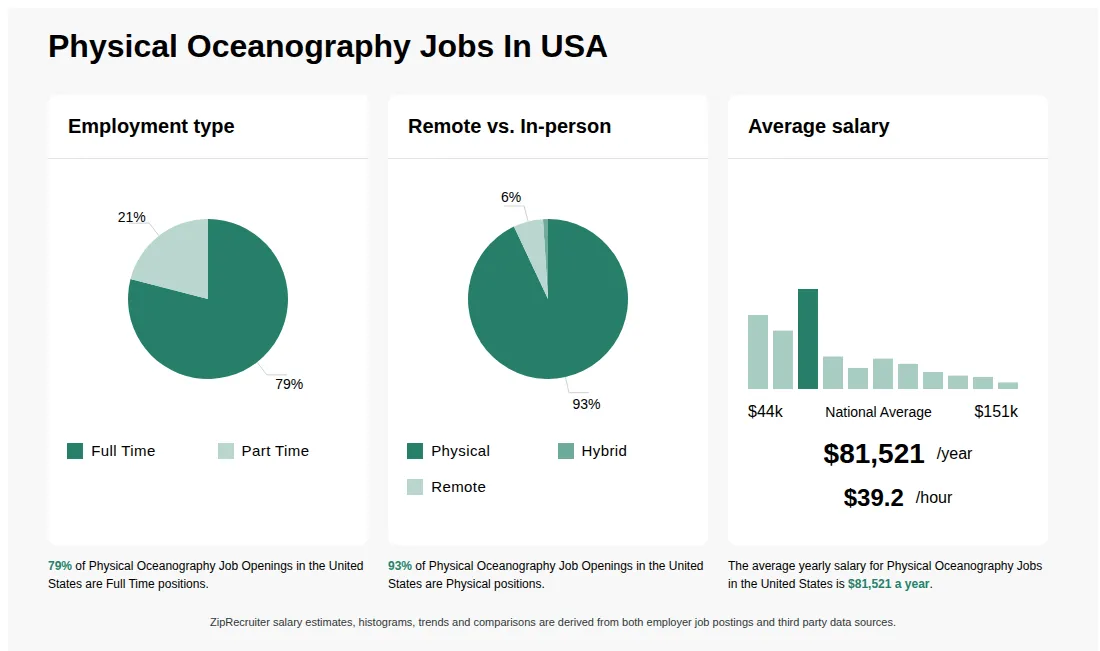
$44K - $53.7K
19% of jobs
$57.5K is the 25th percentile. Wages below this are outliers.
$53.7K - $63.5K
15% of jobs
The median wage is $69.3K / yr.
$63.5K - $73.2K
27% of jobs
$73.2K - $82.9K
9% of jobs
$82.9K - $92.6K
5% of jobs
$93.3K is the 75th percentile. Wages above this are outliers.
$92.6K - $102.4K
7% of jobs
$102.4K - $112.1K
6% of jobs
$112.1K - $121.8K
4% of jobs
$121.8K - $131.5K
3% of jobs
$131.5K - $141.3K
3% of jobs
$141.3K - $151K
1% of jobs
$44K
$81.5K
$151K
How much do physical oceanography jobs pay per year?
As of Sep 8, 2026, the average yearly pay for physical oceanography in the United States is $81,521.00, according to ZipRecruiter salary data. Most workers in this role earn between $59,000.00 and $99,000.00 per year, depending on experience, location, and employer.
What is physical oceanography?
Physical oceanography is the scientific study of the physical conditions and processes within the ocean, including the movement of ocean currents, waves, tides, and the interaction between the ocean and the atmosphere. Physical oceanographers examine how these processes affect climate, weather, and marine ecosystems. Their work helps us understand phenomena like El Niño, sea level rise, and the distribution of heat and nutrients in the ocean. This field is crucial for predicting climate change and managing marine resources.
What are jobs in physical oceanography?
Jobs in physical oceanography focus on studying the movement and flow of the oceans for various purposes. In this role, you may dive underwater to collect information, process data to help create simulations and computer models, and help apply those results. The oceans constantly change, so this job also includes understanding and predicting these differences to understand how they may affect future activities. Physical oceanography jobs fall into several categories, including environmental research, climate change research, and supporting preservation efforts. Some people in this field specialize in specific areas, such as polar oceanography or circulation and climate.
What are the key skills and qualifications needed to thrive as a physical oceanographer, and why are they important?
To thrive as a Physical Oceanographer, a strong background in oceanography, physics, mathematics, and data analysis is essential, typically supported by at least a master's or doctoral degree in a related field. Proficiency in scientific programming languages (such as MATLAB, Python, or R), experience with oceanographic instrumentation (like CTDs and ADCPs), and familiarity with GIS and remote sensing tools are commonly required. Analytical thinking, problem-solving, teamwork, and effective communication make professionals stand out in this field. These skills and qualities are crucial for accurately collecting, interpreting, and sharing complex ocean data to advance scientific understanding and inform environmental policy.
What are some common challenges faced by physical oceanographers when conducting field research?
Physical oceanographers often encounter challenges such as unpredictable weather conditions, complex logistical planning for ship-based data collection, and maintaining sensitive instruments in harsh marine environments. Collaborating with multidisciplinary teams—including engineers, biologists, and data analysts—is essential to address these obstacles and ensure accurate data collection. Additionally, researchers must be adaptable and resourceful to troubleshoot equipment malfunctions and adjust research plans in real time during expeditions.
What is the difference between Physical Oceanography vs Marine Geophysicist?
| Aspect | Physical Oceanography | Marine Geophysicist |
|---|---|---|
| Required Credentials | Bachelor's or Master's in Oceanography, Geophysics, or related fields; often requires research experience | Bachelor's or Master's in Geophysics, Earth Science, or related fields; often requires technical certifications |
| Work Environment | Research vessels, ocean observatories, laboratories | Seismic survey ships, offshore platforms, laboratories |
| Industry Usage | Academic, government agencies, research institutions | Oil & gas, mineral exploration, geophysical consulting |
Physical Oceanography focuses on understanding ocean currents, waves, and climate interactions, while Marine Geophysicist studies Earth's physical properties beneath the ocean floor. Both roles require strong backgrounds in earth sciences and often work in research or industry settings, but they differ in their specific focus and applications.
More about Physical Oceanography jobs
What cities are hiring for Physical Oceanography jobs?
Cities with the most Physical Oceanography job openings:
What are the most commonly searched types of Physical Oceanography jobs?
The most popular types of Physical Oceanography jobs are:
What states have the most Physical Oceanography jobs?
States with the most job openings for Physical Oceanography jobs include:
What job categories do people searching Physical Oceanography jobs look for?
The top searched job categories for Physical Oceanography jobs are:
United States Navy rating

6.4
Based on 380 frontline employees who took The Breakroom Quiz
43rd of 50 rated military and defense
Job description
About Meteorology and Oceanography encompass every natural law that dictates the Navy’s every move. At sea or ashore, we must plan and prepare for the potential environments we will operate in. That’s why we need Officers to inform us of weather patterns, prepare comprehensive maps, and watch over Aerographer’s Mates who forecast the weather. Planning an air mission, charting the best course for a ship or identifying currents that affect a submarine underway—whatever the scenario, meteorology and oceanography are factors that inevitably come into play. Be part of the team that studies how our environment changes our actions.
Responsibilities Whether operating in the air, at sea or underwater, Navy equipment, people and decision-making all rely on the technical and tactical advice of Navy Meteorology and Oceanography (METOC) Officers. They apply expertise in all facets of oceanography, meteorology, hydrography and precise time and astronomy as they:
- Help guide ships, aircraft and troops with recommendations based on weather forecasts and ocean conditions
- Relay forecast updates and weather warnings to military and civilian authorities
- Prepare ocean, sea and waterway charts and maps for anything from basic navigation to search-and-rescue efforts
- Maintain the military's primary master clock, which provides the most precise time interval in the world and drives the Global Positioning System (GPS)
- Oversee the work of Aerographer’s Mates – Enlisted Sailors who monitor weather conditions and provide forecast information
Work Environment Navy Meteorologists and Oceanographers may serve in a wide variety of settings around the world, from serving aboard aircraft carriers or amphibious ships, to conducting research at the Naval Observatory or Naval Research Labs. You will also have the opportunity to further your education at Naval Postgraduate School.
Training and Advancement Those pursuing a Meteorology and Oceanography Officer position are required to attend Officer Candidate School (OCS) in Newport, RI. Upon completion, they typically attend a 5-week Basic Oceanography Accession Training (BOAT) in Gulfport, MS. They also receive specialized training that includes methods of analyzing weather conditions, identification of common weather patterns, and techniques and procedures of forecasting. From there, METOC Officers embark on a career path that usually progresses from an operational tour (a non-oceanography role on a ship or with a deployable unit) to a Naval Oceanography tour (within a warfighting directorate or production center) followed by an education tour (which involves receiving formal education in a preferred discipline). After that, there are opportunities to serve on aircraft carriers, with Strike Group Staff, and in roles more specialized to one’s preferred discipline and with increasing leadership responsibilities.
Post-Service Opportunities Promotion opportunities are regularly available but competitive and based on performance. It’s also important to note that specialized training received and work experience gained in the course of service can lead to valuable credentialing and occupational opportunities in related fields in the civilian sector.
Education Opportunities Beyond professional credentials and certifications, Meteorology and Oceanography Officers can advance their education by:
- Pursuing opportunities at institutions such as Naval Postgraduate School (NPS) or Navy War College (NWC)
- Completing Joint Professional Military Education (JPME) at one of the various service colleges
- Oceanography and Meteorology Officers eventually earn a dual master's degree in meteorology and physical oceanography at Naval Postgraduate School (NPS) in Monterey, CA. There are opportunities to receive informal business training in areas such as budget/finance, manpower and research and development. And beyond that, you could potentially earn a doctoral degree while being paid full-time as a Navy Officer.
Qualifications and Requirements A four-year degree is required to work as a Meteorology and Oceanography Officer. Candidates seeking an Officer position in this community must have a bachelor’s degree from a regionally accredited institution in a technical field, preferably in areas of study such as physics, physics-based oceanography, meteorology, hydrography, earth science or engineering. All candidates must also be U.S. citizens, eligible for a secret security clearance and qualified for sea duty.
- General qualifications may vary depending upon whether you’re currently serving, whether you’ve served before or whether you’ve never served before.
Part-Time Opportunities There are part-time opportunities available as a METOC Officer. Serving part-time as a Navy Reserve Sailor, your duties will be carried out during your scheduled drilling and training periods. During monthly drilling, METOC Officers in the Navy Reserve typically work at a location close to their homes. For annual training, METOC Officers may serve anywhere in the world, whether on a ship at sea or at bases and installations on shore.
- Take a moment to learn more about the general roles and responsibilities of Navy Reserve Sailors.
- Most of what you do in the Navy Reserve is considered training. The basic Navy Reserve commitment involves training a minimum of one weekend a month (referred to as drilling) and two weeks a year (referred to as Annual Training) – or the equivalent of that.
- Meteorology and Oceanography Officers in the Navy Reserve serve in an Officer role. Before receiving the ongoing professional training that comes with this job, initial training requirements must be met.
- For current or former Navy Officers (NAVET): Prior experience satisfies the initial leadership training requirement – so you will not need to go through Officer Training again.
- For current or former Officers of military branches other than the Navy (OSVET), as well as for Officer candidates without prior military experience:Beginning October 1st, 2019, Officer Candidates will be required to attend the Officer Development School (ODS) in Newport, RI, instead of the 12-day Direct Commission Officer School. ODS is a five-week program that provides a comprehensive and intense introduction to the responsibilities of Navy Staff Corps Officers. Here you will learn about the military structure of the U.S. Navy, its rich history of traditions and customs, leadership development and military etiquette. There may be an option for attendees to request to split the five-week program into two sessions.
What United States Navy employees say
Pay
Benefits
Hours and flexibility
Workplace
Get the full story on Breakroom

About US Navy
Sourced by ZipRecruiter
Industry
National security, national security and international affairs, public safety statistics centers and offices, guided missile and space vehicle manufacturing and public administration
Company size
10,000+ Employees
Headquarters location
Washington, DC, US