1

Physical Oceanography Jobs (NOW HIRING)

Oceanography and Meteorology Officers eventually earn a dual master's degree in meteorology and physical oceanography at Naval Postgraduate School (NPS) in Monterey, CA. There are opportunities to ...

Oceanography and Meteorology Officers eventually earn a dual master's degree in meteorology and physical oceanography at Naval Postgraduate School (NPS) in Monterey, CA. There are opportunities to ...

Oceanography and Meteorology Officers eventually earn a dual master's degree in meteorology and physical oceanography at Naval Postgraduate School (NPS) in Monterey, CA. There are opportunities to ...

Oceanography and Meteorology Officers eventually earn a dual master's degree in meteorology and physical oceanography at Naval Postgraduate School (NPS) in Monterey, CA. There are opportunities to ...

Oceanography and Meteorology Officers eventually earn a dual master's degree in meteorology and physical oceanography at Naval Postgraduate School (NPS) in Monterey, CA. There are opportunities to ...

next page

Showing results 1-20

Physical Oceanography information

See salary details

$44K

$81.5K

$151K

How much do physical oceanography jobs pay per year?

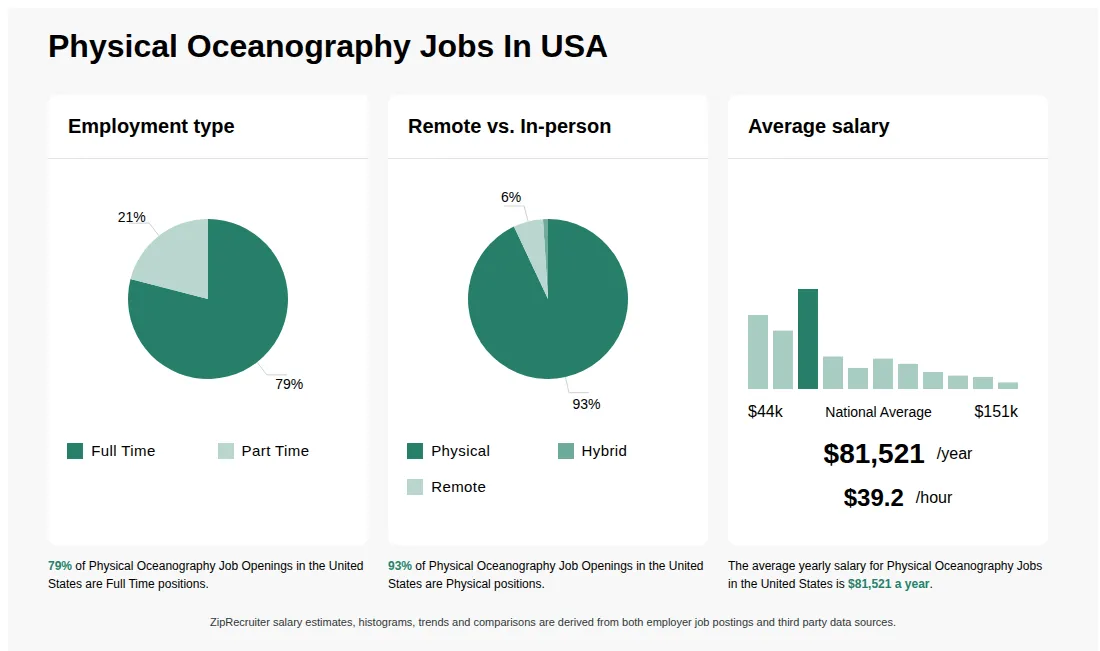
As of Jun 12, 2026, the average yearly pay for physical oceanography in the United States is $81,521.00, according to ZipRecruiter salary data. Most workers in this role earn between $59,000.00 and $99,000.00 per year, depending on experience, location, and employer.

What is physical oceanography?

Physical oceanography is the scientific study of the physical conditions and processes within the ocean, including the movement of ocean currents, waves, tides, and the interaction between the ocean and the atmosphere. Physical oceanographers examine how these processes affect climate, weather, and marine ecosystems. Their work helps us understand phenomena like El Niño, sea level rise, and the distribution of heat and nutrients in the ocean. This field is crucial for predicting climate change and managing marine resources.

What jobs fall under oceanography?

Jobs in oceanography include physical oceanographers, marine scientists, and research analysts who study ocean currents, waves, and climate interactions. These roles often require skills in data collection, computer modeling, and fieldwork using specialized equipment like sonar and buoys. Employment can be found in research institutions, government agencies, environmental consulting firms, and academia.

What does a physical oceanographer do?

A physical oceanographer studies the physical properties and processes of the ocean, such as currents, waves, temperature, and salinity. They analyze data collected through field measurements, remote sensing, and computer models to understand ocean dynamics and their impact on climate and ecosystems.

What are the key skills and qualifications needed to thrive as a Physical Oceanographer, and why are they important?

To thrive as a Physical Oceanographer, a strong background in oceanography, physics, mathematics, and data analysis is essential, typically supported by at least a master's or doctoral degree in a related field. Proficiency in scientific programming languages (such as MATLAB, Python, or R), experience with oceanographic instrumentation (like CTDs and ADCPs), and familiarity with GIS and remote sensing tools are commonly required. Analytical thinking, problem-solving, teamwork, and effective communication make professionals stand out in this field. These skills and qualities are crucial for accurately collecting, interpreting, and sharing complex ocean data to advance scientific understanding and inform environmental policy.

What is the difference between Physical Oceanography vs Marine Geophysicist?

AspectPhysical OceanographyMarine Geophysicist
Required CredentialsBachelor's or Master's in Oceanography, Geophysics, or related fields; often requires research experienceBachelor's or Master's in Geophysics, Earth Science, or related fields; often requires technical certifications
Work EnvironmentResearch vessels, ocean observatories, laboratoriesSeismic survey ships, offshore platforms, laboratories
Industry UsageAcademic, government agencies, research institutionsOil & gas, mineral exploration, geophysical consulting

Physical Oceanography focuses on understanding ocean currents, waves, and climate interactions, while Marine Geophysicist studies Earth's physical properties beneath the ocean floor. Both roles require strong backgrounds in earth sciences and often work in research or industry settings, but they differ in their specific focus and applications.

What are some common challenges faced by physical oceanographers when conducting field research?

Physical oceanographers often encounter challenges such as unpredictable weather conditions, complex logistical planning for ship-based data collection, and maintaining sensitive instruments in harsh marine environments. Collaborating with multidisciplinary teams—including engineers, biologists, and data analysts—is essential to address these obstacles and ensure accurate data collection. Additionally, researchers must be adaptable and resourceful to troubleshoot equipment malfunctions and adjust research plans in real time during expeditions.

Do oceanographers get paid well?

Physical oceanographers typically earn a median salary ranging from $60,000 to $100,000 annually, depending on experience, education, and location. Advanced roles or those with specialized skills in data analysis, modeling, or field research may offer higher compensation, especially in government or research institutions.

What Are Jobs in Physical Oceanography?

Jobs in physical oceanography focus on studying the movement and flow of the oceans for various purposes. In this role, you may dive underwater to collect information, process data to help create simulations and computer models, and help apply those results. The oceans constantly change, so this job also includes understanding and predicting these differences to understand how they may affect future activities. Physical oceanography jobs fall into several categories, including environmental research, climate change research, and supporting preservation efforts. Some people in this field specialize in specific areas, such as polar oceanography or circulation and climate.

What jobs pay $2000 a day?

In the field of physical oceanography, high-paying consulting roles, specialized research positions, or senior scientific advisory jobs can sometimes pay around $2000 per day, especially for experts with extensive experience, advanced degrees, and specialized skills in data analysis, modeling, or environmental assessment. These roles often require a strong background in oceanographic sciences, technical proficiency, and the ability to work on complex projects for government agencies, research institutions, or private companies.
What cities are hiring for Physical Oceanography jobs? Cities with the most Physical Oceanography job openings:
What are the most commonly searched types of Physical Oceanography jobs? The most popular types of Physical Oceanography jobs are:
What states have the most Physical Oceanography jobs? States with the most job openings for Physical Oceanography jobs include:
Infographic showing various Physical Oceanography job openings in the United States as of June 2026, with employment types broken down into 86% Part Time, and 14% Contract. Highlights an 51% Physical, and 49% Remote job distribution, with an average salary of $81,521 per year, or $39.2 per hour.

Physical Oceanography Technician

The University of Texas at Austin

Port Aransas, TX • On-site

$50K/yr

Full-time

Posted 8 days ago


University Of Texas at Austin rating

8.1

Company rating: 8.1 out of 10

Based on 62 frontline employees who took The Breakroom Quiz

132nd of 536 rated colleges and universities


Job description

Job Posting Title:
Physical Oceanography Technician
----
Hiring Department:
Marine Science Institute
----
Position Open To:
All Applicants
----
Weekly Scheduled Hours:
40
----
FLSA Status:
Exempt
----
Earliest Start Date:
May 31, 2026
----
Position Duration:
Expected to Continue Until Apr 30, 2028
----
Location:
PORT ARANSAS, TX
----
Job Details:
General Notes
We are seeking a highly motivated physical oceanographer with experience in Acoustic Doppler Current Profiler (ADCP) measurements, environmental data processing, and mooring deployment to support interdisciplinary coastal and shelf research in the northwestern Gulf of Mexico. The successful candidate will contribute to field-based and data-driven efforts focused on circulation, mixing, and physical-biogeochemical coupling across estuarine, nearshore, and continental shelf environments of the Texas Coastal Bend. This position involves a balance of fieldwork, data analysis, and collaboration
The purpose of this role is to advance understanding of the physical drivers of coastal and shelf ecosystems in the Gulf of Mexico, including the links among circulation, mixing, and biogeochemical processes.
This position is located in Port Aransas, Texas. The position is originally for two years but could be renewed based on performance and funding.
Responsibilities
  • Field Operations
    • Plan and execute mooring deployments and recoveries in estuarine and coastal shelf environments
    • Operate and maintain ADCP systems (moored configurations) and current meters
    • Support additional oceanographic instrumentation (e.g., CTDs, temperature/salinity loggers, meteorological sensors)
    • Participate in small boat and research vessel operations under variable field conditions
  • Data Processing & Analysis
    • Process and quality-control ADCP datasets (e.g., velocity profiles, backscatter)
    • Manage and analyze time-series environmental data from moorings and shipboard surveys
    • Develop reproducible workflows for data organization, QA/QC, and visualization
    • Contribute to the interpretation of circulation patterns, stratification, and mixing processes
  • Collaboration & Reporting
    • Work closely with interdisciplinary teams (biogeochemists, ecologists, modelers)
    • Contribute to reports, manuscripts, and data products
    • Assist with training students and supporting field campaigns

Required Qualifications
M.S. in Physical Oceanography, Ocean Engineering, Marine Science, or related field
Demonstrated experience with:
  • ADCP data collection and processing
  • Environmental time-series data analysis
  • Mooring design, deployment, and recovery
  • Proficiency in at least one scientific programming environment (e.g., Python, MATLAB, or R)
  • Experience working in field-based marine environments, including small boat operations
  • Strong organizational and problem-solving skills

Relevant education and experience may be substituted as appropriate.
Preferred Qualifications
  • Experience in coastal or shelf systems
  • Familiarity with:
    • Data QA/QC standards and metadata practices
    • Oceanographic sensors (CTD, ADCP, wave meters) turbulence sensors, wave/current meters
    • Small boat operation experience (or willingness to obtain certification
  • Ability to work in physically demanding field conditions

Driving Required
This job requires a class "C" operator's driver's license. The applicant selected must provide a current three year driving record from the current state of residence. If not currently a Texas resident, a Texas driver's license must be obtained within 30 days of becoming a Texas resident. Employees who are required to have a CDL are subject to drug and alcohol testing (pre-employment, post-accident, reasonable suspicion, random, return-to-duty, and follow-up drug and alcohol testing).
Salary Range
$50,000 + depending on qualifications
Working Conditions
  • Regular fieldwork in hot, humid, and/or windy conditions, including small boat operations
  • Occasional multi-day research cruises
  • Ability to lift and handle field equipment (~20-50 lbs)

Required Materials
  • Resume/CV
  • 3 work references with their contact information; at least one reference should be from a supervisor
  • Letter of interest

Important for applicants who are NOT current university employees or contingent workers: You will be prompted to submit your resume the first time you apply, then you will be provided an option to upload a new Resume for subsequent applications. Any additional Required Materials (letter of interest, references, etc.) will be uploaded in the Application Questions section; you will be able to multi-select additional files. Before submitting your online job application, ensure that ALL Required Materials have been uploaded. Once your job application has been submitted, you cannot make changes.
Important for Current university employees and contingent workers: As a current university employee or contingent worker, you MUST apply within Workday by searching for Find UT Jobs. If you are a current University employee, log-in to Workday, navigate to your Worker Profile, click the Career link in the left hand navigation menu and then update the sections in your Professional Profile before you apply. This information will be pulled in to your application. The application is one page and you will be prompted to upload your resume. In addition, you must respond to the application questions presented to upload any additional Required Materials (letter of interest, references, etc.) that were noted above.
Employment Eligibility:
Regular staff who have been employed in their current position for the last six continuous months are eligible for openings being recruited for through University-Wide or Open Recruiting, to include both promotional opportunities and lateral transfers. Staff who are promotion/transfer eligible may apply for positions without supervisor approval.
Retirement Plan Eligibility:
The retirement plan for this position is Teacher Retirement System of Texas (TRS), subject to the position being at least 20 hours per week and at least 135 days in length.
Background Checks:
A criminal history background check will be required for finalist(s) under consideration for this position.
Equal Opportunity Employer:
The University of Texas at Austin, as an equal opportunity/affirmative action employer, complies with all applicable federal and state laws regarding nondiscrimination and affirmative action. The University is committed to a policy of equal opportunity for all persons and does not discriminate on the basis of race, color, national origin, age, marital status, sex, sexual orientation, gender identity, gender expression, disability, religion, or veteran status in employment, educational programs and activities, and admissions.
Pay Transparency:
The University of Texas at Austin will not discharge or in any other manner discriminate against employees or applicants because they have inquired about, discussed, or disclosed their own pay or the pay of another employee or applicant. However, employees who have access to the compensation information of other employees or applicants as a part of their essential job functions cannot disclose the pay of other employees or applicants to individuals who do not otherwise have access to compensation information, unless the disclosure is (a) in response to a formal complaint or charge, (b) in furtherance of an investigation, proceeding, hearing, or action, including an investigation conducted by the employer, or (c) consistent with the contractor's legal duty to furnish information.
Employment Eligibility Verification:
If hired, you will be required to complete the federal Employment Eligibility Verification I-9 form. You will be required to present acceptable and original documents to prove your identity and authorization to work in the United States. Documents need to be presented no later than the third day of employment. Failure to do so will result in loss of employment at the university.
----
E-Verify:
The University of Texas at Austin use E-Verify to check the work authorization of all new hires effective May 2015. The university's company ID number for purposes of E-Verify is 854197. For more information about E-Verify, please see the following:
  • E-Verify Poster (English and Spanish) [PDF]
  • Right to Work Poster (English) [PDF]
  • Right to Work Poster (Spanish) [PDF]

----
Compliance:
Employees may be required to report violations of law under Title IX and the Jeanne Clery Disclosure of Campus Security Policy and Crime Statistics Act (Clery Act). If this position is identified a Campus Security Authority (Clery Act), you will be notified and provided resources for reporting. Responsible employees under Title IX are defined and outlined in HOP-3031.
The Clery Act requires all prospective employees be notified of the availability of the Annual Security and Fire Safety report. You may access the most recent report here or obtain a copy at University Compliance Services, 1616 Guadalupe Street, UTA 2.206, Austin, Texas 78701.

What University Of Texas at Austin employees say

Pay

Benefits

Hours and flexibility

Workplace

Get the full story on Breakroom