... geoscience/geology studies, field development and EOR design, reservoir simulation, economic ... Petroleum / Reservoir Engineer Description As a valuable member of our team, a Reservoir Engineer ...
... geoscience/geology studies, field development and EOR design, reservoir simulation, economic ... Petroleum / Reservoir Engineer Description As a valuable member of our team, a Reservoir Engineer ...

... of Geosciences as well as other related colleges and organizations. UT's reputation ... D. in petroleum engineering or a related discipline is required. We are interested in candidates ...
... of Geosciences as well as other related colleges and organizations. UT's reputation ... D. in petroleum engineering or a related discipline is required. We are interested in candidates ...

Artificial Intelligence Engineer
Houston, TX · On-site
$99K - $133K/yr
This role requires specialized technical expertise in AI/ML systems, domain knowledge (e.g geoscience, petroleum engineering), domain foundation models, and enterprise-scale software integration. A ...
Artificial Intelligence Engineer
Houston, TX · On-site
$99K - $133K/yr
This role requires specialized technical expertise in AI/ML systems, domain knowledge (e.g geoscience, petroleum engineering), domain foundation models, and enterprise-scale software integration. A ...

Analyze geoscience and drilling data to design innovative approaches for drilling optimization. Qualifications: * Bachelor's or Master's degree in Petroleum Engineering, Drilling Engineering, or a ...
Analyze geoscience and drilling data to design innovative approaches for drilling optimization. Qualifications: * Bachelor's or Master's degree in Petroleum Engineering, Drilling Engineering, or a ...
Analyze geoscience and drilling data to design innovative approaches for drilling optimization. Qualifications: * Bachelor's or Master's degree in Petroleum Engineering, Drilling Engineering, or a ...
Quick apply
Analyze geoscience and drilling data to design innovative approaches for drilling optimization. Qualifications: * Bachelor's or Master's degree in Petroleum Engineering, Drilling Engineering, or a ...
Analyze geoscience and drilling data to design innovative approaches for drilling optimization. Qualifications: * Bachelor's or Master's degree in Petroleum Engineering, Drilling Engineering, or a ...
Analyze geoscience and drilling data to design innovative approaches for drilling optimization. Qualifications: * Bachelor's or Master's degree in Petroleum Engineering, Drilling Engineering, or a ...

Modeling & Simulation Research Scientist
Cambridge, MA · On-site
$105 - $214/hr
MSc or PhD in Geosciences, Petroleum Engineering, Applied Physics, or a related discipline. * A minimum of 2 years of experience in a research or technical role within the geosciences field.
Modeling & Simulation Research Scientist
Cambridge, MA · On-site
$105 - $214/hr
MSc or PhD in Geosciences, Petroleum Engineering, Applied Physics, or a related discipline. * A minimum of 2 years of experience in a research or technical role within the geosciences field.

Principal Environmental Engineer / Scientist
Albuquerque, NM · On-site
$68K - $90K/yr
Experience with PFAS, chlorinated solvents, petroleum hydrocarbons, metals, contaminant fate and ... At INTERA, Principals are part of a collaborative, multidisciplinary group of geoscience and ...
Principal Environmental Engineer / Scientist
Albuquerque, NM · On-site
$68K - $90K/yr
Experience with PFAS, chlorinated solvents, petroleum hydrocarbons, metals, contaminant fate and ... At INTERA, Principals are part of a collaborative, multidisciplinary group of geoscience and ...

Geological Specialist
San Antonio, TX · On-site
The ideal candidate will excel in geoscience technologies, thrive in data-intensive environments ... This position requires a comprehensive understanding of petroleum systems, operational optimization ...
Geological Specialist
San Antonio, TX · On-site
The ideal candidate will excel in geoscience technologies, thrive in data-intensive environments ... This position requires a comprehensive understanding of petroleum systems, operational optimization ...

Bachelor's degree in Engineering, Petroleum Technology, Geosciences, Business, or related field * 2+ years of relevant industry experience or related business analysis roles Other Requirements:
Bachelor's degree in Engineering, Petroleum Technology, Geosciences, Business, or related field * 2+ years of relevant industry experience or related business analysis roles Other Requirements:
Customer Success Advisor - Reservoir Engineer
Midland, TX · On-site
$80 - $100/hr
Located in Midland, TX. * Bachelor's degree in Petroleum Engineering, Geoscience, Data Science, or a related technical field. * Minimum 2 years of experience in unconventional resources as a ...
New
Customer Success Advisor - Reservoir Engineer
Midland, TX · On-site
$80 - $100/hr
Located in Midland, TX. * Bachelor's degree in Petroleum Engineering, Geoscience, Data Science, or a related technical field. * Minimum 2 years of experience in unconventional resources as a ...
New

Research Professor - STARR PI
Austin, TX · On-site
$135 - $165/hr
PhD in geosciences, petroleum engineering, or related technical discipline. Five or more years of work experience after PhD degree. * Fifteen or more years of experience in the oil and gas industry ...
Research Professor - STARR PI
Austin, TX · On-site
$135 - $165/hr
PhD in geosciences, petroleum engineering, or related technical discipline. Five or more years of work experience after PhD degree. * Fifteen or more years of experience in the oil and gas industry ...
Research Associate Professor - STARR PI
Austin, TX · On-site
$108 - $132/hr
Qualifications Required Qualifications PhD in geosciences, petroleum engineering or related technical discipline. Five or more years of work experience after PhD degree. Preferred Qualifications ...
New
Research Associate Professor - STARR PI
Austin, TX · On-site
$108 - $132/hr
Qualifications Required Qualifications PhD in geosciences, petroleum engineering or related technical discipline. Five or more years of work experience after PhD degree. Preferred Qualifications ...
New

2026USH Geology Specialist
Spring, TX · On-site
... Petroleum Engineering, or a related technical discipline is required. A Ph.D. with a specialization in geomodeling techniques, geostatistics, computational geoscience, or related disciplines is ...
2026USH Geology Specialist
Spring, TX · On-site
... Petroleum Engineering, or a related technical discipline is required. A Ph.D. with a specialization in geomodeling techniques, geostatistics, computational geoscience, or related disciplines is ...

Staff Geophysicist
Oklahoma City, OK · On-site
Applied understanding of unconventional reservoir principles and petroleum engineering concepts ... Bachelor's degree in Geoscience, Math, Physics, or a related scientific field from an accredited ...
Staff Geophysicist
Oklahoma City, OK · On-site
Applied understanding of unconventional reservoir principles and petroleum engineering concepts ... Bachelor's degree in Geoscience, Math, Physics, or a related scientific field from an accredited ...
$110 - $160/hr
Progressive experience in petroleum geology, development geology, operations geology, reservoir characterization, or a related oil and gas geoscience role. * Strong technical understanding of ...
$110 - $160/hr
Progressive experience in petroleum geology, development geology, operations geology, reservoir characterization, or a related oil and gas geoscience role. * Strong technical understanding of ...
Sr. Geologist
Houston, TX · On-site
... assess petroleum systems, and to help generate and mature prospects. This position requires a ... Proficiency with industry-standard geoscience software such as Petra, Petrel, Kingdom, ArcGIS, or ...
Sr. Geologist
Houston, TX · On-site
... assess petroleum systems, and to help generate and mature prospects. This position requires a ... Proficiency with industry-standard geoscience software such as Petra, Petrel, Kingdom, ArcGIS, or ...
Senior Geologist
Morgantown, WV · On-site
$110 - $160/hr
Progressive experience in petroleum geology, development geology, operations geology, reservoir characterization, or a related oil and gas geoscience role. * Strong technical understanding of ...
Senior Geologist
Morgantown, WV · On-site
$110 - $160/hr
Progressive experience in petroleum geology, development geology, operations geology, reservoir characterization, or a related oil and gas geoscience role. * Strong technical understanding of ...
Senior Geologist
Morgantown, WV · On-site
$110 - $170/hr
Progressive experience in petroleum geology, development geology, operations geology, reservoir characterization, or a related oil and gas geoscience role. * Strong technical understanding of ...
Senior Geologist
Morgantown, WV · On-site
$110 - $170/hr
Progressive experience in petroleum geology, development geology, operations geology, reservoir characterization, or a related oil and gas geoscience role. * Strong technical understanding of ...
Senior Geologist
Morgantown, WV · On-site
Progressive experience in petroleum geology, development geology, operations geology, reservoir characterization, or a related oil and gas geoscience role. * Strong technical understanding of ...
Quick apply
Senior Geologist
Morgantown, WV · On-site
Progressive experience in petroleum geology, development geology, operations geology, reservoir characterization, or a related oil and gas geoscience role. * Strong technical understanding of ...
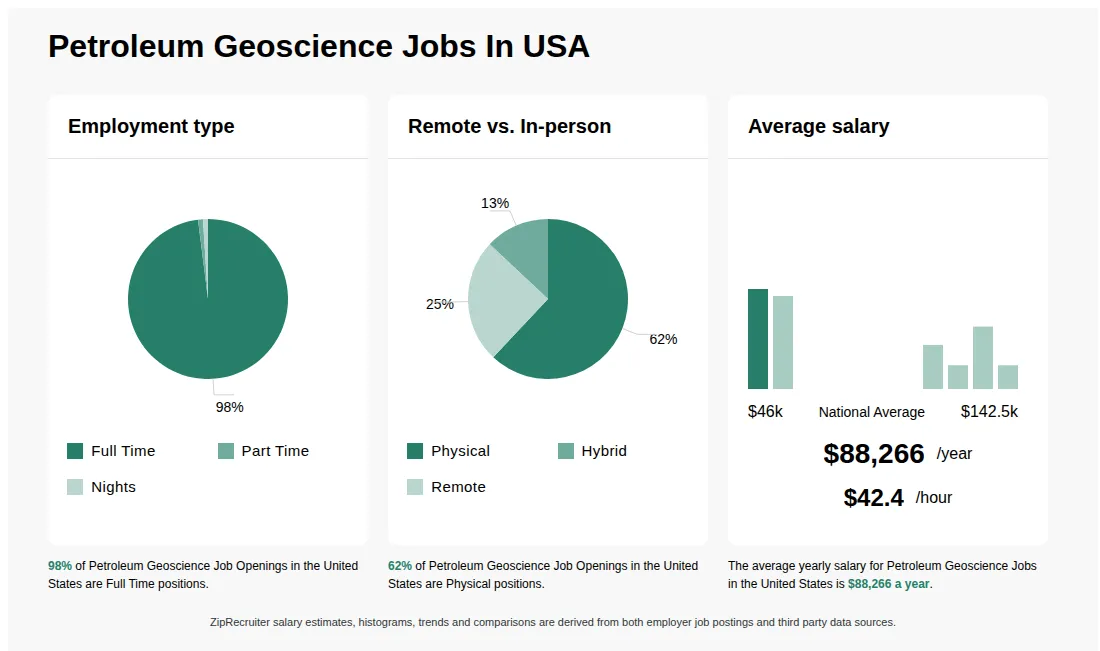
Petroleum Geoscience information
See salary details
$53.5K is the 25th percentile. Wages below this are outliers.
$46K - $54.8K
29% of jobs
The median wage is $61.5K / yr.
$54.8K - $63.5K
27% of jobs
$63.5K - $72.3K
0% of jobs
$72.3K - $81.1K
0% of jobs
$81.1K - $89.9K
0% of jobs
$89.9K - $98.6K
0% of jobs
$98.6K - $107.4K
0% of jobs
$107.4K - $116.2K
13% of jobs
$125K is the 75th percentile. Wages above this are outliers.
$116.2K - $125K
6% of jobs
$125K - $133.7K
19% of jobs
$133.7K - $142.5K
6% of jobs
$46K
$88.3K
$142.5K
How much do petroleum geoscience jobs pay per year?
As of Sep 3, 2026, the average yearly pay for petroleum geoscience in the United States is $88,266.00, according to ZipRecruiter salary data. Most workers in this role earn between $53,500.00 and $128,000.00 per year, depending on experience, location, and employer.
What is a petroleum geoscience?
A Petroleum Geoscience job involves studying the Earth's subsurface to locate and evaluate oil and gas resources. Professionals in this field use geological, geophysical, and geochemical techniques to analyze rock formations and reservoir potential. They work closely with engineers and energy companies to optimize extraction and production. Roles may include exploration geologist, seismic interpreter, or reservoir geoscientist. The job often requires fieldwork, data analysis, and the use of advanced software for modeling subsurface structures.
What does a petroleum geoscientist do?
A typical day in Petroleum Geoscience involves analyzing geological and seismic data to assess subsurface structures, preparing reports and presentations of findings, and working closely with engineers, drilling teams, and project managers. You may spend time both in the office using specialized interpretation software and, occasionally, in the field collecting samples or overseeing drilling operations. Collaboration and regular meetings are common as project teams work together to evaluate potential hydrocarbon reservoirs and minimize exploration risks. This dynamic environment offers a combination of technical challenges and teamwork, helping ensure efficient resource exploration and development.
What are the key skills and qualifications needed to thrive in petroleum geoscience?
To excel in Petroleum Geoscience, a solid background in geology, geophysics, and earth sciences is essential, usually supported by a relevant degree such as geology or geoscience. Familiarity with industry-standard software for seismic interpretation, reservoir modeling, and geographic information systems (GIS) is highly valuable, and certifications like Professional Geologist (PG) can enhance credibility. Strong analytical thinking, attention to detail, teamwork, and effective communication are soft skills that distinguish top performers in this field. These abilities are crucial for accurate subsurface evaluations, facilitating collaboration with multidisciplinary teams, and making informed decisions that impact exploration and production outcomes.
Are petroleum geoscientists in demand?
Petroleum geoscientists are in moderate demand, primarily in regions with active oil and gas exploration and production. Employment opportunities depend on market conditions, technological advancements, and the global energy transition, with skills in seismic interpretation and reservoir characterization being highly valued.
More about Petroleum Geoscience jobs
What job categories do people searching Petroleum Geoscience jobs look for?
The top searched job categories for Petroleum Geoscience jobs are:

Full-time
Medical, Dental, Vision, Retirement, PTO
Re-posted 26 days ago
Job description
Ryder Scott Company – Petroleum / Reservoir Engineer
Job Type
Full-time – Houston, TX
Ryder Scott Company is seeking a Petroleum / Reservoir Engineer to join our Houston Team. In this role, you will work as part of our technical staff on a diverse range of domestic and international projects, with opportunities to take on greater responsibilities and advance your career in a collaborative, highperformance environment.
About Us
Founded in 1937, Ryder Scott Company is one of the largest, oldest, and most respected reservoir-evaluation consulting firms in the oil & gas industry. Ryder Scott provides a complete range of professional engineering, geoscientific, economic evaluation services such as reserves evaluations, geoscience/geology studies, field development and EOR design, reservoir simulation, economic analysis, sustainable energy consulting, management consulting and expert witness testimony.
Headquartered in Houston, Texas, with branch offices in Denver, Colorado, and Calgary, Canada, Ryder Scott serves clients of all sizes—both in the United States and across international markets.
Petroleum / Reservoir Engineer Description
As a valuable member of our team, a Reservoir Engineer would engage with our clients throughout the year for client related services answering questions, creating deliverables and engaging various parts of the organization to assist our clients in their reserves audits, evaluations or certifications. In addition, there is a growing necessity to establish and integrate data analytic tools that lead to informed decisions in a timely manner. Combining an analytic mindset, a team-first attitude, and understanding the workflow methodology, there is a great opportunity to make a difference in how Ryder Scott project teams function on a day-to-day basis.
The Reservoir Engineer will work in our downtown Houston office and may qualify to work two (2) days a week remotely.
Position Responsibilities Summary
- Primary administrator for decline analysis software in support of forecasts and economics.
- Leverage technical, interpersonal, and critical thinking skills to help solve a variety of challenges.
- Must be able to handle multiple projects with minimal supervision, while meeting the established deadlines.
- Capable of working independently, but also very active and effective working in a team environment.
- Identify opportunities to streamline and standardize data flow using macros, scripts or other novel tools
- Other job duties as may be assigned
Position Competencies
- Demonstrates independent judgment and discretion in decision-making
- Maintains a high level of accuracy and attention to detail
- Excels in organization, time management, prioritization, and planning, with the ability to manage multiple tasks and tight deadlines for both self and team
- Collaborates effectively within multidisciplinary teams, fostering strong interpersonal communication and teamwork
- Must maintain high standards of professional and ethical conduct.
Position Qualifications
Required Skills
- Bachelor’s Degree in Engineering required – preferably Petroleum Engineering
- Minimum 7 years reservoir engineering experience
- Conventional and unconventional reservoir experience including decline curve analysis, forecasting and type curve creation
- Sound understanding of classical reservoir engineering principles, forecasting, reserves estimation and classification, fluid and rock characterization
- Functional understanding of geology, geophysics, petrophysics, and reservoir characterization issues and how they relate to reservoir performance
- Proficient with Microsoft Office suite of products (Excel, Access, Word, PowerPoint)
- Proficiency with evaluation software such as ARIES and PHDWin. Background in other analytical and evaluation software such as ComboCurve, Spotfire, would be a plus.
- Strong communication, presentation, writing and organization skills
- Self-motivated and capable of proactively driving continuous improvement
Preferred Skills
- Understanding of economics, with a preference for application in oil and gas developments
- Possess general working knowledge of drilling, completions, and production operations and understanding of upstream oil and gas terminology
- Professional Engineering license in the State of Texas would be a plus
- Offshore Gulf of Mexico experience
- Knowledge of SEC and PRMS Reserves classifications and reserves workflows
Rewards and Benefits
- Competitive compensation and Benefits Package
- Annual bonus based on individual and company performance
- 401(k) retirement plan and profit-sharing plan
- Company paid health insurance including vision and dental for you and your eligible dependents
- Company paid parking/commuting allowance
- 10 paid holidays per year + 1 floating holiday
- 10-15 days paid vacation to start depending on experience
- Hybrid work from home/office with flexible hours (after two years of employment)
Disclaimer: Ryder Scott Company is an equal opportunity employer. Employment selection and related decisions are made without regard to gender, race, color, religion, sexual orientation, marital status, veteran status, age, disability, national origin, or any other protected class. The information provided here indicates the general nature and level of work required of the position and is not a comprehensive list of all responsibilities or qualifications. The benefits list is only a highlight of some of the benefits offered to team members; eligibility for certain benefits may apply.
Ryder Scott does not accept unsolicited resumes through or from search firms or staffing agencies. Only applications made through our application will be considered. All unsolicited resumes will be considered the property of Ryder Scott Company and Ryder Scott Company will not be obligated to pay a placement fee.

About Ryder Scott
Sourced by ZipRecruiter
Industry
Oil and gas extraction
Company size
51 - 200 Employees
Headquarters location
Houston, TX, US
Year founded
1937