1

Oil Rig Engineer Jobs (NOW HIRING)

Operate, maintain and repair as necessary the engine cooling water system, lube oil system, and ... Participate in the effective management of the Rig Maintenance System (RMS) and ensure all records ...

... Rig Technologies NOV is a leading provider of technology, equipment, and services to the global oil ... Work with Product Engineering to create Design Verification Reviews and Procedures. * Review ...

... Rig Technologies NOV is a leading provider of technology, equipment, and services to the global oil ... Work with Product Engineering to create Design Verification Reviews and Procedures. * Review ...

Operate, maintain and repair as necessary the engine cooling water system, lube oil system, and ... Participate in the effective management of the Rig Maintenance System (RMS) and ensure all records ...

Sr. Well Engineer

Houston, TX · On-site

$101K - $139K/yr

... of rig and hydraulic fracturing operations and wellsite execution. This combination of technical ... Translate and adapt NA best practices to Chinese assets (deep shale gas and tight oil/gas ...

Support, maintain and service rig monitoring data systems and technology packages * Install ... General knowledge of oilfield operations or experience in field service is a plus COMPUTER

Showing results 21-40

Oil Rig Engineer information

See salary details

$59.5K

$111.6K

$203K

How much do oil rig engineer jobs pay per year?

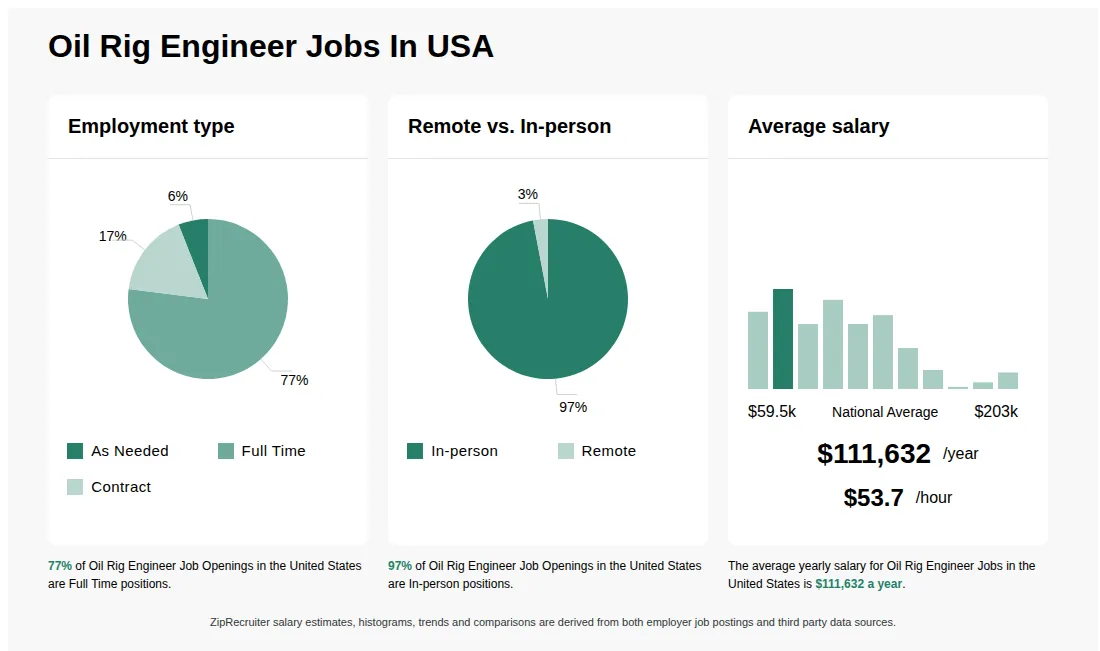
As of Aug 22, 2026, the average yearly pay for oil rig engineer in the United States is $111,632.00, according to ZipRecruiter salary data. Most workers in this role earn between $80,500.00 and $132,500.00 per year, depending on experience, location, and employer.

What does an oil rig engineer do?

An Oil Rig Engineer is responsible for designing, maintaining, and overseeing the operation of equipment and systems used in the extraction of oil and gas from beneath the earth’s surface. They ensure that drilling processes are conducted safely, efficiently, and in compliance with environmental regulations. Their work often involves problem-solving on-site, coordinating with other engineers and technicians, and implementing new technologies to optimize production. Oil Rig Engineers may work offshore for extended periods and must be prepared for challenging and dynamic work environments.

What are the key skills and qualifications needed to thrive as an oil rig engineer?

To thrive as an Oil Rig Engineer, you need a strong background in mechanical, petroleum, or chemical engineering, often supported by a relevant engineering degree and industry certifications like IWCF or Well Control. Familiarity with drilling software, rig monitoring systems, and safety management tools is typically required. Strong problem-solving, teamwork, and communication skills are essential for managing complex operations and working in challenging environments. These skills and qualifications are critical to ensure safe, efficient drilling processes and minimize operational risks on the rig.

What are some typical challenges oil rig engineers face when working offshore, and how can they prepare for them?

Oil Rig Engineers working offshore often encounter challenges such as adapting to extended periods away from home, unpredictable weather conditions, and the need to quickly solve technical problems in a high-pressure environment. They must be prepared to work long shifts and collaborate closely with multidisciplinary teams to ensure safety and efficiency. To succeed, candidates should focus on developing strong problem-solving skills, adaptability, and effective communication, as well as staying up-to-date with the latest safety protocols and industry technologies.

What is the difference between Oil Rig Engineer vs Drilling Engineer?

AspectOil Rig EngineerDrilling Engineer
CredentialsBachelor's in Engineering, certifications in safety and drilling technologyBachelor's in Petroleum or Mechanical Engineering, similar certifications
Work EnvironmentOn offshore oil rigs, overseeing operations and safetyOnshore or offshore, planning and managing drilling operations
Employer & Industry UsageOil companies, drilling contractors, offshore platformsOil companies, drilling service companies, exploration firms

Oil Rig Engineers focus on the operation and safety of offshore rigs, while Drilling Engineers plan and execute drilling projects. Both roles require similar credentials and often work in overlapping environments, but their core responsibilities differ in scope and focus.

How to get an oil rig engineer job?

To become an oil rig engineer, candidates typically need a bachelor's degree in petroleum engineering, mechanical engineering, or a related field. Relevant experience, strong technical skills, and certifications such as H2S safety training or offshore survival are often required, along with the ability to work in challenging offshore environments and adhere to safety regulations.
More about Oil Rig Engineer jobs

What cities are hiring for Oil Rig Engineer jobs?

Cities with the most Oil Rig Engineer job openings:

What states have the most Oil Rig Engineer jobs?

States with the most job openings for Oil Rig Engineer jobs include:

Infographic showing various Oil Rig Engineer job openings in the United States as of August 2026, with employment types broken down into 94% Full Time, 2% Part Time, and 4% Contract. Highlights an 85% Physical, 6% Hybrid, and 9% Remote job distribution, with an average salary of $111,632 per year, or $53.7 per hour.

CLO2 Operator (Oil/Gas) Permian Basin

Shalestone, Inc.

Grand Junction, CO • On-site

$18 - $22/hr

Full-time

Medical, Retirement, PTO

Re-posted 27 days ago


Job description

We are looking for an experienced CLO₂ Operator to join our team. This position involves setting up and rigging down ClO₂ equipment, monitoring water treatment operations, and maintaining company water quality standards throughout the job.
Job Duties:
  • Rig up and rig down ClO₂ equipment and related hoses/lines
  • Monitor water treatment operations in the field
  • Perform water testing and make chemical adjustments as needed
  • Maintain company water quality standards
  • Complete basic documentation and communicate with supervisors/customers
  • Follow all company safety procedures and site requirements
  • Keep equipment and work areas clean and organized

Requirements:
  • Previous ClO₂ and/or oilfield water treatment experience required
  • Must be dependable and able to work independently
  • Ability to work outdoors and handle field equipment
  • Valid driver's license required

Schedule:
Based on field operations and customer needs. Typical rotation is 4 weeks on and 2 weeks off, although schedules can vary depending on workload and customer demand. Operators may occasionally be required to stay over past scheduled time off.
Benefits:
  • Advancement Opportunity
  • Year-round Work
  • Holiday Pay / Sick Pay / Vacation Pay
  • Employee paid health insurance with upgrades available
  • 401K Plan with employer percentage match

Hiring Contacts:
Justin Gartman
Aera Manager - Permian Basin
Email: justin.gartman@shalestone.com
Learn more about Shalestone, Inc:
www.shalestone.com
facebook.com/shalestoneinc
LinkedIn
About ShaleStone, Inc.
Founded in 2008, ShaleStone Inc's principal solution is the design and operation of fluid systems in the oil and gas sector. Although predominantly weighted to service the extraction of our natural resources, our team also provides water solutions in outlying industries. Managing existing, as well as supporting the design and build of new fluid system infrastructure, ShaleStone holds the expertise to engineer, sell, transfer, store, filter, transport, inject, contain, and manage your fields' fluid resource needs. Along-side our core Water Solution services, our team also provides roustabout and drilling support solutions.