1

Oil Rig Engineer Jobs (NOW HIRING)

... rig design, upgrade and repair. The individual will continue to expand knowledge of drilling ... the oil and gas industry, preferably engineering support for contract drilling * Bachelor of ...

Senior Engineer- Structural

Houston, TX

$96K - $130K/yr

... improve rig productivity, while evaluating equipment performance and implementing engineering ... Highly proficient in drilling and oilfield structures * Proficient with structural analysis ...

... rig design, upgrade and repair. The individual will continue to expand knowledge of drilling ... the oil and gas industry, preferably engineering support for contract drilling * Bachelor of ...

... oilfield operations. * Proficient understanding of drilling engineering, well control principles, MPD technologies, and rig operations. * Hands-on experience using engineering software for hydraulic ...

... rig costs, and enhance safety. * Collaborate with product development teams to connect customer ... Three (3) years of experience in a related engineering or operations role within the oil and gas ...

... oilfield operations. * Proficient understanding of drilling engineering, well control principles, MPD technologies, and rig operations. * Hands-on experience using engineering software for hydraulic ...

Showing results 41-60

Oil Rig Engineer information

See salary details

$59.5K

$111.6K

$203K

How much do oil rig engineer jobs pay per year?

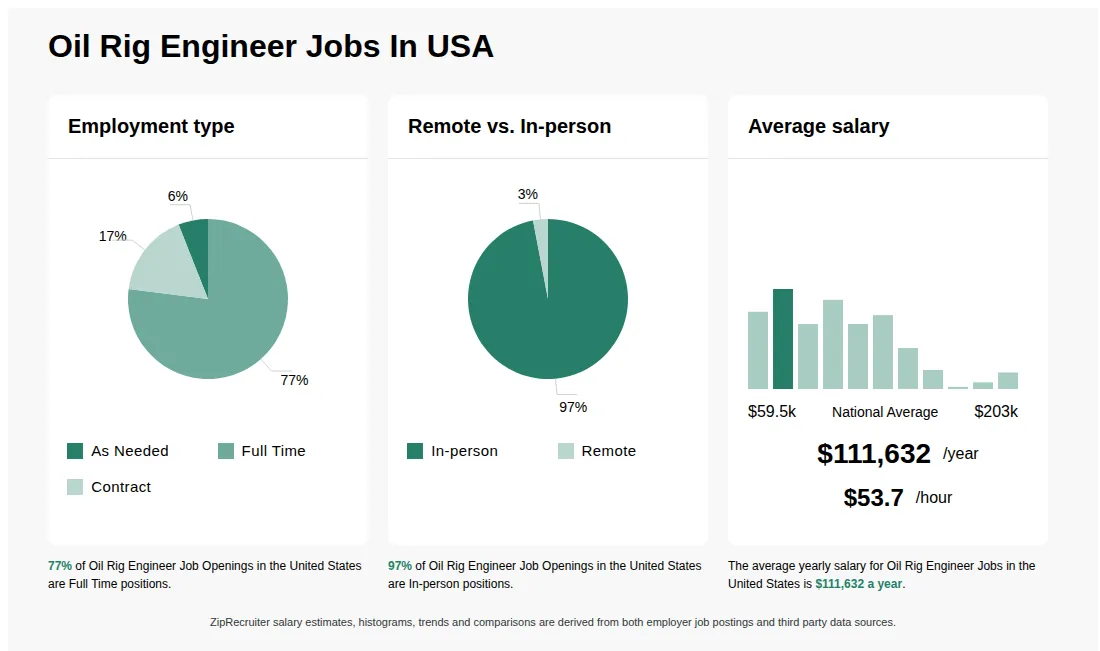
As of Aug 22, 2026, the average yearly pay for oil rig engineer in the United States is $111,632.00, according to ZipRecruiter salary data. Most workers in this role earn between $80,500.00 and $132,500.00 per year, depending on experience, location, and employer.

What does an oil rig engineer do?

An Oil Rig Engineer is responsible for designing, maintaining, and overseeing the operation of equipment and systems used in the extraction of oil and gas from beneath the earth’s surface. They ensure that drilling processes are conducted safely, efficiently, and in compliance with environmental regulations. Their work often involves problem-solving on-site, coordinating with other engineers and technicians, and implementing new technologies to optimize production. Oil Rig Engineers may work offshore for extended periods and must be prepared for challenging and dynamic work environments.

What are the key skills and qualifications needed to thrive as an oil rig engineer?

To thrive as an Oil Rig Engineer, you need a strong background in mechanical, petroleum, or chemical engineering, often supported by a relevant engineering degree and industry certifications like IWCF or Well Control. Familiarity with drilling software, rig monitoring systems, and safety management tools is typically required. Strong problem-solving, teamwork, and communication skills are essential for managing complex operations and working in challenging environments. These skills and qualifications are critical to ensure safe, efficient drilling processes and minimize operational risks on the rig.

What are some typical challenges oil rig engineers face when working offshore, and how can they prepare for them?

Oil Rig Engineers working offshore often encounter challenges such as adapting to extended periods away from home, unpredictable weather conditions, and the need to quickly solve technical problems in a high-pressure environment. They must be prepared to work long shifts and collaborate closely with multidisciplinary teams to ensure safety and efficiency. To succeed, candidates should focus on developing strong problem-solving skills, adaptability, and effective communication, as well as staying up-to-date with the latest safety protocols and industry technologies.

What is the difference between Oil Rig Engineer vs Drilling Engineer?

AspectOil Rig EngineerDrilling Engineer
CredentialsBachelor's in Engineering, certifications in safety and drilling technologyBachelor's in Petroleum or Mechanical Engineering, similar certifications
Work EnvironmentOn offshore oil rigs, overseeing operations and safetyOnshore or offshore, planning and managing drilling operations
Employer & Industry UsageOil companies, drilling contractors, offshore platformsOil companies, drilling service companies, exploration firms

Oil Rig Engineers focus on the operation and safety of offshore rigs, while Drilling Engineers plan and execute drilling projects. Both roles require similar credentials and often work in overlapping environments, but their core responsibilities differ in scope and focus.

How to get an oil rig engineer job?

To become an oil rig engineer, candidates typically need a bachelor's degree in petroleum engineering, mechanical engineering, or a related field. Relevant experience, strong technical skills, and certifications such as H2S safety training or offshore survival are often required, along with the ability to work in challenging offshore environments and adhere to safety regulations.
More about Oil Rig Engineer jobs

What cities are hiring for Oil Rig Engineer jobs?

Cities with the most Oil Rig Engineer job openings:

What states have the most Oil Rig Engineer jobs?

States with the most job openings for Oil Rig Engineer jobs include:

Infographic showing various Oil Rig Engineer job openings in the United States as of August 2026, with employment types broken down into 94% Full Time, 2% Part Time, and 4% Contract. Highlights an 85% Physical, 6% Hybrid, and 9% Remote job distribution, with an average salary of $111,632 per year, or $53.7 per hour.

Full-time

Re-posted 15 days ago


Job description

Utilize engineering fundamentals to design integrated drilling systems and fit-for-purpose products to support drilling operations. This position builds on basic understanding of drilling equipment and structures toward being an effective contributor to rig design, upgrade and repair.  The individual will continue to expand knowledge of drilling processes, equipment, and workflows while developing proficiency in engineering tools and systems.

Nabors is a leading provider of advanced technology for the energy industry. With operations in about 20 countries, Nabors has established a global network of people, technology and equipment to deploy solutions that deliver safe, efficient and responsible hydrocarbon production. By leveraging its core competencies, particularly in drilling, engineering, automation, data science and manufacturing, Nabors aims to innovate the future of energy and enable the transition to a lower carbon world.
Equal Opportunity Employer

Nabors is committed to providing equal employment opportunities to all employees and applicants and prohibiting discrimination and harassment of any type without regard to race, religion, age, color, sex, national origin, disability status, genetics, protected veteran status, sexual orientation, gender identity or expression, or any other characteristic protected by federal, state, or local laws.  This applies to all terms and conditions of employment including recruiting, hiring, placement, promotion, termination, layoff, recall, transfer, leave of absence, compensation, and training.  To learn more about our Fair Employment practices, please refer to the Nabors Code of Conduct.
  • 3+ years of experience in the oil and gas industry, preferably engineering support for contract drilling
  • Bachelor of Science degree in civil/structural or mechanical engineering from an accredited university is required
  • Proficient in Microsoft Word, Excel, Access and Project

  • Basic knowledge of API, IADC, ASME, AISC and other relevant industry standards

  • Basic proficiency and familiarity with drafting software such as AutoCAD and/or SolidWorks

Preferred Qualifications

  • Licensed Engineer in Training (EIT) is considered a benefit for the position but not required.
  • Previous work experience with a drilling contractor or other related company with direct contact to the drilling industry is considered a benefit.

Behavioral Compentencies 

  • Strong analytical skills
  • Reliable self-starter able to establish priorities and organize workload on a daily basis with minimal direction.
  • Dependable and adaptable to change
  • Good interpersonal skills
  • Organized and efficient execution of assigned deliverables through timely and correct decision making
  • Must be a team player with a positive attitude
  • Excellent written and oral communication skills

Technical Compentencies 

  • Understanding of drilling operations and associated equipment and structures
  • Able to read + understand drawings, and explain technical drawings to field personnel

Physical Requirements/Working Conditions

  • Engineer position may require periods of extended travel to domestic or international rig locations equating to approximately 25% of time worked. 

To perform this job successfully, an individual must be able to perform each essential duty satisfactorily. 

Primary job functions may include the following items:

  • Perform engineering calculations under supervision of experienced Engineer to assess safety and suitability of design.
  • Create discipline specific engineering and design document(s) for Engineering Requests (ER's) and projects. 
  • Supervise and document construction, modification or repair activities in a yard or on a drilling rig. 
  • Review research, analyses, internal and supplier specifications, manuals, and other data supporting team and project needs to evaluate the feasibility, cost, and maintenance requirements of designs or applications 

Secondary job functions may include the following items:

  • Expand knowledge through hands-on experience and field exposure through assigned tasks. 
  • Review product design for compliance with engineering principles, company standards, client contract requirements, and related specifications
  • Provide technical support to other functional teams within the Company
  • Interface with 3rd party suppliers and oversee their progress and quality

    #LI-JA1