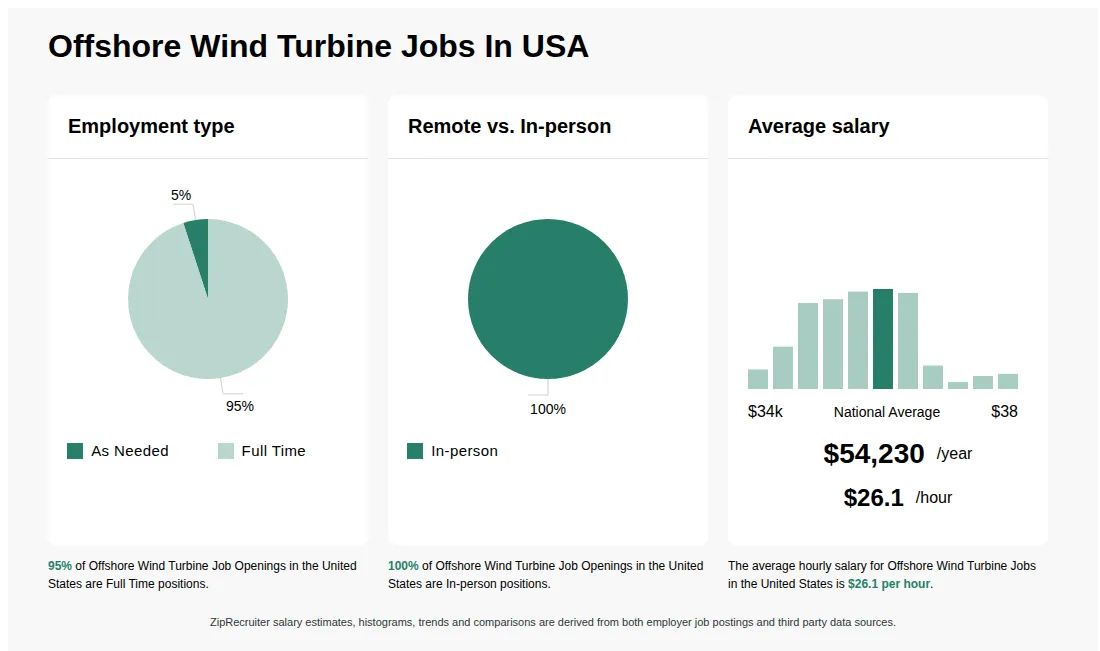
Offshore Wind Turbine information
$16.35 - $18.31
3% of jobs
$18.31 - $20.28
7% of jobs
$22.21 is the 25th percentile. Wages below this are outliers.
$20.28 - $22.25
15% of jobs
$22.25 - $24.21
16% of jobs
The median wage is $25.26 / hr.
$24.21 - $26.18
17% of jobs
$26.18 - $28.15
17% of jobs
$28.18 is the 75th percentile. Wages above this are outliers.
$28.15 - $30.11
17% of jobs
$30.11 - $32.08
3% of jobs
$32.08 - $34.05
1% of jobs
$34.05 - $36.01
2% of jobs
$36.01 - $37.98
2% of jobs
Offshore wind turbines are large structures installed in bodies of water, typically in the ocean or large lakes, that convert wind energy into electricity. Unlike onshore wind turbines, offshore turbines take advantage of stronger and more consistent winds found over open water. These turbines are mounted on foundations fixed to the seabed or floating platforms, allowing them to generate renewable energy with minimal land use. Offshore wind farms contribute to reducing carbon emissions and play a significant role in the transition to clean energy. They require specialized construction, maintenance, and logistics due to their remote and marine locations.
To thrive as an Offshore Wind Turbine Technician, you need strong electrical and mechanical skills, a relevant technical qualification (such as an NVQ or associate degree), and knowledge of wind energy systems. Familiarity with SCADA monitoring systems, safety protocols, and certifications like GWO (Global Wind Organisation) Basic Safety Training are typically required. Excellent problem-solving abilities, teamwork, and effective communication help technicians excel in challenging offshore environments. These skills and qualifications are crucial for maintaining turbine performance, ensuring safety, and minimizing downtime in complex and remote settings.
Offshore Wind Turbine Technicians often encounter challenges such as working in harsh weather conditions, long shifts at sea, and the need for strict adherence to safety protocols. Managing these challenges involves thorough safety training, maintaining strong communication with the onshore team, and following well-established maintenance and emergency procedures. Technicians typically work in teams, which helps distribute workload and ensures that safety measures are always observed. Being adaptable and proactive in addressing mechanical or electrical issues is key to success in this role.
To work as an offshore wind turbine technician, candidates typically need a high school diploma or equivalent, along with technical training or an apprenticeship in electrical, mechanical, or industrial maintenance. Relevant certifications such as OSHA safety training and specialized offshore or wind industry courses improve employability. Experience in working at heights, with heavy machinery, and in challenging environments is also valuable for entry into this field.
More about Offshore Wind Turbine jobs What cities are hiring for Offshore Wind Turbine jobs?
Cities with the most Offshore Wind Turbine job openings:
What are the most commonly searched types of Offshore Wind Turbine jobs?
The most popular types of Offshore Wind Turbine jobs are:
What states have the most Offshore Wind Turbine jobs?
States with the most job openings for Offshore Wind Turbine jobs include:
What job categories do people searching Offshore Wind Turbine jobs look for?
The top searched job categories for Offshore Wind Turbine jobs are: