Our mission is to make nuclear not only the cleanest and safest source of baseload power, but also ... About the Role General Matter is seeking a Radiation Protection Technician to support operations ...
Our mission is to make nuclear not only the cleanest and safest source of baseload power, but also ... About the Role General Matter is seeking a Radiation Protection Technician to support operations ...

Senior Nuclear Radiation Shielding Engineer
Camden, NJ · On-site
$155K - $185K/yr
The selected candidate will join an established and growing radiation protection and analysis team ... Nuclear Regulatory Commission * Mentor junior engineers and support the development of analysis ...
Senior Nuclear Radiation Shielding Engineer
Camden, NJ · On-site
$155K - $185K/yr
The selected candidate will join an established and growing radiation protection and analysis team ... Nuclear Regulatory Commission * Mentor junior engineers and support the development of analysis ...

Manager, Radiation Protection (Superintendent)
Shippingport, PA · On-site
$35.75 - $48.75/hr
Job Summary The Manager of Radiation Protection (Superintendent) is responsible for overseeing all aspects of radiation protection at the nuclear power station. This includes ensuring adherence to ...
Manager, Radiation Protection (Superintendent)
Shippingport, PA · On-site
$35.75 - $48.75/hr
Job Summary The Manager of Radiation Protection (Superintendent) is responsible for overseeing all aspects of radiation protection at the nuclear power station. This includes ensuring adherence to ...

Bachelor's Degree in Nuclear or Radiological Engineering or other technical field. * Must have a ... Radiation Protection, and DOE Order DOE O 458.1, Radiation Protection of the Public and the ...
Bachelor's Degree in Nuclear or Radiological Engineering or other technical field. * Must have a ... Radiation Protection, and DOE Order DOE O 458.1, Radiation Protection of the Public and the ...
Manager, Radiation Protection (Superintendent)
Shippingport, PA · On-site
$35.75 - $48.75/hr
Manager of Radiation Protection (Superintendent) The Manager of Radiation Protection (Superintendent) is responsible for overseeing all aspects of radiation protection at the nuclear power station.
Manager, Radiation Protection (Superintendent)
Shippingport, PA · On-site
$35.75 - $48.75/hr
Manager of Radiation Protection (Superintendent) The Manager of Radiation Protection (Superintendent) is responsible for overseeing all aspects of radiation protection at the nuclear power station.
Manager, Radiation Protection (Superintendent)
Shippingport, PA · On-site
$35.75 - $48.75/hr
Job Summary The Manager of Radiation Protection (Superintendent) is responsible for overseeing all aspects of radiation protection at the nuclear power station. This includes ensuring adherence to ...
Manager, Radiation Protection (Superintendent)
Shippingport, PA · On-site
$35.75 - $48.75/hr
Job Summary The Manager of Radiation Protection (Superintendent) is responsible for overseeing all aspects of radiation protection at the nuclear power station. This includes ensuring adherence to ...
Manager, Radiation Protection (Superintendent)
Shippingport, PA · On-site
$35.75 - $48.75/hr
Job Summary The Manager of Radiation Protection (Superintendent) is responsible for overseeing all aspects of radiation protection at the nuclear power station. This includes ensuring adherence to ...
Manager, Radiation Protection (Superintendent)
Shippingport, PA · On-site
$35.75 - $48.75/hr
Job Summary The Manager of Radiation Protection (Superintendent) is responsible for overseeing all aspects of radiation protection at the nuclear power station. This includes ensuring adherence to ...

Manager, Radiation Protection (Superintendent)
$35.75 - $48.75/hr
Job Summary The Manager of Radiation Protection (Superintendent) is responsible for overseeing all aspects of radiation protection at the nuclear power station. This includes ensuring adherence to ...
Manager, Radiation Protection (Superintendent)
$35.75 - $48.75/hr
Job Summary The Manager of Radiation Protection (Superintendent) is responsible for overseeing all aspects of radiation protection at the nuclear power station. This includes ensuring adherence to ...

Manager, Radiation Protection (Superintendent)
Shippingport, PA · On-site
$35.75 - $48.75/hr
Job Summary The Manager of Radiation Protection (Superintendent) is responsible for overseeing all aspects of radiation protection at the nuclear power station. This includes ensuring adherence to ...
Manager, Radiation Protection (Superintendent)
Shippingport, PA · On-site
$35.75 - $48.75/hr
Job Summary The Manager of Radiation Protection (Superintendent) is responsible for overseeing all aspects of radiation protection at the nuclear power station. This includes ensuring adherence to ...

... the threat of nuclear proliferation, overseeing the US' energy supply, carrying out the ... Senior Radiation Protection Specialist Candidates shall work to support requirements for CLIN 1000:
... the threat of nuclear proliferation, overseeing the US' energy supply, carrying out the ... Senior Radiation Protection Specialist Candidates shall work to support requirements for CLIN 1000:

Radiation Physicist / Radiation Protection Engineer - Advanced Light Source Upgrade (ALS-U ... Master's degree or higher in Health Physics, Physics, Nuclear Engineering, Radiation Physics, or a ...
Radiation Physicist / Radiation Protection Engineer - Advanced Light Source Upgrade (ALS-U ... Master's degree or higher in Health Physics, Physics, Nuclear Engineering, Radiation Physics, or a ...
S. in a radiological/nuclear field or equivalent experience in discipline. Four Years experience in radiation protection Good communication and interpersonal skills. Experience commensurate with ...
S. in a radiological/nuclear field or equivalent experience in discipline. Four Years experience in radiation protection Good communication and interpersonal skills. Experience commensurate with ...
S. in a radiological/nuclear field or equivalent experience in discipline. Four Years experience in radiation protection Good communication and interpersonal skills. Experience commensurate with ...
S. in a radiological/nuclear field or equivalent experience in discipline. Four Years experience in radiation protection Good communication and interpersonal skills. Experience commensurate with ...
S. in a radiological/nuclear field or equivalent experience in discipline. • Four Years experience in radiation protection • Good communication and interpersonal skills. • Experience ...
S. in a radiological/nuclear field or equivalent experience in discipline. • Four Years experience in radiation protection • Good communication and interpersonal skills. • Experience ...
S. in a radiological/nuclear field or equivalent experience in discipline. Four Years experience in radiation protection Good communication and interpersonal skills. Experience commensurate with ...
S. in a radiological/nuclear field or equivalent experience in discipline. Four Years experience in radiation protection Good communication and interpersonal skills. Experience commensurate with ...
S. in a radiological/nuclear field or equivalent experience in discipline. Four Years experience in radiation protection Good communication and interpersonal skills. Experience commensurate with ...
S. in a radiological/nuclear field or equivalent experience in discipline. Four Years experience in radiation protection Good communication and interpersonal skills. Experience commensurate with ...
Radiation Physicist / Radiation Protection Engineer - Advanced Light Source Upgrade (ALS-U ... Master's degree or higher in Health Physics, Physics, Nuclear Engineering, Radiation Physics, or a ...
Quick apply
Radiation Physicist / Radiation Protection Engineer - Advanced Light Source Upgrade (ALS-U ... Master's degree or higher in Health Physics, Physics, Nuclear Engineering, Radiation Physics, or a ...

... nuclear operations, and complex projects. We support clients at every stage, from strategic ... The Radiation Protection Specialist will provide services which may include, but are not limited to ...
... nuclear operations, and complex projects. We support clients at every stage, from strategic ... The Radiation Protection Specialist will provide services which may include, but are not limited to ...
Radiation Physicist / Radiation Protection Engineer - Advanced Light Source Upgrade (ALS-U ... Master's degree or higher in Health Physics, Physics, Nuclear Engineering, Radiation Physics, or a ...
Radiation Physicist / Radiation Protection Engineer - Advanced Light Source Upgrade (ALS-U ... Master's degree or higher in Health Physics, Physics, Nuclear Engineering, Radiation Physics, or a ...
Radiation Physicist / Radiation Protection Engineer - Advanced Light Source Upgrade (ALS-U ... Master's degree or higher in Health Physics, Physics, Nuclear Engineering, Radiation Physics, or a ...
Radiation Physicist / Radiation Protection Engineer - Advanced Light Source Upgrade (ALS-U ... Master's degree or higher in Health Physics, Physics, Nuclear Engineering, Radiation Physics, or a ...
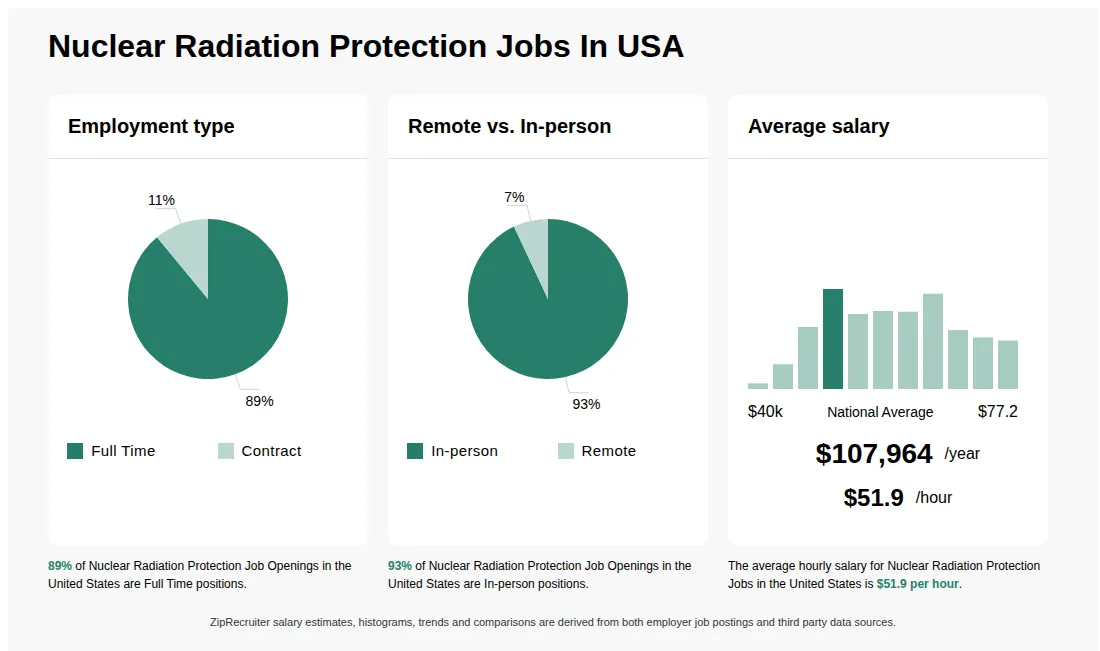
Nuclear Radiation Protection information
See salary details
$19.23 - $24.50
0% of jobs
$24.50 - $29.76
3% of jobs
$29.76 - $35.03
9% of jobs
$39.45 is the 25th percentile. Wages below this are outliers.
$35.03 - $40.30
15% of jobs
$40.30 - $45.56
12% of jobs
The median wage is $50.59 / hr.
$45.56 - $50.83
12% of jobs
$50.83 - $56.10
12% of jobs
$60.71 is the 75th percentile. Wages above this are outliers.
$56.10 - $61.36
15% of jobs
$61.36 - $66.63
8% of jobs
$66.63 - $71.90
7% of jobs
$71.90 - $77.16
7% of jobs
$19
$51
$77
How much do nuclear radiation protection jobs pay per hour?
As of Sep 2, 2026, the average hourly pay for nuclear radiation protection in the United States is $51.91, according to ZipRecruiter salary data. Most workers in this role earn between $39.18 and $62.50 per hour, depending on experience, location, and employer.
What is nuclear radiation protection?
Nuclear radiation protection, also known as radiological protection, is the science and practice of protecting people and the environment from the harmful effects of ionizing radiation. Professionals in this field assess radiation risks, implement safety procedures, and ensure compliance with regulations to minimize radiation exposure in medical, industrial, and nuclear power settings. Their work is critical to safeguarding workers, the public, and the environment from potential radiation hazards.
What are nuclear radiation protection jobs?
Nuclear radiation protection jobs include positions like radiation protection technician and radiation protection training manager. The former role helps to ensure compliance with all maintenance and safety needs, while the latter usually teaches other employees what they need to know about topics like contamination, airborne radioactivity, and some aspects of radioactive waste control. These jobs usually only occur at nuclear facilities, in transportation jobs moving nuclear material, and at radioactive waste storage facilities. Active locations, such as a nuclear plant, usually require more people employed in radiation protection roles. The relatively limited number of active nuclear facilities means these jobs tend to be geographically limited, so if you do not already live near a nuclear facility, you may have to move closer.
What are the key skills and qualifications needed to thrive as a nuclear radiation protection specialist, and why are they important?
To thrive as a Nuclear Radiation Protection Specialist, you need a solid background in physics or engineering, with specialized training or a degree in health physics or nuclear science. Familiarity with radiation detection instruments, dosimetry systems, and safety protocols, as well as relevant certifications like Certified Health Physicist (CHP), is typically required. Strong analytical thinking, attention to detail, and effective communication skills help professionals assess risks and train others in safety procedures. These competencies are essential to ensure regulatory compliance, protect personnel and the environment, and maintain safe operations in nuclear facilities.
What are some common challenges faced by professionals in nuclear radiation protection, and how are they typically addressed?
Professionals in Nuclear Radiation Protection often face challenges such as maintaining strict regulatory compliance, staying current with evolving safety standards, and effectively communicating risks to both technical and non-technical staff. These challenges are typically addressed through regular training, collaboration with multidisciplinary teams, and the use of advanced monitoring technologies to ensure safety protocols are followed. Continuous professional development and teamwork are essential for adapting to new regulations and maintaining a safe work environment.
What is the difference between Nuclear Radiation Protection vs Nuclear Health Physicist?
| Aspect | Nuclear Radiation Protection | Nuclear Health Physicist |
|---|---|---|
| Certifications | Certified Health Physicist (CHP), Radiation Safety Officer (RSO) | Certified Health Physicist (CHP), Radiation Safety Officer (RSO) |
| Work Environment | Radiation safety programs, industrial sites, nuclear facilities | Medical facilities, research labs, nuclear power plants |
| Industry Usage | Regulatory compliance, safety protocols | Medical physics, radiation dose management |
Both roles require similar certifications and work in environments involving radiation safety. Nuclear Radiation Protection specialists focus on safety protocols and regulatory compliance across various industries, while Nuclear Health Physicists primarily work in medical and research settings to manage radiation doses and ensure patient and staff safety.
More about Nuclear Radiation Protection jobs
What cities are hiring for Nuclear Radiation Protection jobs?
Cities with the most Nuclear Radiation Protection job openings:
What are the most commonly searched types of Nuclear Radiation Protection jobs?
The most popular types of Nuclear Radiation Protection jobs are:
What states have the most Nuclear Radiation Protection jobs?
States with the most job openings for Nuclear Radiation Protection jobs include:
What job categories do people searching Nuclear Radiation Protection jobs look for?
The top searched job categories for Nuclear Radiation Protection jobs are:
- Freelance Nuclear Radiation Protection
- Overnight Nuclear Radiation Protection
- Radiation Protection Manager
- Flexible Nuclear Radiation Protection
- Temporary Nuclear Radiation Protection
- Radiation Protection
- Entry Level Nuclear Radiation Protection
- Temporary Nuclear Decontamination
- Wolf Creek Nuclear Plant
- No Experience Nuclear Outage
Full-time
Medical, Dental, Vision, Retirement
Re-posted 2 days ago
Job description
About the Company
General Matter enriches uranium.
We are designing, building, and operating the world's lowest-cost enrichment services, here in the US.
In the process, we are restoring America's ability to produce nuclear fuel to power AI, advanced manufacturing and critical industries our country relies on to remain competitive.
Fuel drives the cost of advanced reactor electricity production, and enrichment drives the cost of the fuel that advanced reactors consume. Reliable, low-cost enrichment is the catalyst for the nuclear Renaissance now under way.
Our mission is to make nuclear not only the cleanest and safest source of baseload power, but also the most affordable. We believe abundant nuclear energy will lead to a post-scarcity society.
We were incubated inside Founders Fund, like Anduril and Palantir before us, and are backed by over a dozen of the world's top venture capital firms.
Our lean, world-class team of engineers and operators is applying a first-principles approach to solving the problem of nuclear fuel production.
We are a mission-driven company with a culture of urgency, accountability, and transparency.
Help us build a high-energy society by making the cleanest, safest form of baseload energy the most affordable.
About the Role
General Matter is seeking a Radiation Protection Technician to support operations, startup, and radiological work planning activities. This role works closely with the Operations Project Manager and Radiation Safety Officer and interfaces with procedures/training, engineering, and procurement teams from pre-construction through start-up. The Technician is responsible for implementing the facility's Radiation Protection (RP) program and supporting cylinder logistics processes, including SOP development, training support, and task documentation.
Responsibilities
Basic Qualifications
Preferred Qualifications
Additional Requirements
Equal Opportunity Employer
General Matter is an Equal Opportunity Employer; employment with General Matter is governed on the basis of merit, competence and qualifications and will not be influenced in any manner by race, color, religion, gender, national origin/ethnicity, veteran status, disability status, age, sexual orientation, gender identity, marital status, mental or physical disability or any other legally protected status.
Compensation and Benefits
The hourly range for this role is $35-$60/hour.
Compensation bands are determined by role, level, location, and alignment with market data. Individual level and base pay is determined on a case-by-case basis and may vary based on job-related skills, education, experience, technical capabilities and internal equity. Please note that the stated salary range is an estimate and may be adjusted based on market conditions, business needs, or other factors. In addition to base salary, for full-time hires, you may also be eligible for long-term incentives, in the form of stock options, and access to medical, vision & dental coverage as well as access to a 401(k) retirement plan.
General Matter enriches uranium.
We are designing, building, and operating the world's lowest-cost enrichment services, here in the US.
In the process, we are restoring America's ability to produce nuclear fuel to power AI, advanced manufacturing and critical industries our country relies on to remain competitive.
Fuel drives the cost of advanced reactor electricity production, and enrichment drives the cost of the fuel that advanced reactors consume. Reliable, low-cost enrichment is the catalyst for the nuclear Renaissance now under way.
Our mission is to make nuclear not only the cleanest and safest source of baseload power, but also the most affordable. We believe abundant nuclear energy will lead to a post-scarcity society.
We were incubated inside Founders Fund, like Anduril and Palantir before us, and are backed by over a dozen of the world's top venture capital firms.
Our lean, world-class team of engineers and operators is applying a first-principles approach to solving the problem of nuclear fuel production.
We are a mission-driven company with a culture of urgency, accountability, and transparency.
Help us build a high-energy society by making the cleanest, safest form of baseload energy the most affordable.
About the Role
General Matter is seeking a Radiation Protection Technician to support operations, startup, and radiological work planning activities. This role works closely with the Operations Project Manager and Radiation Safety Officer and interfaces with procedures/training, engineering, and procurement teams from pre-construction through start-up. The Technician is responsible for implementing the facility's Radiation Protection (RP) program and supporting cylinder logistics processes, including SOP development, training support, and task documentation.
Responsibilities
- Perform smear surveys, direct frisk surveys, airborne radioactivity monitoring support, and routine operational checks of RP instruments in accordance with procedures.
- Perform radiological surveys associated with cylinder receipt, storage, inspection, maintenance, and movement activities.
- Conduct inbound surveys of delivered cylinders
- Prepare clear, traceable survey maps, logs, turnover notes, and deficiency reports; support procedure use and adherence, procedure feedback, and corrective action documentation.
- Support radiological response to alarms, spills, contamination events, material handling abnormalities, and personnel incidents, including surveys, boundary control, and event documentation.
- Provide daily job safety oversight
- Conduct routine radiation surveys and ensure proper postings and boundary controls
- Contribute technical input for SOP and training material development
- Assist with cylinder movement, inspections, sampling, and yard maintenance
- Follow all Job Hazard Analyses to maintain a safe and compliant work environment
- Perform additional assignments as directed by management
- Maintain awareness of company values and strategic objectives
- Implement contamination controls, support area posting and labeling, establish and verify radiological boundaries, and maintain survey records supporting release and work control decisions.
- Support ALARA reviews, pre-job briefings, work package reviews, and radiological hold points for higher-risk tasks.
Basic Qualifications
- Qualified through a documented Radiation Protection Technician training and qualification program, including classroom training, task-specific qualification, and supervised on-the-job training
- Demonstrated familiarity with portable radiation survey instrumentation, source checks, response checks, use limitations, and calibration/traceability expectations consistent with facility procedures and applicable ANSI standards for radiation protection instrumentation.
- Ability to qualify for respiratory protection duties, including medical clearance, training, and fit testing for tight-fitting respirators, as applicable.
- Ability to complete hazardous materials transportation training applicable to assigned shipping, receiving, inspection, or pre-transport functions.
- Strong interpersonal skills and ability to collaborate across departments
- Effective written and verbal communication skills
- Ability to manage multiple tasks in a fast-paced environment
- Self-motivated and proactive, with strong initiative
Preferred Qualifications
- Prior experience in fuel-cycle facilities, DOE sites, commercial nuclear operations, uranium handling, or industrial radiological control
- Demonstrated competency in creating clear documentation (survey maps, logs, turnover notes, deficiency reports)
- Experience supporting procedure development and feedback processes
- Background in providing daily job safety oversight in radiological environments
Additional Requirements
- Ability to work extended hours and weekends as necessary.
Equal Opportunity Employer
General Matter is an Equal Opportunity Employer; employment with General Matter is governed on the basis of merit, competence and qualifications and will not be influenced in any manner by race, color, religion, gender, national origin/ethnicity, veteran status, disability status, age, sexual orientation, gender identity, marital status, mental or physical disability or any other legally protected status.
Compensation and Benefits
The hourly range for this role is $35-$60/hour.
Compensation bands are determined by role, level, location, and alignment with market data. Individual level and base pay is determined on a case-by-case basis and may vary based on job-related skills, education, experience, technical capabilities and internal equity. Please note that the stated salary range is an estimate and may be adjusted based on market conditions, business needs, or other factors. In addition to base salary, for full-time hires, you may also be eligible for long-term incentives, in the form of stock options, and access to medical, vision & dental coverage as well as access to a 401(k) retirement plan.