1

Nasa Mission Control Jobs (NOW HIRING)

Cargo Mission Manager

Houston, TX ยท On-site

$73K - $132K/yr

... NASA reps. * Communicate flight status as needed, including weekly Integrated Product Team, MIOCB(Mission Integration & Operations Control Board), TICB(Transportation Integration Control Board ...

Cargo Mission Manager

Houston, TX ยท On-site

$73K - $132K/yr

... NASA reps. * Communicate flight status as needed, including weekly Integrated Product Team, MIOCB(Mission Integration & Operations Control Board), TICB(Transportation Integration Control Board ...

... NASA reps. * Communicate flight status as needed, including weekly Integrated Product Team, MIOCB(Mission Integration & Operations Control Board), TICB(Transportation Integration Control Board ...

next page

Showing results 1-20

Nasa Mission Control information

See salary details

$13

$24

$51

How much do nasa mission control jobs pay per hour?

As of Jul 20, 2026, the average hourly pay for nasa mission control in the United States is $24.98, according to ZipRecruiter salary data. Most workers in this role earn between $18.27 and $28.37 per hour, depending on experience, location, and employer.

What are the key skills and qualifications needed to thrive in the Nasa Mission Control position, and why are they important?

To thrive as a NASA Mission Control specialist, you need a strong background in engineering, physics, or a related STEM field, along with relevant experience in aerospace operations. Familiarity with mission control software, telemetry systems, and technical certifications such as Security Clearance or ITAR compliance are often required. Excellent problem-solving abilities, teamwork, and effective verbal communication are key soft skills for this high-pressure environment. These skills and qualities are essential to ensure mission safety, clear coordination, and real-time decision-making during space operations.

What is the typical work environment and schedule like for NASA Mission Control team members?

NASA Mission Control team members work in a highly collaborative, fast-paced operations center that runs 24/7 during critical mission phases. Schedules often include shift work, weekends, and holidays to provide continuous monitoring and support for ongoing missions. The team structure is multidisciplinary, with each member responsible for specific technical systems or mission aspects, requiring close coordination. While the pace can be intense, especially during launches or anomalies, you'll benefit from a structured environment with clear protocols and substantial support for professional development and advancement.

How much do NASA mission controllers make?

NASA mission controllers typically earn between $70,000 and $120,000 annually, depending on experience, education, and seniority. They often hold degrees in engineering, science, or related fields and work in high-pressure environments requiring strong technical skills and certifications.

How do I get into Mission Control?

To work in NASA Mission Control, candidates typically need a background in engineering, science, or related fields, along with experience in systems management and problem-solving. Relevant skills include familiarity with spacecraft operations, strong communication abilities, and often a security clearance. Applicants usually go through a competitive hiring process that includes interviews, assessments, and training programs specific to NASA's mission control operations.

What is a NASA Mission Control job?

A NASA Mission Control job involves monitoring and managing spacecraft operations from the Mission Control Center. Engineers and flight controllers work in real-time to ensure the success and safety of space missions, communicating directly with astronauts and analyzing data from spacecraft systems. These roles require extensive technical expertise, problem-solving skills, and the ability to perform under pressure. Mission Control teams support a variety of operations, including crewed missions, robotic spacecraft, and space station activities.

Is it difficult to get hired by NASA?

Getting hired as a NASA Mission Control specialist is highly competitive and requires a strong background in engineering, science, or related fields, along with relevant experience and often advanced degrees. Candidates typically undergo a rigorous selection process, including technical assessments and background checks, due to the high standards and safety requirements of space missions.

How to become a NASA Mission Control?

To become a NASA Mission Control specialist, candidates typically need a bachelor's degree in engineering, science, or related fields, along with strong problem-solving and communication skills. Relevant experience in aerospace, systems management, or operations is also important, and many professionals pursue advanced degrees or certifications to enhance their qualifications. Familiarity with mission planning tools and the ability to work under pressure are essential in this role.
More about Nasa Mission Control jobs
What cities are hiring for Nasa Mission Control jobs? Cities with the most Nasa Mission Control job openings:
What are the most commonly searched types of Nasa Mission Control jobs? The most popular types of Nasa Mission Control jobs are:
What states have the most Nasa Mission Control jobs? States with the most job openings for Nasa Mission Control jobs include:
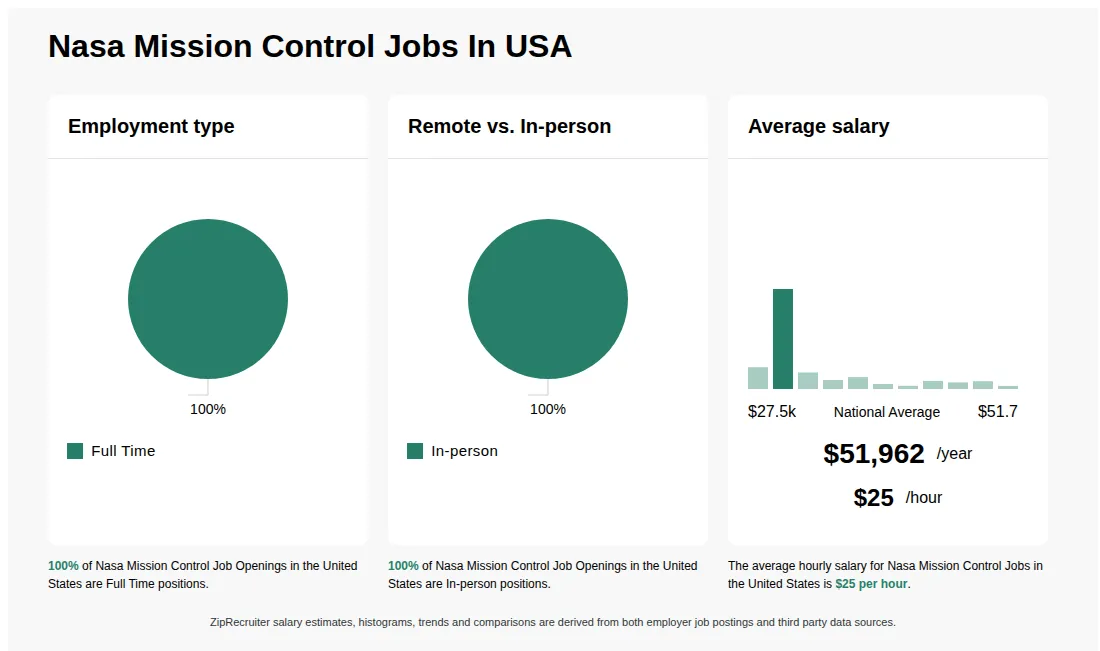
Infographic showing various Nasa Mission Control job openings in the United States as of July 2026, with employment types broken down into 78% Full Time, 11% Part Time, and 11% Nights. Highlights an 100% In-person job distribution, with an average salary of $51,962 per year, or $25 per hour.
Mission Engineer at NASA Wallops

Mission Engineer at NASA Wallops

Metis Technology Solutions Inc

Wallops Island, VA โ€ข On-site

$106K - $140K/yr

Full-time

Posted 16 days ago


Job description

POSITION SUMMARY:

Join the NASA Wallops Flight Facility team and play a pivotal role in enabling some of NASAโ€™s most exciting space missions. As a Mission Engineer on the Wallops Range Contract, you will provide critical engineering optimization and technical leadership for complex range systems supporting sounding rockets, expendable launch vehicles, UAS, balloons, and Artemis-related human spaceflight network support. More than 20 global tracking sites and mobile instrumentation deployments worldwide depend on the real-time performance of Wallops Range systems. Apply your expertise in link analysis, mission configuration design, telemetry systems, and deployed site leadership to ensure mission success for scientists, researchers, and mission controllers around the world.

OVERVIEW OF RESPONSIBILITIES:

  • Perform Mission Engineering as defined in the WRC SOW: engineering optimization of Range systems (telemetry, RF, instrumentation) for missions of greater-than-usual complexity or criticality.
  • Conduct detailed RF link analyses for downlinks and uplinks; evaluate predicted vs. actual performance to inform configuration decisions.
  • Design, implement, and verify comprehensive test plans, schematics, and mission-specific configurations for telemetry ground stations, antennas, receivers, processors, and other range assets.
  • Support NASA Mission Reviews (IPIR, RRR, LRR) including briefing materials on range instrumentation configurations, readiness, risks, and implementation plans.
  • Deploy as Site Lead / ROC Site Lead for mobile telemetry and range instrumentation campaigns; lead assigned technicians, manage site operations, safety, and real-time reporting during remote deployments (including up to 12 weeks at Poker Flat Research Range).
  • Generate and present required post-mission data products (calibrated signal level plots, track analysis, link analysis comparisons, anomaly disposition) for Post Flight Data Reviews and Post Mission Summary Reviews (PMSR).
  • Serve as primary Contractor point-of-contact for field operations and travel; coordinate resources and provide systems engineering support throughout project lifecycle.
  • Contribute to Monthly Status Reports, Discrepancy Report tracking, risk identification, and Lessons Learned processes.
  • Ensure configuration integrity, proper use of work control systems, and adherence to Quality Assurance and safety requirements during all operations.

MINIMUM QUALIFICATIONS:

Education:

Bachelorโ€™s degree in Engineering, Applied Mathematics, Physics, Aerospace Science, or closely related technical field from an accredited institution. Masterโ€™s degree (e.g., Space Studies) strongly preferred or in progress.

Required Skills and Knowledge:

  • Minimum five (5) years of progressive experience in aerospace range operations, telemetry ground systems, mission engineering/support, or equivalent DoD/NASA flight test/range environment. Wallops or sounding rocket/launch range experience highly desirable.
  • Demonstrated hands-on expertise with telemetry ground systems: steerable parabolic antennas, RF receiving/combining equipment, bit synchronizers, decommutators, telemetry processors, data recorders, and display systems.
  • Proven experience performing RF link analysis, designing/implementing mission configurations and test plans/schematics for complex ground asset setups.
  • Prior leadership experience in deployed/field environments (Site Lead or equivalent) with responsibility for technicians and mission execution at remote locations.
  • Strong data analysis and visualization skills for generating post-mission products (signal level plots, track files, performance metrics). Proficiency with Microsoft Office, MATLAB, Python, or similar tools.
  • Active U.S. Secret security clearance (or ability to obtain/maintain). U.S. citizenship required.
  • Excellent written/oral communication skills; ability to interface professionally with scientists, engineers, range users, and Government customers.
  • Willingness and ability to travel extensively and deploy for extended periods (up to 12+ weeks) to remote/austere locations worldwide.

LOCATION SPECIFIC REQUIREMENTS:

On-site at Wallops Flight Facility, Wallops Island, VA. Hybrid work schedule may be approved. Frequent extended deployments to remote range sites (including Poker Flat Research Range, AK, and international locations) are required.

SECURITY CLEARANCE:

Must have ability to obtain and maintain a minimum Secret security clearance. Active Secret clearance preferred.

EEOE Including Vets and Disability

Must be a U.S. Citizen or Permanent Resident