Laboratory Scientist - Molecular Biology / Antibody Discovery Location: Cambridge, MA (Onsite) Duration: Contract on W2 Experience: 0-2+ years Industry: Biotechnology / Pharmaceutical About the Role ...
New
Laboratory Scientist - Molecular Biology / Antibody Discovery Location: Cambridge, MA (Onsite) Duration: Contract on W2 Experience: 0-2+ years Industry: Biotechnology / Pharmaceutical About the Role ...
New
Laboratory Scientist - Molecular Biology / Antibody Discovery Location: Cambridge, MA (Onsite) Duration: Contract on W2 Experience: 0-2+ years Industry: Biotechnology / Pharmaceutical About the Role ...
New
Cambridge, MA · On-site
$38.50 - $48.25/hr
Scientist / Molecular Biology Duration: 24 months contract, extendable up to 48 months Location: Cambridge, MA Note: The client has the right-to-hire you as a permanent employee at any time during or ...
Quick apply
Cambridge, MA · On-site
$38.50 - $48.25/hr
Scientist / Molecular Biology Duration: 24 months contract, extendable up to 48 months Location: Cambridge, MA Note: The client has the right-to-hire you as a permanent employee at any time during or ...
Emeryville, CA · On-site
$88K - $96K/yr
Execute and analyze molecular biology experiments, working closely with scientists to support new product development and process optimization * Perform DNA cloning and manipulation (PCR, restriction ...
Emeryville, CA · On-site
$88K - $96K/yr
Execute and analyze molecular biology experiments, working closely with scientists to support new product development and process optimization * Perform DNA cloning and manipulation (PCR, restriction ...
Position Information Position Title Biochemistry and Molecular Biology Position Number 5417,5418,5419 FTE 1.00 Division College of Medicine Department 720100 - Biochemistry Posting Detail Information ...
Position Information Position Title Biochemistry and Molecular Biology Position Number 5417,5418,5419 FTE 1.00 Division College of Medicine Department 720100 - Biochemistry Posting Detail Information ...
Emeryville, CA · On-site
$88K - $96K/yr
Execute and analyze molecular biology experiments, working closely with scientists to support new product development and process optimization * Perform DNA cloning and manipulation (PCR, restriction ...
Emeryville, CA · On-site
$88K - $96K/yr
Execute and analyze molecular biology experiments, working closely with scientists to support new product development and process optimization * Perform DNA cloning and manipulation (PCR, restriction ...
CEAS for Genetic Characterization Team (Molecular Biology) Support the genetic characterization of cell lines expressing therapeutic proteins. Responsible for molecular biology activities that ...
Quick apply
CEAS for Genetic Characterization Team (Molecular Biology) Support the genetic characterization of cell lines expressing therapeutic proteins. Responsible for molecular biology activities that ...
Emeryville, CA · On-site
$130K - $159K/yr
The ideal candidate has a strong background in molecular biology that is highly familiar with cloning, DNA amplification, and sequencing processes. You will design and execute experiments working in ...
Emeryville, CA · On-site
$130K - $159K/yr
The ideal candidate has a strong background in molecular biology that is highly familiar with cloning, DNA amplification, and sequencing processes. You will design and execute experiments working in ...
San Diego, CA · On-site
$110K - $135K/yr
The candidate will have expertise in molecular biology based analytical assay design and development, data analysis and presentation, robust experience with molecular biology related instrumentation ...
San Diego, CA · On-site
$110K - $135K/yr
The candidate will have expertise in molecular biology based analytical assay design and development, data analysis and presentation, robust experience with molecular biology related instrumentation ...
San Diego, CA · On-site
$110K - $135K/yr
The candidate will have expertise in molecular biology based analytical assay design and development, data analysis and presentation, robust experience with molecular biology related instrumentation ...
Quick apply
San Diego, CA · On-site
$110K - $135K/yr
The candidate will have expertise in molecular biology based analytical assay design and development, data analysis and presentation, robust experience with molecular biology related instrumentation ...
Emeryville, CA · On-site
$130K - $159K/yr
The ideal candidate has a strong background in molecular biology that is highly familiar with cloning, DNA amplification, and sequencing processes. You will design and execute experiments working in ...
Emeryville, CA · On-site
$130K - $159K/yr
The ideal candidate has a strong background in molecular biology that is highly familiar with cloning, DNA amplification, and sequencing processes. You will design and execute experiments working in ...
San Diego, CA · On-site
$110K - $135K/yr
The candidate will have expertise in molecular biology based analytical assay design and development, data analysis and presentation, robust experience with molecular biology related instrumentation ...
San Diego, CA · On-site
$110K - $135K/yr
The candidate will have expertise in molecular biology based analytical assay design and development, data analysis and presentation, robust experience with molecular biology related instrumentation ...
Applies the techniques of molecular and cellular biology, including analysis of deoxyribonucleic acid (DNA) ribonucleic acid (RNA) and proteins to the discovery of drugs, development of drugs and/or ...
Applies the techniques of molecular and cellular biology, including analysis of deoxyribonucleic acid (DNA) ribonucleic acid (RNA) and proteins to the discovery of drugs, development of drugs and/or ...
San Diego, CA · On-site
$33.89 - $42.43/hr
The Research Associate II, Molecular Biology performs a range of molecular biology laboratory procedures in support of technology development, product research, and process improvement initiatives.
San Diego, CA · On-site
$33.89 - $42.43/hr
The Research Associate II, Molecular Biology performs a range of molecular biology laboratory procedures in support of technology development, product research, and process improvement initiatives.
San Diego, CA · On-site
$60 - $80/hr
Scientist - Molecular Biology (Cloning) San Diego, United States | Posted on 08/20/2026 Our client, a worldleader in life sciences, is looking for a Scientist - Molecular Biology, basedin San Diego ...
San Diego, CA · On-site
$60 - $80/hr
Scientist - Molecular Biology (Cloning) San Diego, United States | Posted on 08/20/2026 Our client, a worldleader in life sciences, is looking for a Scientist - Molecular Biology, basedin San Diego ...
Indianapolis, IN · On-site
$150 - $200/hr
Apply molecular biology techniques including 1‑ and 2‑D gel electrophoresis, blotting, and restriction enzyme analysis for product characterization. * Contribute to analytical control strategies ...
Indianapolis, IN · On-site
$150 - $200/hr
Apply molecular biology techniques including 1‑ and 2‑D gel electrophoresis, blotting, and restriction enzyme analysis for product characterization. * Contribute to analytical control strategies ...
$33.89 - $42.43/hr
The Research Associate II, Molecular Biology performs a range of molecular biology laboratory procedures in support of technology development, product research, and process improvement initiatives.
Quick apply
$33.89 - $42.43/hr
The Research Associate II, Molecular Biology performs a range of molecular biology laboratory procedures in support of technology development, product research, and process improvement initiatives.
San Diego, CA · On-site
$33.89 - $42.43/hr
The Research Associate II, Molecular Biology performs a range of molecular biology laboratory procedures in support of technology development, product research, and process improvement initiatives.
San Diego, CA · On-site
$33.89 - $42.43/hr
The Research Associate II, Molecular Biology performs a range of molecular biology laboratory procedures in support of technology development, product research, and process improvement initiatives.
Cellular-Molecular Biology - Part-Time Lecturer Pool Job no: 558293 Work type: Instructional Faculty - Temporary/Lecturer Location: Fullerton Categories: Unit 3 - CFA - California Faculty Association ...
Cellular-Molecular Biology - Part-Time Lecturer Pool Job no: 558293 Work type: Instructional Faculty - Temporary/Lecturer Location: Fullerton Categories: Unit 3 - CFA - California Faculty Association ...
DNA Production & Molecular Biology Independently execute high-throughput plasmid DNA production workflows, including: Bacterial culture growth Plasmid purification Downstream sample handling Perform ...
Quick apply
DNA Production & Molecular Biology Independently execute high-throughput plasmid DNA production workflows, including: Bacterial culture growth Plasmid purification Downstream sample handling Perform ...
Position Details Position Information Position Title Biochemistry and Molecular Biology Position Number 5417,5418,5419 FTE 1.00 Division College of Medicine Department 720100 - Biochemistry Posting ...
Position Details Position Information Position Title Biochemistry and Molecular Biology Position Number 5417,5418,5419 FTE 1.00 Division College of Medicine Department 720100 - Biochemistry Posting ...
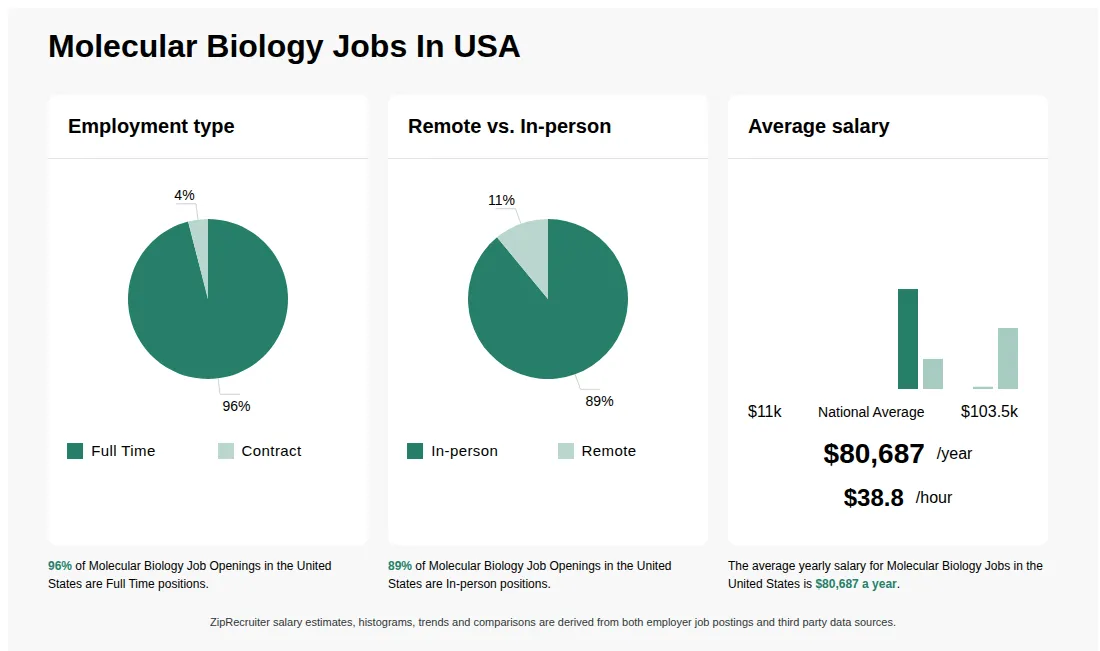
$11K - $19.4K
0% of jobs
$19.4K - $27.8K
0% of jobs
$27.8K - $36.2K
0% of jobs
$36.2K - $44.6K
0% of jobs
$44.6K - $53K
0% of jobs
$53K - $61.5K
0% of jobs
$65.5K is the 25th percentile. Wages below this are outliers.
$61.5K - $69.9K
52% of jobs
$69.9K - $78.3K
15% of jobs
$78.3K - $86.7K
0% of jobs
$86.7K - $95.1K
1% of jobs
$96.9K is the 75th percentile. Wages above this are outliers.
$95.1K - $103.5K
32% of jobs
$11K
$80.7K
$103.5K
There are many jobs in molecular biology, including research assistants, laboratory scientists, clinical specialists, and molecular biologists. Many of the jobs have similar duties, such as collecting samples, running complex tests to study chemistry, biology, and cell physiology, and writing reports demonstrating your findings. Researchers and academics publish papers and write grants for funding future experiments. Molecular biology majors can find jobs in many industries, including medicine, pharmaceuticals, higher education, and plant and agricultural sciences.
| Aspect | Molecular Biology | Microbiologist |
|---|---|---|
| Required Credentials | Bachelor's or Master's in Molecular Biology, Genetics, or related fields | Bachelor's or Master's in Microbiology, Biology, or related fields |
| Work Environment | Laboratories, research institutions, biotech companies | Laboratories, healthcare settings, environmental agencies |
| Industry Usage | Research, biotech, pharmaceuticals | Healthcare, environmental, food safety |
| Common Search/Comparison | Focuses on genetic and molecular techniques | Focuses on microorganisms and their impact |
While both Molecular Biologists and Microbiologists work in laboratory settings and require similar educational backgrounds, Molecular Biology primarily focuses on genetic material and molecular techniques, whereas Microbiologists study microorganisms and their effects. Understanding these differences helps job seekers identify the right career path based on their interests and skills.
Cities with the most Molecular Biology job openings:
The most popular types of Molecular Biology jobs are:
States with the most job openings for Molecular Biology jobs include:
The top searched job categories for Molecular Biology jobs are:
Cambridge, MA • On-site
Other
Posted 2 days ago
New
Laboratory Scientist – Molecular Biology / Antibody Discovery
Location: Cambridge, MA (Onsite)
Duration: Contract on W2
Experience: 0–2+ years
Industry: Biotechnology / Pharmaceutical
About the Role
We are seeking an early-career Laboratory Scientist to support Biomedicine Design and therapeutic antibody discovery. This is a hands-on laboratory position focused on molecular biology workflows used to generate, characterize, and analyze biological materials supporting antibody discovery programs.
The ideal candidate will have strong foundational experience in DNA/RNA extraction, PCR, molecular cloning, gel electrophoresis, nucleic acid purification, and NGS library preparation, along with excellent pipetting, documentation, and troubleshooting skills.
Key Responsibilities
Required Qualifications
Preferred Qualifications
Why This Opportunity?
This is a strong opportunity for a hands-on molecular biology scientist looking to work at the intersection of molecular biology, NGS, automation, and therapeutic antibody discovery.
If you have experience with PCR, cloning, DNA/RNA extraction, NGS, or automated laboratory workflows and want to apply those skills in a drug-discovery environment, we'd like to hear from you.