1

Meteorology Python Jobs (NOW HIRING)

Background with LabVIEW, MATLAB, or Python. * Demonstrate experience in the installation and maintenance of varying instrumentation and equipment (preferably meteorological). * Strong background with ...

Background with LabVIEW, MATLAB, or Python. * Demonstrate experience in the installation and maintenance of varying instrumentation and equipment (preferably meteorological). * Strong background with ...

Bachelor's degree in Atmospheric Science, Meteorology, Computer Science, Information Sciences, or ... Including shell/bash scripting, SQL, and a scientific programming language such as Python. Web ...

Physical Scientist Technician I

Sterling, VA · On-site

$37.90K - $38.40K/yr

Background with LabVIEW, MATLAB, or Python. * Demonstrate experience in the installation and maintenance of varying instrumentation and equipment (preferably meteorological). * Strong background with ...

D. in meteorology, climatology, atmospheric science, wildfire science, environmental science ... Strong programming / scripting skills are required, preferably in R and / or Python, are required

next page

Showing results 1-20

Meteorology Python information

See salary details

$13

$58

$86

How much do meteorology python jobs pay per hour?

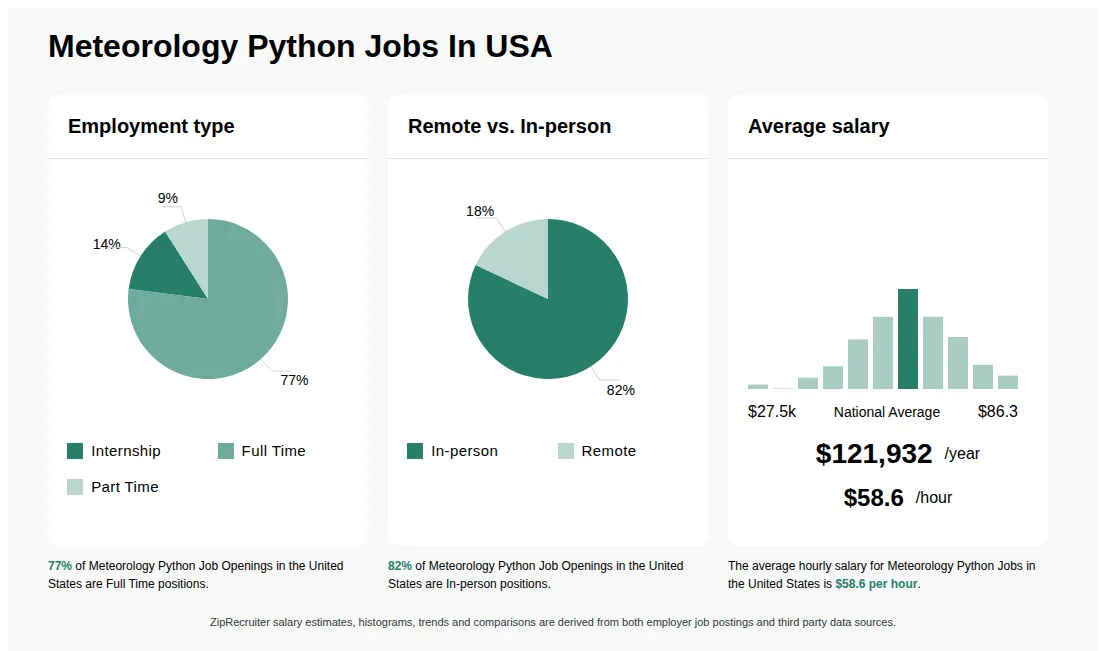
As of May 30, 2026, the average hourly pay for meteorology python in the United States is $58.62, according to ZipRecruiter salary data. Most workers in this role earn between $48.32 and $66.59 per hour, depending on experience, location, and employer.

What are the key skills and qualifications needed to thrive as a Meteorology Python Developer, and why are they important?

To thrive as a Meteorology Python Developer, you need strong programming skills in Python, a solid grasp of meteorological concepts, and a relevant degree in atmospheric science, computer science, or a related field. Experience with data analysis tools (such as NumPy, Pandas, and Matplotlib), weather modeling systems, and libraries like MetPy or PyNGL is typically required. Critical thinking, strong problem-solving abilities, and effective communication help translate complex weather data into actionable insights. These skills are crucial for accurate weather analysis, efficient data handling, and effective collaboration with scientific teams.

How does a Meteorology Python specialist typically collaborate with meteorologists and data scientists on forecasting projects?

A Meteorology Python specialist often works closely with meteorologists to translate atmospheric data into actionable insights using Python-based tools. They collaborate with data scientists to develop, optimize, and maintain scripts for data analysis, visualization, and model automation. Regular interactions may include joint code reviews, sharing domain knowledge, and integrating meteorological models with advanced analytics pipelines. This teamwork ensures accurate forecasts and innovative solutions to complex weather-related challenges.

What is Meteorology Python?

Meteorology Python refers to the use of the Python programming language for meteorological data analysis, visualization, and modeling. Professionals in this area use Python to process large datasets from weather stations, satellites, and climate models, enabling them to analyze patterns, forecast weather, and visualize atmospheric phenomena. Python's powerful libraries, such as MetPy, xarray, and matplotlib, make it a popular choice for both research and operational meteorology. This skillset is valuable in meteorological agencies, research institutions, and private sectors that require weather-related data processing.

What is the difference between Meteorology Python vs Meteorology Data Analyst?

AspectMeteorology PythonMeteorology Data Analyst
Required CredentialsBachelor's in Meteorology, Computer Science, or related; Python programming skillsBachelor's in Meteorology, Data Science, or related; proficiency in data analysis tools
Work EnvironmentResearch labs, weather agencies, tech companiesWeather services, research institutions, government agencies
Employer & Industry UsageDeveloping weather models, automation, data processingAnalyzing weather data, reporting, forecasting support
Common Search & Comparison IntentFocus on Python skills in meteorologyFocus on data analysis roles in meteorology

While both roles involve meteorology, Meteorology Python emphasizes programming and developing weather models using Python, whereas Meteorology Data Analysts focus on interpreting weather data and generating reports. Both careers often require similar educational backgrounds but differ in daily tasks and skill sets.

More about Meteorology Python jobs
What cities are hiring for Meteorology Python jobs? Cities with the most Meteorology Python job openings:
What states have the most Meteorology Python jobs? States with the most job openings for Meteorology Python jobs include:
What job categories do people searching Meteorology Python jobs look for? The top searched job categories for Meteorology Python jobs are:
Infographic showing various Meteorology Python job openings in the United States as of May 2026, with employment types broken down into 22% Full Time, and 78% Contract. Highlights an 7% Physical, 17% Hybrid, and 76% Remote job distribution, with an average salary of $121,932 per year, or $58.6 per hour.

Job description

Position: Summer Research Intern: Weather & Machine Learning

Duration: 10-12 weeks

Level: Undergraduate or Graduate

Overview: We are seeking a motivated student with coursework in meteorology and hands-on experience with machine learning to join our research team for the summer. The intern will contribute to a project focused on using machine learning to better understand and track microscale features within winter weather systems using radar data.

Responsibilities

  • Work with radar datasets to identify and organize cases of microscale features
  • Assist in preparing and processing data for use in machine learning models
  • Help evaluate and visualize model results using Python-based tools
  • Contribute to team meetings and discussions about storm behavior and model performance
  • Document progress and assist in preparing summaries of findings
Qualifications
  • Currently enrolled in an undergraduate or graduate program in meteorology, atmospheric science, or a related field
  • Basic familiarity with radar products through coursework or experience
  • Prior coursework or project experience in machine learning or data science
  • Proficiency in Python for data analysis

Preferred

  • Coursework or experience in radar meteorology
  • Experience with or understanding of cloud seeding atmospheric effects
  • Familiarity with deep learning frameworks such as PyTorch or TensorFlow
  • Experience with data analysis tools such as Py-ART, MetPy, xarray, or similar
  • Prior research experience of any kind (REU, class projects, lab work)

What You Will Gain

  • Hands-on experience applying machine learning to real operational radar data
  • Mentorship from researchers across meteorology and data science
  • A meaningful research contribution suitable for graduate school applications
  • Collaborative work environment bridging atmospheric science and modern data science methods
apply for this job