Passionate about law enforcement? * Physically and mentally fit? * Able to excel under stress? * Confident and assertive? Skills You'll Learn Leadership and communication Maritime law enforcement ...
Passionate about law enforcement? * Physically and mentally fit? * Able to excel under stress? * Confident and assertive? Skills You'll Learn Leadership and communication Maritime law enforcement ...
The law enforcement topical areas for which we are accepting applications include: firearms, driver training, marine training, maritime, active shooter, behavioral science, general investigative ...
The law enforcement topical areas for which we are accepting applications include: firearms, driver training, marine training, maritime, active shooter, behavioral science, general investigative ...
$89K/yr
The law enforcement topical areas for which we are accepting applications include: firearms, driver training, marine training, maritime, active shooter, behavioral science, general investigative ...
$89K/yr
The law enforcement topical areas for which we are accepting applications include: firearms, driver training, marine training, maritime, active shooter, behavioral science, general investigative ...
$106K/yr
The law enforcement topical areas for which we are accepting applications include: firearms, driver training, marine training, maritime, active shooter, behavioral science, general investigative ...
$106K/yr
The law enforcement topical areas for which we are accepting applications include: firearms, driver training, marine training, maritime, active shooter, behavioral science, general investigative ...
The law enforcement topical areas for which we are accepting applications include: firearms, driver training, marine training, maritime, active shooter, behavioral science, general investigative ...
The law enforcement topical areas for which we are accepting applications include: firearms, driver training, marine training, maritime, active shooter, behavioral science, general investigative ...
The law enforcement topical areas for which we are accepting applications include: firearms, driver training, marine training, maritime, active shooter, behavioral science, general investigative ...
The law enforcement topical areas for which we are accepting applications include: firearms, driver training, marine training, maritime, active shooter, behavioral science, general investigative ...
The law enforcement topical areas for which we are accepting applications include: firearms, driver training, marine training, maritime, active shooter, behavioral science, general investigative ...
The law enforcement topical areas for which we are accepting applications include: firearms, driver training, marine training, maritime, active shooter, behavioral science, general investigative ...

Maritime Field Service Representative Job Category: Engineering and Technical Support Time Type ... Experience working with military, government, law enforcement, contractors, vendors, or equivalent ...
Maritime Field Service Representative Job Category: Engineering and Technical Support Time Type ... Experience working with military, government, law enforcement, contractors, vendors, or equivalent ...
The law enforcement topical areas for which we are accepting applications include: firearms, driver training, marine training, maritime, active shooter, behavioral science, general investigative ...
The law enforcement topical areas for which we are accepting applications include: firearms, driver training, marine training, maritime, active shooter, behavioral science, general investigative ...
The law enforcement topical areas for which we are accepting applications include: firearms, driver training, marine training, maritime, active shooter, behavioral science, general investigative ...
The law enforcement topical areas for which we are accepting applications include: firearms, driver training, marine training, maritime, active shooter, behavioral science, general investigative ...
Maritime Field Service Representative Job Category: Engineering and Technical Support Time Type ... Experience working with military, government, law enforcement, contractors, vendors, or equivalent ...
Maritime Field Service Representative Job Category: Engineering and Technical Support Time Type ... Experience working with military, government, law enforcement, contractors, vendors, or equivalent ...
Maritime Field Service Representative Job Category: Engineering and Technical Support Time Type ... Experience working with military, government, law enforcement, contractors, vendors, or equivalent ...
Maritime Field Service Representative Job Category: Engineering and Technical Support Time Type ... Experience working with military, government, law enforcement, contractors, vendors, or equivalent ...
Maritime Field Service Representative Job Category: Engineering and Technical Support Time Type ... Experience working with military, government, law enforcement, contractors, vendors, or equivalent ...
Maritime Field Service Representative Job Category: Engineering and Technical Support Time Type ... Experience working with military, government, law enforcement, contractors, vendors, or equivalent ...
Law Enforcement Advisor Department of State - International Narcotics and Law Enforcement (INL ... focus on maritime crime, counter narcotics trafficking, critical mineral supply chains ...
Law Enforcement Advisor Department of State - International Narcotics and Law Enforcement (INL ... focus on maritime crime, counter narcotics trafficking, critical mineral supply chains ...

Maritime Security Officer
Titusville, FL · On-site
$17.50 - $18.21/hr
Maritime Officers work under the direction of Law Enforcement to promote public safety and the free flow of legitimate trade and travel. Position Duties The tasks below are those that represent the ...
Maritime Security Officer
Titusville, FL · On-site
$17.50 - $18.21/hr
Maritime Officers work under the direction of Law Enforcement to promote public safety and the free flow of legitimate trade and travel. Position Duties The tasks below are those that represent the ...
Maritime Security Officer
Titusville, FL · On-site
$17.50 - $18.21/hr
Maritime Officers work under the direction of Law Enforcement to promote public safety and the free flow of legitimate trade and travel. Position Duties The tasks below are those that represent the ...
Maritime Security Officer
Titusville, FL · On-site
$17.50 - $18.21/hr
Maritime Officers work under the direction of Law Enforcement to promote public safety and the free flow of legitimate trade and travel. Position Duties The tasks below are those that represent the ...
Maritime Security Officer
Cape Canaveral, FL · On-site
$14.75 - $18.75/hr
Maritime Officers work under the direction of Law Enforcement to promote public safety and the free flow of legitimate trade and travel. Position Duties The tasks below are those that represent the ...
Maritime Security Officer
Cape Canaveral, FL · On-site
$14.75 - $18.75/hr
Maritime Officers work under the direction of Law Enforcement to promote public safety and the free flow of legitimate trade and travel. Position Duties The tasks below are those that represent the ...
Maritime Security Officer
$17.50 - $18.21/hr
Maritime Officers work under the direction of Law Enforcement to promote public safety and the free flow of legitimate trade and travel. Position Duties The tasks below are those that represent the ...
Maritime Security Officer
$17.50 - $18.21/hr
Maritime Officers work under the direction of Law Enforcement to promote public safety and the free flow of legitimate trade and travel. Position Duties The tasks below are those that represent the ...
Mission Integrator
Arlington, VA · On-site
Experience in defense, intelligence, or maritime law enforcement. * Knowledge of naval order of battle (OOB) maritime intelligence * Familiarity with machine learning applications in maritime ...
Mission Integrator
Arlington, VA · On-site
Experience in defense, intelligence, or maritime law enforcement. * Knowledge of naval order of battle (OOB) maritime intelligence * Familiarity with machine learning applications in maritime ...

Maritime Security Officer
Cape Canaveral, FL · On-site
$13.50 - $16/hr
Maritime Officers work under the direction of Law Enforcement to promote public safety and the free flow of legitimate trade and travel. Position Duties The tasks below are those that represent the ...
Maritime Security Officer
Cape Canaveral, FL · On-site
$13.50 - $16/hr
Maritime Officers work under the direction of Law Enforcement to promote public safety and the free flow of legitimate trade and travel. Position Duties The tasks below are those that represent the ...
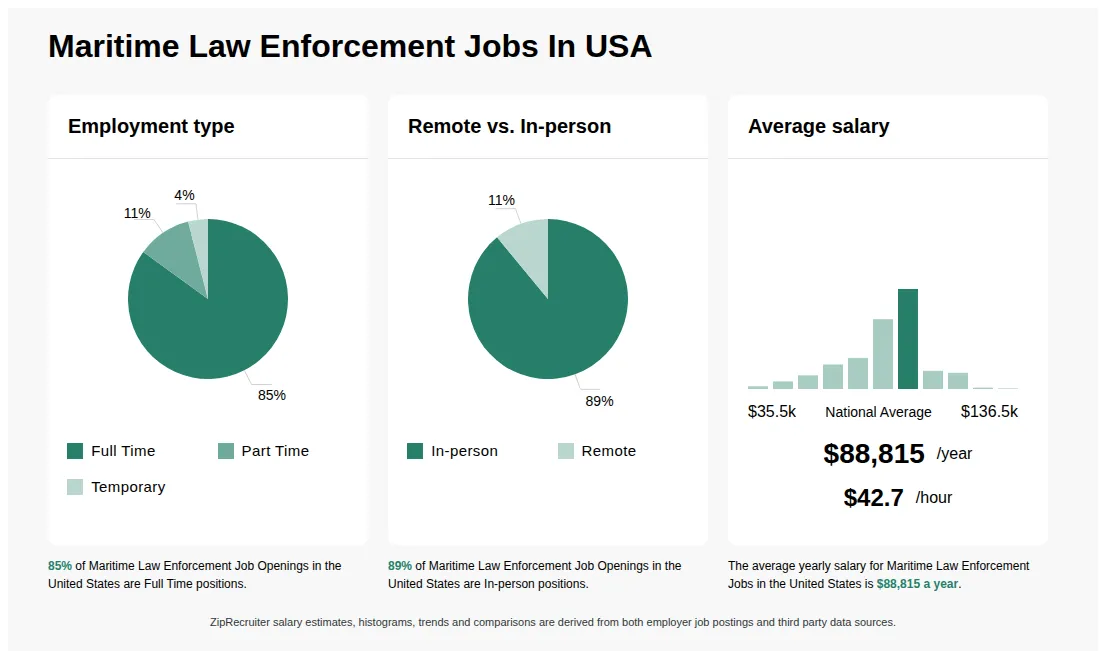
Maritime Law Enforcement information
See salary details
$35.5K - $44.7K
0% of jobs
$44.7K - $53.9K
2% of jobs
$53.9K - $63K
4% of jobs
$63K - $72.2K
9% of jobs
$81K is the 25th percentile. Wages below this are outliers.
$72.2K - $81.4K
11% of jobs
The median wage is $90.2K / yr.
$81.4K - $90.6K
26% of jobs
$96.5K is the 75th percentile. Wages above this are outliers.
$90.6K - $99.8K
37% of jobs
$99.8K - $109K
6% of jobs
$109K - $118.1K
5% of jobs
$118.1K - $127.3K
0% of jobs
$127.3K - $136.5K
0% of jobs
$35.5K
$88.8K
$136.5K
How much do maritime law enforcement jobs pay per year?
As of Sep 3, 2026, the average yearly pay for maritime law enforcement in the United States is $88,815.00, according to ZipRecruiter salary data. Most workers in this role earn between $77,500.00 and $98,500.00 per year, depending on experience, location, and employer.
What is a maritime law enforcement officer?
A Maritime Law Enforcement job involves enforcing laws and regulations on the water to ensure maritime safety, security, and environmental protection. This can include preventing illegal activities such as smuggling, piracy, and illegal fishing, as well as conducting search and rescue operations. Professionals in this field typically work for agencies like the U.S. Coast Guard, Navy, or local maritime enforcement units. Their duties may involve patrolling waterways, inspecting vessels, and responding to maritime emergencies. Strong knowledge of maritime laws and operational procedures is essential for success in this career.
What are the key skills and qualifications needed to thrive in maritime law enforcement?
Maritime Law Enforcement professionals require a strong background in maritime operations, law enforcement procedures, and often a relevant degree or maritime academy training. Familiarity with navigation systems, maritime communication devices, and certifications such as STCW or specialized law enforcement credentials are common technical requirements. Outstanding situational awareness, teamwork, and decision-making skills help individuals excel in this demanding and dynamic environment. These abilities are essential to ensure legal compliance, effective safety enforcement, and the ability to respond swiftly to incidents at sea or in port areas.
What are the typical working conditions for someone in maritime law enforcement?
Maritime Law Enforcement officers typically work in a variety of settings, including on patrol vessels at sea, in ports and harbors, and occasionally on shore at administrative offices or command centers. Shifts may include overnight, weekends, and extended periods away from home, especially during patrols or special operations. The work often involves physically demanding tasks and exposure to various weather conditions, as well as high-stress situations requiring quick thinking and coordination with fellow officers and other agencies. While challenging, this environment offers unique opportunities for hands-on problem-solving and professional development in a close-knit team.
Do maritime law enforcement officers get paid?
Maritime law enforcement officers are typically paid a salary for their work, which can vary based on agency, experience, and location. They often receive benefits such as health insurance and retirement plans, and may work irregular hours or shifts depending on operational needs.
How do you become a maritime law enforcement officer?
To become a maritime law enforcement officer, candidates typically need a high school diploma or equivalent, pass physical fitness and background checks, and complete specialized training such as the U.S. Coast Guard Academy or other federal, state, or local law enforcement training programs. Certification in first aid, CPR, and maritime safety is often required, along with knowledge of maritime laws and regulations.
How to become a maritime law enforcement specialist?
To become a maritime law enforcement specialist, candidates typically need a high school diploma or equivalent, followed by specialized training at a maritime academy or law enforcement training program. Relevant skills include navigation, surveillance, and communication, and applicants often must pass physical fitness tests, background checks, and obtain security clearances. Some positions require prior law enforcement or military experience, and certifications such as Marine Safety or Homeland Security may be advantageous.
What is maritime law enforcement?
Maritime law enforcement involves agencies and personnel responsible for enforcing laws and regulations on navigable waters, including preventing illegal activities such as smuggling, piracy, and environmental violations. Officers in this field often work on patrol boats, require specialized training, and may hold certifications like marine safety or vessel operation licenses.
More about Maritime Law Enforcement jobs
What cities are hiring for Maritime Law Enforcement jobs?
Cities with the most Maritime Law Enforcement job openings:
What are the most commonly searched types of Maritime Law Enforcement jobs?
The most popular types of Maritime Law Enforcement jobs are:
What states have the most Maritime Law Enforcement jobs?
States with the most job openings for Maritime Law Enforcement jobs include:
What job categories do people searching Maritime Law Enforcement jobs look for?
The top searched job categories for Maritime Law Enforcement jobs are:

Full-time, Part-time
Re-posted 15 hours ago
United States Coast Guard rating

7.5
Based on 34 frontline employees who took The Breakroom Quiz
31st of 49 rated military and defense
Job description
Are You...
Skills You'll Learn
Leadership and communication
Maritime law enforcement
Tactical law enforcement operations
Training You'll Get
Related Civilian Jobs
- Passionate about law enforcement?
- Physically and mentally fit?
- Able to excel under stress?
- Confident and assertive?
Skills You'll Learn
Leadership and communication
Maritime law enforcement
Tactical law enforcement operations
Training You'll Get
- MEs receive a 10-week rating course in Charleston, SC, with instruction in maritime law enforcement, force protection, weapons, and coastal security operations.
- Advanced training in security tactics, police academy, emergency vehicle operation.
- Both full-time and part-time Coast Guard-funded educational opportunities that lead to an associate degree, bachelor's degree, or higher may be available.
Related Civilian Jobs
- Local, State, and Federal Law Enforcement
- Physical and Personal Security Officer
- Safety and Security Advisor
- Corrections Officer
What United States Coast Guard employees say
Pay
Benefits
Hours and flexibility
Workplace
Get the full story on Breakroom

About United States Coast Guard
Sourced by ZipRecruiter
The United States Coast Guard (USCG) is a branch of the United States Armed Forces situated in Washington, DC, US. As part of its key mission, it is responsible for ensuring maritime safety, security, and stewardship. Founded on August 4, 1790, it is one of the country's oldest organizations in continuous service. The USCG offers a service portfolio that includes maritime law enforcement, mariner assistance, maritime environmental protection, and defense readiness. The USCG's core values include Honor, Respect, and Devotion to Duty. The mission statement of the USCG is to protect the maritime interests of the United States and ensure the nation's maritime economy.
Industry
National security and international affairs
Headquarters location
Washington, DC, US