1

Japan Veterinary Jobs (NOW HIRING)

... veterinary biologic products, within guidelines set internally and by regulatory agencies. Main ... Croatia, Italy, Germany, Japan, Jordan, Norway, South Africa, Thailand, the USA, and the ...

Japan Veterinary information

See salary details

$12

$21

$31

How much do japan veterinary jobs pay per hour?

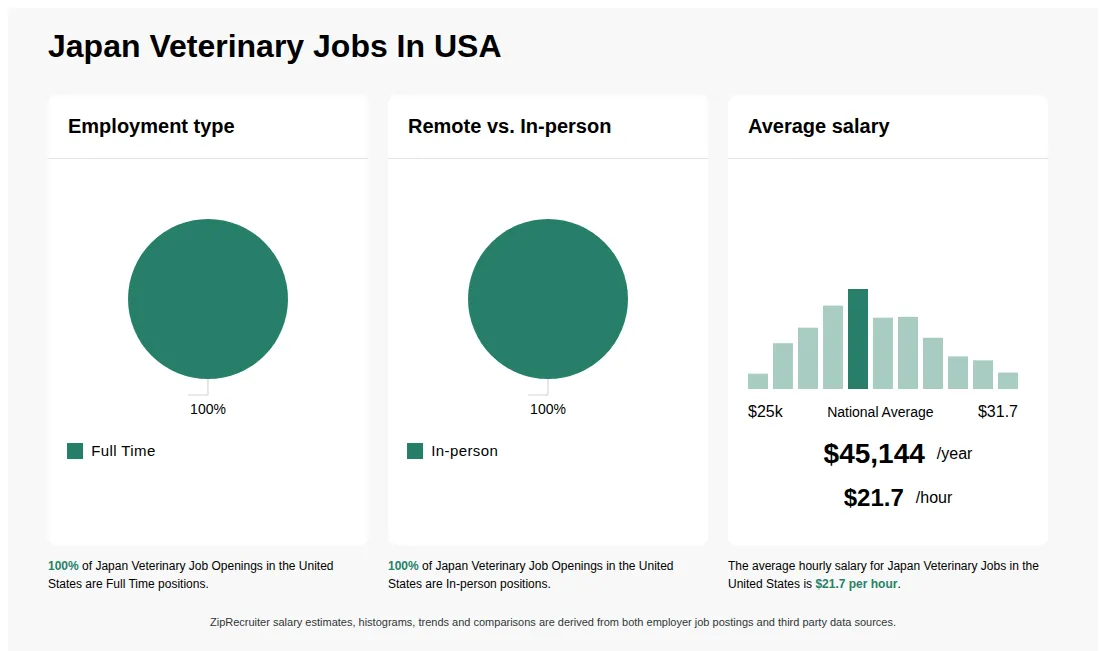
As of Jun 29, 2026, the average hourly pay for japan veterinary in the United States is $21.70, according to ZipRecruiter salary data. Most workers in this role earn between $17.79 and $24.76 per hour, depending on experience, location, and employer.

What is the difference between Japan Veterinary vs Japan Veterinary Technician?

AspectJapan VeterinaryJapan Veterinary Technician
CredentialsVeterinary degree, license to practiceCertified veterinary technician license
Work EnvironmentVeterinary clinics, hospitals, animal sheltersAssist veterinarians in clinics and hospitals
Job RoleDiagnose, treat, perform surgeriesSupport veterinary procedures, patient care
Industry UsageVeterinarians are primary care providersAssistants to veterinarians, technical support

Japan Veterinary professionals are licensed veterinarians responsible for diagnosing and treating animals, while Japan Veterinary Technicians support veterinarians by performing technical tasks and patient care. Both roles are essential in veterinary practice but differ in qualifications and responsibilities.

What are the key skills and qualifications needed to thrive as a veterinarian in Japan, and why are they important?

To thrive as a veterinarian in Japan, you need a veterinary medicine degree and a valid Japanese veterinary license, with strong competencies in animal diagnosis, treatment, and preventive care. Familiarity with veterinary diagnostic tools, laboratory systems, and digital record-keeping software is commonly required. Strong communication, cultural sensitivity, and problem-solving skills are crucial for effectively interacting with clients and collaborating within multidisciplinary teams. These skills ensure high-quality animal care and client trust, which are essential for success in the veterinary field.

How much do vets get paid in Japan?

Veterinarians in Japan typically earn between 4 million and 8 million yen annually, depending on experience, location, and workplace. Entry-level vets may start at lower salaries, while experienced professionals or specialists can earn higher wages, often working in clinics, hospitals, or research institutions.

Are vets in demand?

Veterinarians are in demand in Japan due to increasing pet ownership and a growing awareness of animal health. The profession requires a veterinary license and often involves working in clinics, hospitals, or research facilities, with demand driven by urbanization and pet care trends.

Which country is best for veterinary jobs for foreigners?

Countries with high demand for veterinarians and established licensing processes, such as Canada, Australia, and the United Kingdom, are often considered favorable for foreign veterinary professionals. These countries typically require certification, language proficiency, and sometimes additional training or exams, but offer opportunities in private practices, research, and animal health organizations.

What does a Japan Veterinary do?

A Japan Veterinary, commonly called a veterinarian in Japan, is a medical professional who diagnoses, treats, and helps prevent diseases and injuries in animals. They provide medical care to pets, livestock, and sometimes wildlife, performing surgeries, prescribing medications, and offering advice on animal health and welfare. In Japan, veterinarians may also be involved in public health, food safety, and animal welfare regulations. They often work in private clinics, animal hospitals, zoos, or government agencies. To become a veterinarian in Japan, one must complete veterinary school and pass a national licensing exam.

Can a foreign Veterinarian work in Japan?

Foreign veterinarians can work in Japan if they pass the national licensing exam and meet language proficiency requirements. They may also need to obtain a work visa and have their credentials recognized by Japanese authorities. Licensing standards and certification processes are regulated by the Japanese Veterinary Medical Association.

What are some common challenges veterinarians in Japan face when working with pet owners?

Veterinarians in Japan often encounter challenges related to communication and education when working with pet owners. Many clients may have limited knowledge of animal health, which requires vets to spend extra time explaining diagnoses, treatment plans, and preventive care. Additionally, cultural expectations around pet ownership can influence decisions about treatments and end-of-life care. Building trust and fostering open communication are essential for successful outcomes and client satisfaction.
More about Japan Veterinary jobs
What cities are hiring for Japan Veterinary jobs? Cities with the most Japan Veterinary job openings:
What states have the most Japan Veterinary jobs? States with the most job openings for Japan Veterinary jobs include:
Infographic showing various Japan Veterinary job openings in the United States as of June 2026, with employment types broken down into 100% Full Time. Highlights an 100% In-person job distribution, with an average salary of $45,144 per year, or $21.7 per hour.
Veterinary Technologist I

Veterinary Technologist I

The Jackson Laboratory

Bar Harbor, ME • On-site

$19.93 - $27.40/hr

Full-time

Posted 26 days ago


The Jackson Laboratory rating

8.3

Company rating: 8.3 out of 10

Based on 22 frontline employees who took The Breakroom Quiz

26th of 103 rated laboratories


Job description

The Veterinary Technologist I is responsible for providing veterinary care to sick, injured or otherwise compromised mice and assists the clinical veterinarians to ensure the health and welfare of mice at the Laboratory. This position is additionally responsible for performing entry-level pharmacy duties.

The salary range is $19.93-$27.40. Salary will be determined based on qualifications and experience.

Shift information: Monday through Friday, 7:00am-3:30pm EST. There is some flexibility for a later shift. There is a rotational On Call schedule for outside of normal business hours, weekends, and holidays around every 5 weeks.

Key Responsibilities & Essential Functions:

Veterinary Assessment and Treatment

  • Working with guidance from a CMQ veterinarian or designee, prioritizes assessment of clinical conditions based on type of illness or injury and severity.
  • Performs physical evaluations on sick/ injured or otherwise compromised mice.
  • Accurately identifies common clinical conditions in laboratory mice.
  • Routinely treats sick/injured mice; monitors the animals' response to the prescribed treatment plan
  • Provides ongoing communication with JAX research staff members
  • Maintains accurate and complete medical records.
  • Monitors mice in animal rooms and determines if action is required (e.g. enrollment in the Animal Treatment Program, submission to pathology).
  • Recognizes and reports adverse events and instances of non-compliance.
  • Performs entry level pharmacy duties including but not limited to pharmacy order fulfillment, maintenance of supply inventory, preparation of items for sterilization.

Minimum Qualifications:

  • Knowledge of animal anatomy and physiology as would normally be acquired through a BS or AS degree in Animal Science or related field OR high school diploma and 2 years' experience working with rodents and successful completion of Laboratory Animal Science and Genetics.
  • Must possess the interpersonal skills (verbal and written communication) necessary to interact with people representing a variety of levels of sophistication across the organization.
  • Proficient with a variety of software tools to include word-processing, spreadsheets, and other computer software to record and report activities.
  • Ability to work a flexible work schedule; participate on a rotational on-call roster for after business hours, holidays and weekends; and travel occasionally.
  • Positive team player with ability to multitask in a fast-paced work environment.
  • If the hired candidate is a licensed veterinary technician, they can be hired at the Vet Tech II level.

#CA-DS5

About JAX:

The Jackson Laboratory is an independent, nonprofit biomedical research institution with a National Cancer Institute-designated Cancer Center and nearly 3,000 employees in locations across the United States (Maine, Connecticut, California),Japan andChina. Its mission is to discover precise genomic solutions for disease and empower the global biomedical community in the shared quest to improve human health.

Founded in 1929, JAX applies over nine decades of expertise in genetics to increase understanding of human disease, advancing treatments and cures for cancer, neurological and immune disorders, diabetes, aging and heart disease. It models and interprets genomic complexity, integrates basic research with clinical application, educates current and future scientists, and provides critical data, tools and services to the global biomedical community. For more information, please visitwww.jax.org.

EEO Statement:

The Jackson Laboratory provides equal employment opportunities to all employees and applicants for employment in all job classifications without regard to race, color, religion, age, mental disability, physical disability, medical condition, gender, sexual orientation, genetic information, ancestry, marital status, national origin, veteran status, and other classifications protected by applicable state and local non-discrimination laws.


What The Jackson Laboratory employees say

Pay

Benefits

Hours and flexibility

Workplace

Get the full story on Breakroom