1

Internship Quantum Computing Google Jobs (NOW HIRING)

Quantum architecture internships offer a chance to work in cutting edge research to move quantum computing from a theoretical concept to a real-world technology. As an intern you will work with our ...

next page

Showing results 1-20

Internship Quantum Computing Google information

See salary details

$5

$16

$25

How much do internship quantum computing google jobs pay per hour?

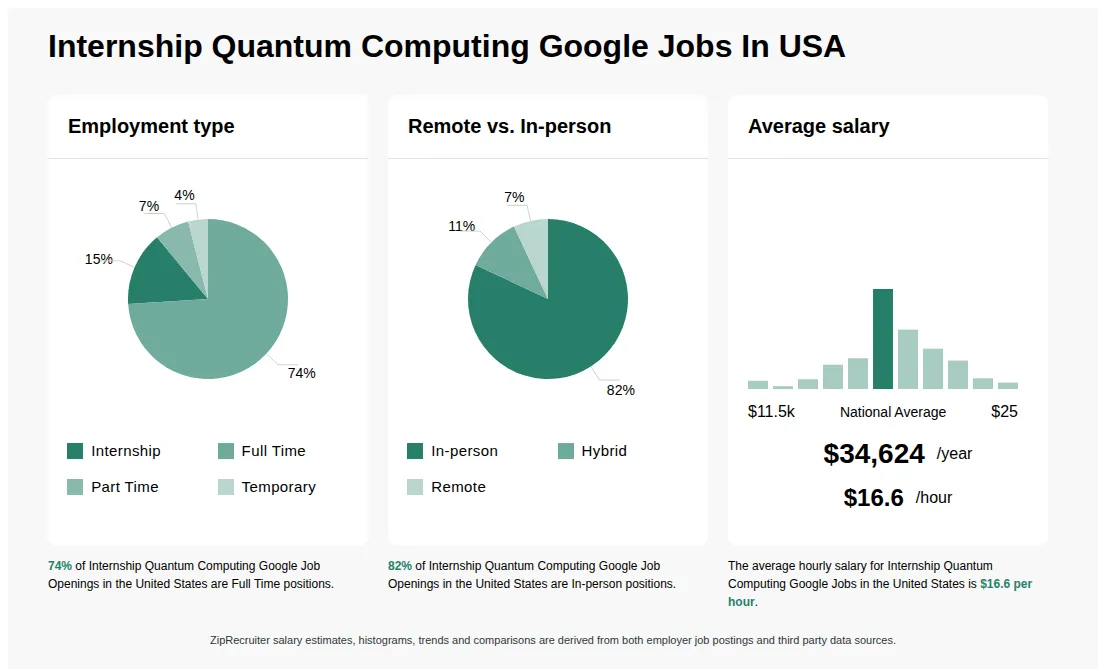
As of Jun 20, 2026, the average hourly pay for internship quantum computing google in the United States is $16.65, according to ZipRecruiter salary data. Most workers in this role earn between $14.42 and $18.51 per hour, depending on experience, location, and employer.

What is an Internship in Quantum Computing at Google?

An Internship in Quantum Computing at Google is a temporary position for students or recent graduates to work on projects related to quantum algorithms, quantum hardware, or quantum software. Interns collaborate with Google's Quantum AI team, gaining hands-on experience with cutting-edge quantum technologies and research. The internship typically lasts for a few months and provides mentorship, access to Google's resources, and opportunities to contribute to real-world quantum computing advancements. Applicants usually need a strong background in physics, computer science, mathematics, or related fields, along with programming experience.

What are the key skills and qualifications needed to thrive as an intern in Quantum Computing at Google, and why are they important?

To thrive as a Quantum Computing intern at Google, you need a strong background in quantum mechanics, computer science, and mathematics, typically evidenced by advanced coursework or research experience. Familiarity with programming languages such as Python and quantum computing frameworks like Cirq or Qiskit is highly valued. Strong problem-solving skills, collaboration, and effective communication are essential soft skills for excelling in team-based research environments. These abilities are crucial for contributing to cutting-edge projects, rapidly learning new concepts, and effectively sharing findings within a multidisciplinary team.

What kinds of projects do interns typically work on during a Quantum Computing internship at Google?

Quantum Computing interns at Google often contribute to cutting-edge research and development projects, such as designing quantum algorithms, optimizing quantum hardware, or building software tools for quantum systems. Interns may collaborate with research scientists, software engineers, and fellow interns in multidisciplinary teams. The work environment is fast-paced and highly collaborative, with opportunities to attend seminars, present findings, and gain hands-on experience with Google's quantum computing platforms. These internships provide valuable exposure to both theoretical and practical aspects of quantum computing, helping interns build strong foundations for future roles in academia or industry.

What is the difference between Internship Quantum Computing Google vs Quantum Software Engineer?

AspectInternship Quantum Computing GoogleQuantum Software Engineer
Required CredentialsUndergraduate or graduate in CS, Physics, or related fields; some coding experienceAdvanced degree (Master's/PhD) in CS, Physics, or related; strong coding and quantum computing skills
Work EnvironmentInternship program at Google, collaborative, research-focusedFull-time role in tech companies or research labs, development and implementation focus
Employer & Industry UsageGoogle's quantum research division, tech industryTech companies, research institutions, startups in quantum computing

Internship Quantum Computing Google offers a temporary, entry-level experience for students interested in quantum tech, focusing on learning and research. Quantum Software Engineers are full-time professionals developing quantum algorithms and software, requiring advanced skills. The internship is ideal for students exploring the field, while the engineer role is for those seeking a career in quantum software development.


More about Internship Quantum Computing Google jobs
What cities are hiring for Internship Quantum Computing Google jobs? Cities with the most Internship Quantum Computing Google job openings:
What are the most commonly searched types of Quantum Computing Google jobs? The most popular types of Quantum Computing Google jobs are:
What states have the most Internship Quantum Computing Google jobs? States with the most job openings for Internship Quantum Computing Google jobs include:
Quantum Calibrations Intern, Quantum Computing Services

Quantum Calibrations Intern, Quantum Computing Services

QuEra Computing, Inc.

Boston, MA

$16.25 - $21.75/hr

Other

Posted 9 hours ago


Job description

Job Title:                Intern, Quantum Calibrations, Quantum Computing Services 
Job Type:                 Full-time, 3-6 months
Job Location:          Boston, MA 
Reports to:            VP of Quantum Computing Services                                                                                                                             

Summary:  

QuEra is seeking motivated interns to join our growing team focused on developing the calibration and performance characterization framework for QuEra's neutral-atom quantum computers. As an intern, you will collaborate with physicists, software engineers, and hardware specialists to design benchmarking protocols, build physics-informed models of device behavior, and develop predictive tools for real-time qubit state evolution.

This internship offers a unique opportunity to gain hands-on experience at the interface of quantum hardware and data science, contributing to the development of calibration and performance characterization frameworks for scalable, reliable neutral-atom quantum computers.

This role is part of QuEra's Quantum Computing Services team and is based at QuEra's Boston headquarters. The team's mission is to develop QuEra's neutral-atom technology into cutting-edge quantum computing products and services.

Core Responsibilities

  • Develop and test data analysis routines to fit, visualize, and interpret experimental data.
  • Design and execute device benchmarking and characterization experiments.
  • Build and apply Hamiltonian learning routines to infer effective system parameters from time-evolution data.
  • Develop predictive models for key performance metrics (gate fidelity, coherence, readout error) using time-series calibration history and machine learning methods.
  • Collaborate closely with physicists, engineers, and software developers to integrate your work into QuEra's operational stack.

Qualifications

Required

  • Foundational understanding of quantum mechanics and open quantum systems at the graduate level.
  • Experience designing and analyzing experiments involving quantum or physical systems
  • Strong programming skills in Python, including familiarity with libraries such as NumPy, SciPy, Pandas, and Matplotlib.
  • Enjoys hands-on experimentation, iteration, and uncovering structure in data.
  • Strong analytical, problem-solving, and communication skills.

Preferred

  • Familiarity with quantum gate characterization protocols (randomized benchmarking, process tomography, GST) and error budget decomposition.
  • Exposure to Hamiltonian learning, system identification, or quantum noise spectroscopy methods.
  • Experience applying machine learning (Gaussian processes, time-series models, or neural networks) to physical or experimental data.
  • Exposure to laboratory instrumentation, data acquisition, or experimental control systems.

Education & Experience

  • Currently pursuing or recently completed a Master's or PhD in Physics, Applied Physics, Computer Science, Electrical Engineering, Applied Mathematics, or a related quantitative field.

QuEra is committed to cultivating a diverse work environment and is proud to be an equal opportunity employer. We highly value diversity in our current and future employees and do not discriminate (including in our hiring and promotion practices) based on race, religion, color, national origin, gender, gender expression, sexual orientation, age, marital status, veteran status, disability status, or any other characteristic protected by law.