
Job Title: Automation Engineer - UiPath RPA Developer Job Code: OH 810238 Client: State of Ohio ... About SR International INC SR International has been a leading name among the IT consulting ...
Job Title: Automation Engineer - UiPath RPA Developer Job Code: OH 810238 Client: State of Ohio ... About SR International INC SR International has been a leading name among the IT consulting ...

Automation Engineer
Berkeley, CA · On-site
$120K - $140K/yr
Hill International is seeking an Automation Engineer in Berkeley, California Hill is seeking an experienced Automation Engineer to support the design, development, and implementation of safety ...
Automation Engineer
Berkeley, CA · On-site
$120K - $140K/yr
Hill International is seeking an Automation Engineer in Berkeley, California Hill is seeking an experienced Automation Engineer to support the design, development, and implementation of safety ...
Automation Engineer
Berkeley, CA · On-site
$120K - $140K/yr
Hill International is seeking an Automation Engineer in Berkeley, California Hill is seeking an experienced Automation Engineer to support the design, development, and implementation of safety ...
Automation Engineer
Berkeley, CA · On-site
$120K - $140K/yr
Hill International is seeking an Automation Engineer in Berkeley, California Hill is seeking an experienced Automation Engineer to support the design, development, and implementation of safety ...

Design Automation Engineer
White Bear Lake, MN · On-site
$43 - $58/hr
Our engineering and automation solutions support a wide range of product lines across all our international entities, ensuring consistent quality, innovation, and efficiency throughout our global ...
Design Automation Engineer
White Bear Lake, MN · On-site
$43 - $58/hr
Our engineering and automation solutions support a wide range of product lines across all our international entities, ensuring consistent quality, innovation, and efficiency throughout our global ...

Automation Engineer
Cuyahoga Falls, OH · On-site
Job Title: Automation Engineer Job Location: Cuyahoga Falls, OH Job Type: Full Time Engineering ... international) Customer Support: * Provide on-site field service and customer training * Offer ...
Quick apply
Automation Engineer
Cuyahoga Falls, OH · On-site
Job Title: Automation Engineer Job Location: Cuyahoga Falls, OH Job Type: Full Time Engineering ... international) Customer Support: * Provide on-site field service and customer training * Offer ...
Design Automation Engineer
$43 - $58/hr
Our engineering and automation solutions support a wide range of product lines across all our international entities, ensuring consistent quality, innovation, and efficiency throughout our global ...
Quick apply
Design Automation Engineer
$43 - $58/hr
Our engineering and automation solutions support a wide range of product lines across all our international entities, ensuring consistent quality, innovation, and efficiency throughout our global ...

Automation Engineer
$115K - $165K/yr
HiFyve is hiring an Automation Engineer for an Industrial Manufacturing Equipment Company! Salary ... Kansas City Metro / North America with occasional international travel (Germany/Europe) 10-30 ...
Quick apply
Automation Engineer
$115K - $165K/yr
HiFyve is hiring an Automation Engineer for an Industrial Manufacturing Equipment Company! Salary ... Kansas City Metro / North America with occasional international travel (Germany/Europe) 10-30 ...
Automation Engineer
Kansas City, MO · On-site
$115K - $165K/yr
HiFyve is hiring an Automation Engineer for an Industrial Manufacturing Equipment Company! Salary ... Kansas City Metro / North America with occasional international travel (Germany/Europe) 10-30 ...
Automation Engineer
Kansas City, MO · On-site
$115K - $165K/yr
HiFyve is hiring an Automation Engineer for an Industrial Manufacturing Equipment Company! Salary ... Kansas City Metro / North America with occasional international travel (Germany/Europe) 10-30 ...

Automation Engineer
$95K - $115K/yr
Automation Engineer We are seeking a skilled Automation Engineer to plan, commission, and ... Support occasional international travel (approximately 10-15%) for supplier audits, equipment ...
Quick apply
Automation Engineer
$95K - $115K/yr
Automation Engineer We are seeking a skilled Automation Engineer to plan, commission, and ... Support occasional international travel (approximately 10-15%) for supplier audits, equipment ...
Automation Engineer
Sugar Land, TX · On-site
$95K - $115K/yr
Automation Engineer We are seeking a skilled Automation Engineer to plan, commission, and ... Support occasional international travel (approximately 10-15%) for supplier audits, equipment ...
Quick apply
Automation Engineer
Sugar Land, TX · On-site
$95K - $115K/yr
Automation Engineer We are seeking a skilled Automation Engineer to plan, commission, and ... Support occasional international travel (approximately 10-15%) for supplier audits, equipment ...
Automation Engineer Autoliv's primary goal is to Save More Lives. Our products never get a second ... In our international work setting, you will find a range of opportunities that are designed to ...
Quick apply
Automation Engineer Autoliv's primary goal is to Save More Lives. Our products never get a second ... In our international work setting, you will find a range of opportunities that are designed to ...

Automation Engineer
$107K - $130K/yr
As a leading international supplier of steel products and solutions, principally focused on the ... Automation Engineer Spokane, Kalama or Tacoma, WA We are unable to sponsor or takeover sponsorship ...
Automation Engineer
$107K - $130K/yr
As a leading international supplier of steel products and solutions, principally focused on the ... Automation Engineer Spokane, Kalama or Tacoma, WA We are unable to sponsor or takeover sponsorship ...
Automation Engineer
Columbus, OH · Remote
Automation Engineer - UiPath RPA Developer Job Code: OH 810238 Client: State of Ohio - JFS Location: Columbus, Ohio Work Arrangement: Remote - Ohio candidates preferred/local candidates highly ...
Quick apply
Automation Engineer
Columbus, OH · Remote
Automation Engineer - UiPath RPA Developer Job Code: OH 810238 Client: State of Ohio - JFS Location: Columbus, Ohio Work Arrangement: Remote - Ohio candidates preferred/local candidates highly ...

Automation Engineer
Fort George G Meade, MD · On-site
$125 - $150/hr
As an automation engineer at Booz Allen, you can use your technical skills to affect ... international law. #J-18808-Ljbffr
Automation Engineer
Fort George G Meade, MD · On-site
$125 - $150/hr
As an automation engineer at Booz Allen, you can use your technical skills to affect ... international law. #J-18808-Ljbffr

Automation Engineer
Sugar Land, TX · On-site
Summary We are seeking an Automation Engineer to support the implementation, commissioning ... Expect 5% to 10% international travel for automation supplier visits, equipment qualification, or ...
Automation Engineer
Sugar Land, TX · On-site
Summary We are seeking an Automation Engineer to support the implementation, commissioning ... Expect 5% to 10% international travel for automation supplier visits, equipment qualification, or ...
Summary We are seeking an Automation Engineer to support the implementation, commissioning ... Expect 5% to 10% international travel for automation supplier visits, equipment qualification, or ...
Quick apply
Summary We are seeking an Automation Engineer to support the implementation, commissioning ... Expect 5% to 10% international travel for automation supplier visits, equipment qualification, or ...

Automation Engineer
Tacoma, WA · On-site
$100 - $125/hr
As a leading international supplier of steel products and solutions, principally focused on the ... Automation Engineer****Spokane, Kalama or Tacoma, WA****We are unable to sponsor or takeover ...
Automation Engineer
Tacoma, WA · On-site
$100 - $125/hr
As a leading international supplier of steel products and solutions, principally focused on the ... Automation Engineer****Spokane, Kalama or Tacoma, WA****We are unable to sponsor or takeover ...
Automation Engineer
Tremonton, UT · On-site
Automation Engineer Autoliv's primary goal is to Save More Lives. Our products never get a second ... In our international work setting, you will find a range of opportunities that are designed to ...
Automation Engineer
Tremonton, UT · On-site
Automation Engineer Autoliv's primary goal is to Save More Lives. Our products never get a second ... In our international work setting, you will find a range of opportunities that are designed to ...
Automation Engineer
Sugar Land, TX · On-site
Summary We are seeking an Automation Engineer to support the implementation, commissioning ... Expect 5% to 10% international travel for automation supplier visits, equipment qualification, or ...
Automation Engineer
Sugar Land, TX · On-site
Summary We are seeking an Automation Engineer to support the implementation, commissioning ... Expect 5% to 10% international travel for automation supplier visits, equipment qualification, or ...
Automation Engineer
Tremonton, UT · On-site
Automation Engineer Autoliv's primary goal is to Save More Lives. Our products never get a second ... In our international work setting, you will find a range of opportunities that are designed to ...
Automation Engineer
Tremonton, UT · On-site
Automation Engineer Autoliv's primary goal is to Save More Lives. Our products never get a second ... In our international work setting, you will find a range of opportunities that are designed to ...
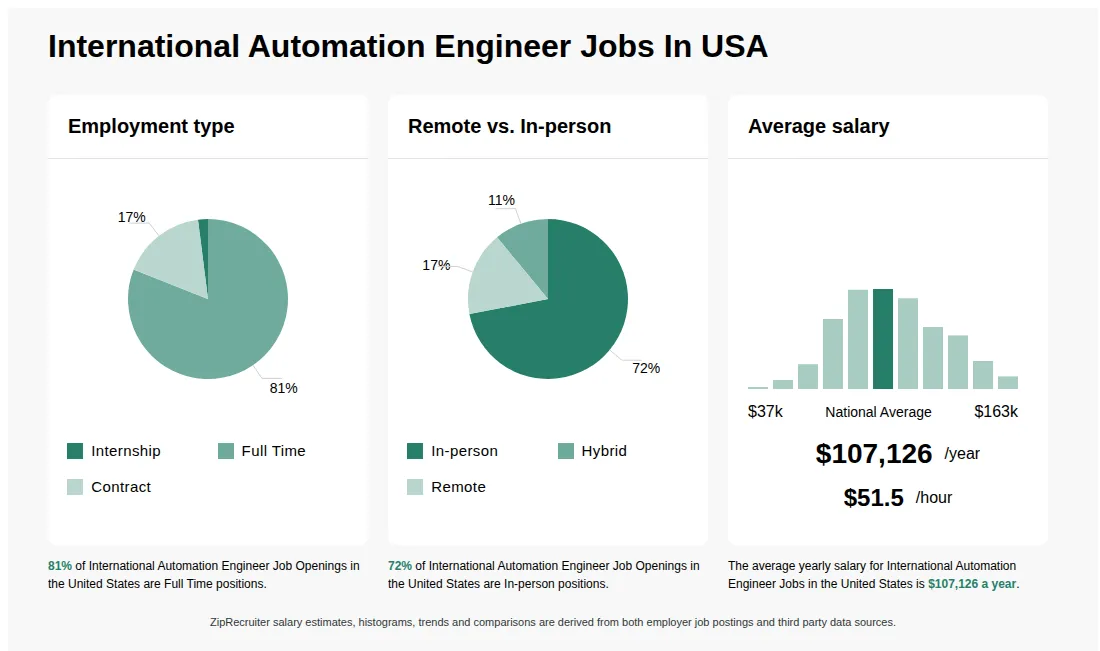
International Automation Engineer information
See salary details
$37K - $48.5K
0% of jobs
$48.5K - $59.9K
1% of jobs
$59.9K - $71.4K
4% of jobs
$71.4K - $82.8K
13% of jobs
$87.4K is the 25th percentile. Wages below this are outliers.
$82.8K - $94.3K
18% of jobs
The median wage is $102.9K / yr.
$94.3K - $105.7K
19% of jobs
$105.7K - $117.2K
17% of jobs
$120.6K is the 75th percentile. Wages above this are outliers.
$117.2K - $128.6K
12% of jobs
$128.6K - $140.1K
9% of jobs
$140.1K - $151.5K
5% of jobs
$151.5K - $163K
2% of jobs
$37K
$107.1K
$163K
How much do international automation engineer jobs pay per year?
As of Sep 8, 2026, the average yearly pay for international automation engineer in the United States is $107,126.00, according to ZipRecruiter salary data. Most workers in this role earn between $86,500.00 and $123,500.00 per year, depending on experience, location, and employer.
What does an international automation engineer do?
An International Automation Engineer designs, implements, and maintains automated systems for manufacturing or business processes across multiple countries. They ensure that automation technologies comply with global standards, improve efficiency, and integrate seamlessly with existing systems. This role often involves travel, cross-cultural collaboration, and adapting solutions to regional regulations and operational requirements. Strong problem-solving skills, knowledge of control systems, and expertise in robotics or industrial automation are essential.
What are the key skills and qualifications needed to thrive as an international automation engineer?
To thrive as an International Automation Engineer, you need a solid background in electrical, mechanical, or control engineering, often supported by a relevant degree and experience with automation projects. Familiarity with PLCs, SCADA systems, robotics, and certifications like Certified Automation Professional (CAP) or similar are typically expected. Excellent problem-solving skills, cross-cultural communication, and adaptability are crucial soft skills for success in diverse international environments. These competencies are vital to effectively design, implement, and support automation solutions across different countries and organizational contexts.
What are the typical work environments and travel requirements for an international automation engineer?
International Automation Engineers often split their time between office-based project planning, on-site equipment installation, and remote troubleshooting for global clients. Regular international travel is common, especially for commissioning new systems or supporting local teams during project rollouts. Collaboration with cross-functional teams, including engineers, project managers, and local technical staff, is a key aspect of the job. Flexibility and a willingness to adapt to various cultural and regulatory environments help ensure project success and client satisfaction.
More about International Automation Engineer jobs
What are the most commonly searched types of International Automation Engineer jobs?
The most popular types of International Automation Engineer jobs are:
What job categories do people searching International Automation Engineer jobs look for?
The top searched job categories for International Automation Engineer jobs are:
Job description
Job Title: Automation Engineer - UiPath RPA Developer
Job Code: OH 810238
Client: State of Ohio - JFS
Location: Columbus, Ohio
Work Arrangement: Remote - Ohio candidates preferred/local candidates highly preferred
Duration: Until 06/30/2027
Closing Date: 09/01/2026 at 4:00 PM
Position Overview
The State of Ohio is seeking an experienced Automation Engineer / UiPath RPA Developer to design, develop, test, deploy, and optimize Robotic Process Automation (RPA) solutions using the UiPath Platform.
The role will work closely with business and IT stakeholders to identify automation opportunities and deliver secure, scalable, and high-performing solutions. The position will also develop and maintain SharePoint Online solutions using Microsoft Power Platform.
Key Responsibilities
Required Skills
Preferred Skills
Education
Bachelor's degree in Computer Science, Information Systems, or a related discipline, or equivalent combination of education and experience. Master's degree preferred.
Primary Skills
UiPath | RPA | RPA Development | RPA Solution Architecture | UiPath Orchestrator | UiPath Studio | Automation Hub | UiPath Insights | Microsoft Power Platform | SharePoint Online | SQL | OCR/ICR | AI | Machine Learning | NLP | Chatbots | REST APIs | SOAP APIs | Agile | Lean | SDLC
Screening Question
Do you have 6+ years of hands-on experience developing and implementing RPA solutions using UiPath, including 2+ years as an RPA Solution Architect and 3+ years developing SharePoint Online solutions using Microsoft Power Platform? Please provide your years of experience and confirm your current location (City, State)
Additional Requirements
This is a remote position.
About SR International INC
SR International has been a leading name among the IT consulting companies with offices in US and India. For past 16 years, our industry experience and domain knowledge have enabled us to provide innovative solutions to our customers.
Who We Are
We Are Leading IT Based Solution Providers
Today, the world of business information represents the realization of our collective efforts toward improving the future. Held only by the limits of our imagination, the business world is accelerating at an ever-increasing pace. Imagine a better way of doing business, of implementing the perfect software, of refining practice or business integration. All it takes are benchmark standards in service, support, and technical know-how, which have been our bread and butter.
Our Vision
Established in 2002, SR International Inc is one of the fastest growing and reputed provider of Information Technology Services and Solutions in the USA. Since our inception, we have been a trusted IT partner for our clients. We take pride in our highly skilled IT Resources and unique engagement model. We have been consistently delivering on our promises as a high-performance team. Our expertise in Cloud Computing, Mobility, Web Technologies, ERP and CRM are second to none. Our industry-leading flagship product iMathSmart is re-defining math learning experience for school students.
Career At SR International
At SR International, we treat our consultants like family. Our business and our reputation have been built and maintained by quality resources working onboard, so it's important for us to maintain the quality resource pool.
Job Code: OH 810238
Client: State of Ohio - JFS
Location: Columbus, Ohio
Work Arrangement: Remote - Ohio candidates preferred/local candidates highly preferred
Duration: Until 06/30/2027
Closing Date: 09/01/2026 at 4:00 PM
Position Overview
The State of Ohio is seeking an experienced Automation Engineer / UiPath RPA Developer to design, develop, test, deploy, and optimize Robotic Process Automation (RPA) solutions using the UiPath Platform.
The role will work closely with business and IT stakeholders to identify automation opportunities and deliver secure, scalable, and high-performing solutions. The position will also develop and maintain SharePoint Online solutions using Microsoft Power Platform.
Key Responsibilities
- Design, build, test, and deploy end-to-end RPA workflows using UiPath.
- Analyze business processes and translate requirements into technical specifications and automation logic.
- Build reusable automation components and advanced RPA solutions.
- Develop and optimize SQL queries supporting automation and data operations.
- Debug workflows, perform root-cause analysis, break-fix activities, and continuous improvements.
- Maintain RPA bots, dashboards, integrations, and automation solutions.
- Develop and maintain SharePoint Online solutions using Microsoft Power Platform.
- Collaborate with business, IT, process owners, platform owners, and cross-functional teams.
- Apply Agile and Lean methodologies to manage backlogs and deliver iterative improvements.
- Establish standards for automation development, documentation, coding, value measurement, and governance.
- Communicate project risks, issues, timelines, and mitigation strategies.
- Develop technical designs and specifications while following SDLC practices.
Required Skills
- 6+ years of hands-on experience architecting, designing, developing, and implementing RPA solutions using UiPath.
- 2+ years of experience as an RPA Solution Architect.
- 3+ years of experience developing and maintaining SharePoint Online solutions using Microsoft Power Platform.
- 8+ years of software application development and implementation experience.
- Extensive experience with UiPath Automation Hub, Orchestrator, Studio Web, and Insights.
- Strong UiPath workflow development and debugging experience.
- Experience with OCR data extraction.
- Strong understanding of programming, software design, and coding practices.
- Knowledge of REST and SOAP APIs.
- Strong analytical, research, problem-solving, and communication skills.
Preferred Skills
- Experience with AI technologies, including:
- OCR/ICR
-
- Chatbots
-
- Machine Learning (ML)
-
- Natural Language Processing (NLP)
- UiPath Automation Developer Professional (ADP) certification.
- UiPath Automation Solution Architect Professional (ASAP) certification.
- UiPath Agentic Automation Professional certification.
- Master's degree in a related field.
Education
Bachelor's degree in Computer Science, Information Systems, or a related discipline, or equivalent combination of education and experience. Master's degree preferred.
Primary Skills
UiPath | RPA | RPA Development | RPA Solution Architecture | UiPath Orchestrator | UiPath Studio | Automation Hub | UiPath Insights | Microsoft Power Platform | SharePoint Online | SQL | OCR/ICR | AI | Machine Learning | NLP | Chatbots | REST APIs | SOAP APIs | Agile | Lean | SDLC
Screening Question
Do you have 6+ years of hands-on experience developing and implementing RPA solutions using UiPath, including 2+ years as an RPA Solution Architect and 3+ years developing SharePoint Online solutions using Microsoft Power Platform? Please provide your years of experience and confirm your current location (City, State)
Additional Requirements
- Candidate must agree to fingerprint background checks.
- Government equipment must not be taken or used outside the United States.
This is a remote position.
About SR International INC
SR International has been a leading name among the IT consulting companies with offices in US and India. For past 16 years, our industry experience and domain knowledge have enabled us to provide innovative solutions to our customers.
Who We Are
We Are Leading IT Based Solution Providers
Today, the world of business information represents the realization of our collective efforts toward improving the future. Held only by the limits of our imagination, the business world is accelerating at an ever-increasing pace. Imagine a better way of doing business, of implementing the perfect software, of refining practice or business integration. All it takes are benchmark standards in service, support, and technical know-how, which have been our bread and butter.
Our Vision
Established in 2002, SR International Inc is one of the fastest growing and reputed provider of Information Technology Services and Solutions in the USA. Since our inception, we have been a trusted IT partner for our clients. We take pride in our highly skilled IT Resources and unique engagement model. We have been consistently delivering on our promises as a high-performance team. Our expertise in Cloud Computing, Mobility, Web Technologies, ERP and CRM are second to none. Our industry-leading flagship product iMathSmart is re-defining math learning experience for school students.
Career At SR International
At SR International, we treat our consultants like family. Our business and our reputation have been built and maintained by quality resources working onboard, so it's important for us to maintain the quality resource pool.

About SR International Incorporation
Sourced by ZipRecruiter
Industry
It services
Company size
11 - 50 Employees
Headquarters location
Naperville, IL, US
Year founded
2002