GT Biosciences is seeking a detail-oriented Contract In Vivo Research Associate / Scientist to support studies in mouse models. Key responsibilities include performing intravenous (IV; tail vein ...
Quick apply
GT Biosciences is seeking a detail-oriented Contract In Vivo Research Associate / Scientist to support studies in mouse models. Key responsibilities include performing intravenous (IV; tail vein ...
Quick apply
GT Biosciences is seeking a detail-oriented Contract In Vivo Research Associate / Scientist to support studies in mouse models. Key responsibilities include performing intravenous (IV; tail vein ...
La Jolla, CA · On-site
$25 - $35/hr
Preclinical Veterinary Research Associate I, II, or III Department: Ophthalmology Hourly Range: $25 ... This role offers hands-on experience supporting in vivo ophthalmic studies involving rodents ...
La Jolla, CA · On-site
$25 - $35/hr
Preclinical Veterinary Research Associate I, II, or III Department: Ophthalmology Hourly Range: $25 ... This role offers hands-on experience supporting in vivo ophthalmic studies involving rodents ...
The Research Associate (RA) at Crown Bioscience North Carolina will support the execution of in vivo research studies, contributing to the advancement of oncology and pharmacology research. The RA ...
The Research Associate (RA) at Crown Bioscience North Carolina will support the execution of in vivo research studies, contributing to the advancement of oncology and pharmacology research. The RA ...
San Diego, CA · On-site
$26 - $28/hr
... Associate's or Bachelor's degree in Biology, Animal Science, or related field preferred Required: Strong interest in in vivo animal research Willingness to work hands-on with laboratory animals ...
San Diego, CA · On-site
$26 - $28/hr
... Associate's or Bachelor's degree in Biology, Animal Science, or related field preferred Required: Strong interest in in vivo animal research Willingness to work hands-on with laboratory animals ...
La Jolla, CA · On-site
$25 - $35/hr
Preclinical Veterinary Research Associate I, II, or III Department: Ophthalmology Hourly Range: $25 ... This role offers hands-on experience supporting in vivo ophthalmic studies involving rodents ...
La Jolla, CA · On-site
$25 - $35/hr
Preclinical Veterinary Research Associate I, II, or III Department: Ophthalmology Hourly Range: $25 ... This role offers hands-on experience supporting in vivo ophthalmic studies involving rodents ...
The Research Associate (RA) at Crown Bioscience North Carolina will support the execution of in vivo research studies, contributing to the advancement of oncology and pharmacology research. The RA ...
The Research Associate (RA) at Crown Bioscience North Carolina will support the execution of in vivo research studies, contributing to the advancement of oncology and pharmacology research. The RA ...
Portland, OR · On-site
Function/Duties of Position The Research Associate will independently lead research projects ... Experience with in vivo tumor models and/or pharmacokinetic/pharmacodynamic studies. * Experience ...
Portland, OR · On-site
Function/Duties of Position The Research Associate will independently lead research projects ... Experience with in vivo tumor models and/or pharmacokinetic/pharmacodynamic studies. * Experience ...
Senior / Principal Research Associate, In Vivo Studies Location: Boston, MA Reports to: Scientist II Job Type: Full time, Onsite About Us We are an innovative, stealth-mode biotech focused on ...
Senior / Principal Research Associate, In Vivo Studies Location: Boston, MA Reports to: Scientist II Job Type: Full time, Onsite About Us We are an innovative, stealth-mode biotech focused on ...
Job Summary The In Vivo Studies team is hiring a Senior / Principal Research Associate to support the planning, execution, and analysis of in vivo pharmacology and biodistribution studies that ...
Quick apply
Job Summary The In Vivo Studies team is hiring a Senior / Principal Research Associate to support the planning, execution, and analysis of in vivo pharmacology and biodistribution studies that ...
Cambridge, MA · On-site
$90K - $120K/yr
Senior / Principal Research Associate, In Vivo Studies Location: Boston, MA Reports to: Scientist II Job Type: Full time, Onsite About Us We are an innovative, stealth-mode biotech focused on ...
Cambridge, MA · On-site
$90K - $120K/yr
Senior / Principal Research Associate, In Vivo Studies Location: Boston, MA Reports to: Scientist II Job Type: Full time, Onsite About Us We are an innovative, stealth-mode biotech focused on ...
Portland, OR · On-site
Function/Duties of Position The Research Associate will independently lead research projects ... Experience with in vivo tumor models and/or pharmacokinetic/pharmacodynamic studies. * Experience ...
Portland, OR · On-site
Function/Duties of Position The Research Associate will independently lead research projects ... Experience with in vivo tumor models and/or pharmacokinetic/pharmacodynamic studies. * Experience ...
Portland, OR · On-site
Function/Duties of Position The Research Associate will independently lead research projects ... Experience with in vivo tumor models and/or pharmacokinetic/pharmacodynamic studies. * Experience ...
Portland, OR · On-site
Function/Duties of Position The Research Associate will independently lead research projects ... Experience with in vivo tumor models and/or pharmacokinetic/pharmacodynamic studies. * Experience ...
We are looking for Research Associate (RA-I or RA-II) with an innovative mindset, great attention ... to supporting in vivo dosing studies and related research activities within the in vivo ...
We are looking for Research Associate (RA-I or RA-II) with an innovative mindset, great attention ... to supporting in vivo dosing studies and related research activities within the in vivo ...
As a Senior Research Associate, In Vivo Pharmacology, you'll help advance next-generation cell therapies through hands-on research, innovative animal studies, and cutting-edge immunology. Join a team ...
As a Senior Research Associate, In Vivo Pharmacology, you'll help advance next-generation cell therapies through hands-on research, innovative animal studies, and cutting-edge immunology. Join a team ...
As a Senior Research Associate, In Vivo Pharmacology, you'll help advance next-generation cell therapies through hands-on research, innovative animal studies, and cutting-edge immunology. Join a team ...
As a Senior Research Associate, In Vivo Pharmacology, you'll help advance next-generation cell therapies through hands-on research, innovative animal studies, and cutting-edge immunology. Join a team ...
San Diego, CA · On-site
$75K - $85K/yr
We are seeking a motivated and organized Senior Research Associate who aspires to make a meaningful ... The successful candidate will play a key role in the design and execution of in vivo studies and ...
Quick apply
San Diego, CA · On-site
$75K - $85K/yr
We are seeking a motivated and organized Senior Research Associate who aspires to make a meaningful ... The successful candidate will play a key role in the design and execution of in vivo studies and ...
We are looking for Research Associate (RA-I or RA-II) with an innovative mindset, great attention ... to supporting in vivo dosing studies and related research activities within the in vivo ...
We are looking for Research Associate (RA-I or RA-II) with an innovative mindset, great attention ... to supporting in vivo dosing studies and related research activities within the in vivo ...
We are looking for Research Associate (RA-I or RA-II) with an innovative mindset, great attention ... to supporting in vivo dosing studies and related research activities within the in vivo ...
Quick apply
We are looking for Research Associate (RA-I or RA-II) with an innovative mindset, great attention ... to supporting in vivo dosing studies and related research activities within the in vivo ...
As a Senior Research Associate, In Vivo Pharmacology, you'll help advance next-generation cell therapies through hands-on research, innovative animal studies, and cutting-edge immunology. Join a team ...
As a Senior Research Associate, In Vivo Pharmacology, you'll help advance next-generation cell therapies through hands-on research, innovative animal studies, and cutting-edge immunology. Join a team ...
... microbiologists, and in vivo research groups, to integrate findings into broader research ... Fellow/Associate. Preferred Qualifications * Doctoral or Masters degree. * Two years of post ...
... microbiologists, and in vivo research groups, to integrate findings into broader research ... Fellow/Associate. Preferred Qualifications * Doctoral or Masters degree. * Two years of post ...
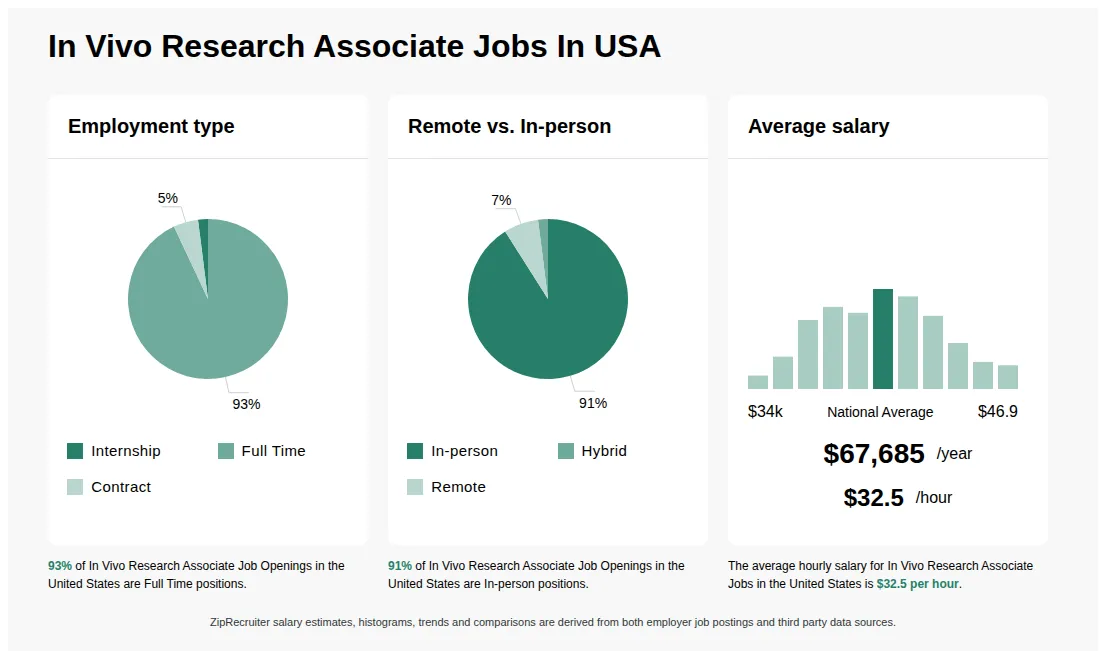
$16.35 - $19.12
2% of jobs
$19.12 - $21.90
5% of jobs
$21.90 - $24.67
11% of jobs
$26.18 is the 25th percentile. Wages below this are outliers.
$24.67 - $27.45
13% of jobs
$27.45 - $30.22
12% of jobs
The median wage is $31.52 / hr.
$30.22 - $33
16% of jobs
$33 - $35.77
15% of jobs
$36.15 is the 75th percentile. Wages above this are outliers.
$35.77 - $38.55
12% of jobs
$38.55 - $41.32
7% of jobs
$41.32 - $44.10
4% of jobs
$44.10 - $46.88
3% of jobs
$16
$32
$46
Contractor
Posted 22 days ago
GT Biosciences is seeking a detail-oriented Contract In Vivo Research Associate / Scientist to support studies in mouse models. Key responsibilities include performing intravenous (IV; tail vein), intraperitoneal (IP), subcutaneous Injection (SC/Subq) dosing procedures; animal handling and monitoring; blood and tissue collection; organ harvesting; and tissue processing (slicing) for downstream analyses. The ideal candidate will have demonstrated expertise in rodent in vivo techniques and experience preparing and sectioning tissues for histological, molecular, or cellular characterization.
This is a contract, onsite position based in the Cambridge, MA area and will involve work at local vivarium and CRO facilities, including Charles River Laboratories.
Time commitment: Approximately 5–10 hours per week, with scheduling dependent on study timelines and animal facility availability. Work may be clustered around dosing days, study endpoints, and tissue collection windows.
Independently perform rodent dosing procedures, including intravenous (tail vein), intraperitoneal, subcutaneous, and other routes of administration in accordance with study protocols.
Support the execution of preclinical studies in mouse and rat models while ensuring compliance with approved IACUC protocols and institutional animal care guidelines.
Perform animal handling, restraint, clinical observations, body weight measurements, and general study support activities.
Perform transcardial perfusions and tissue fixation procedures to support histology, immunohistochemistry, and other downstream tissue-based assays.
Conduct blood collection procedures using appropriate techniques, including terminal and non-terminal sampling methods.
Harvest and collect tissues at designated study endpoints, including brain, spleen, liver, lung, kidney, bone marrow, lymph nodes, tumors, and other organs as required.
Process tissues for downstream analyses, including weighing, dissection, sectioning, dissociation, fixation, cryopreservation, embedding, and histological preparation.
Prepare tissue samples for flow cytometry, molecular biology, histopathology, immunohistochemistry, and other analytical assays.
Maintain accurate and organized experimental records, study documentation, and data entry in accordance with company standards and regulatory requirements.
Coordinate closely with scientists and external animal research facilities to ensure timely and successful study execution.
Communicate study progress, technical observations, and potential issues proactively to project teams.
BS or MS degree in Biology, Animal Science, Biomedical Sciences, Pharmacology, Immunology, or a related scientific discipline.
Demonstrated proficiency performing mouse intravenous (tail vein) injections independently and reproducibly.
Hands-on experience with intraperitoneal, subcutaneous, and other rodent dosing techniques.
Experience with rodent handling, restraint, monitoring, and general in vivo study procedures.
Experience performing tissue and organ collection, necropsy, and tissue processing.
Strong organizational skills, attention to detail, and commitment to high-quality experimental execution.
Experience performing transcardial perfusions and tissue fixation procedures for tissue preservation and downstream histological or molecular analyses.
Ability to independently plan and execute assigned study activities with minimal supervision.
Excellent communication and interpersonal skills, with the ability to work effectively across internal and external teams.
Ability to travel locally to animal research facilities in the Greater Boston/Cambridge area as needed.
Two or more years of industry, CRO, academic, or biotechnology experience supporting in vivo pharmacology, translational research, or drug development programs.
Experience with blood collection techniques, including submandibular, saphenous, tail vein, and terminal cardiac puncture.
Experience preparing tissues for flow cytometry, histology, immunohistochemistry, molecular biology, or related downstream analyses.
Familiarity with oncology, immunology, cell therapy, gene therapy, biologics, or other advanced therapeutic modalities.
Experience working at external animal research facilities, including Charles River Laboratories or similar institutions.
Experience with rat studies and additional dosing or surgical procedures.
Experience with tissue sectioning, cryosectioning, microtomy, or histological sample preparation.
Experience performing brain dissections and isolating discrete neuroanatomical regions (e.g., cortex, hippocampus, cerebellum, striatum, brainstem, and olfactory bulb) for downstream molecular, cellular, or histological analyses.
Familiarity with tissue processing workflows, including preparation of fresh, frozen, and fixed brain specimens.