1

Geospatial Data Scientist Jobs (NOW HIRING)

This position will report to the Head of Data Science and Geospatial Analytics. The ideal candidate is a practitioner who thinks first like an economist, real estate analyst, or quantitative urban ...

This position will report to the Head of Data Science and Geospatial Analytics. The ideal candidate is a practitioner who thinks first like an economist, real estate analyst, or quantitative urban ...

This position will report to the Head of Data Science and Geospatial Analytics. The ideal candidate is a practitioner who thinks first like an economist, real estate analyst, or quantitative urban ...

This position will report to the Head of Data Science and Geospatial Analytics. The ideal candidate is a practitioner who thinks first like an economist, real estate analyst, or quantitative urban ...

This position will report to the Head of Data Science and Geospatial Analytics. The ideal candidate is a practitioner who thinks first like an economist, real estate analyst, or quantitative urban ...

This position will report to the Head of Data Science and Geospatial Analytics. The ideal candidate is a practitioner who thinks first like an economist, real estate analyst, or quantitative urban ...

This position will report to the Head of Data Science and Geospatial Analytics. The ideal candidate is a practitioner who thinks first like an economist, real estate analyst, or quantitative urban ...

This position will report to the Head of Data Science and Geospatial Analytics. The ideal candidate is a practitioner who thinks first like an economist, real estate analyst, or quantitative urban ...

This position will report to the Head of Data Science and Geospatial Analytics. The ideal candidate is a practitioner who thinks first like an economist, real estate analyst, or quantitative urban ...

This position will report to the Head of Data Science and Geospatial Analytics. The ideal candidate is a practitioner who thinks first like an economist, real estate analyst, or quantitative urban ...

This position will report to the Head of Data Science and Geospatial Analytics. The ideal candidate is a practitioner who thinks first like an economist, real estate analyst, or quantitative urban ...

next page

Showing results 1-20

Geospatial Data Scientist information

See salary details

$37.5K

$122.7K

$196.5K

How much do geospatial data scientist jobs pay per year?

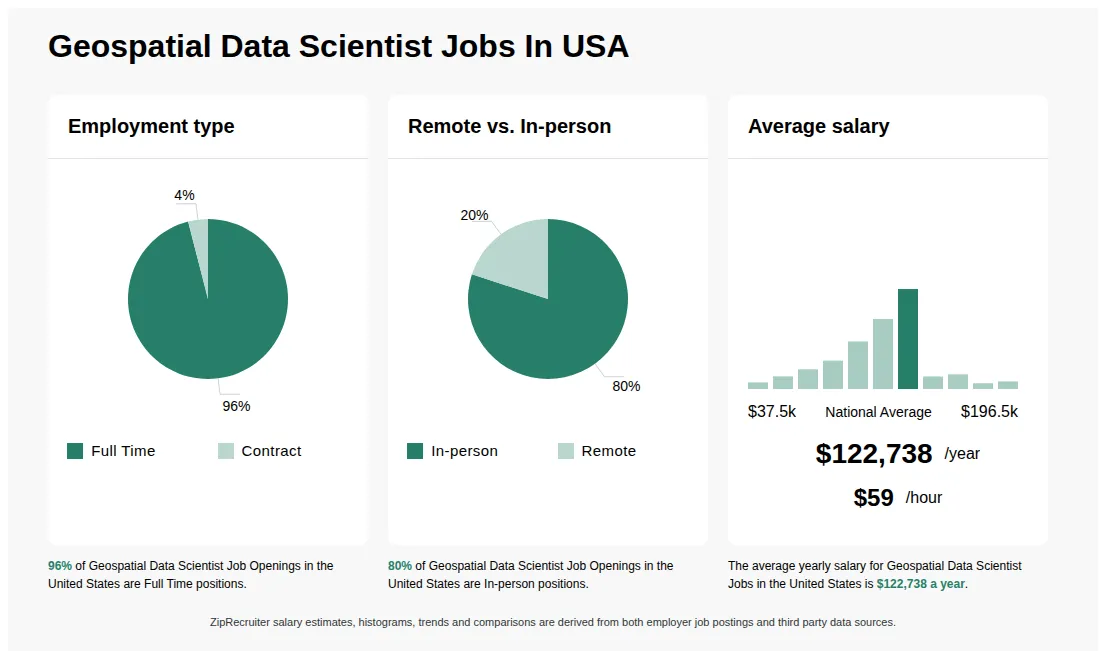
As of Jul 12, 2026, the average yearly pay for geospatial data scientist in the United States is $122,738.00, according to ZipRecruiter salary data. Most workers in this role earn between $98,500.00 and $136,000.00 per year, depending on experience, location, and employer.

Is 40 too late for data science?

A geospatial data scientist can start or transition into the field at age 40, as data science values skills, experience, and continuous learning over age. Many professionals successfully switch careers or advance in data science later in life by acquiring relevant skills such as programming, statistics, and GIS tools, and obtaining certifications if needed.

What are the typical daily tasks of a Geospatial Data Scientist?

As a Geospatial Data Scientist, your daily tasks often involve collecting, cleaning, and analyzing spatial datasets using GIS tools and programming languages. You may be responsible for developing spatial models, visualizing geographic data through interactive maps, and generating reports to help guide strategic decisions. Collaboration with professionals from engineering, urban planning, or environmental science teams is common, requiring you to communicate complex analyses in a clear and actionable manner. Additionally, you might participate in project meetings to align your work with organizational goals and stakeholder needs. This dynamic role blends technical analysis with communication and teamwork, making each day varied and intellectually stimulating.

What are the key skills and qualifications needed to thrive in the Geospatial Data Scientist position, and why are they important?

Geospatial Data Scientists require expertise in spatial analysis, statistics, and data modeling, typically supported by a degree in geography, computer science, or a related field. Proficiency with GIS software (such as ArcGIS or QGIS), programming languages like Python or R, and familiarity with spatial databases are often expected, while certifications in GIS can be advantageous. Strong problem-solving abilities, collaboration, and effective communication skills help professionals translate complex data into actionable insights and work well with diverse teams. Mastery of these skills ensures accurate geospatial analyses and supports informed, data-driven decision making in various industries.

Can data scientists make $300k?

Geospatial Data Scientists with extensive experience, advanced skills in GIS tools, programming, and machine learning can potentially earn $300,000 or more, especially in high-demand industries or senior roles. However, such salaries are typically achieved through seniority, specialized expertise, or leadership positions, and are not common for entry-level or mid-career roles.

Is GIS still in demand?

Geospatial Data Scientists and GIS professionals are in high demand due to the increasing reliance on spatial data across industries such as urban planning, environmental management, and logistics. Skills in GIS software, spatial analysis, and programming languages like Python or R enhance job prospects in this field, which continues to grow with advancements in technology and data integration.

What is a Geospatial Data Scientist job?

A Geospatial Data Scientist analyzes spatial and geographic data to extract insights, create predictive models, and support decision-making. They use tools like GIS, remote sensing, machine learning, and statistical analysis to process location-based data. Their work spans various industries, including urban planning, environmental monitoring, agriculture, and logistics. By leveraging spatial data, they help optimize operations, manage resources, and solve complex geographic problems.

What does a geospatial data scientist do?

A geospatial data scientist analyzes geographic data to identify patterns, trends, and insights using tools like GIS software, programming languages such as Python or R, and spatial databases. They develop models, visualize data on maps, and support decision-making in fields like urban planning, environmental management, and transportation.
More about Geospatial Data Scientist jobs
What cities are hiring for Geospatial Data Scientist jobs? Cities with the most Geospatial Data Scientist job openings:
What are the most commonly searched types of Geospatial Data Scientist jobs? The most popular types of Geospatial Data Scientist jobs are:
What states have the most Geospatial Data Scientist jobs? States with the most job openings for Geospatial Data Scientist jobs include:
Junior Data Scientist

Full-time

Medical, Dental, Vision, Life, Retirement

Posted 18 days ago


Cushman & Wakefield rating

7.5

Company rating: 7.5 out of 10

Based on 153 frontline employees who took The Breakroom Quiz

76th of 160 rated real estate companies


Job description

Job Title

Junior Data Scientist

Job Description Summary

This role sits at the intersection of real estate economics, urban analysis, and data science. The Junior Data Scientist will support the development and evolution of Cushman and Wakefield Quantitative Insight Group's (QIG) analytical capabilities by producing rigorous, insight-driven work on commercial real estate markets across the Americas. This position will report to the Head of Data Science and Geospatial Analytics. The ideal candidate is a practitioner who thinks first like an economist, real estate analyst, or quantitative urban planner, and who brings the technical skills to build and operate the data infrastructure their own work requires.
This is not primarily an engineering role, though the ideal candidate will possess data engineering knowledge, skills, and abilities. The Analyst will spend most of their time doing substantive analytical and research work: synthesizing complex datasets, identifying market patterns and anomalies, and producing outputs that inform Cushman & Wakefield's House View, including elements that are unique to QIG, and related analytical products for key clients. At the same time, the candidate should be comfortable constructing and maintaining data pipelines, working fluently in Python and/or R and SQL, and collaborating closely with Technology & Data Solutions (TDS) as a knowledgeable and credible partner.

Job Description

Key Responsibilities

Real Estate & Urban Economic Analysis (45%)

  • Conduct rigorous quantitative analysis on commercial real estate markets, synthesizing property, macroeconomic, and urban data to surface market trends, structural shifts, and investment-relevant insights.

  • Apply econometric and statistical methods (time series modeling, regression, spatial econometrics, or similar) to real estate and labor market questions in support of QIG research products.

  • Integrate geospatial data and methods into analytical workflows: working with Census geographies, parcel data, land use classifications, walkability or transit metrics, demographic overlays, and similar inputs to enrich market analysis.

  • Contribute to the development of novel datasets and indicators that advance QIG's analytical edge, including working closely with the Head of Data Science & Geospatial Analytics to specify and build integrated data products combining proprietary CRE data with public and third-party sources.

  • Support the QIG team on ad hoc analytical requests from Americas Research, the Global Think Tank, and senior stakeholders, producing clean, well-documented, and reproducible outputs.

Data Engineering & Pipeline Maintenance (35%)

  • Build andmaintainautomated data pipelines for ingesting, transforming, and storing CRE and macroeconomic datasets used in analytical modelsand reoccurring analysis.

  • Ensure data integrity and consistency across QIG inputs and outputs through validation, quality control procedures, and structured data interfaces.

  • Perform exploratory data analysis and profiling on raw and processed datasets tovalidatepipeline outputs andidentifyanomalies or inconsistencies.

  • Partner with PRI (Property Research & Intelligence), TDS (Technology & Data Solutions), and the GIS team to ensure governance of time series and geospatial data, particularly as geography-based competitive sets evolve.

  • Serve as a knowledgeable liaison to TDS: translating analytical requirements into engineering specifications, tracking the status of data requests in the TDS backlog, and validating outputs against analytical expectations.

Documentation, Integration & Infrastructure (20%)

  • Develop andmaintaininternal documentation covering data sources, model architecture, data flows, and diagnostic procedures, with attention to field-level lineage and traceability.

  • Serve as the team's subject matter expert on integration and processing of internal, third-party vendor, and public datasets (e.g., Census TIGER, IPUMS, LODES, NLCD, Overture Maps), and advise on cleaning, normalization, andappropriate analyticalapplications.

  • Monitor the evolution of third-party data products; assess their fit against QIG analytical requirements and produce intake specifications when new sources are approved for integration.

  • Support the adoption of emerging analytical technologies (including ML/AI methods and advanced data infrastructure patterns) through hands-on prototyping and coordination with TDS whereappropriate.

Qualifications

  • Bachelor's degree inEconomics,Data Science,Real Estate, Applied Economics, Geography,UrbanPlanningor anyclosely related field with quantitative emphasis.A master's degree ispreferredand adoctoral degree is a plus.

  • 2 to 6yearsof experience ina research, analytical, or data science role, preferably in a real estate, urban policy, planning, or economic research context.

  • Strong command of quantitative methods: regression,time series analysis,spatial econometrics, or comparable approaches applied to real estate or urban economic questions.

  • Working knowledge of geospatial data and methods: experience with GIS tools (ArcGIS, QGIS, or programmatic approaches via R or Python), familiarity with spatial data formats and concepts, and comfort integrating geographic context into analysis.

  • Proficiencyin Python and/or R for data analysis, modeling, and pipeline construction; working knowledge of SQL. Familiarity with cloud platforms (Azure, AWS) and version control is a plus.

  • Experience working with public datasets commonly used in urban and real estate research: Census products (ACS, TIGER, LODES), BLS, IPUMS, or similar.

  • Ability to produce clean, well-documented, reproducible analytical work and communicate findings clearly to both technical and non-technical audiences.

  • Comfortable operating in a cross-functional environment, working both independently and alongside engineering and research teams on iterative deliverables.

  • Genuine intellectual interest in urban economics, commercial real estate markets, and the spatial dimensions of economic activity.

  • Comfortability in communicating analysis, methods and related topics withrelated teams and immediate management.


Cushman & Wakefield also provides eligible employees with an opportunity to enroll in a variety of benefit programs, generally including health, vision, and dental insurance, flexible spending accounts, health savings accounts, retirement savings plans, life, and disability insurance programs, and paid and unpaid time away from work. In addition to a comprehensive benefits package, Cushman and Wakefield provide eligible employees with competitive pay, which may vary depending on eligibility factors such as geographic location, date of hire, total hours worked, job type, business line, and applicability of collective bargaining agreements.
The compensation that will be offered to the successful candidate will depend on factors such as whether the position is covered by a collective bargaining agreement, the geographic area in which the work will be performed, market pay rates in that area, and the candidate's experience and qualifications.
The company will not pay less than minimum wage for this role.
The compensation for the position is: $ 114,750.00 - $135,000.00Cushman & Wakefield is an Equal Opportunity employer to all protected groups, including protected veterans and individuals with disabilities. Discrimination of any type will not be tolerated.

In compliance with the Americans with Disabilities Act Amendments Act (ADAAA), if you have a disability and would like to request an accommodation in order to apply for a position at Cushman & Wakefield, please call the ADA line at 1-888-365-5406 or emailAccommodations@cushwake.com. Please refer to the job title and job location when you contact us.

INCO: "Cushman & Wakefield"

What Cushman & Wakefield employees say

Pay

Benefits

Hours and flexibility

Workplace

Get the full story on Breakroom