1

Geospatial Data Scientist Jobs (NOW HIRING)

Process and analyze large-scale geospatial datasets * Create data visualization and reporting ... Master's degree in Data Science, Computer Science, Statistics, Mathematics, or related field * 5+ ...

Process and analyze large-scale geospatial datasets * Create data visualization and reporting ... Master's degree in Data Science, Computer Science, Statistics, Mathematics, or related field * 5+ ...

Process and analyze large-scale geospatial datasets * Create data visualization and reporting ... Master's degree in Data Science, Computer Science, Statistics, Mathematics, or related field * 5+ ...

Senior Geospatial Data Engineer

Mclean, VA · On-site

$116K - $139K/yr

... Science, Data Science, Engineering, or a related technical discipline. • 12+ years of ... geospatial technology, software development, data engineering, data analysis, or a related ...

Collaborate with geospatial data analysts to understand and automate workflows and improve human ... Support scientific research projects and develop geospatial algorithms while collaborating among ...

This position will report to the Head of Data Science and Geospatial Analytics. The ideal candidate is a practitioner who thinks first like an economist, real estate analyst, or quantitative urban ...

This position will report to the Head of Data Science and Geospatial Analytics. The ideal candidate is a practitioner who thinks first like an economist, real estate analyst, or quantitative urban ...

This position will report to the Head of Data Science and Geospatial Analytics. The ideal candidate is a practitioner who thinks first like an economist, real estate analyst, or quantitative urban ...

next page

Showing results 1-20

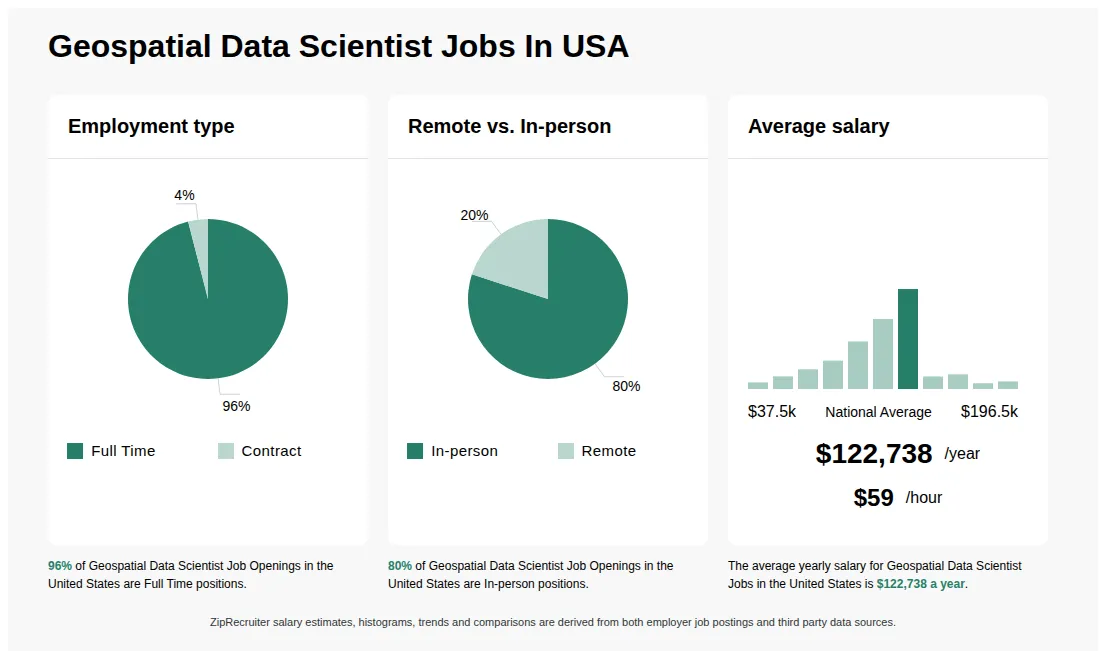
Geospatial Data Scientist information

See salary details

$37.5K

$122.7K

$196.5K

How much do geospatial data scientist jobs pay per year?

As of Jul 12, 2026, the average yearly pay for geospatial data scientist in the United States is $122,738.00, according to ZipRecruiter salary data. Most workers in this role earn between $98,500.00 and $136,000.00 per year, depending on experience, location, and employer.

Is 40 too late for data science?

A geospatial data scientist can start or transition into the field at age 40, as data science values skills, experience, and continuous learning over age. Many professionals successfully switch careers or advance in data science later in life by acquiring relevant skills such as programming, statistics, and GIS tools, and obtaining certifications if needed.

What are the typical daily tasks of a Geospatial Data Scientist?

As a Geospatial Data Scientist, your daily tasks often involve collecting, cleaning, and analyzing spatial datasets using GIS tools and programming languages. You may be responsible for developing spatial models, visualizing geographic data through interactive maps, and generating reports to help guide strategic decisions. Collaboration with professionals from engineering, urban planning, or environmental science teams is common, requiring you to communicate complex analyses in a clear and actionable manner. Additionally, you might participate in project meetings to align your work with organizational goals and stakeholder needs. This dynamic role blends technical analysis with communication and teamwork, making each day varied and intellectually stimulating.

What are the key skills and qualifications needed to thrive in the Geospatial Data Scientist position, and why are they important?

Geospatial Data Scientists require expertise in spatial analysis, statistics, and data modeling, typically supported by a degree in geography, computer science, or a related field. Proficiency with GIS software (such as ArcGIS or QGIS), programming languages like Python or R, and familiarity with spatial databases are often expected, while certifications in GIS can be advantageous. Strong problem-solving abilities, collaboration, and effective communication skills help professionals translate complex data into actionable insights and work well with diverse teams. Mastery of these skills ensures accurate geospatial analyses and supports informed, data-driven decision making in various industries.

Can data scientists make $300k?

Geospatial Data Scientists with extensive experience, advanced skills in GIS tools, programming, and machine learning can potentially earn $300,000 or more, especially in high-demand industries or senior roles. However, such salaries are typically achieved through seniority, specialized expertise, or leadership positions, and are not common for entry-level or mid-career roles.

Is GIS still in demand?

Geospatial Data Scientists and GIS professionals are in high demand due to the increasing reliance on spatial data across industries such as urban planning, environmental management, and logistics. Skills in GIS software, spatial analysis, and programming languages like Python or R enhance job prospects in this field, which continues to grow with advancements in technology and data integration.

What is a Geospatial Data Scientist job?

A Geospatial Data Scientist analyzes spatial and geographic data to extract insights, create predictive models, and support decision-making. They use tools like GIS, remote sensing, machine learning, and statistical analysis to process location-based data. Their work spans various industries, including urban planning, environmental monitoring, agriculture, and logistics. By leveraging spatial data, they help optimize operations, manage resources, and solve complex geographic problems.

What does a geospatial data scientist do?

A geospatial data scientist analyzes geographic data to identify patterns, trends, and insights using tools like GIS software, programming languages such as Python or R, and spatial databases. They develop models, visualize data on maps, and support decision-making in fields like urban planning, environmental management, and transportation.
More about Geospatial Data Scientist jobs
What cities are hiring for Geospatial Data Scientist jobs? Cities with the most Geospatial Data Scientist job openings:
What are the most commonly searched types of Geospatial Data Scientist jobs? The most popular types of Geospatial Data Scientist jobs are:
What states have the most Geospatial Data Scientist jobs? States with the most job openings for Geospatial Data Scientist jobs include:
Geospatial Data Engineer II

Geospatial Data Engineer II

Oak Ridge National Laboratory

Oak Ridge, TN • On-site

Full-time

Posted 20 days ago


Oak Ridge National Laboratory rating

8.8

Company rating: 8.8 out of 10

Based on 16 frontline employees who took The Breakroom Quiz

10th of 105 rated laboratories


Job description

Requisition Id 16691
Overview:
The Geospatial Science and Human Security Division (GSHSD) is currently seeking world-class research and development professionals for the National Security Sciences Directorate within Oak Ridge National Lab. The geospatial data engineer will support the development of next generation data strategies that will support and deploy operational situational awareness products for sponsors across the Federal Government. We're looking for staff who bring fresh ideas from areas including information retrieval, distributed computing and storage, and data processing workflows. We need our staff to be flexible and be enthusiastic to take on problems across the organization as we continue to solve complex global scale problems in the areas associated with spatial computing.
The Geospatial Data Engineer will focus on the implementation of scalable data storage and processing solutions for high-volume and high-velocity data applications. The proposed solutions will include distributed computing that can be applicable for several geospatially focused research and development projects in the domains of energy, transportation, and other cross-disciplinary geospatial applications. The geospatial data engineer works with research scientists across the lab with the primary goal of researching and developing cutting edge solutions to complex problems posed by sponsors including DoD and DOE leveraging the lab's world-class resources.
Major Duties/Responsibilities:
  • R&D: assist in conducting research and development to support project-specific applications.
  • Data Development: working alongside researchers to develop and deploy geospatial data storage and processing solutions.
  • Requirements Decomposition: working alongside researchers and project sponsors to capture, understand, integrate, and implement project requirements in developed system architectures and software.

Interdisciplinary Collaboration: collaborating with a highly diverse and multidisciplinary team - from photogrammetrists, geographers, mathematicians, physicists, computer scientists, and engineers - in research, development, integration, testing, and deployment.
Basic Qualifications:
  • Requires an B.S. or M.S. in the field of Geography, Data Science, Computer Science, or related fields with a minimum of 2 years of relevant experience
  • Experience with programming languages such as SQL, Python
  • Experience with Extract, Transform, Load (ETL) processes.
  • Excellent written and oral communication skills and the ability to communicate in English to a scientific audience
  • Ability to function well in a fast-paced research environment, set priorities to accomplish multiple tasks within deadlines, and adapt to changing needs
  • Demonstrated ability to present technical results to technical communities.
  • Excellent interpersonal skills with a strong commitment to a team environment

Preferred Qualifications:
  • Experience with Docker, Kubernetes, or similar container platforms/concepts.
  • Experience with s3, parquet, Duckdb, zarr and related software and technologies is a plus
  • At least 2 years of experience working with geospatial data and processing workflows and assessing data sources for fit-for-purpose.
  • Motivated self-starter with the ability to work independently and to participate creatively in collaborative and frequently interacting teams of researchers.
  • Experience with software and data governance best practices including, but not limited to: Agile development; version control using Git/GitFlow or similar system; data retention life-cycles, and project management via systems like JIRA, Asana, etc.
  • Utilize open-source and commercial tools and approaches to solve complex problems including information retrieval/extraction, machine learning/deep learning, and networking

Special Requirements:
  • Export control, no clearance: This position requires access to technology that is subject to export control requirements. Successful candidates must be qualified for such access without an export control license.

Security, Credentialing, and Eligibility Requirements:
For employment at Oak Ridge National Laboratory (ORNL), a Real ID compliant form of identification will be required. Additionally, ORNL is subject to Department of Energy (DOE) access restrictions. All employees must also be able to obtain and maintain a federal Personal Identity Verification (PIV) card as mandated by Homeland Security Presidential Directive 12 (HSPD-12) and Department of Energy (DOE) Order 473.1A, which requires a favorable post-employment background investigation.
To obtain this credential, new employees must successfully complete and pass a Federal Tier 1 background check investigation. This investigation includes a declaration of illegal drug activities, including use, supply, possession, or manufacture within the last year. This includes marijuana and cannabis derivatives, which are still considered illegal under federal law, regardless of state laws.
Relocation:
Moving can be overwhelming and expensive. UT-Battelle offers a generous relocation package to ease the transition process. Domestic and international relocation assistance is available for certain positions. If invited to interview, be sure to ask your Recruiter (Talent Acquisition Partner) for details.
For more information about our benefits, working here, and living here, visit the "About" tab at jobs.ornl.gov.
This position will remain open for a minimum of 5 days after which it will close when a qualified candidate is identified and/or hired.
We accept Word (.doc, .docx), Adobe (unsecured .pdf), Rich Text Format (.rtf), and HTML (.htm, .html) up to 5MB in size. Resumes from third party vendors will not be accepted; these resumes will be deleted and the candidates submitted will not be considered for employment.
If you have trouble applying for a position, please email ORNLRecruiting@ornl.gov.
ORNL is an equal opportunity employer. All qualified applicants, including individuals with disabilities and protected veterans, are encouraged to apply. UT-Battelle is an E-Verify employer.

What Oak Ridge National Laboratory employees say

Pay

Benefits

Hours and flexibility

Workplace

Get the full story on Breakroom