The Product Owner partners with AI Engineering & Delivery and other technology teams for technical ... Represent Geoscience, Reservoir Engineering, and Planning stakeholder needs; coordinate cross ...
The Product Owner partners with AI Engineering & Delivery and other technology teams for technical ... Represent Geoscience, Reservoir Engineering, and Planning stakeholder needs; coordinate cross ...
The Product Owner partners with AI Engineering & Delivery and other technology teams for technical ... Represent Geoscience, Reservoir Engineering, and Planning stakeholder needs; coordinate cross ...
The Product Owner partners with AI Engineering & Delivery and other technology teams for technical ... Represent Geoscience, Reservoir Engineering, and Planning stakeholder needs; coordinate cross ...
Lead, Product Operations
Englewood, CO · On-site
$110K - $149K/yr
The Product Operations team drives operational excellence and strategic execution across S&P Global's Geoscience, Engineering and Upstream Data Science software portfolio, serving subsurface ...
Lead, Product Operations
Englewood, CO · On-site
$110K - $149K/yr
The Product Operations team drives operational excellence and strategic execution across S&P Global's Geoscience, Engineering and Upstream Data Science software portfolio, serving subsurface ...

Lead, Product Operations
$110K - $149K/yr
The Product Operations team drives operational excellence and strategic execution across S&P Global's Geoscience, Engineering and Upstream Data Science software portfolio, serving subsurface ...
Lead, Product Operations
$110K - $149K/yr
The Product Operations team drives operational excellence and strategic execution across S&P Global's Geoscience, Engineering and Upstream Data Science software portfolio, serving subsurface ...

Subsurface Geoscience Postdoc
Los Alamos, NM · On-site
$44K - $60K/yr
Publication record including subsurface geoscience and deep learning applications ... Proficiency in programing languages such as Python, C/C++ * Experience using supercomputing and HPC ...
Subsurface Geoscience Postdoc
Los Alamos, NM · On-site
$44K - $60K/yr
Publication record including subsurface geoscience and deep learning applications ... Proficiency in programing languages such as Python, C/C++ * Experience using supercomputing and HPC ...
Subsurface Geoscience Postdoc
Los Alamos, NM · On-site
$44K - $60K/yr
Publication record including subsurface geoscience and deep learning applications ... Proficiency in programing languages such as Python, C/C++ * Experience using supercomputing and HPC ...
Subsurface Geoscience Postdoc
Los Alamos, NM · On-site
$44K - $60K/yr
Publication record including subsurface geoscience and deep learning applications ... Proficiency in programing languages such as Python, C/C++ * Experience using supercomputing and HPC ...

Bachelor's Degree from an accredited college or university in Management Information Systems, Data Analytics, Information Science/Management, Economics, Finance, Accounting, Geoscience, Engineering ...
Bachelor's Degree from an accredited college or university in Management Information Systems, Data Analytics, Information Science/Management, Economics, Finance, Accounting, Geoscience, Engineering ...

Bachelor's degree in Petroleum Engineering, Mechanical Engineering, Chemical Engineering, or a related geoscience/engineering discipline. (Advanced degree or PE license is a plus). * Experience:
Bachelor's degree in Petroleum Engineering, Mechanical Engineering, Chemical Engineering, or a related geoscience/engineering discipline. (Advanced degree or PE license is a plus). * Experience:
Lead, Product Operations
Houston, TX · On-site
$110K - $149K/yr
The Product Operations team drives operational excellence and strategic execution across S&P Global's Geoscience, Engineering and Upstream Data Science software portfolio, serving subsurface ...
Lead, Product Operations
Houston, TX · On-site
$110K - $149K/yr
The Product Operations team drives operational excellence and strategic execution across S&P Global's Geoscience, Engineering and Upstream Data Science software portfolio, serving subsurface ...
Lead, Product Operations
$110K - $149K/yr
The Product Operations team drives operational excellence and strategic execution across S&P Global's Geoscience, Engineering and Upstream Data Science software portfolio, serving subsurface ...
Lead, Product Operations
$110K - $149K/yr
The Product Operations team drives operational excellence and strategic execution across S&P Global's Geoscience, Engineering and Upstream Data Science software portfolio, serving subsurface ...
Lead, Product Operations
$110K - $149K/yr
The Product Operations team drives operational excellence and strategic execution across S&P Global's Geoscience, Engineering and Upstream Data Science software portfolio, serving subsurface ...
Lead, Product Operations
$110K - $149K/yr
The Product Operations team drives operational excellence and strategic execution across S&P Global's Geoscience, Engineering and Upstream Data Science software portfolio, serving subsurface ...
Subsurface Geoscience Postdoc
Los Alamos, NM · On-site
$44K - $60K/yr
Publication record including subsurface geoscience and deep learning applications ... Proficiency in programing languages such as Python, C/C++ * Experience using supercomputing and HPC ...
Subsurface Geoscience Postdoc
Los Alamos, NM · On-site
$44K - $60K/yr
Publication record including subsurface geoscience and deep learning applications ... Proficiency in programing languages such as Python, C/C++ * Experience using supercomputing and HPC ...

Contracts Advisor II - Geoscience Contracting Duration: 12 months contract Schedule: 5/40 Location ... Requirements: * BS in Supply Chain, Industrial Engineering, or another relevant Business or ...
Contracts Advisor II - Geoscience Contracting Duration: 12 months contract Schedule: 5/40 Location ... Requirements: * BS in Supply Chain, Industrial Engineering, or another relevant Business or ...
Lead, Product Operations
Houston, TX · On-site
$110K - $149K/yr
The Product Operations team drives operational excellence and strategic execution across S&P Global's Geoscience, Engineering and Upstream Data Science software portfolio, serving subsurface ...
Lead, Product Operations
Houston, TX · On-site
$110K - $149K/yr
The Product Operations team drives operational excellence and strategic execution across S&P Global's Geoscience, Engineering and Upstream Data Science software portfolio, serving subsurface ...
Lead, Product Operations
Denver, CO · On-site
$110K - $149K/yr
The Product Operations team drives operational excellence and strategic execution across S&P Global's Geoscience, Engineering and Upstream Data Science software portfolio, serving subsurface ...
Lead, Product Operations
Denver, CO · On-site
$110K - $149K/yr
The Product Operations team drives operational excellence and strategic execution across S&P Global's Geoscience, Engineering and Upstream Data Science software portfolio, serving subsurface ...
Lead, Product Operations
Houston, TX · On-site
$110K - $149K/yr
The Product Operations team drives operational excellence and strategic execution across S&P Global's Geoscience, Engineering and Upstream Data Science software portfolio, serving subsurface ...
Lead, Product Operations
Houston, TX · On-site
$110K - $149K/yr
The Product Operations team drives operational excellence and strategic execution across S&P Global's Geoscience, Engineering and Upstream Data Science software portfolio, serving subsurface ...
Bachelor's degree in Petroleum Engineering, Mechanical Engineering, Chemical Engineering, or a related geoscience/engineering discipline. (Advanced degree or PE license is a plus). * Experience:
Bachelor's degree in Petroleum Engineering, Mechanical Engineering, Chemical Engineering, or a related geoscience/engineering discipline. (Advanced degree or PE license is a plus). * Experience:
... Geoscience, Engineering, or related degree. Competencies: • Technical Execution: Independently ... executes and adapts queries; automates routine data tasks. • Tool Proficiency: Integrates ...
... Geoscience, Engineering, or related degree. Competencies: • Technical Execution: Independently ... executes and adapts queries; automates routine data tasks. • Tool Proficiency: Integrates ...
Degree in Geoscience, Geology, Geological Engineering, or related discipline * Typically 7+ years ... of relevant experience delivering applied geohazard or geoscience scopes * Demonstrated capability ...
Degree in Geoscience, Geology, Geological Engineering, or related discipline * Typically 7+ years ... of relevant experience delivering applied geohazard or geoscience scopes * Demonstrated capability ...

Geoscience Trainee
Harrisburg, PA · Hybrid
$59K - $80K/yr
As a Geoscience Trainee, you will learn how to perform the following duties: Contamination ... Engineers, Land Surveyors, and Geologists; or A bachelor's degree in geology, geophysics ...
Geoscience Trainee
Harrisburg, PA · Hybrid
$59K - $80K/yr
As a Geoscience Trainee, you will learn how to perform the following duties: Contamination ... Engineers, Land Surveyors, and Geologists; or A bachelor's degree in geology, geophysics ...
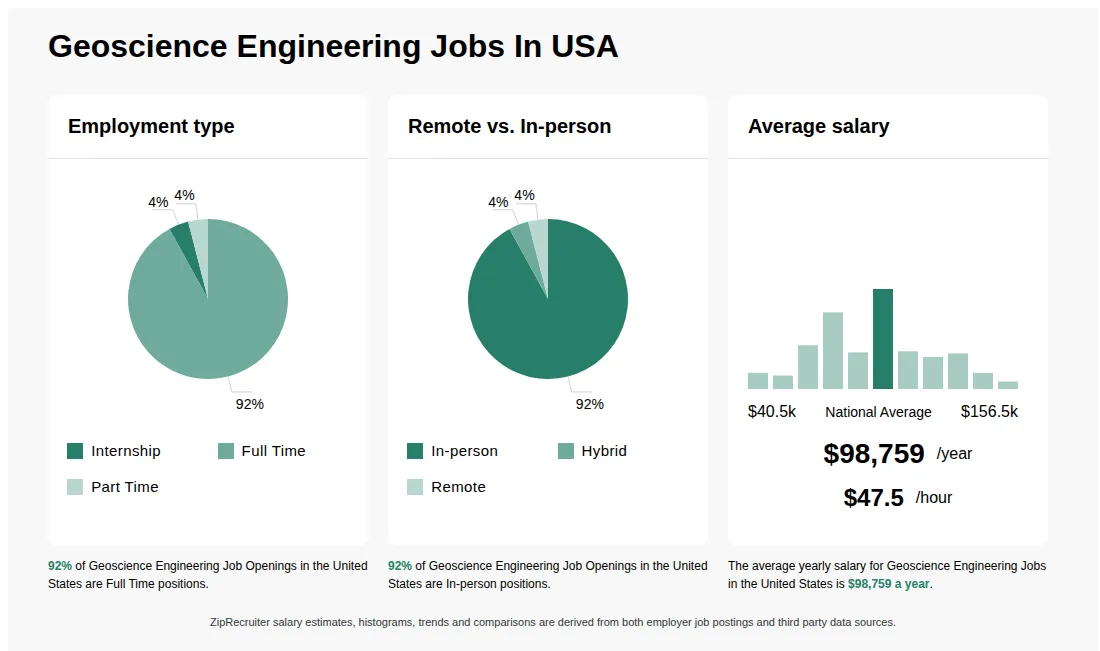
Geoscience Engineering information
See salary details
$40.5K - $51K
3% of jobs
$51K - $61.6K
3% of jobs
$61.6K - $72.1K
11% of jobs
$76.5K is the 25th percentile. Wages below this are outliers.
$72.1K - $82.7K
19% of jobs
$82.7K - $93.2K
9% of jobs
The median wage is $95.4K / yr.
$93.2K - $103.8K
26% of jobs
$109K is the 75th percentile. Wages above this are outliers.
$103.8K - $114.3K
10% of jobs
$114.3K - $124.9K
7% of jobs
$124.9K - $135.4K
9% of jobs
$135.4K - $146K
3% of jobs
$146K - $156.5K
1% of jobs
$40.5K
$98.8K
$156.5K
How much do geoscience engineering jobs pay per year?
As of Sep 13, 2026, the average yearly pay for geoscience engineering in the United States is $98,759.00, according to ZipRecruiter salary data. Most workers in this role earn between $78,000.00 and $116,000.00 per year, depending on experience, location, and employer.
What is geoscience engineering?
Geoscience engineering is a multidisciplinary field that combines principles of geology, engineering, and environmental science to solve problems related to the Earth’s resources and processes. Professionals in this field study soil, rock, groundwater, and other natural systems to support construction projects, resource extraction, environmental protection, and hazard assessment. Geoscience engineers play a key role in industries such as mining, oil and gas, civil infrastructure, and environmental consulting. Their work ensures the safe and sustainable use of Earth’s materials and helps manage risks associated with natural hazards.
What are the key skills and qualifications needed to thrive as a geoscience engineer, and why are they important?
To thrive as a Geoscience Engineer, you need a solid background in geology, mathematics, and engineering principles, typically supported by a degree in geoscience or geological engineering. Familiarity with GIS software, modeling tools, and certifications like Professional Engineer (PE) or Fundamentals of Engineering (FE) are commonly required. Strong analytical thinking, problem-solving, and effective communication skills help you interpret data and collaborate with multidisciplinary teams. These competencies are crucial for ensuring accurate site assessments, resource management, and the safe execution of engineering projects.
What are some common challenges faced by geoscience engineers when working on multidisciplinary teams?
Geoscience Engineers often collaborate with professionals from fields like civil engineering, environmental science, and geology, which can present challenges in aligning different technical languages and project goals. Effective communication and adaptability are essential to bridge knowledge gaps and integrate diverse perspectives into cohesive solutions. Navigating regulatory requirements and balancing project deadlines with thorough scientific analysis are also frequent challenges. However, this multidisciplinary environment offers opportunities for learning and professional growth.
What is the difference between Geoscience Engineering vs Geology?
| Aspect | Geoscience Engineering | Geology |
|---|---|---|
| Required Credentials | Bachelor's or higher in Geoscience, Engineering, or related fields; often includes certifications in geotechnical or environmental engineering | Bachelor's or higher in Geology or Earth Sciences; professional licensure (e.g., PG) varies by region |
| Work Environment | Fieldwork, site investigations, engineering projects, consulting firms, construction sites | Field and laboratory work, research institutions, environmental agencies, academia |
| Employer & Industry Usage | Mining, oil & gas, environmental consulting, civil engineering projects | Natural resource exploration, environmental assessment, academia, research |
Geoscience Engineering combines principles of geology and engineering to solve practical problems related to earth materials, construction, and resource extraction. Geology focuses more on studying Earth's processes and history. While both roles involve fieldwork and earth sciences, Geoscience Engineering emphasizes applying engineering solutions to geoscience problems, making it more industry-oriented and project-specific.
Are geoscience engineers in high demand?
Geoscience engineering is a growing field with steady demand driven by the need for resource exploration, environmental assessment, and natural hazard management. Employment opportunities are often available in industries such as oil and gas, mining, and environmental consulting, especially for professionals with strong technical skills and relevant certifications. Job prospects are generally favorable, with a focus on data analysis, fieldwork, and the use of specialized tools like GIS and seismic imaging.
What can I do with a geoscience engineering degree?
A geoscience engineering degree prepares individuals for careers in resource extraction, environmental consulting, and geotechnical engineering. Professionals often work in fields such as oil and gas, mining, environmental assessment, and hazard mitigation, utilizing skills in geology, engineering principles, and data analysis. Certifications like Professional Engineer (PE) can enhance job prospects, and work may involve fieldwork, laboratory analysis, and technical reporting.
What jobs can I get with a geoscience engineering degree?
A geoscience engineering degree qualifies graduates for roles such as petroleum engineer, environmental consultant, hydrogeologist, geotechnical engineer, and exploration geologist. These jobs often involve fieldwork, data analysis, and the use of specialized tools like GIS software and drilling equipment, with some positions requiring professional licensure or certifications. Employment can be found in energy, environmental consulting, mining, and government agencies.
More about Geoscience Engineering jobs
What cities are hiring for Geoscience Engineering jobs?
Cities with the most Geoscience Engineering job openings:
What states have the most Geoscience Engineering jobs?
States with the most job openings for Geoscience Engineering jobs include:
What are popular job titles for Geoscience Engineering?
Popular job titles for Geoscience Engineering:
AI Product Owner - Geoscience & Reservoir
Midland, TX • On-site
Diamondbackenergy
Full-time
Posted 19 days ago
Job description
CURRENT EMPLOYEES - Please apply using "Jobs Hub" in Workday. This career site is for external applicants only.
The AI Product Owner - Geoscience and Reservoir serves as the primary business representative for Artificial Intelligence (AI) products supporting Diamondback Energy's Geoscience, Reservoir Engineering, Planning, and related subsurface workflows. This role owns the product outcome lifecycle from opportunity identification and discovery through prioritization, product definition, business validation, adoption, value realization, and continuous improvement. The Product Owner partners with AI Engineering & Delivery and other technology teams for technical feasibility, solution engineering, productionization, deployment, and technical operations. The Product Owner combines subsurface domain knowledge, product ownership skills, and AI fluency to deliver responsible solutions that improve reservoir characterization, development planning, forecasting, reserve optimization, asset performance, and operational decision-making.Job Responsibilities:
Include but are not limited to
- Partner with geoscientists, reservoir engineers, and related stakeholders to understand subsurface workflows, user needs, data requirements, controls, and challenges, and identify, evaluate, and prioritize AI and automation opportunities based on business value, technical feasibility, risk, data readiness, and strategic alignment.
- Own the business problem definition, product vision, target users and workflows, value hypothesis, roadmap, priorities, success measures, and expected business outcomes, partnering with business sponsors and the AI Value & Economics Lead to establish baseline performance and the approach for measuring realized outcomes before significant investment.
- Lead product discovery to validate the business problem, user needs, workflows, constraints, value hypothesis, and potential solution approaches before significant production investment, using rapid prototypes, workflow simulations, data exploration, user testing, vendor capability assessment, and other lightweight experiments to reduce uncertainty and test assumptions.
- Translate business needs into clear product requirements, user stories, acceptance criteria, and AI quality expectations.
- Manage the product backlog and make product scope and priority decisions; lead business validation and user acceptance testing; and hold product acceptance decision rights against defined requirements, acceptance criteria, user needs, and expected business outcomes.
- Partner with technology, data, security, governance, legal, risk, and technical subject matter experts to deliver scalable solutions that meet responsible AI, confidentiality, data quality, and compliance requirements.
- Represent Geoscience, Reservoir Engineering, and Planning stakeholder needs; coordinate cross-functional dependencies with Production, Operations, and asset teams; and support user readiness and adoption.
- Own post-launch product performance and continuous improvement by monitoring adoption, AI performance, business outcomes, realized value, user feedback, and relevant risk measures, and prioritize the changes needed to improve product outcomes.
Required Qualifications:
- Bachelor's degree in Geoscience, Petroleum Engineering, Reservoir Engineering, Data Science, Information Systems, or a related technical field
- 5+ years of experience supporting geoscience, reservoir engineering, subsurface planning, or a closely adjacent technical function within oil and gas
- Experience leading cross-functional technology, analytics, process improvement, or business transformation initiatives in a technical subsurface environment
- Experience translating technical workflows and business needs into clear requirements, priorities, and measurable outcomes
- Experience working with subsurface, reservoir engineering, planning, production, or analytics data and systems, including technologies such as Kingdom, IP, Aries, Petrel, OFM, Spotfire, Snowflake, SQL, Power BI, Python, and similar tools
- Experience delivering or supporting AI, machine learning, automation, data, or analytics products from concept through adoption
Preferred Qualifications:
- Direct Product Owner experience managing product roadmaps, backlogs, user stories, and acceptance criteria in an Agile environment
- Experience using AI-enabled rapid product discovery techniques, including prototyping, user testing, workflow simulation, data exploration, or lightweight experimentation to test assumptions and reduce uncertainty before development.
- Knowledge of AI model evaluation, subsurface data practices, responsible AI governance, model risk controls, and data quality requirements
- Experience leading digital transformation or change adoption across Geoscience, Reservoir Engineering, Planning, Production, Operations, or asset teams
- Familiarity with reservoir simulation, reserves evaluation, production forecasting, type curve development, decline curve analysis, development planning workflows
Diamondback is an Equal Employment Opportunity Employer. Diamondback provides equal employment opportunities to all qualified applicants without regard to race, sex, sexual orientation, gender identity, national origin, color, age, religion, veteran or disability status, genetic information, pregnancy, or any other status protected by law. Diamondback participates in E-Verify. Learn more aboutE-Verify.