1

Geodetic Engineer Jobs (NOW HIRING)

A qualification in construction, land surveying, civil engineering, geospatial or geodetic engineering would be preferred but isn't essential * A strong work ethic, ambition and interest in new ...

Post Doctoral Scholar

Columbus, OH · On-site

$47K - $64K/yr

Engineering | Civil Environmental and Geodetic Engineering The Post Doctoral Scholar will conduct advanced research in environmental health and engineering with a focus on viral dynamics in built ...

Post Doctoral Scholar

Columbus, OH · On-site

$47K - $64K/yr

Engineering | Civil Environmental and Geodetic Engineering The Post Doctoral Scholar will conduct advanced research in environmental health and engineering with a focus on viral dynamics in built ...

Research Technician 3

Columbus, OH

$17.50 - $24/hr

Engineering | Civil Environmental and Geodetic Engineering The Research Technician 3 will support a project funded by The Ohio State University Office of Innovation and Economic Development focused ...

next page

Showing results 1-20

Geodetic Engineer information

See salary details

$16

$44

$70

How much do geodetic engineer jobs pay per hour?

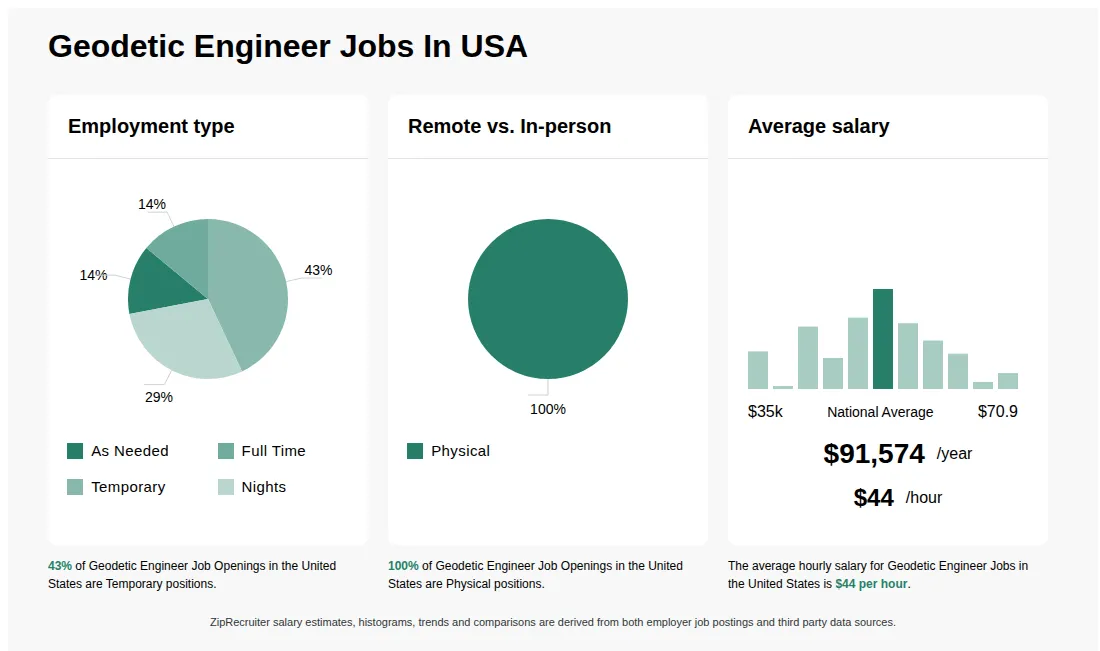
As of Jul 7, 2026, the average hourly pay for geodetic engineer in the United States is $44.03, according to ZipRecruiter salary data. Most workers in this role earn between $34.86 and $51.92 per hour, depending on experience, location, and employer.

What engineers make $500,000?

Among engineering roles, some specialized fields such as petroleum engineers, aerospace engineers, and certain senior software engineers can reach or exceed a $500,000 annual salary, often with experience, advanced skills, and in high-demand industries. Geodetic engineers typically do not reach this salary level, as their compensation is generally lower, but senior or consulting roles may approach high six-figure earnings depending on the project scope and location.

What is the job of a geodetic engineer?

A geodetic engineer is responsible for measuring and mapping the Earth's surface to establish precise geographic positions. They use specialized tools like GPS and total stations, and their work supports construction, surveying, and mapping projects. Accuracy and knowledge of geospatial data are essential in this role.

What does a Geodetic Engineer do?

A Geodetic Engineer specializes in measuring and mapping the Earth's surface using advanced surveying techniques and geographic information systems (GIS). They conduct land surveys, determine property boundaries, and support infrastructure projects such as roads, bridges, and construction sites. Their work is essential for urban planning, disaster management, and environmental monitoring. Geodetic Engineers use tools like GPS, drones, and satellite imagery to collect accurate spatial data.

What are some common challenges faced by Geodetic Engineers on the job?

Geodetic Engineers often encounter challenges such as working in remote or difficult terrain, ensuring the highest accuracy in data collection, and adapting to rapidly changing environmental and technological conditions. Projects may require long hours outdoors and problem-solving when unexpected obstacles arise, such as inclement weather or accessibility issues. Additionally, keeping up with advancements in surveying technology and regulatory standards is essential. However, overcoming these challenges can be highly rewarding and contribute to personal and professional growth in the field.

Is geodetic engineering in demand?

Geodetic engineering is in demand due to ongoing infrastructure development, urban planning, and environmental projects that require precise surveying and mapping skills. Professionals in this field with knowledge of GIS software and GPS technology are often sought after by engineering firms, government agencies, and construction companies.

What are the key skills and qualifications needed to thrive in the Geodetic Engineer position, and why are they important?

To excel as a Geodetic Engineer, you need a solid background in mathematics, surveying principles, geospatial science, and typically a degree in geodetic engineering or a related field. Proficiency with GPS/GNSS equipment, total stations, GIS software, and a strong understanding of data processing systems is highly valued, with professional licensure often preferred. Strong attention to detail, analytical thinking, and effective communication skills help geodetic engineers work accurately and collaborate well within multidisciplinary teams. Mastery of these skills ensures precise data collection, effective project execution, and quality results in land surveying, infrastructure development, and mapping projects.

Can I make 200K as a data engineer?

A geodetic engineer's salary typically depends on experience, location, and industry. While senior geodetic engineers with specialized skills and certifications can earn high salaries, reaching 200K is more common in senior or managerial roles, often requiring advanced expertise and project management experience. Data engineering salaries are generally higher, but for geodetic engineers, such a salary is achievable with significant experience and responsibility.
More about Geodetic Engineer jobs
What cities are hiring for Geodetic Engineer jobs? Cities with the most Geodetic Engineer job openings:
What are the most commonly searched types of Geodetic Engineer jobs? The most popular types of Geodetic Engineer jobs are:
What states have the most Geodetic Engineer jobs? States with the most job openings for Geodetic Engineer jobs include:
Infographic showing various Geodetic Engineer job openings in the United States as of July 2026, with employment types broken down into 100% Full Time. Highlights an 100% In-person job distribution, with an average salary of $91,574 per year, or $44 per hour.
Geodetic Surveyor (Open Continuous)

Geodetic Surveyor (Open Continuous)

U.S. Department of Defense (DOD)

Cape Canaveral, FL

$49K/yr

Other

Re-posted 7 days ago


U.S. Department Of Defense rating

7.8

Company rating: 7.8 out of 10

Based on 532 frontline employees who took The Breakroom Quiz

25th of 46 rated military and defense


Job description

Geodetic Surveyors perform geodetic, geophysical, and GC-LiDAR surveys. They use, maintain, and troubleshoot survey equipment, and compute, adjust, and evaluate geodetic and geophysical (G&G) survey data. They provide technical expertise on G&G issues to customers and represent NGA in external community forums.

Qualifications:

MANDATORY QUALIFICATION CRITERIA: For this particular job, applicants must meet all competencies reflected under the Mandatory Qualification Criteria to include education (if required). Online resumes must demonstrate qualification by providing specific examples and associated results, in response to the announcement's mandatory criteria specified in this vacancy announcement:
1. Knowledge of best practices with operating Global Navigation Satellite System (GNSS) receivers, data collectors, electronic/robotic total stations, and/or terrestrial/mobile LiDAR.
2. Experience conducting basic scientific or statistical analysis to interpret data and draw appropriate conclusions.
3. Experience engaging with teammates to support a common goal.
EDUCATION REQUIREMENT: A. Education: Bachelor's degree from an accredited college or university in Geodesy, Mathematics, Physical Science, or a related discipline that includes at least 30 semester (45 quarter) hours of coursework in any combination of Astronomy, Cartography, Computer Science, Engineering Science, Geodesy, Geodetic Surveying, Geology, Geomatics, Geophysics, Geographic Information Systems, Mathematics, Meteorology, Orbital Mechanics, Photogrammetry, Physical Science, Physics, Remote Sensing, or Surveying. Coursework must include differential and integral calculus. -OR- B. Combination of Education and Experience: A minimum of 30 semester (45 quarter) hours of coursework in any area listed in option A, plus appropriate experience conducting work related to Civil Engineering, Geodesy, Geophysics, Geotechnical Analysis, Surveying, or a related field that demonstrates the ability to successfully perform the duties associated with this work. As a rule, every 30 semester (45 quarter) hours of coursework is equivalent to one year of experience. Candidates should show that their combination of education and experience totals 4 years. -AND- LICENSES/CERTIFICATIONS: Registration as a Professional Engineer or Land Surveyor is highly desirable.
PHYSICAL REQUIREMENT: Heavy lifting, 45 pounds and over; Heavy carrying, 45 pounds and over; Straight pulling; Pushing; Reaching above shoulder; Use of fingers; Use of hands; Walking; Prolonged periods of standing; Crawling; Kneeling; Repeated bending; Climbing, use of legs and arms; Operation of crane, truck, tractor, or motor vehicle; Depth perception; Hearing (aid permitted); Distinguish principal colors and shades/hues of principal colors; Near visual acuity of 20/20 or better with or without corrective lenses; Far visual acuity of 20/30 or better binocular with or without corrective lenses
ENVIRONMENTAL REQUIREMENT: Working outside and inside; Working around excessive noise, intermittent; Exposure to fumes, smoke, or gases; Working around slippery or uneven walking surfaces; Working around machinery with moving parts; Working around moving objects or vehicles; Working on ladders or scaffolding; Working below ground; Repetitive physical tasks; Working in harsh environments

DESIRABLE QUALIFICATION CRITERIA: In addition to the mandatory qualifications, experience in the following is desired:
1. Experience operating Global Navigation Satellite System (GNSS) receivers, data collectors, electronic/robotic total stations, and/or terrestrial/mobile LiDAR.
2. Experience collecting, processing, and/or analyzing LIDAR data utilizing terrestrial, mobile, and/or airborne LiDAR platforms.
3. Experience collecting, processing, and/or analyzing geophysical data, such as gravity, magnetics, or astronomic positions or azimuths.
4. Knowledge of GNSS baseline processing and/or least squares adjustment software.
5. Experience performing field work in harsh environmental conditions.

Education:Employment Type: OTHER

What U.S. Department Of Defense employees say

Pay

Benefits

Hours and flexibility

Workplace

Get the full story on Breakroom