1

Generative Ai Cybersecurity Jobs (NOW HIRING)

Showing results 41-60

Generative Ai Cybersecurity information

See salary details

$57K

$133K

$186K

How much do generative ai cybersecurity jobs pay per year?

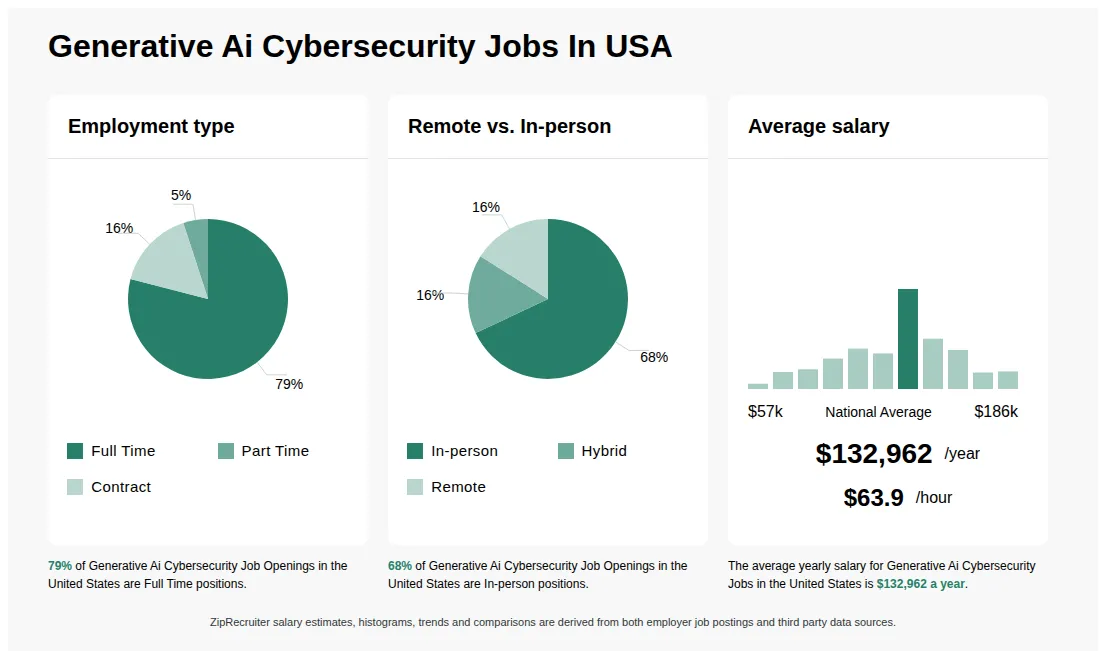
As of Aug 18, 2026, the average yearly pay for generative ai cybersecurity in the United States is $132,962.00, according to ZipRecruiter salary data. Most workers in this role earn between $111,000.00 and $150,000.00 per year, depending on experience, location, and employer.

What is generative AI cybersecurity?

Generative AI Cybersecurity refers to the use of advanced artificial intelligence models, such as generative adversarial networks (GANs) and large language models, to enhance cybersecurity measures. These AI systems can identify vulnerabilities, simulate cyberattacks, generate realistic phishing attempts for training, and automate threat detection and response. The goal is to proactively strengthen defenses and adapt to evolving cyber threats by leveraging the creative and predictive capabilities of generative AI. This field is rapidly evolving as organizations seek to stay ahead of increasingly sophisticated cyber adversaries.

How does a generative AI cybersecurity professional typically collaborate with other teams in an organization?

A Generative AI Cybersecurity professional often works closely with data scientists, software engineers, and IT security teams to identify system vulnerabilities and design AI-driven defenses. Collaboration is essential when developing and deploying AI models that detect threats, as cross-team input ensures that solutions are both technically robust and aligned with organizational security policies. Regular meetings and knowledge-sharing sessions are common, helping to address emerging risks quickly and effectively. This collaborative environment not only strengthens security posture but also offers opportunities for learning and professional growth.

What are the key skills and qualifications needed to thrive as a generative AI cybersecurity specialist, and why are they important?

To thrive as a Generative AI Cybersecurity Specialist, you need a strong background in cybersecurity principles, AI/ML concepts, and programming (often with degrees in computer science or related fields). Familiarity with cybersecurity tools (like SIEM, IDS/IPS), knowledge of AI frameworks (such as TensorFlow or PyTorch), and relevant certifications (e.g., CISSP, CEH, or AI-specific credentials) are typically required. Analytical thinking, problem-solving, and effective communication are essential soft skills for identifying threats and collaborating across technical teams. These skills and qualifications are critical to protect advanced AI systems from evolving cyber threats and ensure secure deployment of generative AI technologies.

What is the difference between Generative Ai Cybersecurity vs Cybersecurity Analyst?

AspectGenerative Ai CybersecurityCybersecurity Analyst
Required CredentialsCertifications in AI, cybersecurity, and data science (e.g., CISSP, CEH, AI certifications)Certifications like CISSP, CompTIA Security+, CEH
Work EnvironmentFocus on developing AI models, threat detection algorithms, and automation toolsMonitoring security systems, analyzing threats, implementing security measures
Employer & Industry UsageTech companies, cybersecurity firms, organizations deploying AI-driven security solutionsAll industries, including finance, healthcare, government, and private sectors

While Generative Ai Cybersecurity involves creating AI models to enhance security, Cybersecurity Analysts focus on monitoring and responding to threats. Both roles require cybersecurity knowledge, but Generative Ai Cybersecurity emphasizes AI development and automation, whereas Cybersecurity Analysts concentrate on threat analysis and incident response.


Can generative AI be used in cybersecurity?

Generative AI is increasingly used in cybersecurity roles to develop advanced threat detection, automate incident response, and identify vulnerabilities. Cybersecurity professionals leverage tools like machine learning models to analyze large data sets and improve security measures efficiently.
More about Generative Ai Cybersecurity jobs

What cities are hiring for Generative Ai Cybersecurity jobs?

Cities with the most Generative Ai Cybersecurity job openings:

What states have the most Generative Ai Cybersecurity jobs?

States with the most job openings for Generative Ai Cybersecurity jobs include:

Infographic showing various Generative Ai Cybersecurity job openings in the United States as of August 2026, with employment types broken down into 76% Full Time, 21% Part Time, and 3% Contract. Highlights an 64% Physical, 4% Hybrid, and 32% Remote job distribution, with an average salary of $132,962 per year, or $63.9 per hour.

Technical Lead - Generative AI (GenAI) Solutions

Interon IT Solutions

Houston, TX โ€ข On-site

Contractor

Re-posted 10 hours ago


Job description

Job Title: Technical Lead – Generative AI (GenAI) Solutions

Location: Houston, TX (Onsite)
Contract Type-W2

Job Description

We are looking for a Technical Lead – Generative AI (GenAI) Solutions to lead the design, development, and delivery of enterprise-grade AI solutions. The ideal candidate will have strong hands-on engineering experience, proven technical leadership, and deep knowledge of AI/ML systems, agent architectures, and modern microservices platforms. This role requires close collaboration with product managers, engineering leaders, and business stakeholders.

Key Responsibilities

  • Lead end-to-end technical delivery of Generative AI solutions, including AI agents, RAG pipelines, and automation components.
  • Translate business and product requirements into scalable technical designs and implementations.
  • Own technical architecture, design decisions, and engineering standards across the pod/team.
  • Participate in sprint planning, backlog grooming, and technical discovery sessions.
  • Conduct code reviews, manage module ownership, and ensure adherence to best practices.
  • Track delivery metrics including velocity, quality, and performance.
  • Drive A/B testing, experimentation, and continuous improvement initiatives.
  • Mentor and support junior engineers (SDE I and SDE II).
  • Collaborate with Product Managers, Tech Chapter Leads, and Engagement Leads to align solutions with platform strategy.
  • Communicate technical updates and risks to business and technical stakeholders.
  • Represent the team in architecture reviews and technical forums.

Required Skills & Qualifications

Technical Leadership & Engineering

  • 8+ years of software engineering experience with at least 2+ years in a technical lead role.
  • Strong experience in client-side and backend development, including service orchestration and streaming.
  • Expertise in microservices architecture and enterprise AI/ML platforms.
  • Experience with API design, service integrations, and cross-platform communication.
  • Proficiency with CI/CD pipelines, version control, and automated deployments.

Generative AI & Agent Systems

  • Hands-on experience designing and developing Generative AI applications.
  • Experience building conversational AI, autonomous agents, and multi-agent systems.
  • Strong understanding of Retrieval-Augmented Generation (RAG) architectures.
  • Experience with inference strategies and model selection trade-offs (cloud-based vs on-device).

Security & Compliance

  • Knowledge of enterprise data privacy, cybersecurity standards, and regulatory requirements.
  • Experience handling user interaction data, logs, observability, and retention policies.

Testing & Observability

  • Experience with observability tools for logging, monitoring, and distributed tracing.
  • Strong understanding of API testing, authentication, and authorization mechanisms.

Preferred Qualifications

  • Experience delivering AI solutions in large-scale enterprise environments.
  • Exposure to data science, automation, or ML engineering workflows.
  • Strong communication skills with the ability to translate technical concepts to non-technical stakeholders.