1

Forensic Chemistry Intern Jobs (NOW HIRING)

2026 Internship Program

Pittsburgh, PA · On-site

$16.25 - $21/hr

Includes candidates for a degree in geology, biology, ecology, environmental chemistry, natural ... Team members will have the opportunity to explore forensic and statistical analysis techniques to ...

Forensic Chemistry Intern information

See salary details

$8

$17

$24

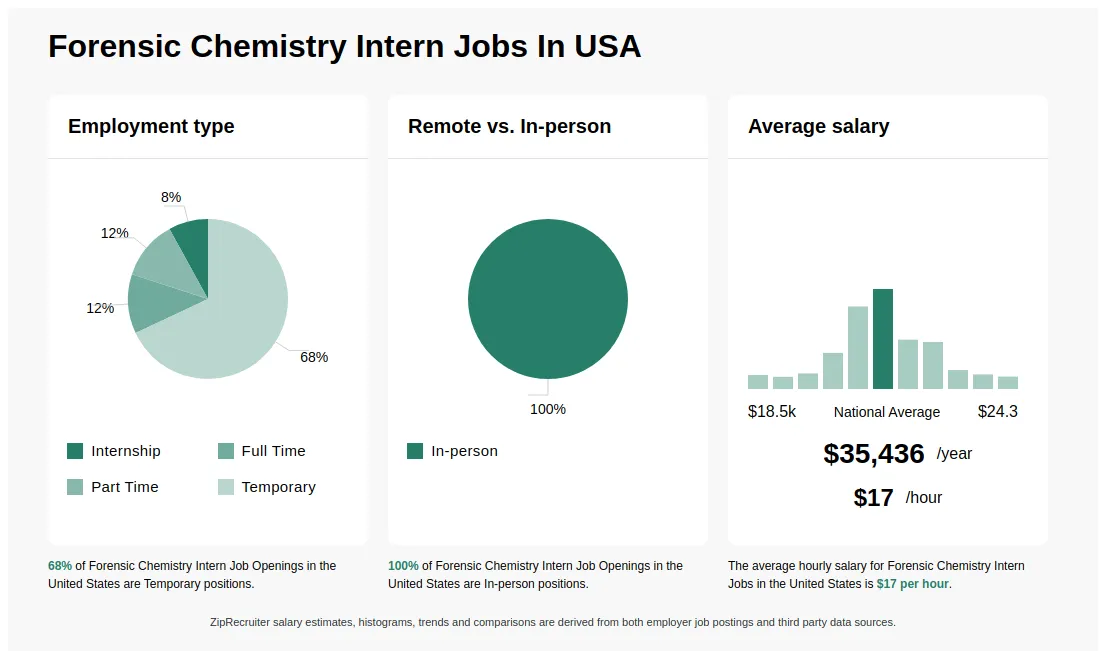
How much do forensic chemistry intern jobs pay per hour?

As of Jul 19, 2026, the average hourly pay for forensic chemistry intern in the United States is $17.04, according to ZipRecruiter salary data. Most workers in this role earn between $14.42 and $19.23 per hour, depending on experience, location, and employer.

What kinds of projects or casework might a Forensic Chemistry Intern typically assist with?

As a Forensic Chemistry Intern, you may support casework involving the analysis of physical evidence such as drugs, toxicology samples, or trace materials collected from crime scenes. You'll likely assist with tasks like preparing chemical reagents, running instrumental analyses under supervision, maintaining detailed records, and helping to interpret experimental results. Interns often collaborate with experienced forensic chemists and other lab staff, gaining exposure to real-world casework and the scientific process behind evidence analysis. This experience not only builds technical skills but also offers valuable insight into the daily responsibilities within a forensic laboratory environment.

What does a Forensic Chemistry Intern do?

A Forensic Chemistry Intern assists forensic scientists in analyzing physical and chemical evidence for criminal investigations. They may conduct lab tests on substances like drugs, toxins, or biological samples, using techniques such as chromatography or spectroscopy. Interns help maintain lab equipment, document findings, and follow strict safety and legal protocols. This role provides hands-on experience in forensic analysis and can be a stepping stone to a career in forensic science.

What are the key skills and qualifications needed to thrive in the Forensic Chemistry Intern position, and why are they important?

To excel as a Forensic Chemistry Intern, a solid background in chemistry, attention to detail, and a basic understanding of laboratory protocols are required, typically supported by coursework in analytical or forensic chemistry. Familiarity with laboratory instruments such as gas chromatographs, mass spectrometers, and data management systems is often advantageous. Strong analytical thinking, effective communication, and the ability to work both independently and collaboratively will help you stand out. These skills are crucial for ensuring the accuracy, reliability, and integrity needed in forensic investigations.

More about Forensic Chemistry Intern jobs
What cities are hiring for Forensic Chemistry Intern jobs? Cities with the most Forensic Chemistry Intern job openings:
What are the most commonly searched types of Forensic Chemistry jobs? The most popular types of Forensic Chemistry jobs are:
What states have the most Forensic Chemistry Intern jobs? States with the most job openings for Forensic Chemistry Intern jobs include:

Other

Re-posted 6 days ago


Job description


Idaho National Laboratory University/College Internships-Nuclear Nonproliferation

Typical Degree Programs Sought Include: (Nuclear Engineering, Analytical Chemistry, Materials Science & Engineering, Chemical Engineering, Physics, and Forensics)
 
Please note that if you are interested in other INL internship categories in addition to this one, you will need to complete the application for each of those categories as well. Most of the information you provide while completing the initial application carries over to your new applications. You will have to review your previously submitted information in each step, ensure it is complete and then click the submit button on the final step.
 

The Opportunity:


Internships at Idaho National Laboratory  

Idaho National Laboratory (INL) hosts over 300 undergraduate and graduate students each year to support INL's mission.  Opportunities for interns at INL range from nuclear engineering to cybersecurity and include non-scientific positions in various operations and business disciplines.

Join INL's team and find your exceptional educational experience in a real-world work environment.  INL offers a unique opportunity to learn, collaborate, innovate and conduct research with top researchers and professionals.

The Deliverables:

Interns will spend the first week of their assignment working with their mentor to outline their work scope and to secure resources for a successful internship.  For the next several weeks, the mentor will provide considerable program assistance and guidance to the intern.  In addition to regular activities, interns are invited to attend weekly seminars, tours and community events designed with career development in mind.  Completion of a final project is highly recommended and can be completed through a variety of mediums - a traditional poster, electronic presentation or video.

The Process:

Through this single application, you are considered for all internship projects related to INL Nuclear Nonproliferation (Nuclear Nonproliferation. Simply complete the application questions which will help us identify what knowledge and experience you already have that may be related to the preferred qualifications for each individual internship project. It is common for applicants to receive consideration for multiple projects at varying times throughout the process. Mentors will make direct contact with applicants who meet their project qualifications to share the specific details of the project. On average, INL plans for approximately 300 internships each year.  Most internships provide flexibility with start and end dates to account for varying university term schedules.  We encourage early applications to increase the number of opportunities available to you.

The Projects:

Internship projects may focus on a wide variety of nonproliferation. INL operates unique assets to support a broad range of technology testing and evaluation to assist in the safeguarding and securing nuclear materials and facilities. Below are descriptions of the type of projects a student may work on:

--Support accelerator-based production of short-lived fission products and photonuclear production of isotopes. Experience with radiation detection, high-purity germanium detectors, data acquisition, photonuclear physics, and Monte-Carlo particle transport modeling is desired. Previous internship experience at a national laboratory is also desired.

--Support modeling and data collection for a project to characterize and analyze irradiated fuel using a high purity gamma ray detector.

--Support the Advance Test Reactor Low Enriched Uranium Fuel Conversion Project in defining technical and functional requirements for new and modified tools and equipment. Work with others to complete a conceptual design Chemistry or Analytical Chemistry summer intern. The student will perform sample preparation, separations, and analyses of environmental samples. A strong background in Analytical Chemistry is desired. Experience working with environmental samples (digestions, extractions, separations, etc) is also desired. The student must be a U.S. citizen and be able to pass a background check. of the ancillary tools and equipment needed for conversion of the reactor

Required Qualifications:
All Internship Candidates Must:
  • Have the ability to pass a background check
  • Possess a minimum overall 3.0 Grade Point Average (GPA)
  • Complete this application, which is used to place students based on their academic interests, coursework, knowledge and communication skills
  • Enrolled full time student status at an accredited college or university (undergraduate, graduate, PhD).
Note:  Many INL community college interns are hired through the U.S. Department of Energy's Community College Internship Program. We recommend you also apply to DOE's Internship Program at http://science.energy.gov/wdts/cci/
 
Helpful Tips to Prepare You for Your INL Internship Application:
  1. Current resume or Curriculum Vitae (CV)
  2. Unofficial Transcripts (include current and completed degree programs)
  3. Current class schedule and number of credits
Recommendations:
  • Work with your career center to develop a resume or CV that is functional (this is your opportunity for a first impression)
  • Review the INL website and learn more about our business and research programs and how they could enrich your degree plan https://www.inl.gov/
  • Ask your professors if they have collaborated on INL research programs and seek their permission to list them as a reference
  • Review the INL Academic Partnerships web site for valuable information on our internship programs  https://www.inl.gov/inl-initiatives/education/
Internship Programs Specialists: 
 Ali Josephson (ali.josephson@inl.gov)         Brian Rucks (brian.rucks@inl.gov)
Delisa Rogers (delisa.rogers@inl.gov)          Myken Johnson (myken.johnson@inl.gov)      Thomas Steele (thomas.steele@inl.gov)
 
Equal Employment Opportunity
 
Idaho National Laboratory (INL) is an Equal Employment Opportunity (EEO) employer.  It is the policy of INL to provide equal employment opportunities to all qualified applicants without regard to race, color, religion, sex, sexual orientation, gender identity, national origin, age, protected veteran or disabled status, or genetic information.