1

Fish Processor Jobs in Alaska (NOW HIRING)

... process Uphold a high level of confidentiality of fishermen and company records. Other administrative and/or fish buying duties as assigned Follow all company policies and procedures while ...

next page

Showing results 1-20

Fish Processor information

See Alaska salary details

$9

$18

$27

How much do fish processor jobs pay per hour?

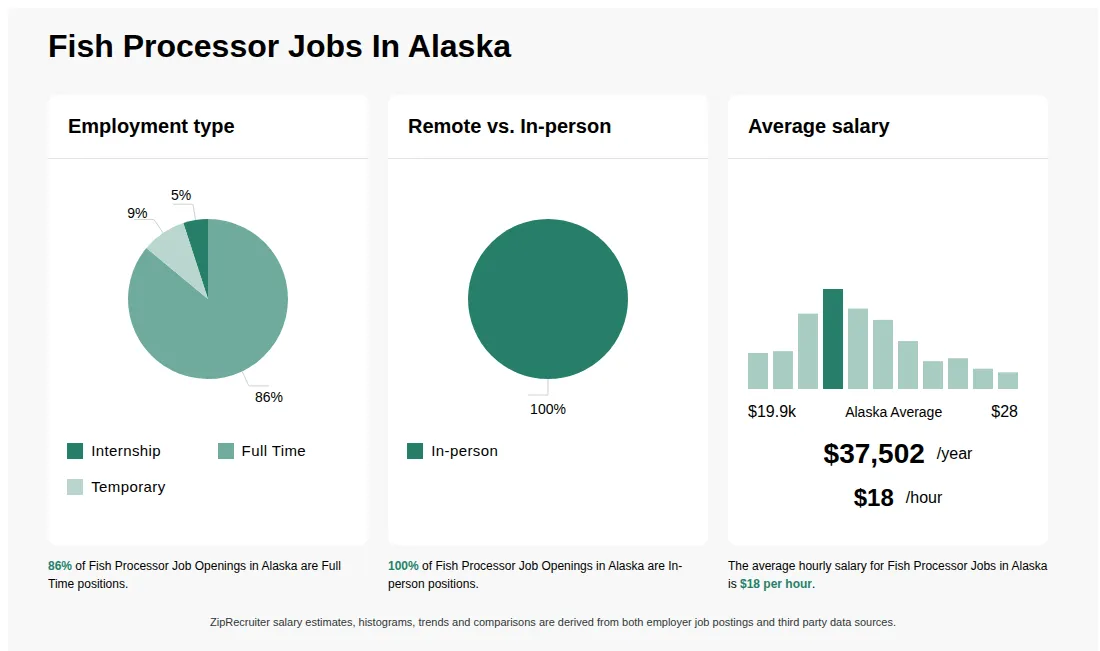
As of May 29, 2026, the average hourly pay for fish processor in Alaska is $18.03, according to ZipRecruiter salary data. Most workers in this role earn between $14.52 and $20.72 per hour, depending on experience, location, and employer.

What is a Fish Processor job?

A Fish Processor is responsible for cleaning, cutting, and packaging fish and seafood products in processing plants or on fishing vessels. Duties often include gutting, filleting, scaling, and inspecting fish for quality before packaging for distribution. The job requires standing for long hours in cold, wet environments and following strict hygiene and safety regulations. Fish Processors play a crucial role in ensuring seafood products meet industry standards and consumer expectations.

What are the key skills and qualifications needed to thrive in the Fish Processor position, and why are they important?

To thrive as a Fish Processor, you need manual dexterity, attention to detail, and the ability to handle repetitive tasks, often with a high school diploma or equivalent preferred. Experience with cutting tools, conveyor belts, scales, and adherence to food safety protocols or certifications (such as HACCP) is commonly required. Strong teamwork, reliability, and stamina under physically demanding conditions are key soft skills for this position. These skills and qualities ensure efficient, safe, and high-quality seafood processing in a fast-paced, production-oriented environment.

What is the typical work environment and schedule for a Fish Processor?

Fish Processors usually work in seafood processing plants or on fishing vessels, often in cold, wet, and fast-paced settings where safety gear is required. The role can involve standing for long periods, lifting boxes of fish, and handling various processing equipment. Schedules can vary depending on the employer and the season, but overtime and night shifts are common—especially during peak fishing periods. Teamwork is essential, as Fish Processors frequently collaborate with other processors, quality control staff, and supervisors to meet production targets and maintain product quality. This dynamic environment suits individuals who are adaptable and comfortable with physically demanding tasks.
What are the most commonly searched types of Fish Processor jobs in Alaska? The most popular types of Fish Processor jobs in Alaska are:
What are popular job titles related to Fish Processor jobs in Alaska? For Fish Processor jobs in Alaska, the most frequently searched job titles are:
What job categories do people searching Fish Processor jobs in Alaska look for? The top searched job categories for Fish Processor jobs in Alaska are:
What cities in Alaska are hiring for Fish Processor jobs? Cities in Alaska with the most Fish Processor job openings:
Infographic showing various Fish Processor job openings in Alaska as of May 2026, with employment types broken down into 66% Full Time, 31% Part Time, 2% Temporary, and 1% Contract. Highlights an 96% Physical, 2% Hybrid, and 2% Remote job distribution, with an average salary of $37,502 per year, or $18 per hour.

Other

Posted 9 days ago


Job description

Description

Fish Processor

*This is a full-time, year-round position located in Juneau, Alaska. Housing and/or Transportation is not included*


Department: Alaska Seafoods

Location: Juneau

Exemption Status: Non-Exempt


Purpose: The Fish Processing Worker is responsible for performing various tasks involved in the processing and packaging of fish and seafood products. This role involves working in a fast-paced environment to ensure the highest standards of quality, hygiene, and safety are maintained throughout the processing stages.


Essential Functions. An individual in this role must be able to perform the following functions with or without reasonable accommodation:

Fish Cleaning and Filleting: Clean, scale, and fillet fish according to established procedures and specifications.

Packaging: Package processed fish and seafood products efficiently and in accordance with labeling and packaging guidelines.

Equipment Operation: Safely and efficiently operate processing equipment, including cutters, grinders, and other machinery, to prepare fish products. Perform routine maintenance and report any malfunctions to maintenance personnel.

Sanitation: Maintain cleanliness and sanitation of work areas, equipment, and tools to prevent contamination and ensure a safe working environment.

Quality Control: Inspect fish for quality, freshness, and defects and ensure they meet company and regulatory standards. Report any issues or discrepancies to the supervisor.

Documentation: Document processing activities, including quantities, quality checks, production metrics, inventory levels, and any issues encountered during processing.

Safety Compliance: Adhere to all safety protocols and guidelines to ensure personal safety and the safety of team members.

Team Collaboration: Work collaboratively with other team members to meet production goals and ensure efficient processing. Communicate effectively with supervisors and co-workers.

Physical Requirements: Ability to lift and carry heavy items, stand for extended periods, and work in a cold environment.

Other duties as assigned.


Requirements

Knowledge, Skills & Abilities. A comprehensive set of capabilities required to perform job tasks effectively:

Ability to handle and process fish and seafood products efficiently.

Strong attention to detail to ensure high-quality product.

Good organizational and time-management skills.

Ability to work in a fast-paced environment, across different processing functions.

Knowledge of food safety standards and regulations.

Ability to adhere to hygiene and sanitation practices. 


Minimum Qualifications (education, experience, skills):

High school diploma or equivalent

One (1) experience in fish processing or a related field is advantageous but not required; on-the-job training will be provided.


Preferred Qualifications (education, experience, skills):

N/A


Physical Requirements. The physical demands described here are representative of those that must be met by an employee to successfully perform the essential functions of this job with or without reasonable accommodation:

The majority of work is performed in a cannery setting requiring routine walking, standing, bending, and carrying of items weighing less than 70 lbs.


Work Environment. The work environment characteristics described here are representative of those an employee encounters while performing the essential functions of this job:

Some travel may be required on small aircraft or ferry.  

Certain positions at Tlingit and Haida may have exposure to certain hazardous materials or conditions.  The supervisor will review these if applicable.