1

Environmental Ecology Jobs (NOW HIRING)

Requirements • Minimum BA or BS in Environmental, Ecology, or Biology. • 2 to 5 years of experience in delineation, permitting, monitoring, and/or construction oversight • Familiarity with ...

Environmental Monitor

Albany, NY · On-site

$23 - $25/hr

Requirements • Minimum BA or BS in Environmental, Ecology, or Biology. • 2 to 5 years of experience in delineation, permitting, monitoring, and/or construction oversight • Familiarity with ...

Environmental Monitor

Ithaca, NY · On-site

$23 - $25/hr

Requirements Minimum BA or BS in Environmental, Ecology, or Biology. 2 to 5 years of experience in delineation, permitting, monitoring, and/or construction oversight Familiarity with NYSDEC ...

Requirements Minimum BA or BS in Environmental, Ecology, or Biology. 2 to 5 years of experience in delineation, permitting, monitoring, and/or construction oversight Familiarity with NYSDEC ...

Environmental Monitor

Rochester, NY · On-site

$23 - $25/hr

Requirements Minimum BA or BS in Environmental, Ecology, or Biology. 2 to 5 years of experience in delineation, permitting, monitoring, and/or construction oversight Familiarity with NYSDEC ...

Requirements • Minimum BA or BS in Environmental, Ecology, or Biology. • 2 to 5 years of experience in delineation, permitting, monitoring, and/or construction oversight • Familiarity with ...

Requirements • Minimum BA or BS in Environmental, Ecology, or Biology. • 2 to 5 years of experience in delineation, permitting, monitoring, and/or construction oversight • Familiarity with ...

next page

Showing results 1-20

Environmental Ecology information

See salary details

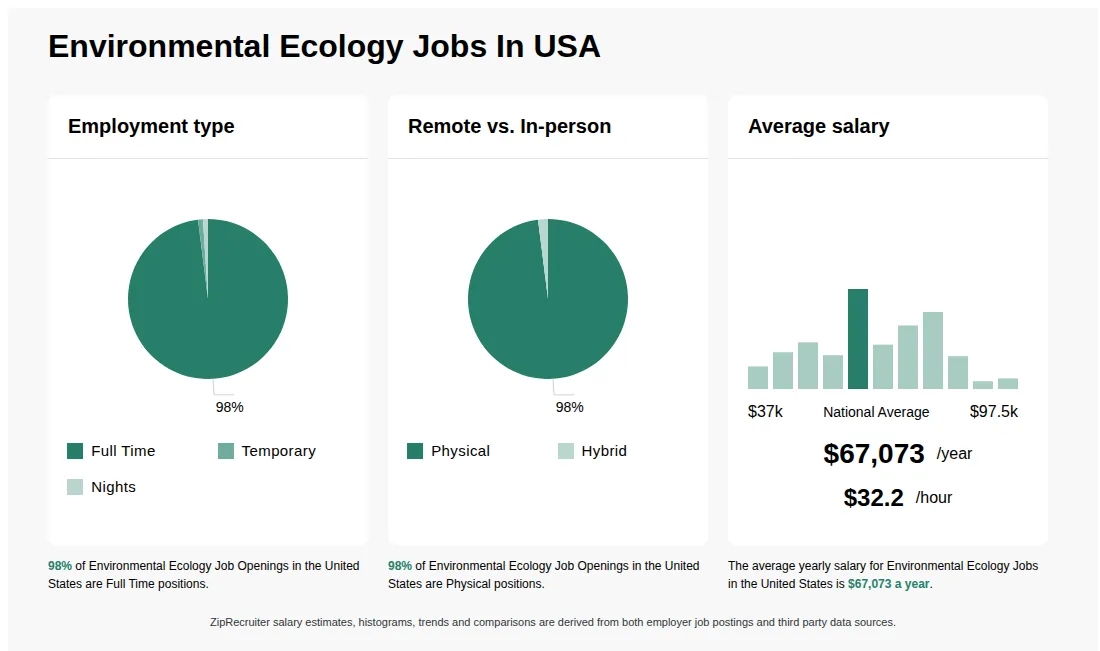
$37K

$67.1K

$97.5K

How much do environmental ecology jobs pay per year?

As of Jul 13, 2026, the average yearly pay for environmental ecology in the United States is $67,073.00, according to ZipRecruiter salary data. Most workers in this role earn between $56,000.00 and $80,000.00 per year, depending on experience, location, and employer.

What is the difference between Environmental Ecology vs Environmental Scientist?

AspectEnvironmental EcologyEnvironmental Scientist
Required CredentialsBachelor's or Master's in Ecology, Environmental Science, or related fieldsBachelor's or higher in Environmental Science, Biology, or related disciplines
Work EnvironmentFieldwork, research labs, environmental agenciesResearch institutions, government agencies, consulting firms
Industry UsageFocuses on ecosystems, species interactions, habitat conservationBroader environmental issues, policy, impact assessments

Environmental Ecology primarily concentrates on ecosystems and species interactions, often involving field research and habitat conservation. In contrast, Environmental Scientists have a broader scope, addressing various environmental issues, conducting impact assessments, and working in diverse settings. Both roles require similar educational backgrounds but differ in focus and application.

What is the highest paying ecology job?

The highest paying ecology jobs are often in environmental consulting, ecological research leadership, or senior roles in conservation organizations, with salaries exceeding $100,000 annually. Positions requiring advanced degrees, specialized skills, and management responsibilities tend to offer the highest compensation in the field.

What are 5 potential jobs for ecology?

Five potential jobs in ecology include environmental scientist, conservation biologist, wildlife biologist, ecological consultant, and park ranger. These roles often require fieldwork, data analysis, and knowledge of ecosystems, with some positions needing specialized certifications or advanced degrees. They are typically based in natural settings, research facilities, or government agencies.

What are the key skills and qualifications needed to thrive as an Environmental Ecologist, and why are they important?

To thrive as an Environmental Ecologist, you need a solid background in ecological principles, environmental science, and data analysis, typically supported by a relevant degree such as ecology, biology, or environmental science. Familiarity with GIS software, statistical analysis tools, and field sampling equipment is commonly required. Strong problem-solving abilities, teamwork, and effective communication skills distinguish top performers in this field. These competencies are crucial for conducting impactful research, interpreting complex ecological data, and collaborating on sustainable environmental solutions.

What are some typical challenges environmental ecologists face when working on field research projects?

Environmental ecologists often encounter challenges such as unpredictable weather conditions, difficult terrain, and logistical hurdles while conducting field research. They must also ensure accurate data collection and minimize disturbances to natural habitats, which can be demanding in remote or sensitive environments. Collaboration with landowners, government agencies, and interdisciplinary teams is crucial for gaining access to sites and integrating diverse expertise. Effective planning, adaptability, and strong communication skills help address these challenges and ensure successful research outcomes.

What biology jobs pay over $100k?

Environmental ecology professionals such as senior environmental consultants, environmental managers, and conservation directors can earn over $100,000 annually, especially with advanced degrees and extensive experience. These roles often require strong analytical skills, knowledge of environmental regulations, and proficiency with data analysis tools.

What is environmental ecology?

Environmental ecology is the scientific study of how living organisms interact with each other and their physical environment. It explores the relationships between plants, animals, humans, and their surroundings, focusing on topics like biodiversity, ecosystems, and the impact of human activities on nature. Environmental ecologists work to understand and address issues such as pollution, climate change, and habitat loss, aiming to promote sustainability and conservation.

What do environmental ecologists do?

Environmental ecologists study the relationships between organisms and their environments to understand ecological processes and how human activities impact ecosystems. They conduct field research, analyze data, and develop conservation strategies using tools like GIS and statistical software. Their work often involves monitoring biodiversity, assessing environmental health, and advising on sustainable practices.
More about Environmental Ecology jobs
What cities are hiring for Environmental Ecology jobs? Cities with the most Environmental Ecology job openings:
What states have the most Environmental Ecology jobs? States with the most job openings for Environmental Ecology jobs include:

Sr. Environmental/ Ecological Project Manager

Groundwater and Environmental Svcs.

New Hudson, MI • On-site

Full-time

Medical, Dental, Vision, Retirement

Posted 20 days ago


Job description

We are seeking an experienced and motivated Principal Environmental/ Ecological Project Manager & Office Lead to guide and manage our local environmental operations and our regional environmental/ ecological needs.


The primary focus of this position’s duties and responsibilities is on the technical aspects of diverse environmental and ecological projects. This individual provides principal project support activities, including work plan and proposal preparation, project resource management and scheduling, deadline tracking, budget evaluation and analysis, and technical editing and report finalization. This position also requires a local to regional field presence, while also including national presence on a large Ecological Team. The position requires daily management of project/site assigned staff. Under limited supervision, the Principal Environmental/ Ecological Project Manager & Office Lead plans, executes, supervises, and documents field aspects of highly complex ecological projects (permitting, ecological restoration, delineations, determinations, NEPA, etc.), support environmental remediation, and support construction observation, to include all aspects of post remediation ecological restoration, mitigation banking, nutrient banking, permitting, permitting support, reporting, etc. The individual in this position must be a multi-tasked, detail-oriented team player, and possess excellent skills in verbal and written communications, time management, organizational management, problem solving, decision making, and leadership.


Key Responsibilities

  • Contribute to strategic planning and growth of ecological services
  • Lead and manage the day-to-day operations of the local office
  • Oversee regional ecological assessments, surveys, and environmental impact studies
  • Provide technical leadership and mentorship to staff
  • Ensure high-quality project delivery, on time and within budget
  • Develop and maintain client relationships and support business development
  • Ensure compliance with environmental regulations, policies, and best practices
  • Collaborate with multidisciplinary teams on infrastructure and land-use projects

Qualifications & Experience

  • Degree in Ecology, Biology, Agricultural Sciences, Soil Science, Environmental Science, Geology or related discipline
  • 15+ years of professional ecological (required) Extensive knowledge in 401/404 permitting, WOTUS Delineations, CWA, NEPA, ESA/T&E species, FERC, etc.) or other similarly aligned ecological disciplines- Stream Restoration, wetland restoration or other restoration discipline a plus
  • Demonstrated experience leading teams and managing projects
  • Strong knowledge of ecological laws, legislation and regulatory frameworks
  • Experience with field surveys, habitat assessments, and reporting
  • Interacts with other project support services (technical services, professional, engineering, administrative) and subcontractors to ensure all resources are in place for proper fieldwork execution
  • Mastery knowledge of applicable standard operating procedures (SOPs) related to all field activities and relevant regulatory programs and the willingness to learn and master other state regulatory programs as necessary
  • Acts as the primary author for site work plans, proposals, and reports for highly complex scopes of work, including permits, NEPA/FERC documents, delineation reports, ecological restoration plans, compensatory migration plans and strategies, etc.
  • Excellent communication and stakeholder management skills
  • Adheres to client contract specifications in all field-related activities and informs project group of those specifications
  • Manages procurement of subcontractors and vendors for completion of project tasks, including subcontractor/vendor bid package development
  • Must complete annual refresher OSHA HAZWOPER training and be able to wear required PPE
  • Must maintain a valid drivers’ license and acceptable driving record

Skills & Competencies

  • Strong leadership and organizational skills
  • Strategic thinking with a solutions-focused approach
  • High attention to detail and scientific rigor
  • Ability to manage multiple priorities in a dynamic environment
  • Commitment to sustainability and environmental stewardship

Our comprehensive benefits include: Hybrid workforce, medical, dental, vision, prescription card, 401k, FSA, LTD, STD, New Parent Leave, 529 CollegeBound Fund, Tuition Assistance, Bonus Plan, and more.

Groundwater & Environmental Services, Inc. (GES) believes that diversity and inclusion among our staff is critical to our success, and we seek to recruit, develop and retain the most talented people from a diverse candidate pool. At GES, we are committed to providing an environment of mutual respect where equal employment opportunities are available to all applicants and employees without regard to race, color, religion, gender, pregnancy, national origin, age, disability, marital status, sexual orientation, gender identity or expression, military and veteran status, and any other characteristic protected by law.