2

Entry Level Video Game Producer Jobs (NOW HIRING)

Producer/Director

Houston, TX · On-site

$118K - $120K/yr

The Commercial Producer is responsible for the development and production of promotional content ... video and audio, and manipulate design and motion graphics. Candidates need to be well versed in ...

Producer/Director

Houston, TX

$118K - $120K/yr

The Commercial Producer is responsible for the development and production of promotional content ... video and audio, and manipulate design and motion graphics. Candidates need to be well versed in ...

Producer

Lexington, KY · On-site

$122K - $124K/yr

Producer Used by more than two million people each week, KET is Kentucky's only statewide media ... Experience with professional video cameras is required. Editing experience and directing finishing ...

Junior Producer

Campus, IL

$120K - $122K/yr

Junior Producer Apply now Job no: 495191 Work type: Fixed-term (Full-time) Location: Main campus ... video editing towards the seamless development of episodes that educate and inform the public ...

Video Game Department Lead

San Francisco, CA · On-site

$146K - $148K/yr

Company Description As a website that covers multiple mediums that millions of people are highly enthusiastic for, Entertainment Fuse is seeking experienced and talented writers. This position calls ...

Producer

Lexington, KY · On-site

$122K - $124K/yr

Producer Used by more than two million people each week, KET is Kentucky's only statewide media ... Experience with professional video cameras is required. Editing experience and directing finishing ...

next page

Showing results 1-20

Entry Level Video Game Producer information

See salary details

$61.5K

$127K

How much do entry level video game producer jobs pay per year?

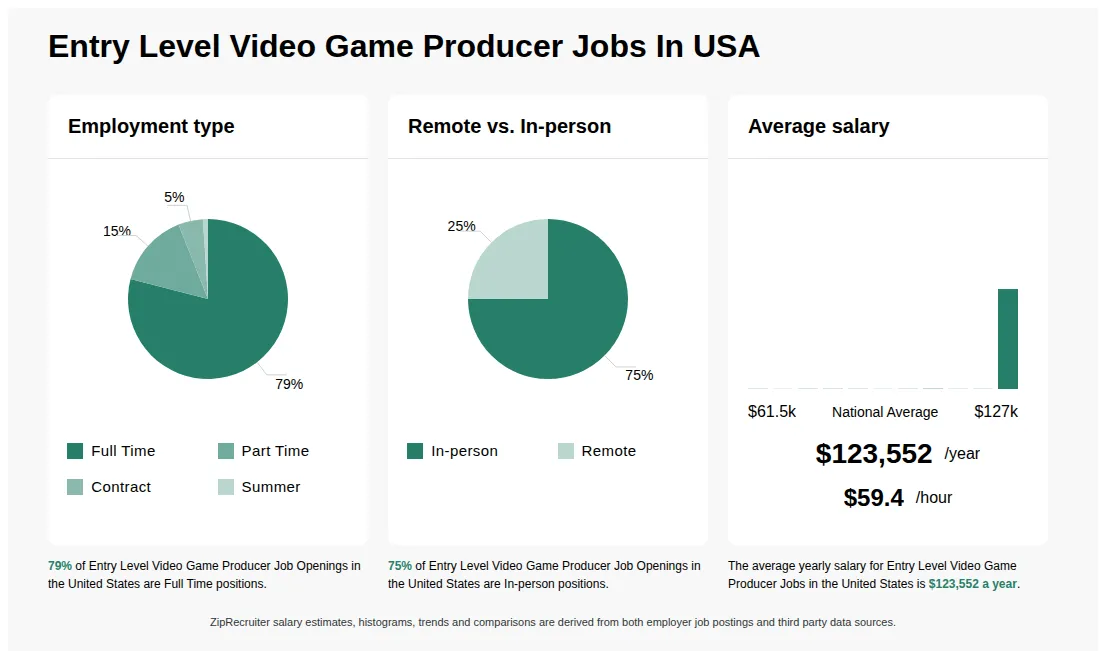
As of Jun 30, 2026, the average yearly pay for entry level video game producer in the United States is $123,552.00, according to ZipRecruiter salary data. Most workers in this role earn between $124,000.00 and $126,000.00 per year, depending on experience, location, and employer.

What are the key skills and qualifications needed to thrive as an Entry Level Video Game Producer, and why are they important?

To thrive as an Entry Level Video Game Producer, you need a solid understanding of project management, basic game development concepts, and excellent organizational skills, often backed by a degree in game design, computer science, or a related field. Familiarity with project management tools like Jira or Trello, and knowledge of game engines such as Unity or Unreal Engine, are typically required. Strong communication, problem-solving, and teamwork abilities help you coordinate effectively with diverse teams and stakeholders. These skills ensure smooth project execution, timely delivery, and successful collaboration in the fast-paced game development environment.

What are some common challenges faced by entry level video game producers in their first year?

Entry level video game producers often encounter challenges such as balancing multiple tasks, adapting to fast-changing project requirements, and learning effective communication across multidisciplinary teams. Navigating tight deadlines while ensuring that both creative and technical goals are met can be demanding, especially when coordinating between developers, artists, and QA testers. However, these experiences provide invaluable learning opportunities and help build the organizational and leadership skills necessary for career advancement.

What is the difference between Entry Level Video Game Producer vs Junior Game Designer?

AspectEntry Level Video Game ProducerJunior Game Designer
Required CredentialsBachelor's degree in game design, computer science, or related field; some project management certificationsBachelor's degree in game design, computer science, or related field; portfolio of game projects
Work EnvironmentCollaborates with development teams, manages schedules, and oversees project progressCreates game concepts, designs gameplay mechanics, and develops prototypes
Industry UsageCommonly employed in game studios to coordinate productionUsed in game studios to develop game ideas and mechanics

While both roles require a background in game development, an Entry Level Video Game Producer focuses on managing projects and coordinating teams, whereas a Junior Game Designer concentrates on creating game concepts and mechanics. The producer ensures timely delivery, while the designer shapes the game's creative aspects.

What does an Entry Level Video Game Producer do?

An Entry Level Video Game Producer assists in coordinating various aspects of game development, such as scheduling, communication between departments, and tracking project milestones. They help ensure that the team stays on schedule and that the project meets its goals. Their responsibilities might include organizing meetings, updating documentation, and assisting with quality assurance tasks. While they may not make major creative decisions, they play a vital role in keeping the development process running smoothly.
More about Entry Level Video Game Producer jobs
What cities are hiring for Entry Level Video Game Producer jobs? Cities with the most Entry Level Video Game Producer job openings:
What are the most commonly searched types of Video Game Producer jobs? The most popular types of Video Game Producer jobs are:
What states have the most Entry Level Video Game Producer jobs? States with the most job openings for Entry Level Video Game Producer jobs include:
What job categories do people searching Entry Level Video Game Producer jobs look for? The top searched job categories for Entry Level Video Game Producer jobs are:
Infographic showing various Entry Level Video Game Producer job openings in the United States as of June 2026, with employment types broken down into 1% Internship, 50% Full Time, 1% Part Time, 1% Temporary, and 47% Contract. Highlights an 88% Physical, 2% Hybrid, and 10% Remote job distribution, with an average salary of $123,552 per year, or $59.4 per hour.

Founding AI / Motion Video Producer

Loop AI

San Francisco, CA

$146K - $148K/yr

Contractor

Posted 25 days ago


Key responsibilities

  • Develop and own Loop's video design language, including visual style, brand voice, reusable clip library, and video templates.

  • Build and operate an AI-leveraged video production pipeline that enables rapid creation of templated customer education videos.

  • Translate raw context such as synopses, briefs, and customer call recordings into scripts, storyboards, and finished videos.


Job description

About Loop AI:
 

Loop AI is an agentic restaurant intelligence software that augments the back office of restaurant chains by automating workflows and delivering intelligence across the finance, operations and marketing functions. Loop deploys AI agents built by our in-house team of AI engineers, strategists and subject matter experts into restaurant brands - bringing industry best practices in handling complex internal functions. We have offices in San Francisco, New York, Tampa and India.

Loop is one of the fastest growing restaurant technology companies powering a few billion dollars in revenue and growing to serve 10K+ restaurants within 3 years across some of the most recognizable brands of the USA (McDonald’s, Burger King, Sweetgreen, Dave’s Hot Chicken - to name a few), helping them grow their topline & bottomline.

Loop is built by a world class team of entrepreneurs, operators, leaders and AI engineers from different industries, ranging from cutting edge big-tech, management consulting, investment banking among others across companies like Uber, Google, Amazon, McKinsey and others.

About the Role:

You're here to define how Loop talks to its customers on screen - and to build the AI-leveraged engine that does it at the pace we ship product.

Loop's products power a few billion dollars in delivery revenue and are landing in the hands of tens of thousands of restaurant operators. Most of them don't have the time to read through docs - they learn through video, on a phone, between shifts, with a delivery tablet in the other hand. The version of customer education that wins for Loop is video-first. The version of that system that works at our scale is templated and AI-leveraged.

The person we want thinks in three lenses at once:

  • The base - the design language and clip library that everything is built off

  • The pipeline - the workflow (AI-leveraged or otherwise) that turns idea into finished video in hours/days, not weeks

  • Scalability - the system that survives weekly product change and scales to hundreds of customers without rebuilding from zero

You'll be working with the agent owners, the GMs, and the CSMs - figuring out what an operator actually needs to see, then templatizing and pipelining it so we never re-invent.

What you'll own
  • The base. Loop's video design language - visual style, brand voice on camera, sound, reusable clip library, templates for the recurring video shapes (onboarding, training, per-customer value, agent walkthroughs).

  • The pipeline. The AI-leveraged production stack - pair the templates with the right model and editing layer (After Effects, Remotion, Runway, Veo, Kling, Claude skills, Clueso, etc.) so a per-customer video takes hours/days, not weeks.

  • The translation. Take raw context - synopses, pod owner briefs, customer call recordings — and turn it into the script, storyboard, and finished video. The leap from "what we want to teach" to "what an operator actually finishes watching" is where this role exists.

  • Scalability. A workflow others can run - standards docs, prompt libraries, model handoffs, the rebuild-resistant approach that survives Loop shipping product weekly.

  • The proving set. 15-20 on-brand 60-90 sec explainers in the first phase (30 days) 

The quality bar. Push back on off-brand work. If it ships under your name and it's flat or off, that's on you.
What you've done before:
  • Produced product or brand video at a SaaS / consumer / agency context where the bar was high and the cadence was real 

  • Built a template / system / design language for video - not just shipped individual assets. You've already proved you can scale yourself

  • Fluent across the traditional (After Effects, Premiere Pro) and modern AI-video stack - Remotion, Runway, Veo, Kling, Claude skills, etc.. You have a point of view on when to use which (programmatic vs. gen video vs. voice clone vs. editing assistant) and you've shipped on it. Sometimes the answer is After Effects. Sometimes it is Remotion. Sometimes it is a clean screen recording with smart annotations. Sometimes it is a reusable template that can generate 50 customer-specific variants. You should know the difference.

  • Worked in-person with product and GTM teams to extract context and translate it into video - fast

  • Held the quality bar against deadline pressure. The answer to "ship it ugly" is a no from you

Engagement shape:
 
  • Contract: 2 months to start, extendable based on output. Open to a longer term if it works on both sides.

  • Hybrid. The work depends on being in the room with the people (at least a few in-person sprints) who own the product surface and the customer calls. 

  • Compensation. Tell us what you need to do it well - rate, tools, model credits - and we work back from the outcome.

We may use artificial intelligence (AI) tools to support parts of the hiring process, such as reviewing applications, analyzing resumes, or assessing responses and identifying potential inconsistencies or verification signals in application materials based on available information. These tools assist our recruitment team but do not replace human judgment. Final hiring decisions are ultimately made by humans. If you would like more information about how your data is processed, please contact us.