In order to reach this goal, experienced traders work with entry level traders in an extensive trade review program after the market close each day. Traders are educated in the nuances of technical ...
In order to reach this goal, experienced traders work with entry level traders in an extensive trade review program after the market close each day. Traders are educated in the nuances of technical ...
In order to reach this goal, experienced traders work with entry level traders in an extensive trade review program after the market close each day. Traders are educated in the nuances of technical ...
In order to reach this goal, experienced traders work with entry level traders in an extensive trade review program after the market close each day. Traders are educated in the nuances of technical ...
In order to reach this goal, experienced traders work with entry level traders in an extensive trade review program after the market close each day. Traders are educated in the nuances of technical ...
In order to reach this goal, experienced traders work with entry level traders in an extensive trade review program after the market close each day. Traders are educated in the nuances of technical ...
In order to reach this goal, experienced traders work with entry level traders in an extensive trade review program after the market close each day. Traders are educated in the nuances of technical ...
In order to reach this goal, experienced traders work with entry level traders in an extensive trade review program after the market close each day. Traders are educated in the nuances of technical ...
We are recruiting hardworking, entrepreneurial entry level-traders for remote positions in our nationwide Trading Group. Trading with T3TG Our goal is to help every trader maximize their potential ...
We are recruiting hardworking, entrepreneurial entry level-traders for remote positions in our nationwide Trading Group. Trading with T3TG Our goal is to help every trader maximize their potential ...
We are recruiting hardworking, entrepreneurial entry level-traders for remote positions in our nationwide Trading Group. Trading with T3TG Our goal is to help every trader maximize their potential ...
We are recruiting hardworking, entrepreneurial entry level-traders for remote positions in our nationwide Trading Group. Trading with T3TG Our goal is to help every trader maximize their potential ...
We are recruiting hardworking, entrepreneurial entry level-traders for remote positions in our nationwide Trading Group. Trading with T3TG Our goal is to help every trader maximize their potential ...
We are recruiting hardworking, entrepreneurial entry level-traders for remote positions in our nationwide Trading Group. Trading with T3TG Our goal is to help every trader maximize their potential ...
We are recruiting hardworking, entrepreneurial entry level-traders for remote positions in our nationwide Trading Group. Trading with T3TG Our goal is to help every trader maximize their potential ...
We are recruiting hardworking, entrepreneurial entry level-traders for remote positions in our nationwide Trading Group. Trading with T3TG Our goal is to help every trader maximize their potential ...
We are recruiting hardworking, entrepreneurial entry level-traders for remote positions in our nationwide Trading Group. Trading with T3TG Our goal is to help every trader maximize their potential ...
We are recruiting hardworking, entrepreneurial entry level-traders for remote positions in our nationwide Trading Group. Trading with T3TG Our goal is to help every trader maximize their potential ...
We are recruiting hardworking, entrepreneurial entry level-traders for remote positions in our nationwide Trading Group. Trading with T3TG Our goal is to help every trader maximize their potential ...
We are recruiting hardworking, entrepreneurial entry level-traders for remote positions in our nationwide Trading Group. Trading with T3TG Our goal is to help every trader maximize their potential ...
We are recruiting hardworking, entrepreneurial entry level-traders for remote positions in our nationwide Trading Group. Trading with T3TG Our goal is to help every trader maximize their potential ...
We are recruiting hardworking, entrepreneurial entry level-traders for remote positions in our nationwide Trading Group. Trading with T3TG Our goal is to help every trader maximize their potential ...
In order to reach this goal, experienced traders work with entry level traders in an extensive trade review program after the market close each day. Traders are educated in the nuances of technical ...
In order to reach this goal, experienced traders work with entry level traders in an extensive trade review program after the market close each day. Traders are educated in the nuances of technical ...
In order to reach this goal, experienced traders work with entry level traders in an extensive trade review program after the market close each day. Traders are educated in the nuances of technical ...
In order to reach this goal, experienced traders work with entry level traders in an extensive trade review program after the market close each day. Traders are educated in the nuances of technical ...
In order to reach this goal, experienced traders work with entry level traders in an extensive trade review program after the market close each day. Traders are educated in the nuances of technical ...
In order to reach this goal, experienced traders work with entry level traders in an extensive trade review program after the market close each day. Traders are educated in the nuances of technical ...
We are recruiting hardworking, entrepreneurial entry level-traders for remote positions in our nationwide Trading Group. Trading with T3TG Our goal is to help every trader maximize their potential ...
We are recruiting hardworking, entrepreneurial entry level-traders for remote positions in our nationwide Trading Group. Trading with T3TG Our goal is to help every trader maximize their potential ...
We are recruiting hardworking, entrepreneurial entry level-traders for remote positions in our nationwide Trading Group. Trading with T3TG Our goal is to help every trader maximize their potential ...
We are recruiting hardworking, entrepreneurial entry level-traders for remote positions in our nationwide Trading Group. Trading with T3TG Our goal is to help every trader maximize their potential ...
We are recruiting hardworking, entrepreneurial entry level-traders for remote positions in our nationwide Trading Group. Trading with T3TG Our goal is to help every trader maximize their potential ...
We are recruiting hardworking, entrepreneurial entry level-traders for remote positions in our nationwide Trading Group. Trading with T3TG Our goal is to help every trader maximize their potential ...
We are recruiting hardworking, entrepreneurial entry level-traders for remote positions in our nationwide Trading Group. Trading with T3TG Our goal is to help every trader maximize their potential ...
We are recruiting hardworking, entrepreneurial entry level-traders for remote positions in our nationwide Trading Group. Trading with T3TG Our goal is to help every trader maximize their potential ...
We are recruiting hardworking, entrepreneurial entry level-traders for remote positions in our nationwide Trading Group. Trading with T3TG Our goal is to help every trader maximize their potential ...
We are recruiting hardworking, entrepreneurial entry level-traders for remote positions in our nationwide Trading Group. Trading with T3TG Our goal is to help every trader maximize their potential ...
In order to reach this goal, experienced traders work with entry level traders in an extensive trade review program after the market close each day. Traders are educated in the nuances of technical ...
In order to reach this goal, experienced traders work with entry level traders in an extensive trade review program after the market close each day. Traders are educated in the nuances of technical ...
Entry Level Trader information
See salary details
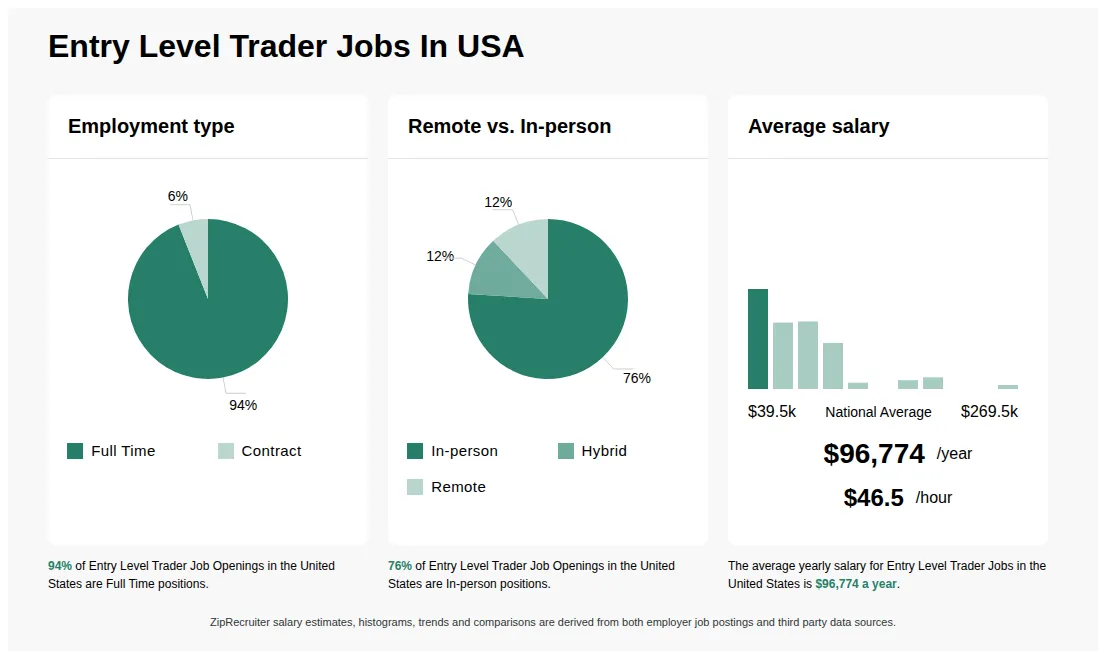
$55.2K is the 25th percentile. Wages below this are outliers.
$39.5K - $60.4K
33% of jobs
The median wage is $76.3K / yr.
$60.4K - $81.3K
22% of jobs
$100.2K is the 75th percentile. Wages above this are outliers.
$81.3K - $102.2K
22% of jobs
$102.2K - $123.1K
15% of jobs
$123.1K - $144K
2% of jobs
$144K - $165K
0% of jobs
$165K - $185.9K
2% of jobs
$185.9K - $206.8K
3% of jobs
$206.8K - $227.7K
0% of jobs
$227.7K - $248.6K
0% of jobs
$248.6K - $269.5K
1% of jobs
$39.5K
$96.8K
$269.5K
How much do entry level trader jobs pay per year?
As of Sep 2, 2026, the average yearly pay for entry level trader in the United States is $96,774.00, according to ZipRecruiter salary data. Most workers in this role earn between $56,500.00 and $105,500.00 per year, depending on experience, location, and employer.
What is an entry level trader?
Entry level traders are professionals who are just starting their careers in financial trading, typically working at investment banks, trading firms, or hedge funds. They are responsible for buying and selling financial instruments such as stocks, bonds, currencies, or commodities under the supervision of more experienced traders. Their main tasks often include market analysis, executing trades, monitoring positions, and learning risk management strategies. Entry level traders usually receive on-the-job training and are expected to develop strong analytical and decision-making skills as they progress in their careers.
What does an entry level trader do?
As an entry-level trader, your responsibilities are to develop different types of investment strategies for clients. Traders can work in many areas of finance, such as commodity, bond, and stock trading. Your specific responsibilities vary depending on the type of trading you do. For example, as a junior commodities trader, your strategy may be to suggest short term investments based on your forecasts for commodity markets. As a bond trader, you research short- and long-term bonds and execute sales that improve the position of your client.
What are the key skills and qualifications needed to thrive as an entry level trader?
To thrive as an Entry Level Trader, you need strong analytical abilities, quantitative skills, and a foundational understanding of financial markets, usually supported by a relevant degree such as finance, economics, or mathematics. Proficiency with trading platforms, financial modeling tools like Excel, and sometimes Bloomberg Terminal or similar market data systems is commonly required. Strong attention to detail, resilience under pressure, and effective communication set outstanding candidates apart. These skills and qualities enable traders to make informed decisions quickly, manage risk, and collaborate effectively in a fast-paced trading environment.
What are some common challenges faced by entry level traders during their first year on the job?
Entry level traders often encounter challenges such as adapting to the fast-paced environment, managing the pressure of real-time decision-making, and quickly learning to analyze large volumes of market data. Building confidence while executing trades and understanding risk management strategies can also be difficult initially. However, many firms provide mentorship, training programs, and teamwork opportunities to help new traders develop their skills and succeed in the role.
What is the difference between Entry Level Trader vs Junior Trader?
| Aspect | Entry Level Trader | Junior Trader |
|---|---|---|
| Required Credentials | Bachelor's degree in finance, economics, or related field; some firms may require licensing (e.g., Series 7) | Similar credentials; often holds or is working towards licensing; some firms prefer prior internship experience |
| Work Environment | Fast-paced trading floors or offices; supervised environment with training | Similar environment; more responsibility but still under supervision |
| Employer & Industry Usage | Common entry point in investment banks, trading firms, hedge funds | Often a stepping stone to Trader roles within same firms or firms hiring junior staff |
Entry Level Traders and Junior Traders share similar educational backgrounds, work environments, and industry usage. The main difference is that Entry Level Traders are typically new to the field with limited experience, focusing on learning and supporting trading activities. Junior Traders usually have some experience and begin taking on more responsibilities, preparing for full trading roles.
How do you start a career as an entry level trader?
To start a career as an entry level trader, individuals typically pursue a bachelor's degree in finance, economics, or related fields, and develop strong analytical and decision-making skills. Gaining experience through internships or trading simulations, obtaining relevant certifications like the Series 7 or Series 63, and understanding trading platforms are also important steps to enter the field.
More about Entry Level Trader jobs
What cities are hiring for Entry Level Trader jobs?
Cities with the most Entry Level Trader job openings:
What are the most commonly searched types of Trader jobs?
The most popular types of Trader jobs are:
What states have the most Entry Level Trader jobs?
States with the most job openings for Entry Level Trader jobs include:
What job categories do people searching Entry Level Trader jobs look for?
The top searched job categories for Entry Level Trader jobs are:
- General Dynamics Entry Level
- Weekend Entry Level Proprietary Trading
- Overnight Entry Level Proprietary Trading
- Entry Level Proprietary Trading
- Urgently Hiring Entry Level Administrative Assistant
- Entry Level Interpreter Trainer
- Full Time Entry Level Office
- Entry Level Six Figures
- Stock Broker Trader
- Broker Trader

Full-time
Re-posted 16 days ago
Job description
NOW HIRING Proprietary Equity Traders Wanted
T3 Trading Group, LLC (www.t3trading.com) is a registered SEC Broker-Dealer & Member of FINRA SIPC. T3's office headquarters is located at 88 Pine Street the heart of New York City's financial district. We provide aspiring proprietary traders with the education necessary to trade based on risk/reward, probability parameters, and strict money management. In order to maximize the potential of our traders, we will provide:
WE PROVIDE:
REQUIRED QUALIFICATIONS:
We are now accepting applications to join our dedicated and experienced team of professional traders. New and aspiring traders work to reach a level of consistent profitability in their trading through appropriate risk/reward and probability parameters with an eye toward strict money management.
In order to reach this goal, experienced traders work with entry level traders in an extensive trade review program after the market close each day. Traders are educated in the nuances of technical analysis, tape reading, money management, and market psychology.
Traders will learn how to identify and capitalize on stock trends and retracements with a view towards multiple time frames. Each day prospects will work to learn and grow as traders.
Series 57 & SIE license required. We will sponsor qualified candidates for this exam.
If interested, please contact Paolo Fontana at 917-548-4492 or Paolo.Fontana@t3trading.com
T3 Trading Group, LLC (www.t3trading.com) is a registered SEC Broker-Dealer & Member of FINRA SIPC. T3's office headquarters is located at 88 Pine Street the heart of New York City's financial district. We provide aspiring proprietary traders with the education necessary to trade based on risk/reward, probability parameters, and strict money management. In order to maximize the potential of our traders, we will provide:
WE PROVIDE:
- Education in technical analysis, tape reading, money management, and market psychology
- Daily trading review with experienced traders
- Competitive payout structure
- Cutting edge technology
- Open and friendly team environment
REQUIRED QUALIFICATIONS:
- College degree with a competitive GPA
- Basic familiarity with the equity markets
- Strong analytical skills
- Ability to work well in a team environment
- A focused, dedicated, and entrepreneurial personality
- Enthusiasm for the equity markets
- Prior trading experience is not required
We are now accepting applications to join our dedicated and experienced team of professional traders. New and aspiring traders work to reach a level of consistent profitability in their trading through appropriate risk/reward and probability parameters with an eye toward strict money management.
In order to reach this goal, experienced traders work with entry level traders in an extensive trade review program after the market close each day. Traders are educated in the nuances of technical analysis, tape reading, money management, and market psychology.
Traders will learn how to identify and capitalize on stock trends and retracements with a view towards multiple time frames. Each day prospects will work to learn and grow as traders.
Series 57 & SIE license required. We will sponsor qualified candidates for this exam.
If interested, please contact Paolo Fontana at 917-548-4492 or Paolo.Fontana@t3trading.com

About T3 Trading Group
Sourced by ZipRecruiter
Industry
Finance and insurance
Company size
201 - 500 Employees
Headquarters location
New York, NY, US
Year founded
2007