... advanced testing equipment and tools. * R ead and interpret technical service manuals and ... Qualifications: Entry-Level Candidates: * H igh school diploma or equivalent; coursework in ...
... advanced testing equipment and tools. * R ead and interpret technical service manuals and ... Qualifications: Entry-Level Candidates: * H igh school diploma or equivalent; coursework in ...

You will be assisting lead technicians with prepping, inspecting, testing, and repairing aircraft ... Must be able to read and interpret maintenance manuals and specifications to competently perform ...
You will be assisting lead technicians with prepping, inspecting, testing, and repairing aircraft ... Must be able to read and interpret maintenance manuals and specifications to competently perform ...
Automotive Technician Entry Level & Experienced $20.00 - $60.00
Palmer, MA · On-site
$20 - $60/hr
... advanced testing equipment and tools. - Read and interpret technical service manuals and ... Qualifications:** *Entry-Level Candidates:* - High school diploma or equivalent; coursework in ...
Automotive Technician Entry Level & Experienced $20.00 - $60.00
Palmer, MA · On-site
$20 - $60/hr
... advanced testing equipment and tools. - Read and interpret technical service manuals and ... Qualifications:** *Entry-Level Candidates:* - High school diploma or equivalent; coursework in ...

Hydro-Mechanical Systems Service Engineer (Entry-Level)
Seal Beach, CA · On-site
$76K - $103K/yr
... manuals) in accordance with engineering processes and procedures. * Assists with the study and ... Boeing is a Drug Free Workplace where post offer applicants and employees are subject to testing ...
Hydro-Mechanical Systems Service Engineer (Entry-Level)
Seal Beach, CA · On-site
$76K - $103K/yr
... manuals) in accordance with engineering processes and procedures. * Assists with the study and ... Boeing is a Drug Free Workplace where post offer applicants and employees are subject to testing ...

Ability to read, write, and interpret procedures, manuals, technical documents, and reports related to construction materials testing and laboratory protocols. * Mathematical skills sufficient to add ...
Ability to read, write, and interpret procedures, manuals, technical documents, and reports related to construction materials testing and laboratory protocols. * Mathematical skills sufficient to add ...
Entry Level Field Technician
$20 - $30/hr
If you have a great attitude and are willing to work outside performing field testing in the ... Good or corrected vision and manual dexterity Pay Range $20--$30 USD GeoTek is an Equal Opportunity ...
Quick apply
Entry Level Field Technician
$20 - $30/hr
If you have a great attitude and are willing to work outside performing field testing in the ... Good or corrected vision and manual dexterity Pay Range $20--$30 USD GeoTek is an Equal Opportunity ...
This includes: 1. Automation & manual Testing. 2. Testing using automation testing tools i.e. QTP, Selenium (IDE, RC, Webdriver & Grid), SOAPUI & HP Quality centre. 3. Programming and Coding through ...
This includes: 1. Automation & manual Testing. 2. Testing using automation testing tools i.e. QTP, Selenium (IDE, RC, Webdriver & Grid), SOAPUI & HP Quality centre. 3. Programming and Coding through ...

Entry Level Technician
Salem, OR · On-site
... with manual transmissions able to safely operate company and client vehicles must have a valid ... random drug testing and results must be clean The information contained in this is not an ...
Quick apply
Entry Level Technician
Salem, OR · On-site
... with manual transmissions able to safely operate company and client vehicles must have a valid ... random drug testing and results must be clean The information contained in this is not an ...

Optical Machinist Technician, ALL Shifts
Ontario, NY · On-site
$47K - $71K/yr
Optical Machinist Technician, All Shifts We are accepting all skill levels from Entry level - ... Learn to operate and coordinate measuring machines and other advanced testing equipment
Quick apply
Optical Machinist Technician, ALL Shifts
Ontario, NY · On-site
$47K - $71K/yr
Optical Machinist Technician, All Shifts We are accepting all skill levels from Entry level - ... Learn to operate and coordinate measuring machines and other advanced testing equipment
... Entry Level Quality Assurance Analyst Under direct supervision, the Quality Assurance Analyst ... Executes manual functional testing based on analysis and understanding of the requirements and ...
... Entry Level Quality Assurance Analyst Under direct supervision, the Quality Assurance Analyst ... Executes manual functional testing based on analysis and understanding of the requirements and ...
Business Analyst 4
Richmond, VA · Remote
Perform manual testing on web applications and verify successful completion of test plans. Create testing plans to confirm that application meets requirements and design specifications. Document bugs ...
Quick apply
Business Analyst 4
Richmond, VA · Remote
Perform manual testing on web applications and verify successful completion of test plans. Create testing plans to confirm that application meets requirements and design specifications. Document bugs ...

Entry-Level Assembly Technician
Scottdale, GA · On-site
$19/hr
We are seeking an Entry-Level Assembly Technician who is responsible for assembling, testing, and ... Manual dexterity for handling small parts and tools. * May require working in varying temperatures ...
Quick apply
Entry-Level Assembly Technician
Scottdale, GA · On-site
$19/hr
We are seeking an Entry-Level Assembly Technician who is responsible for assembling, testing, and ... Manual dexterity for handling small parts and tools. * May require working in varying temperatures ...

Entry Level Panel Technician
Auburn, NY · On-site
$16 - $18/hr
To read and interpret electrical schematics, mechanical drawings, and technical manuals ... Point to Point wire tests in accordance with PFT testing procedures Along with acquiring technical ...
Quick apply
Entry Level Panel Technician
Auburn, NY · On-site
$16 - $18/hr
To read and interpret electrical schematics, mechanical drawings, and technical manuals ... Point to Point wire tests in accordance with PFT testing procedures Along with acquiring technical ...

Lab Tech (Entry-level, #1 Hospital Worldwide)
Rochester, MN · On-site
$23 - $24/hr
Clinical Laboratory Technologist Entry-level | #1 Hospital Worldwide | Excellent Room for Growth ... Testing is conducted in specialized laboratories and may involve highly skilled manual techniques ...
Quick apply
Lab Tech (Entry-level, #1 Hospital Worldwide)
Rochester, MN · On-site
$23 - $24/hr
Clinical Laboratory Technologist Entry-level | #1 Hospital Worldwide | Excellent Room for Growth ... Testing is conducted in specialized laboratories and may involve highly skilled manual techniques ...

... Entry Level QA Black Box:- Consultant contributes in software ... testing and/or software quality control including automated and manual test scripting. Must Have:
... Entry Level QA Black Box:- Consultant contributes in software ... testing and/or software quality control including automated and manual test scripting. Must Have:
... Entry Level QA Black Box:- Consultant contributes in software ... testing and/or software quality control including automated and manual test scripting. Must Have:
... Entry Level QA Black Box:- Consultant contributes in software ... testing and/or software quality control including automated and manual test scripting. Must Have:
Job Type: Full Time - W2 Employment Position: Entry Level - Business Analyst Location: United ... Position 2- Manual QA Engineer/ Tester Education: Masters/Bachelors preferably in Computer Science ...
Job Type: Full Time - W2 Employment Position: Entry Level - Business Analyst Location: United ... Position 2- Manual QA Engineer/ Tester Education: Masters/Bachelors preferably in Computer Science ...

Entry Level Maintenance Tech
Riviera Beach, FL · On-site
$20 - $30/hr
Pool cleaning and water testing * Maintain a clean and safe work environment for customers and ... Requires manual and bi-manual dexterity, fine and gross motor skills, eye/hand coordination, near ...
Entry Level Maintenance Tech
Riviera Beach, FL · On-site
$20 - $30/hr
Pool cleaning and water testing * Maintain a clean and safe work environment for customers and ... Requires manual and bi-manual dexterity, fine and gross motor skills, eye/hand coordination, near ...
Pool cleaning and water testing * Maintain a clean and safe work environment for customers and ... Requires manual and bi-manual dexterity, fine and gross motor skills, eye/hand coordination, near ...
Pool cleaning and water testing * Maintain a clean and safe work environment for customers and ... Requires manual and bi-manual dexterity, fine and gross motor skills, eye/hand coordination, near ...

Entry-Level Engineer
Port Hueneme, CA · On-site
$52K - $82K/yr
... testing, data collection/analysis, review/update specifications/documents, Test and Evaluation, and ... manuals, MRCs, CSOSS, C&L, APL/AEL) used by ISEA, Mission Package Support Facility, (MPSF) primary ...
Entry-Level Engineer
Port Hueneme, CA · On-site
$52K - $82K/yr
... testing, data collection/analysis, review/update specifications/documents, Test and Evaluation, and ... manuals, MRCs, CSOSS, C&L, APL/AEL) used by ISEA, Mission Package Support Facility, (MPSF) primary ...
Entry Level Manual Tester information
See salary details
$10.34 - $14.93
4% of jobs
$14.93 - $19.51
0% of jobs
$19.51 - $24.10
0% of jobs
$24.10 - $28.69
4% of jobs
$28.69 - $33.28
14% of jobs
$34.43 is the 25th percentile. Wages below this are outliers.
$33.28 - $37.87
11% of jobs
The median wage is $42.19 / hr.
$37.87 - $42.46
18% of jobs
$42.46 - $47.05
17% of jobs
$48.71 is the 75th percentile. Wages above this are outliers.
$47.05 - $51.64
19% of jobs
$51.64 - $56.23
9% of jobs
$56.23 - $60.82
4% of jobs
$10
$41
$60
How much do entry level manual tester jobs pay per hour?
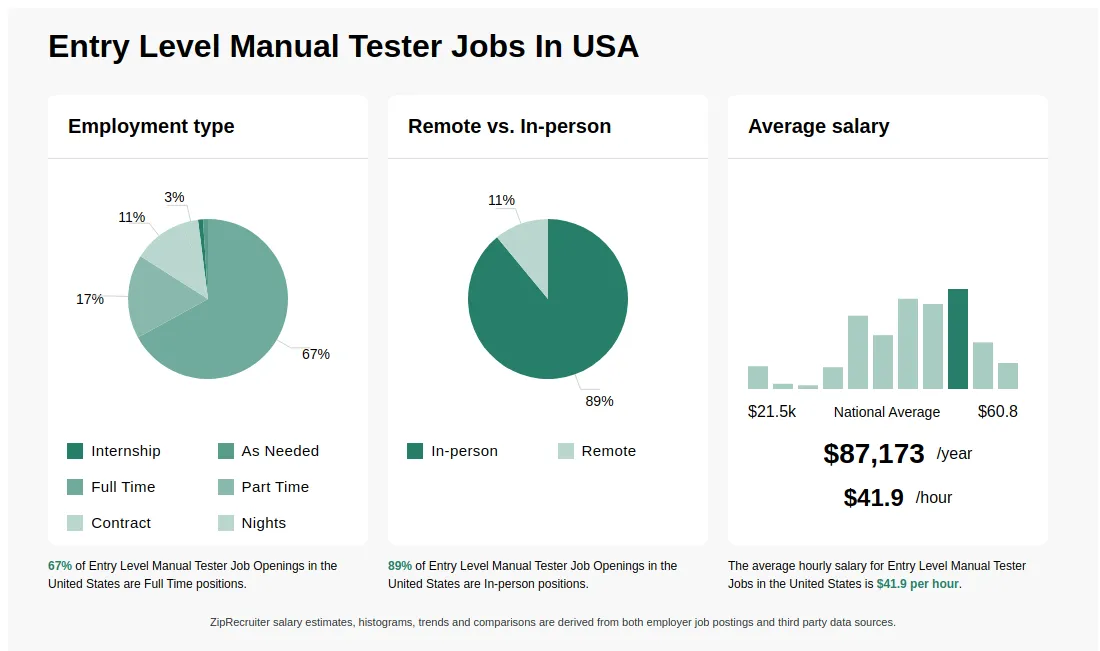
As of Jul 23, 2026, the average hourly pay for entry level manual tester in the United States is $41.91, according to ZipRecruiter salary data. Most workers in this role earn between $33.65 and $48.80 per hour, depending on experience, location, and employer.
What is the difference between Entry Level Manual Tester vs QA Tester?
| Aspect | Entry Level Manual Tester | QA Tester |
|---|---|---|
| Required Credentials | High school diploma or equivalent; some roles may prefer certifications like ISTQB | Similar; often requires ISTQB or related certifications |
| Work Environment | Software development teams, testing labs, office settings | Same; involved in software development lifecycle |
| Industry Usage | IT, software companies, tech startups | IT, software, gaming, and tech industries |
| Common Search/Comparison | Yes | Yes |
Both Entry Level Manual Testers and QA Testers typically require similar certifications and work in software development environments. The main difference is that 'QA Tester' can sometimes imply a broader role including quality assurance processes beyond manual testing, but at entry level, they are often used interchangeably. Understanding these roles helps job seekers target the right positions in the tech industry.
What are some common challenges faced by entry level manual testers, and how can they be addressed?
Entry level manual testers often face challenges such as understanding complex application workflows, keeping up with frequent software changes, and ensuring thorough test coverage without missing critical defects. To address these, it's important to ask clarifying questions during team meetings, document test cases clearly, and collaborate closely with developers and senior testers. Participating in regular team reviews and leveraging knowledge-sharing sessions can also help build confidence and improve testing accuracy.
What does an Entry Level Manual Tester do?
An Entry Level Manual Tester is responsible for testing software applications to identify bugs and ensure they work as intended. They execute test cases, document defects, and report issues to the development team. Manual testers do not use automation tools but instead follow written instructions to check the software’s functionality, usability, and reliability. This role is essential for maintaining software quality before products are released to users.
What Does an Entry-Level Manual Tester Do?
An entry-level manual tester coordinates with a software or application developer to test a system and determine if there are any issues in a piece of software. You look for repeated crashes or bugs in a program with stress testing. While you do not necessarily have to know how to fix them, you may need to be able to identify what caused them. Your duties are to design test cases and scenarios, implement inputs for test plans, operate software testing, use bug tracking to identify problems, document your findings, and provide reports on issues within the software. Your responsibilities are essential for finalizing a program before release to the end user.
What are the key skills and qualifications needed to thrive as an Entry Level Manual Tester, and why are they important?
To thrive as an Entry Level Manual Tester, you need a strong understanding of software testing concepts, attention to detail, and basic knowledge of software development lifecycles, often supported by a relevant degree or coursework. Familiarity with bug tracking tools like JIRA, test case management systems, and basic office productivity software is typically required. Strong analytical thinking, effective communication, and the ability to work collaboratively help set candidates apart in this role. These skills are important for accurately identifying software defects, ensuring product quality, and facilitating clear communication within development teams.
Are manual testers still in demand?
Manual testers are still in demand as they play a crucial role in identifying user interface issues and ensuring software quality, especially in projects requiring detailed testing without automation. While automation testing skills are increasingly valued, manual testing remains essential for exploratory testing and usability assessments, making entry-level manual tester roles relevant in many organizations.
How to be a QA tester with no experience?
To become an entry-level manual QA tester with no experience, focus on learning basic testing concepts, software development life cycle, and common testing tools like Jira or TestRail. Gaining certifications such as ISTQB can also improve your chances, and building a portfolio of sample test cases or participating in online testing communities can demonstrate your skills to employers.
Can I be a game tester with no experience?
Entry level manual testers can often start without prior experience if they have strong attention to detail, basic computer skills, and an understanding of testing processes. Many companies provide on-the-job training, and familiarity with testing tools or game development can be helpful but are not always required for entry-level positions.
How do I start a career in manual testing?
To start a career as an entry-level manual tester, gain basic knowledge of software testing principles and learn testing tools like Jira or TestRail. Obtain relevant skills through online courses or certifications such as ISTQB, and gain practical experience by working on sample projects or internships to build your understanding of test cases, defect tracking, and testing environments.
More about Entry Level Manual Tester jobs
What cities are hiring for Entry Level Manual Tester jobs? Cities with the most Entry Level Manual Tester job openings:
What are the most commonly searched types of Manual Tester jobs? The most popular types of Manual Tester jobs are:
What states have the most Entry Level Manual Tester jobs? States with the most job openings for Entry Level Manual Tester jobs include:
What job categories do people searching Entry Level Manual Tester jobs look for? The top searched job categories for Entry Level Manual Tester jobs are:

$20 - $60/hr
Other
Medical, Dental, Vision, Retirement, PTO
Posted 27 days ago
Job description
Job Title: Automotive Technician (Entry Level & Experienced)
Location: Bertera Chevrolet Palmer,MA.
Salary Range: $20.00 - $60.00 per hour (dependent on experience)
Company Overview:
Bertera Auto Group is a leading automotive repair shop committed to providing high-quality service and customer satisfaction. We are currently seeking passionate and dedicated Automotive Technicians, both entry-level and experienced, to join our team. If you have a love for vehicles and a desire to learn, or if you have years of experience and are looking for a new challenge, we want to hear from you!
Job Overview:
As an Automotive Technician, you will be responsible for diagnosing, repairing, and maintaining a variety of vehicles. You will work on everything from routine maintenance to more complex repairs. This role requires a strong attention to detail, great problem-solving skills, and the ability to work effectively both independently and as part of a team.
Key Responsibilities:
Qualifications:
Entry-Level Candidates:
Experienced Candidates:
Benefits:
How to Apply:
Interested candidates are invited to submit their resume and a brief cover letter highlighting their qualifications to directly on our website at Berterachevy.com
https://bertera-chevrolet-inc.verahr-hiring.com/job/98718/automotive-technician-entry-level-experienced-20-00-60-00
Equal Opportunity Employer:
Bertera Auto Group is an equal opportunity employer.
Join our dynamic team and start your journey in the automotive industry today!

About Bertera Chevrolet
Sourced by ZipRecruiter
Industry
Motor vehicle manufacturing
Company size
51 - 200 Employees
Headquarters location
Palmer, MA, US
Year founded
1997