2

Entry Level Engineering Jobs in Texas (NOW HIRING)

Engineer Assc- Engineer

Abilene, TX · On-site

$74K - $109K/yr

In this role you are responsible to the assigned supervisor for performing entry level engineering work activities and projects requiring the application of engineering knowledge in a safe, effective ...

Engineer Assc- Engineer

Abilene, TX · On-site

$74K - $109K/yr

In this role you are responsible to the assigned supervisor for performing entry level engineering work activities and projects requiring the application of engineering knowledge in a safe, effective ...

next page

Showing results 1-20

Entry Level Engineering information

See Texas salary details

$27.9K

$64.6K

$109.9K

How much do entry level engineering jobs pay per year?

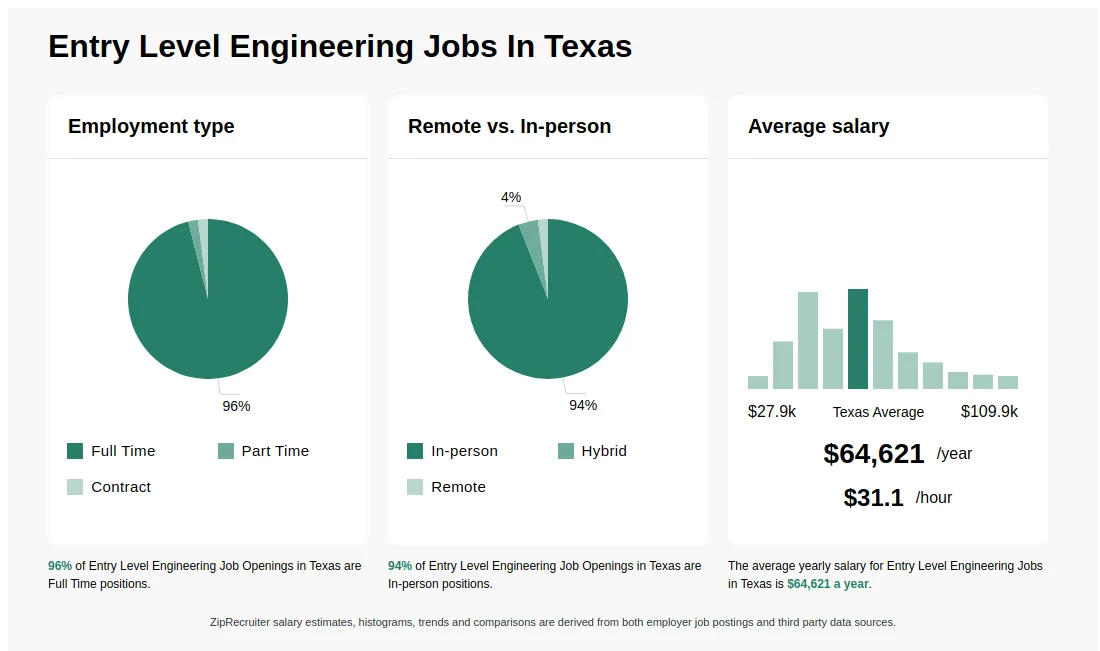
As of Jun 10, 2026, the average yearly pay for entry level engineering in Texas is $64,621.00, according to ZipRecruiter salary data. Most workers in this role earn between $48,000.00 and $73,100.00 per year, depending on experience, location, and employer.

What is the difference between Entry Level Engineering vs Mechanical Engineering?

AspectEntry Level EngineeringMechanical Engineering
Required CredentialsBachelor's degree in engineering or related fieldBachelor's degree in mechanical engineering; often requires licensure for advanced roles
Work EnvironmentInternships, entry-level positions in offices, labs, or manufacturing plantsDesign, analysis, testing in offices, labs, manufacturing facilities
Employer & Industry UsageEngineering firms, manufacturing, construction, technology companiesManufacturing, automotive, aerospace, energy sectors

Entry Level Engineering typically involves foundational engineering tasks with a bachelor's degree, often in various disciplines, and is used across many industries. Mechanical Engineering is a specialized field focusing on design, analysis, and manufacturing of mechanical systems, often requiring specific technical skills and licensure for advanced roles. Both roles share similar work environments but differ in specialization and scope.

How to find an engineering job with no experience?

Entry level engineering positions often accept candidates with limited or no professional experience if they demonstrate relevant skills, such as proficiency in CAD, programming, or technical problem-solving, and hold a relevant degree or certification. Gaining internships, participating in engineering projects, and networking with industry professionals can improve chances of securing such roles. Tailoring your resume to highlight transferable skills and applying to companies with entry-level openings are also effective strategies.

What are entry level engineering jobs?

Entry level engineering jobs are positions designed for recent graduates or individuals with limited professional experience in the engineering field. These roles typically involve assisting senior engineers with projects, performing basic technical tasks, and gaining hands-on experience in a specific engineering discipline such as civil, mechanical, electrical, or software engineering. Entry level engineers often receive on-the-job training and mentoring to develop their skills and advance their careers. These roles serve as a foundation for future growth and specialization within the engineering industry.

What are the key skills and qualifications needed to thrive as an Entry Level Engineer, and why are they important?

To thrive as an Entry Level Engineer, you need a solid educational background in engineering fundamentals, strong problem-solving abilities, and proficiency in mathematics, usually obtained through a relevant bachelor's degree. Familiarity with technical tools such as CAD software, industry-specific modeling programs, and basic project management systems is typically expected. Effective communication, teamwork, and a willingness to learn are important soft skills that help you integrate into engineering teams and adapt to new challenges. These skills and qualities are vital for ensuring accurate technical work, smooth collaboration, and ongoing professional development in a dynamic engineering environment.

What types of projects and responsibilities can I expect as an entry-level engineer?

As an entry-level engineer, you’ll typically begin by supporting more senior engineers on a variety of projects, which may include drafting designs, running simulations, conducting data analysis, or assisting with testing and troubleshooting. Your daily tasks will often involve collaborating with team members, participating in meetings, and learning industry-specific tools and software. Over time, you'll gain more responsibility, such as managing small project components or communicating directly with clients. This role is designed to help you build foundational technical skills while gaining exposure to different aspects of engineering within your organization.
What are the most commonly searched types of Engineering jobs in Texas? The most popular types of Engineering jobs in Texas are:
What job categories do people searching Entry Level Engineering jobs in Texas look for? The top searched job categories for Entry Level Engineering jobs in Texas are:
What cities in Texas are hiring for Entry Level Engineering jobs? Cities in Texas with the most Entry Level Engineering job openings:
Infographic showing various Entry Level Engineering job openings in Texas as of June 2026, with employment types broken down into 100% Full Time. Highlights an 100% In-person job distribution, with an average salary of $64,621 per year, or $31.1 per hour.
Intern Engineering Support - Huntsville

Intern Engineering Support - Huntsville

Texas Department of Transportation

Huntsville, TX • On-site

$14.25 - $18.50/hr

Part-time

Posted 25 days ago


Texas Department Of Transportation rating

8.9

Company rating: 8.9 out of 10

Based on 36 frontline employees who took The Breakroom Quiz

58th of 646 rated public administrative organizations


Job description

Must be enrolled in an engineering or related science degree program in an accredited college or university accepted by TX PELS. Assists in transportation engineering support work such as construction or maintenance inspection, structural construction or maintenance, laboratory work, landscaping, surveying or engineering data collection, operating data collection equipment, and other entry-level engineering support work. Employees at this level perform assignments following specific instructions and are subject to frequent review by the immediate supervisor.

Essential Duties:
  • Compiles information from microfilm records and other archival materials.

  • Develops spreadsheets, databases, and other electronic documents.

  • Gathers basic data and assists with routine statistical analysis

  • Inspects construction methods and workmanship to ensure contractors build roadways, bridges, airports, traffic signals and related highway structures in accordance with plans and specifications.

  • Inspects materials, equipment, and production procedures in a manufacturing plant and/or conducts laboratory tests to ensure construction materials meet Department specifications; as required, moves items related to these duties.

  • Inspects routine maintenance contract work.

  • Obtains material samples for analysis and assists with routine lab testing including operation and cleaning of laboratory equipment; as required, moves items related to these duties.

  • Performs data entry and computer-aided analysis.

  • Performs mechanical and electrical repairs.

  • Performs survey work such as positioning rod and chain.

  • Performs traffic counts and gathers related traffic and accident data.

  • Prepares base sheets, details, specifications and estimates for landscape construction projects. Prepares required worksheets and inspection reports.

  • Processes various construction-related documents and maintains construction project records. Scans airport directory drawings; files and maintains related airport documents.

  • Uses drafting equipment and performs hand or computer-aided drafting and calculating work.

  • Performs other job responsibilities as assigned.

Minimum Qualifications:Education: 

Must be enrolled in an engineering or related science degree program in an accredited college or university accepted by TX PELS.

Other Conditions:
  • Must be at least 16 years of age, a student currently enrolled in high school or any institution of higher education to include

  • a trade/vocational school.

  • Employees at least 18 years of age with valid driver's license may be assigned driving duties and may use power tools.

 Preferred Qualifications:Competencies:
  • Some skill in using computers and applicable programs, applications, and systems.
  • Ability to:
    • Communicate effectively.
    • Follow verbal and written instructions.
    • Follow applicable safety standards, practices and procedures.
    • Protect sensitive and confidential information.
Physical Requirements and Working Conditions:
  • Required to wear protective hard hat, or other personal protective equipment/devices.

  • Subject to outside environmental conditions; no effective weather protection.

  • Medium work: Lift up to 50 lbs at a time and frequently lift or carry objects up to 25 lbs.

  • Balancing-walking, standing, crouching on various surfaces without falling.

  • Kneeling-bending legs at knee to come to a rest on knee(s).

  • Lifting-raising objects from lower to higher position/horizontally to a different position.

  • Reaching-extending hand(s) and arm(s) in any direction.

  • Standing-prolonged periods of time.

  • Close Visual Acuity-work includes visual inspection of small defects/parts.

  • Close Visual Acuity-using measurement devices; and/or assembly or fabrication parts.

  • Visual Acuity-operate machines, such as drill presses, power saws, and mills.

Conditions of Employment:

Please read the Standard Conditions of Employment (TxDOT) for all positions

  • This job has been identified as physically demanding and will require a pre-employment physical.

  • Must pass a drug test prior to employment for safety impact positions. This is a Safety Impact position and will be subject to random drug testing.

    • Please note that the Department of Transportation's Drug and Alcohol Testing Regulation - 49 CFR Part 40, at 40.151(e) - does not authorize "medical marijuana" under a state law to be a valid medical explanation for a positive drug test result for an employee in this position.


What Texas Department Of Transportation employees say

Pay

Benefits

Hours and flexibility

Workplace

Get the full story on Breakroom