1

Engineering Jobs in Connecticut (NOW HIRING)

Engineering IPTL

East Hartford, CT Ā· On-site

$72K - $87K/yr

The Engineering Integrated Product Team Lead (IPTL) is responsible for leading cross-functional engineering teams in the evaluation, validation, and disposition of nonconforming material through ...

The Engineering Integrated Product Team Lead (IPTL) is responsible for leading cross-functional engineering teams in the evaluation, validation, and disposition of nonconforming material through ...

Be Seen First

Engineering Manager

New Haven, CT Ā· On-site

$100K - $150K/yr

The Engineering Manager is responsible for leading the Engineering Department and driving the successful execution of product design, documentation, and manufacturing support. This position bridges ...

Engineering Manager Aerospace Manufacturing (Special Processes) We are seeking an experienced and driven Engineering Manager to lead our engineering team within a highly regulated aerospace ...

The Engineering Technician IV will provide technical and field engineering support for Submarine Hull, Mechanical & Electrical (HM&E) systems, with a focus on Sail and Towed Antenna Systems. The ...

The Engineering Technician IV will provide technical and field engineering support for Submarine Hull, Mechanical & Electrical (HM&E) systems, with a focus on Sail and Towed Antenna Systems. The ...

Advanced Materials and Joining - Engineering polymer and metal joining solutions for optimally performing circuits * Film & Smart Surface Solutions - Transforming electronics with cutting-edge ...

next page

Showing results 1-20

Engineering information

See Connecticut salary details

$44.2K

$139.7K

$165.5K

How much do engineering jobs pay per year?

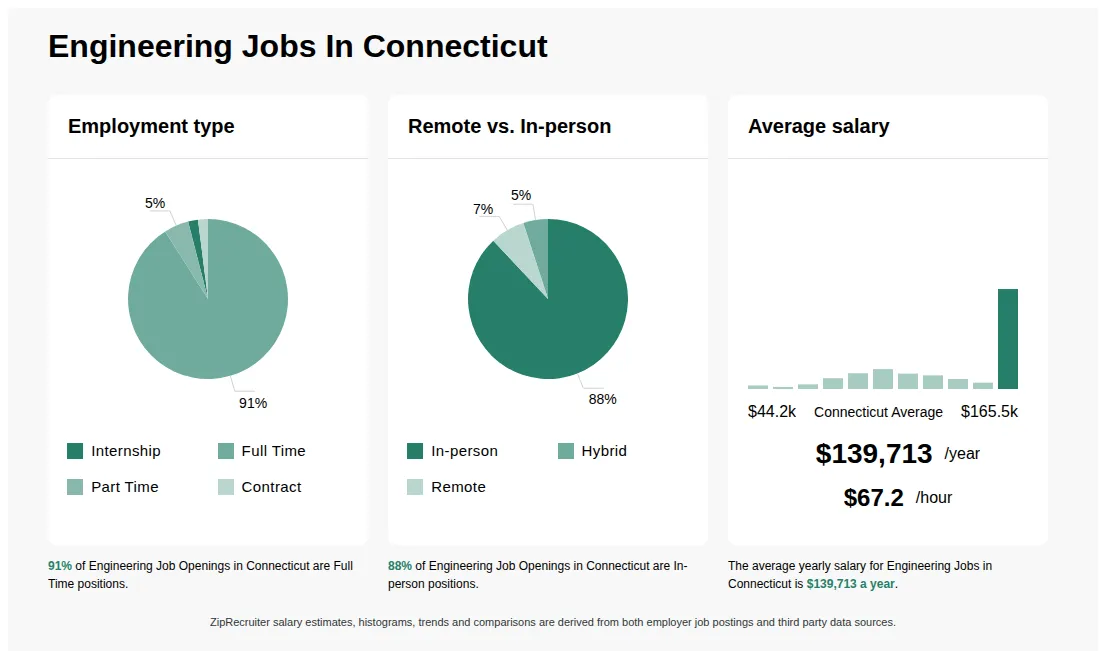
As of Jul 19, 2026, the average yearly pay for engineering in Connecticut is $139,713.00, according to ZipRecruiter salary data. Most workers in this role earn between $110,800.00 and $164,600.00 per year, depending on experience, location, and employer.

What are the key skills and qualifications needed to thrive as an Engineer, and why are they important?

To thrive as an Engineer, you need strong analytical abilities, problem-solving skills, and a relevant engineering degree or certification. Familiarity with CAD software, project management tools, and industry-specific technical systems is typically required. Excellent teamwork, communication, and adaptability help engineers collaborate and navigate complex projects effectively. These skills and qualities are vital for delivering innovative, efficient solutions and ensuring project success in dynamic technical environments.

What are careers in engineering?

Careers in engineering involve designing, developing, and maintaining systems, structures, or products across various fields such as civil, mechanical, electrical, and software engineering. These roles typically require strong problem-solving skills, technical knowledge, and often a bachelor's degree in engineering or related disciplines. Engineers work in diverse environments including offices, laboratories, and construction sites, and may pursue professional licensure or certifications to advance their careers.

What Are Engineering Jobs?

Engineering jobs encompass a range of positions in a variety of technical fields, including mechanical, chemical, electrical, aeronautic, and civil engineering. Some engineering jobs are in research and design, while others focus on the construction and manufacturing industry. In this career, you need a mix of design, project management, and research skills. You can work in numerous industries, including construction, manufacturing, agriculture, medical, aviation, and natural resource extraction. Some jobs are based primarily in an office or lab setting, while others require you to travel to field sites to make surveys and assessments.

What are some common challenges engineers face when working on multidisciplinary teams?

Engineers often collaborate with professionals from diverse backgrounds, such as designers, project managers, and business analysts. One common challenge is ensuring clear communication, as each discipline may use different terminology or prioritize different aspects of a project. Additionally, aligning objectives and managing conflicting expectations can require strong interpersonal and problem-solving skills. Successfully navigating these challenges helps engineers contribute to more innovative and efficient solutions while building valuable teamwork experience.

What jobs can you do with engineering?

Engineering graduates can pursue a variety of roles such as civil, mechanical, electrical, software, or chemical engineers. These jobs typically involve designing, developing, testing, and maintaining systems or products, often requiring technical skills and relevant certifications. Opportunities exist in industries like construction, manufacturing, technology, and energy.

What is engineering?

Engineering is the application of scientific and mathematical principles to design, build, and maintain structures, machines, devices, systems, and processes. Engineers use creativity, technical knowledge, and problem-solving skills to develop solutions that meet societal needs in areas such as infrastructure, technology, manufacturing, and the environment. There are many branches of engineering, including civil, mechanical, electrical, chemical, and software engineering, each focusing on different aspects of technology and innovation.

What engineer makes $500,000 a year?

Highly experienced engineers in specialized fields such as petroleum engineering, aerospace engineering, or software engineering in senior or executive roles can earn $500,000 or more annually. These positions often require advanced skills, extensive experience, and sometimes leadership responsibilities or working in high-demand industries.

What is the difference between Engineering vs Mechanical Engineering?

AspectEngineeringMechanical Engineering
Required CredentialsBachelor's degree in engineering or related fieldBachelor's degree in mechanical engineering or similar
Work EnvironmentVaries widely across disciplines, including offices, labs, and manufacturingDesign, analysis, and manufacturing environments, often involving machinery and systems
Industry UsageBroadly used across multiple industries such as civil, electrical, and mechanical sectorsPrimarily in manufacturing, automotive, aerospace, and energy sectors

Engineering is a broad field encompassing various disciplines, including mechanical engineering. Mechanical engineering focuses specifically on designing and analyzing mechanical systems and machinery. While all mechanical engineers are engineers, not all engineers are mechanical engineers. The two roles often overlap but differ in specialization and application areas.

What are 10 engineering jobs?

Engineering encompasses a wide range of roles including civil engineer, mechanical engineer, electrical engineer, software engineer, chemical engineer, aerospace engineer, industrial engineer, environmental engineer, biomedical engineer, and petroleum engineer. These jobs typically require technical skills, relevant degrees, and often professional certifications. They involve designing, developing, testing, and maintaining systems or products across various industries.
What are the most commonly searched types of Engineering jobs in Connecticut? The most popular types of Engineering jobs in Connecticut are:
What cities in Connecticut are hiring for Engineering jobs? Cities in Connecticut with the most Engineering job openings:
Infographic showing various Engineering job openings in Connecticut as of July 2026, with employment types broken down into 90% Full Time, 5% Part Time, and 5% Contract. Highlights an 100% In-person job distribution, with an average salary of $139,713 per year, or $67.2 per hour.

Other

Re-posted 20 days ago


Job description

Job Summary: SEACORP is looking for an Engineering Technician V for the Hardware Solutions Business Area. The Engineering Technician will beĀ responsiblefor the build, integration and test of hardware and software capabilities forElectronic Warfare Systems.

Duties include requirements and design/drawingreview, component build/test/Quality Assurance (QA), and system integration andtest. Lead/Mentor junior technicians in the execution of their job dutiesĀ  Experience in the Electronic Warfare domaindesired.