Electrical and Instrumentation Inspector (Part Time) - United States Intertek, a leading provider of quality and safety solutions to many of the world's top-recognized brands and companies, is ...
Electrical and Instrumentation Inspector (Part Time) - United States Intertek, a leading provider of quality and safety solutions to many of the world's top-recognized brands and companies, is ...

Electrical and Instrumentation Inspector (Part Time) - Minneapolis, MN Intertek, a leading provider of quality and safety solutions to many of the world's top-recognized brands and companies, is ...
Electrical and Instrumentation Inspector (Part Time) - Minneapolis, MN Intertek, a leading provider of quality and safety solutions to many of the world's top-recognized brands and companies, is ...
Electrical and Instrumentation Inspector (Part Time) - Minneapolis, MN Intertek, a leading provider of quality and safety solutions to many of the world's top-recognized brands and companies, is ...
Electrical and Instrumentation Inspector (Part Time) - Minneapolis, MN Intertek, a leading provider of quality and safety solutions to many of the world's top-recognized brands and companies, is ...
Electrical and Instrumentation Inspector (Part Time) - Minneapolis, MN Intertek, a leading provider of quality and safety solutions to many of the world's top-recognized brands and companies, is ...
Electrical and Instrumentation Inspector (Part Time) - Minneapolis, MN Intertek, a leading provider of quality and safety solutions to many of the world's top-recognized brands and companies, is ...

Perform field inspection, testing, design and construction coordination for electrical, instrumentation and control systems for water and wastewater utility clients. * Provide troubleshooting and ...
Perform field inspection, testing, design and construction coordination for electrical, instrumentation and control systems for water and wastewater utility clients. * Provide troubleshooting and ...

Perform routine inspections and preventive maintenance on electrical and instrumentation equipment. * Diagnose and troubleshoot electrical and instrumentation issues using appropriate tools and ...
Perform routine inspections and preventive maintenance on electrical and instrumentation equipment. * Diagnose and troubleshoot electrical and instrumentation issues using appropriate tools and ...
Perform field inspection, testing, design and construction coordination for electrical, instrumentation and control systems for water and wastewater utility clients. * Provide troubleshooting and ...
Perform field inspection, testing, design and construction coordination for electrical, instrumentation and control systems for water and wastewater utility clients. * Provide troubleshooting and ...

Position Summary The ELECTRICAL AND INSTRUMENTATION INSPECTOR is responsible for surveilling and evaluating suppliers to ensure that all delivered equipment complies with the company's quality ...
Position Summary The ELECTRICAL AND INSTRUMENTATION INSPECTOR is responsible for surveilling and evaluating suppliers to ensure that all delivered equipment complies with the company's quality ...
In this role, you will perform and witness inspections and testing activities to ensure compliance with industry codes, customer specifications, and PPI Quality & Engineering procedures. You will ...
In this role, you will perform and witness inspections and testing activities to ensure compliance with industry codes, customer specifications, and PPI Quality & Engineering procedures. You will ...
In this role, you will perform and witness inspections and testing activities to ensure compliance with industry codes, customer specifications, and PPI Quality & Engineering procedures. You will ...
In this role, you will perform and witness inspections and testing activities to ensure compliance with industry codes, customer specifications, and PPI Quality & Engineering procedures. You will ...
Position Summary The ELECTRICAL AND INSTRUMENTATION INSPECTOR is responsible for surveilling and evaluating suppliers to ensure that all delivered equipment complies with the company's quality ...
Position Summary The ELECTRICAL AND INSTRUMENTATION INSPECTOR is responsible for surveilling and evaluating suppliers to ensure that all delivered equipment complies with the company's quality ...
ELECTRICAL AND INSTRUMENTATION INSPECTOR
Elkhorn, NE · On-site +1
Position Summary The ELECTRICAL AND INSTRUMENTATION INSPECTOR is responsible for surveilling and evaluating suppliers to ensure that all delivered equipment complies with the company's quality ...
ELECTRICAL AND INSTRUMENTATION INSPECTOR
Elkhorn, NE · On-site +1
Position Summary The ELECTRICAL AND INSTRUMENTATION INSPECTOR is responsible for surveilling and evaluating suppliers to ensure that all delivered equipment complies with the company's quality ...
In this role, you will perform and witness inspections and testing activities to ensure compliance with industry codes, customer specifications, and PPI Quality & Engineering procedures. You will ...
In this role, you will perform and witness inspections and testing activities to ensure compliance with industry codes, customer specifications, and PPI Quality & Engineering procedures. You will ...
In this role, you will perform and witness inspections and testing activities to ensure compliance with industry codes, customer specifications, and PPI Quality & Engineering procedures. You will ...
In this role, you will perform and witness inspections and testing activities to ensure compliance with industry codes, customer specifications, and PPI Quality & Engineering procedures. You will ...
In this role, you will perform and witness inspections and testing activities to ensure compliance with industry codes, customer specifications, and PPI Quality & Engineering procedures. You will ...
In this role, you will perform and witness inspections and testing activities to ensure compliance with industry codes, customer specifications, and PPI Quality & Engineering procedures. You will ...
In this role, you will perform and witness inspections and testing activities to ensure compliance with industry codes, customer specifications, and PPI Quality & Engineering procedures. You will ...
In this role, you will perform and witness inspections and testing activities to ensure compliance with industry codes, customer specifications, and PPI Quality & Engineering procedures. You will ...
In this role, you will perform and witness inspections and testing activities to ensure compliance with industry codes, customer specifications, and PPI Quality & Engineering procedures. You will ...
In this role, you will perform and witness inspections and testing activities to ensure compliance with industry codes, customer specifications, and PPI Quality & Engineering procedures. You will ...
In this role, you will perform and witness inspections and testing activities to ensure compliance with industry codes, customer specifications, and PPI Quality & Engineering procedures. You will ...
In this role, you will perform and witness inspections and testing activities to ensure compliance with industry codes, customer specifications, and PPI Quality & Engineering procedures. You will ...
In this role, you will perform and witness inspections and testing activities to ensure compliance with industry codes, customer specifications, and PPI Quality & Engineering procedures. You will ...
In this role, you will perform and witness inspections and testing activities to ensure compliance with industry codes, customer specifications, and PPI Quality & Engineering procedures. You will ...
In this role, you will perform and witness inspections and testing activities to ensure compliance with industry codes, customer specifications, and PPI Quality & Engineering procedures. You will ...
In this role, you will perform and witness inspections and testing activities to ensure compliance with industry codes, customer specifications, and PPI Quality & Engineering procedures. You will ...
Electrical Instrumentation Inspector information
See salary details
$17.07 - $20.28
4% of jobs
$20.28 - $23.49
9% of jobs
$26.13 is the 25th percentile. Wages below this are outliers.
$23.49 - $26.70
15% of jobs
$26.70 - $29.92
12% of jobs
The median wage is $32.84 / hr.
$29.92 - $33.13
12% of jobs
$33.13 - $36.34
13% of jobs
$36.34 - $39.55
7% of jobs
$40.80 is the 75th percentile. Wages above this are outliers.
$39.55 - $42.77
10% of jobs
$42.77 - $45.98
10% of jobs
$45.98 - $49.19
6% of jobs
$49.19 - $52.40
3% of jobs
$17
$34
$52
How much do electrical instrumentation inspector jobs pay per hour?
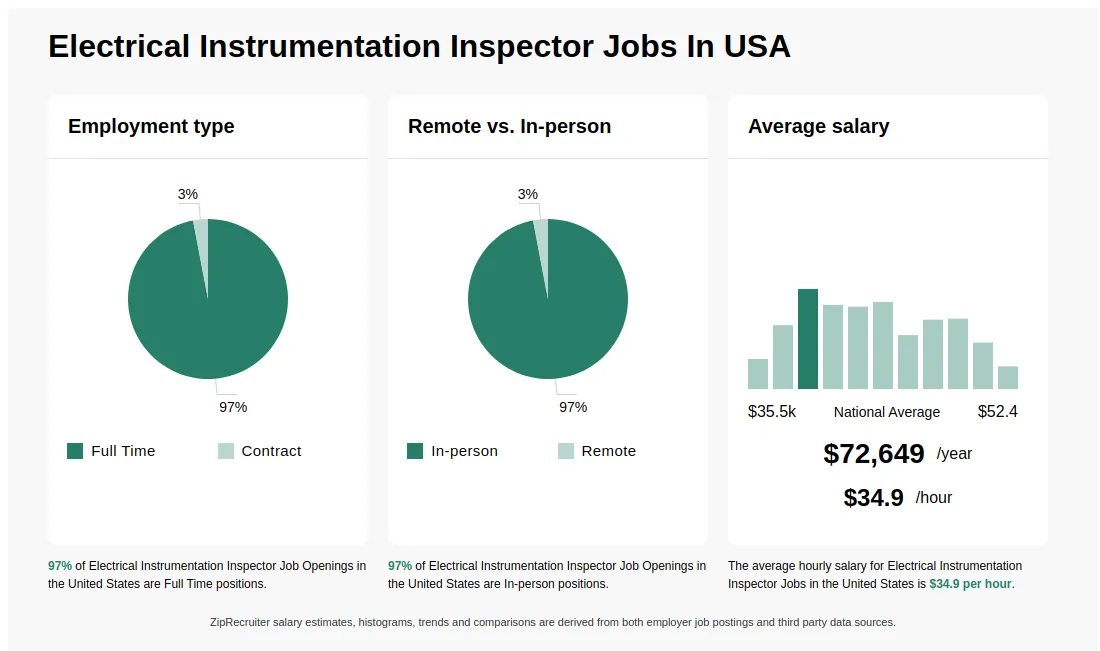
As of Jul 14, 2026, the average hourly pay for electrical instrumentation inspector in the United States is $34.93, according to ZipRecruiter salary data. Most workers in this role earn between $25.96 and $42.07 per hour, depending on experience, location, and employer.
What is the difference between Electrical Instrumentation Inspector vs Electrical Maintenance Technician?
| Aspect | Electrical Instrumentation Inspector | Electrical Maintenance Technician |
|---|---|---|
| Certifications | Typically requires certifications in instrumentation, electrical safety, and inspection standards | Requires electrical trade certifications, such as journeyman or master electrician licenses |
| Work Environment | Inspects electrical instrumentation systems in industrial, manufacturing, or power plant settings | Performs maintenance and repairs on electrical systems in various facilities |
| Job Focus | Ensures instrumentation and control systems meet safety and quality standards | Maintains and repairs electrical systems to ensure operational efficiency |
While both roles involve electrical systems, the Electrical Instrumentation Inspector primarily focuses on inspecting and verifying instrumentation and control systems, whereas the Electrical Maintenance Technician handles ongoing maintenance and repairs. The inspector role emphasizes compliance and quality assurance, often requiring specialized certifications, while the technician role is more hands-on with electrical system troubleshooting and repair.
What does an Electrical Instrumentation Inspector do?
An Electrical Instrumentation Inspector is responsible for ensuring that all electrical and instrumentation systems in a facility or project are installed correctly and function according to design specifications and safety standards. They inspect wiring, control systems, sensors, and related equipment, verifying compliance with codes and project requirements. Inspectors also document their findings, suggest corrective actions, and may conduct tests or audits. Their work is essential for maintaining operational safety, efficiency, and regulatory compliance in industries like oil and gas, manufacturing, and construction.
What are the key skills and qualifications needed to thrive as an Electrical Instrumentation Inspector, and why are they important?
To thrive as an Electrical Instrumentation Inspector, you need a solid understanding of electrical systems, instrumentation, and relevant industry standards, usually supported by a technical diploma or engineering degree. Familiarity with inspection tools, calibration equipment, and software like PLCs or SCADA systems, as well as certifications such as API or ISA, is often required. Attention to detail, problem-solving, and strong communication skills help inspectors accurately assess installations and collaborate with engineering teams. These skills ensure compliance, safety, and reliability of electrical and instrumentation systems in industrial settings.
What are some common challenges faced by Electrical Instrumentation Inspectors on large construction projects?
Electrical Instrumentation Inspectors often encounter challenges such as coordinating inspections across multiple contractors, ensuring compliance with strict safety and quality standards, and managing tight project timelines. They must stay up-to-date with evolving codes and client specifications while documenting inspection results accurately. Effective communication and problem-solving skills are essential, as the role requires close collaboration with engineers, project managers, and field technicians to resolve issues quickly and keep the project on track.
More about Electrical Instrumentation Inspector jobs
What cities are hiring for Electrical Instrumentation Inspector jobs? Cities with the most Electrical Instrumentation Inspector job openings:
What states have the most Electrical Instrumentation Inspector jobs? States with the most job openings for Electrical Instrumentation Inspector jobs include:
What job categories do people searching Electrical Instrumentation Inspector jobs look for? The top searched job categories for Electrical Instrumentation Inspector jobs are:
Part-time
Re-posted 21 days ago
Job description
Electrical and Instrumentation Inspector (Part Time) - United States
Intertek, a leading provider of quality and safety solutions to many of the world's top-recognized brands and companies, is actively seeking an Electrical and Instrumentation Inspector (Part Time) to join our Technical Inspection Services team in the United States. This is a fantastic opportunity to grow a versatile career in Inspection Services!
Intertek Technical Inspection Services (TIS) is a partner to clients in diverse industries such as oil & gas, renewable energy, engineering, chemical, and transportation. Intertek supports our clients striving to meet the growing global infrastructure requirements and demands for secure and sustainable sources of energy through services such as inspection, expediting, technical auditing, and site construction support.
What are we looking for?
The Electrical and Instrumentation Inspector (Part Time) is responsible for ensuring that the Project Quality Plan in conjunction with Project Execution Plan is developed and implemented. This role will promote quality awareness throughout the organization, emphasizing excellence, continuous improvement, and corrective action to influence the overall success of company business. By joining Intertek, your contributions will be valued as we continue to help the world Build Back Ever Better.
Shift/Schedule: All inspectors are utilized on an Adhoc basis and are not provided daily duties. All needs are based on our clients' needs and we source inspectors based on availability, location, taxonomy approvals, and specific client requests.
Location: United States
What you'll do:
- Witness inspection, testing, and verification of electrical and instrumentation installations, materials, and equipment.
- Ensure compliance with project specifications, design drawings, and approved procedures.
- Monitor construction and installation activities to confirm adherence to quality and safety standards.
- Review and interpret electrical and instrumentation drawings, loop diagrams, and data sheets.
- Verify calibration and certification of test instruments and tools.
- Conduct pre-commissioning and commissioning inspections, including continuity, insulation resistance, loop checks, and function tests.
- Identify non-conformances, document findings, and ensure corrective actions are implemented.
- Maintain accurate inspection records, reports, and documentation
- Collaborate with engineering, construction, and quality teams to resolve technical issues and ensure compliance.
- Promote adherence to safety procedures and regulatory requirements, especially in hazardous (classified) areas.
This position outline is a general guideline and does not represent all encompassing details. The position assumes that the incumbent has both the mental and physical requirements to carry out the above defined duties.
Minimum Requirements & Qualifications:
- High School Diploma or GED, Trade School, On-The-Job Training or University Diploma
- Industry standard certifications preferred
- 10+ years of inspection experience on-site during construction in Electrical inspection
- Ability to travel frequently throughout the continental US
- Valid driver's license and reliable driving record is required
- Proficient in MS Office programs and Outlook
Preferred Requirements & Qualifications:
- Valid Industry Certification preferred - Examples of such certifications include, but not limited to: AWS CWI, API 510, 570, SI, (Source Inspector), Electrical Journeyman License, NACE CIP 1, 2, 3, EMA (Expediting Management Association) Basic, Advanced, ASNT NDT Level II, III, and ASQ or IRCA Certified Auditor
Intertek: Total Quality. Assured.
Intertek is a world leader in the Quality Assurance market, with a proven, high-quality business model and a global network of customer-focused operations and highly engaged subject matter experts. With passion, pace, and precision we work to exceed our customers' expectations, while engaging with our employees to be 10X in their performance and professional growth.
Intertek is a drug-free workplace. As a condition of employment, certain positions may be required to pass a pre-employment drug test based on the type of work that will be performed.
We Value Diversity
Intertek's network of phenomenal people are our greatest assets, and the diversity they bring fuels our success. Intertek is an Equal Employment Opportunity Employer that values inclusion and diversity. We take affirmative action to ensure all qualified applicants will receive consideration for employment without regard to race, color, religion, sex, sexual orientation, gender identity, national origin, disability, veteran status, or other legally protected characteristics.
For individuals with disabilities who would like to request accommodation, or who need assistance applying, please email hr.eeo@intertek.com or call 1-877-694-8543 (option #5) to speak with a member of the HR Department.
CA-IS
#LI-TB2
*Intertek does not accept unsolicited approaches from agencies and will not pay a fee for any placement resulting from the receipt of an unsolicited resume.
Intertek is a leading Total Quality Assurance provider to industries worldwide. Our network of more than 1,000 laboratories and offices in more than 100 countries, delivers innovative and bespoke Assurance, Testing, Inspection and Certification (ATIC) solutions for our customers' operations and supply chains. Working at Intertek means joining a global network of state-of-the-art facilities and passionate people who deliver superior customer service with a purpose of bringing quality, safety, and sustainability to life. Intertek's Industry Services team uses expert technical knowledge of industries such as oil & gas, power generation, renewable energy, chemical, construction and transportation to provide a diverse range of innovative Total Quality Assurance solutions that optimize operations while minimizing risks in quality, safety and cost. Some of our key services include vendor inspection, site construction services, asset integrity management, non-destructive & materials testing, 3D laser scanning & dimensional control and energy & water consulting services.