1

Digital Court Reporter Jobs (NOW HIRING)

Digital Court Reporter I

SC · On-site

$51K/yr

The Digital Court Reporter I serves both the Circuit and Family Courts by accurately capturing the record according to the policies and procedures prescribed in relevant statutes and court rules.

Digital Court Reporter II

SC · On-site

$56K/yr

Job Responsibilities Under direct management of a Court Reporter Supervisor, the Digital Court Reporter II serves both the Circuit and Family Courts by accurately capturing the record and providing ...

Position description The Ninth Judicial Circuit Court in Orlando is seeking a Digital Court Reporter to join our team. The position is responsible for recording and transcribing court proceedings ...

next page

Showing results 1-20

Digital Court Reporter information

See salary details

$19

$32

$48

How much do digital court reporter jobs pay per hour?

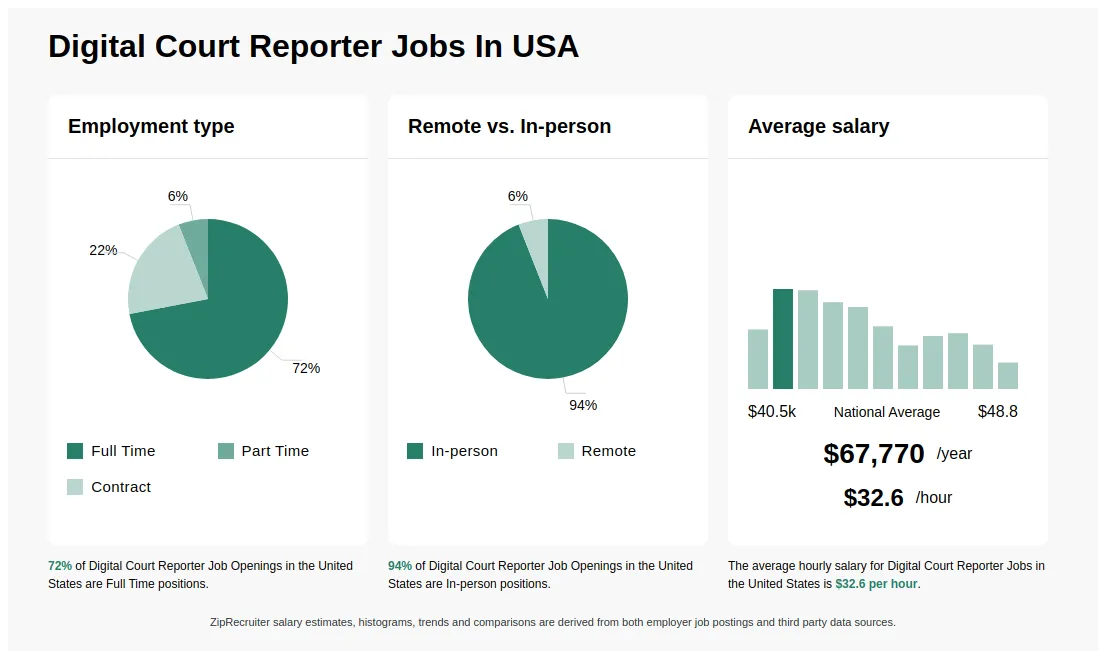
As of Jul 7, 2026, the average hourly pay for digital court reporter in the United States is $32.58, according to ZipRecruiter salary data. Most workers in this role earn between $25.24 and $39.66 per hour, depending on experience, location, and employer.

What is a Digital Court Reporter?

A Digital Court Reporter is a professional who uses specialized digital audio recording equipment to capture verbatim records of legal proceedings, such as trials, depositions, and hearings. Instead of traditional shorthand or stenography, they monitor and annotate audio recordings to ensure clarity and accuracy. Digital Court Reporters are also responsible for maintaining equipment, creating accurate transcripts, and managing digital files. Their role is essential in preserving an official record of court proceedings for future reference.

What is the difference between Digital Court Reporter vs Court Reporter?

AspectDigital Court ReporterCourt Reporter
CredentialsTypically requires certification in digital reporting or stenographyRequires certification in stenography or digital reporting
Work EnvironmentCourts, legal proceedings, remote depositionsCourts, legal proceedings, depositions
Industry UsageLegal industry, courtrooms, legal documentationLegal industry, courtrooms, legal documentation
Primary FunctionRecording proceedings digitally, often via audio/videoTranscribing spoken words in real-time using stenography or digital tools

Both Digital Court Reporters and Court Reporters work in legal environments, capturing court proceedings. Digital Court Reporters focus on recording proceedings digitally, often using audio or video technology, while Court Reporters typically transcribe spoken words in real-time using stenography or digital devices. The roles overlap in credentials and work settings, but their methods of capturing and producing records differ.

How to Become a Digital Court Reporter

The qualifications needed to become a digital court reporter include proficiency with a variety of equipment, including microphones, video recorders, and stenotype machines. Your duties are to record the courtroom proceedings to create a factual account of a trial using various mediums, so computer and software skills are vital. Your duties also involve administrative tasks, such as providing transcripts to the court. Your responsibilities may include the collection of other information in a non-court situation, such as depositions given in a lawyer’s office. You need an associate degree and a certification through an organization like the American Association of Electronic Reporters and Transcribers.


What does a digital court reporter do?

A digital court reporter transcribes court proceedings using specialized recording and transcription technology, often replacing traditional stenography. They ensure accurate, real-time documentation of legal proceedings and may use software to review and produce official transcripts. Certification and familiarity with legal terminology and digital tools are typically required.

What are the key skills and qualifications needed to thrive as a Digital Court Reporter, and why are they important?

To thrive as a Digital Court Reporter, you need strong listening skills, attention to detail, and a solid understanding of legal terminology, often supported by a postsecondary certificate in court reporting or a related field. Familiarity with digital audio recording equipment, transcription software, and case management systems is typically required. Excellent time management, discretion, and strong written communication help professionals excel in this role. These skills are essential to ensure accurate and confidential records of legal proceedings, which are critical for the justice system.

What are some common challenges faced by Digital Court Reporters, and how can they be managed?

Digital Court Reporters often encounter challenges such as ensuring the clarity of audio recordings in busy or noisy courtrooms, maintaining focus during long proceedings, and efficiently annotating important moments for later transcription. To manage these challenges, it's important to be proactive in setting up and testing recording equipment, communicate with the court staff to minimize background noise, and develop strong organizational skills to keep accurate notes. Staying up-to-date with the latest recording technology and best practices can also make day-to-day tasks more manageable.

Will AI replace digital court reporters?

Digital court reporters use specialized transcription software and sometimes AI tools to transcribe court proceedings. While AI can assist with transcription accuracy and efficiency, human court reporters are still essential for capturing context, managing complex terminology, and ensuring legal accuracy. Full replacement by AI is unlikely in the near term due to the need for human judgment and oversight in legal settings.

How do I become a digital court reporter?

To become a digital court reporter, you typically need to complete a postsecondary training program in court reporting or digital transcription, which covers the use of stenotype machines and digital recording equipment. Certification or licensing may be required depending on the jurisdiction, and strong listening, typing, and technical skills are essential for success in this role.

How much do you make as a digital court reporter?

Digital court reporters typically earn between $50,000 and $80,000 annually, depending on experience, location, and the complexity of cases. They often work in courtrooms or legal settings, using specialized transcription and recording equipment, and may require certification or training in digital reporting tools.
What cities are hiring for Digital Court Reporter jobs? Cities with the most Digital Court Reporter job openings:
What are the most commonly searched types of Digital Court Reporter jobs? The most popular types of Digital Court Reporter jobs are:
Who are the top companies hiring for Digital Court Reporter jobs? The top employers for Digital Court Reporter jobs are:
What states have the most Digital Court Reporter jobs? States with the most job openings for Digital Court Reporter jobs include:
What are popular job titles related to Digital Court Reporter jobs? For Digital Court Reporter jobs, the most frequently searched job titles are:
Infographic showing various Digital Court Reporter job openings in the United States as of July 2026, with employment types broken down into 84% Full Time, 14% Part Time, 1% Temporary, and 1% Contract. Highlights an 90% Physical, 3% Hybrid, and 7% Remote job distribution, with an average salary of $67,770 per year, or $32.6 per hour.
Digital Court Reporter I

$51K/yr

Full-time

Medical, Dental, Vision, Life, Retirement, PTO

Re-posted 27 days ago


State Of South Carolina rating

7.9

Company rating: 7.9 out of 10

Based on 41 frontline employees who took The Breakroom Quiz

13th of 50 rated states


Job description

Salary: $51,636.00 Annually
Location : Statewide, SC
Job Type: FTE - Full-Time
Job Number: 186245
Agency: Judicial Branch
Division: Court Services
Opening Date: 03/13/2026
Closing Date: Continuous
Class Code:: ah1024
Position Number:: TBD
Normal Work Schedule:: Monday - Friday (8:30 - 5:00)
Pay Grade: Unclassified
Opening Date: 03/13/2026
EEO Statement: Equal Opportunity Employer
Agency Specific Application Procedures:: nterested persons meeting the required qualifications should submit an online application at www.careers.sc.gov to include all work history and education. All questions on the application must be completed. A resume may be included but will not be accepted or reviewed in lieu of an incomplete application. Supplemental questions are considered a part of your application and must be completed.
Veteran Preference Statement: South Carolina is making our Veterans a priority for employment in state agencies and institutions.
Job Responsibilities
The South Carolina Judicial Branch is seeking to fill Digital Court Reporter I positions statewide. The Digital Court Reporter I serves both the Circuit and Family Courts by accurately capturing the record according to the policies and procedures prescribed in relevant statutes and court rules.
ESSENTIAL DUTIES AND RESPONSIBILITIES OF THE POSITION
Note: This job bulletin represents general duties for this position and is not intended to be construed as exclusive or all-inclusive. Other duties may be required and assigned.
  • Attends court proceedings and creates verbatim recordings by operating electronic audio recording equipment provided by SCJB to create a clear and complete quality audio recording of legal proceedings.
  • Verifies proper operation of the equipment prior to court proceedings and troubleshoots issues with designated IT support team so as to avoid delays and disruptions to court.
  • Creates accurate and detailed electronic time-linked annotations of case events and terminology to serve as a guide to assist the creation of an accurate transcript. Plays back testimony during proceedings at the direction of the presiding judge.
  • Receives, inventories, records, and maintains exhibits entered as evidence in court. Files case exhibits with Clerk of Court in compliance with applicable laws, rules, and regulations. Retains a receipt of delivery to the Clerk's office.
  • Adheres to common principles of professionalism to include being punctual and prepared; dressed in accordance with SCJB's dress code; and being courteous and civil when interacting with the judge, counsel, parties, clerk's staff, and the public.
  • Remains as a neutral observer during court proceedings, refrains from causing disruptions to the proceedings; and exercises the highest levels of professional integrity in the disposition of job responsibilities. Must be able to work independently, exercising good judgement and discretion.
  • Assists judges and court personnel with reasonable requests while working in and outside of the courtroom.
  • Attends meetings or training sessions as required.
  • Performs other related duties as assigned.

Minimum and Additional Requirements
MINIMUM QUALIFICATIONS (EDUCATION AND EXPERIENCE)
  • High school diploma.
  • Verified current credentials as a Certified Electronic/Digital Court Reporter by the American Association of Electronic Reporters and Transcribers (AAERT). Successful completion of an AAERT approved Electronic/Digital Court Reporting Program from an institution of higher education may be substituted for the required credentials as a Certified Electronic/Digital Court Reporter.
  • Minimum typing speed of 60 wpm with a high rate of accuracy.
  • Computer and word processing experience and ability to operate digital recording equipment.
  • Must be able to maintain concentration and sit in a courtroom for extended periods of time.
  • Must have dependable transportation as this position will require occasional travel to courthouses throughout the circuit.
  • Punctuality and avoidance of excessive absences required.

REQUIRED KNOWLEDGE, SKILLS, ABILITIES AND OTHER CHARACTERISTICS
Knowledge:
  • General knowledge of nationally recognized court reporter practices and procedures.
  • Specific knowledge of court reporter policies, procedures, and practices as outlined in the SC Court Reporters Manual.
  • Knowledge and use of modern court reporting technology and equipment.
  • Proficient in the use of computers and computer equipment.
Abilities:
  • Must possess excellent time management and listening skills.
  • Must be detail-oriented and able to work independently.
  • Must be able to deal with others in a courteous and professional manner.
  • Ability to exercise judgment and discretion in interpreting and applying policies and procedures.
  • Ability to communicate effectively with Judges, attorneys, coworkers and the general public.
  • Ability to establish and maintain effective working relationships.
  • Ability to maintain the confidentiality of the court proceedings.
  • Punctuality and avoidance of excessive absences required.

Preferred Qualifications
DESIRABLE (PREFERRED) REQUIREMENTS (EDUCATION AND/OR EXPERIENCE)
  • Two (2) or more years of court reporting experience, with a thorough knowledge of hearing procedures and production of transcripts.

Additional Comments
ADDITIONAL COMMENTS
The South Carolina Judicial Branch offers an exceptional benefits package for FTE positions that include:
  • Health, Dental, Vision, Long Term Disability, and Life Insurance for Employee, Spouse, and Children;
  • State Retirement Plan and Deferred Compensation Programs (Temporary positions have option to enroll);
  • 15 days paid annual (vacation) leave per year;
  • 15 days paid sick leave per year;
  • Option to designate 10 days of earned paid sick leave per year as family sick leave;
  • Paid parental leave;
  • 13 paid state holidays; and
  • Workers' Compensation Benefits.

Benefits for State Employees
The state of South Carolina offers eligible employees generous benefits, including health and dental insurance; retirement and savings plan options; and paid vacation and sick leave. Plus, work-life balance programs such as telecommuting and flexible work schedules are available to employees of some state agencies.
Insurance Benefits
Eligible employees may enroll in health insurance, which includes prescription coverage and wellness benefits. Other available insurance benefits include dental, vision, term life insurance, long term disability and flexible spending accounts for health and child care expenses.
Retirement Benefits
State employees are also offered retirement plan options, including defined benefit and defined contribution plans. Additionally, eligible employees may elect to participate in the South Carolina Deferred Compensation Program, which is a voluntary, supplemental retirement savings plan offering 401(k) and 457 plan options.
Workplace Benefits
State employees may also be eligible for other benefits, including tuition assistance; holiday, annual and sick leave; and discounts on purchases, travel and more.
Note: The benefits above are available to most state employees, with the exception of those in temporary positions. Employees in temporary grant and time-limited positions may be eligible for all, some or none of these benefits as benefits are associated with each position type. For these positions, contact the hiring agency to determine what benefits may be available.
01
Please indicate the county(ies) for which you are applying.
02
What is your highest completed level of education?
  • Juris Doctorate
  • Master's Degree
  • Bachelor's Degree
  • Associate Degree
  • Some College but No Degree
  • High School Diploma
  • GED
  • None of the above

03
How many years of prime court reporting experience to you have?
  • Less than a year
  • 1-3 years
  • 3-5 years
  • More than 5 years

04
What verified court reporting credentials do you currently possess?
05
Give a summary of your court reporting experience.
Required Question

What State Of South Carolina employees say

Pay

Benefits

Hours and flexibility

Workplace

Get the full story on Breakroom


State of South Carolina logo

About State of South Carolina

Sourced by ZipRecruiter

State of South Carolina is not a typical corporation, but the governing body of the US state of South Carolina, located in the capital city of Columbia. Its industry focuses on public administration, providing key essential services to ensure the efficient functioning of the state. These services range from public safety and environment protection to education, healthcare, and economic development. The state was founded in 1788, grounded in democratic principles meant to support the overall well-being of its citizenry. Its core values revolve around service, integrity, accountability, and transparency. The mission of the State of South Carolina is to improve the quality of life for all its people, with a focus on education advancement, economic growth, and improved healthcare.

Industry

Public administration

Company size

10,000+ Employees

Headquarters location

Columbia, SC, US

Social media