1

Diabetes Pharmacist Jobs (NOW HIRING)

Diabetes Educator II

Berkeley, CA · On-site

$53.25 - $74.55/hr

Provides diabetes self-management education/training (DSMT) and/or medical nutrition therapy (MNT ... Coordinates patient care in collaboration with other healthcare providers (physicians, pharmacists ...

New

$75 - $86/hr

Provides diabetes education to participants with pre-diabetes, Type 1, or Type 2 diabetes. Develops ... Assists medical provider/pharmacist in data collection for continuous glucose monitors. Assists ...

Showing results 21-40

Diabetes Pharmacist information

See salary details

$27

$60

$74

How much do diabetes pharmacist jobs pay per hour?

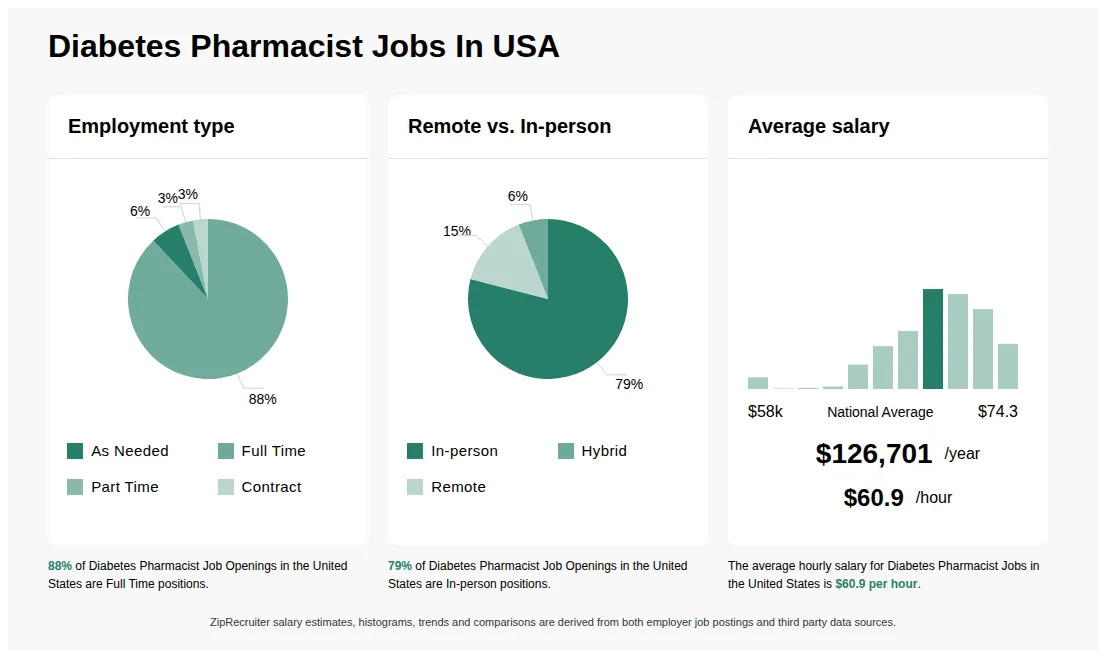
As of Sep 3, 2026, the average hourly pay for diabetes pharmacist in the United States is $60.91, according to ZipRecruiter salary data. Most workers in this role earn between $56.01 and $67.31 per hour, depending on experience, location, and employer.

What is a diabetes pharmacist?

A Diabetes Pharmacist is a specialized pharmacist who focuses on managing and optimizing medication therapy for patients with diabetes. They provide education on medications, lifestyle changes, and blood sugar management to help improve patient outcomes. They work closely with healthcare providers to adjust treatment plans, monitor for potential complications, and ensure safe and effective medication use. Their goal is to enhance diabetes care through personalized support and medication management.

What are the most common daily responsibilities of a diabetes pharmacist?

As a Diabetes Pharmacist, your typical day involves providing medication therapy management, offering patient education on diabetes self-care, reviewing blood glucose logs, and collaborating with physicians to optimize treatment plans. You may also monitor patient adherence, adjust medications under collaborative practice agreements, and conduct wellness screenings or group education sessions. Your expertise helps patients navigate complex medication regimens and empowers them to manage their condition more effectively. Working closely with nurses, dietitians, and other healthcare professionals is also routine to ensure comprehensive diabetes care.

What are the key skills and qualifications needed to thrive in the diabetes pharmacist position, and why are they important?

To thrive as a Diabetes Pharmacist, you need a Doctor of Pharmacy degree, state licensure, and specialized knowledge in diabetes management and pharmacotherapy. Familiarity with blood glucose monitoring devices, continuous glucose monitoring (CGM) technology, electronic health records (EHRs), and certifications like Certified Diabetes Care and Education Specialist (CDCES) are highly beneficial. Excellent patient counseling skills, attention to detail, and the ability to collaborate across multidisciplinary teams set outstanding candidates apart. These qualifications are essential for optimizing medication regimens, educating patients, and improving outcomes in diabetes care.

More about Diabetes Pharmacist jobs

What cities are hiring for Diabetes Pharmacist jobs?

Cities with the most Diabetes Pharmacist job openings:

What are the most commonly searched types of Diabetes Pharmacist jobs?

The most popular types of Diabetes Pharmacist jobs are:

What states have the most Diabetes Pharmacist jobs?

States with the most job openings for Diabetes Pharmacist jobs include:

Infographic showing various Diabetes Pharmacist job openings in the United States as of August 2026, with employment types broken down into 2% As Needed, 72% Full Time, 13% Part Time, 2% Temporary, and 11% Contract. Highlights an 89% In-person, and 11% Remote job distribution, with an average salary of $126,701 per year, or $60.9 per hour.

Outpatient Diabetes Educator - Redbank Diabetic Education - Full Time - Days

The Christ Hospital

Cincinnati, OH • On-site

Full-time

Re-posted 26 days ago


Christ Hospital Health Network rating

6.9

Company rating: 6.9 out of 10

Based on 95 frontline employees who took The Breakroom Quiz

454th of 898 rated healthcare providers


Job description

A member of the multi-disciplinary health care team responsible for the design, coordination and implementation of optimal comprehensive diabetes care and education of diabetic clients in accordance with established ADA standards of care. In addition, the dietitian will be consulted on and provide specialized education on nutrition related care for diabetes.

KNOWLEDGE AND SKILLS:

EDUCATION: Bachelor's/Master's degree from an Accredited Education Program of the Academy of Nutrition and Dietetics.

YEARS OF EXPERIENCE: Experience in general clinical dietetics practice desirable. One year's experience in practice area preferred.

REQUIRED SKILLS AND KNOWLEDGE: Knowledge/use of adult learning principles required. Knowledge and expertise in diabetes mellitus and its management required. Ability to develop and implement effective medical nutrition therapy plans/programs for the patient with prediabetes, or diabetes. Strong verbal and written communication skills are required in addition to good people skills, problem solving, decision making, and time management and leadership skills. Computer skills in Microsoft Office, and EMR.

LICENSES & CERTIFICATIONS:

Active Registration Status with The Commission on Dietetic Registration of the Academy of Nutrition and Dietetics is required. Current License to Practice Dietetics in the State of Ohio is required. License to Practice Dietetics in the State of Kentucky is required within six months of hire. Certification as a Diabetes Care and Education Specialist (CDCES) preferred. Certification within 4 years of hire required. If part time or PRN time will be adjusted.

Education 

Provides comprehensive Diabetes Self-Management Training (DSMT) 

  • Considering age-specific physiological, developmental, and cultural/socioeconomic parameters, assesses educational and nutritional needs of patients diagnosed with diabetes mellitus.
  •  Assessment includes medical history, nutrition practices, physical activity, medications, health literacy, readiness to learn and readiness to change behaviors. 
  • Assists patients in determination of realistic and measurable goals or outcomes consistent with diabetes practice guidelines and appropriate to patient's state of health, resources, and needs.
  •  Guides patients in identification of behaviors necessary for goal attainment within a designated time frame. 
  • Monitors progress made toward achievement of pre-determined goals
  • Provides DSMT in group and individual settings in accordance with nine content areas of the American Diabetes Association: diabetes pathophysiology, healthy eating, being active, taking medications, monitoring glucose, prevention/detections/treatment of acute and chronic complications, lifestyle and healthy coping, and diabetes distress and support.
  • Provides Medical Nutrition Therapy (MNT) to patients requiring in depth guidance and education to achieve nutritional behavioral goals. 
  • Utilizes clinical practice recommendations and standards of care of the American Diabetes Association (A.D.A.) - Responsible for designing the curriculum and assisting in the delivery of DSME 
  • Participates in the planning or implementation of educational programs for the community, or professional health care staff as needed

Provides Medical Nutrition Therapy

  • Considering age-specific physiological, developmental, and cultural/socioeconomic parameters, assesses educational and nutritional needs of patients diagnosed with various diet-related diseases or conditions 
  • Assessment includes medical history, nutrition practices, physical activity, medications, health literacy, readiness to learn and readiness to change behaviors.
  •  Assists patients in determination of realistic and measurable goals or outcomes and appropriate to patient's state of health, resources, and needs. 
  • Guides patients in identification of behaviors necessary for goal attainment within a designated time frame.

Communication

Maintains ongoing communication with other pertinent departments and health care providers of The Christ Hospital Health Network. 

  • Communicates clearly, concisely, and accurately while considering others' needs and beliefs.
  •  Collaborates with clinical staff to develop plans of care to meet needs of patients with diabetes. 
  • Provides up-to-date information regarding diabetes and its management to various health care groups. 
  •  Documents educational sessions and post program support plans in the EMR and communicates diabetes education plan and progress with referring providers.

Teamwork 

  • Participates as an active member of the multidisciplinary diabetes team. 
  • Literature favors the registered nurse, registered dietitian, and pharmacist serving both as the key primary instructors for diabetes education and as members of the multidisciplinary team 
  • Participates in department meetings and Annual Advisory meetings 
  • Work collaboratively with others in endeavor to meet customers' needs.

Professional Development 

Expert consensus supports the need for specialized diabetes and educational training beyond academic preparation for the primary instructors on the diabetes team.

Develops high degree of competency through continued professional growth.

  • Utilizes appropriate journals, books, websites/list servers and attendance of seminars, workshops, and meetings/conferences. Non CDEES dietitians must complete 15 hours of continuing education on diabetes topics each year.
  • Participates in competency assessment process and self-evaluation to establish professional goals and development plan emphasizing area of specialization as appropriate. 
  • Participates in diabetes-related professional organizations such as DECA, the professional division of the A.D.A. or the American Association of Diabetes Educators (AADE). Now ADCES
  • Maintains or is working towards Certification as a Diabetes Care and Education Specialist.

Performance improvement/Research  

  • Participates in interdepartmental and intradepartmental performance improvement activities related to patient care and service. 
  • Participates in data collection and development of the core curriculum for ADA recognition

Unit Population Served Competency

  • Evidence exists that The Christ Hospital staff considers the special needs and behaviors of the specific patient populations served. Evidence also exists that shows the staff demonstrates those competencies that address the unique characteristics related to developmental, physical, psychosocial, mental, emotional, and social needs of patients across the life span. Associates should also be able to demonstrate those competencies that address the needs of patients with unique cultural norms, religious preferences, language/communication barriers and/or literacy limitations

Miscellaneous 

  • Coordinates scheduling of patients 
  • Performs other duties as required

What Christ Hospital Health Network employees say

Pay

Benefits

Hours and flexibility

Workplace

Get the full story on Breakroom