1

Data Integration Engineer Jobs (NOW HIRING)

Maintain alignment with security frameworks, compliance data, and IT operations standards. * Engaging with the engineering team to implement and test mappings on virtual hardware and devices as ...

Maintain alignment with security frameworks, compliance data, and IT operations standards. * Engaging with the engineering team to implement and test mappings on virtual hardware and devices as ...

Maintain alignment with security frameworks, compliance data, and IT operations standards. * Engaging with the engineering team to implement and test mappings on virtual hardware and devices as ...

Data Integration Engineer

Baltimore, MD · Remote

$50K - $100K/yr

Maintain alignment with security frameworks, compliance data, and IT operations standards. * Engaging with the engineering team to implement and test mappings on virtual hardware and devices as ...

Data Integration Engineer

NC · Remote

$50K - $100K/yr

Maintain alignment with security frameworks, compliance data, and IT operations standards. * Engaging with the engineering team to implement and test mappings on virtual hardware and devices as ...

Maintain alignment with security frameworks, compliance data, and IT operations standards. * Engaging with the engineering team to implement and test mappings on virtual hardware and devices as ...

Maintain alignment with security frameworks, compliance data, and IT operations standards. * Engaging with the engineering team to implement and test mappings on virtual hardware and devices as ...

$55 - $75/hr

Conexus is seeking intermediate level data integration engineers for contract work. Candidates will be supported to follow commonly established best practices as well as utilizing cutting edge ...

Sr Data Integration Engineer

Ankeny, IA · On-site +1

$97.50K - $131.20K/yr

The Senior Data Integration Engineer is responsible for managing, securing, and optimizing the MuleSoft Anypoint Platform with a strong emphasis on Salesforce-hosted integrations. This role supports ...

next page

Showing results 1-20

Data Integration Engineer information

See salary details

$10

$51

$84

How much do data integration engineer jobs pay per hour?

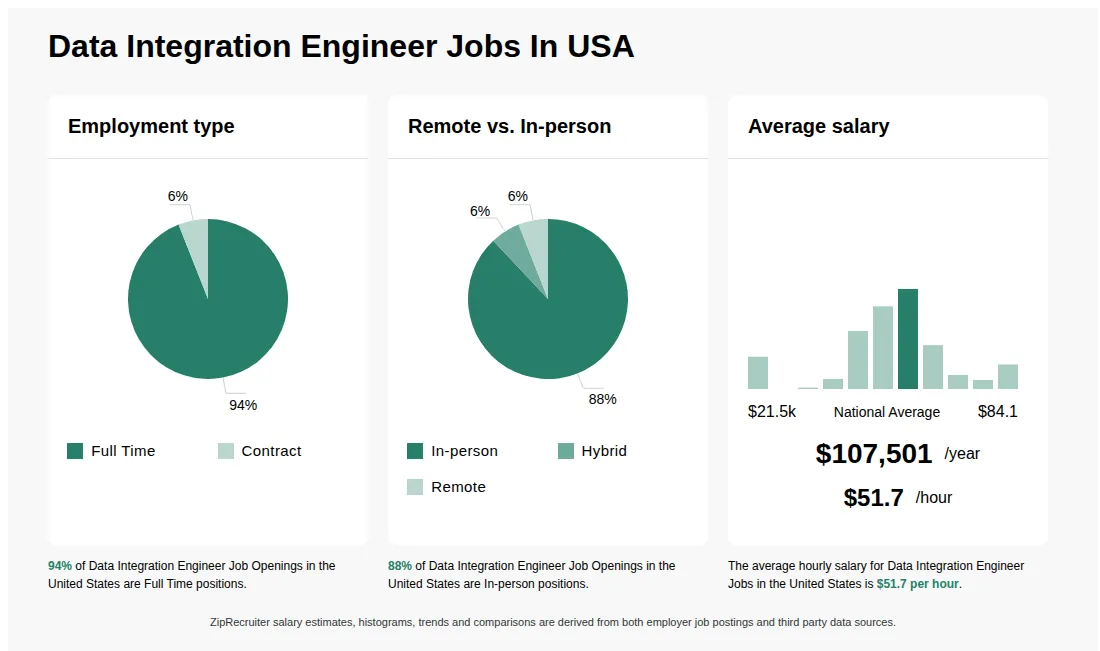
As of Jun 3, 2026, the average hourly pay for data integration engineer in the United States is $51.68, according to ZipRecruiter salary data. Most workers in this role earn between $43.51 and $58.17 per hour, depending on experience, location, and employer.

What are the key skills and qualifications needed to thrive as a Data Integration Engineer, and why are they important?

To thrive as a Data Integration Engineer, you need strong skills in data modeling, ETL (extract, transform, load) processes, and experience with database management, often supported by a degree in computer science or a related field. Familiarity with integration tools like Informatica, Talend, or Microsoft SSIS, and knowledge of programming languages such as SQL and Python, are typically required. Excellent problem-solving abilities, attention to detail, and effective communication help you collaborate with cross-functional teams and resolve integration challenges. These skills are critical for ensuring seamless data flow, system interoperability, and the delivery of reliable, actionable business insights.

What are some common challenges Data Integration Engineers face when working with multiple data sources?

Data Integration Engineers often encounter challenges such as handling inconsistent data formats, resolving data quality issues, and ensuring seamless data flow between disparate systems. Integrating legacy databases with modern cloud platforms can require creative problem-solving and careful planning. Additionally, maintaining data security and compliance across various sources demands a strong understanding of protocols and best practices. Collaboration with data architects, developers, and business analysts is crucial to address these challenges effectively and deliver reliable integration solutions.

What are Data Integration Engineers?

Data Integration Engineers are IT professionals who design, build, and maintain systems that combine data from multiple sources into a unified view. They develop and manage data pipelines, ensuring data flows smoothly between databases, applications, and storage solutions. Their work enables organizations to access accurate and consistent information for analytics, reporting, and business decision-making. Data Integration Engineers often use ETL (Extract, Transform, Load) tools, APIs, and custom scripts to achieve seamless data integration.

What is the difference between Data Integration Engineer vs Data Engineer?

AspectData Integration EngineerData Engineer
Primary FocusDesigning and implementing data pipelines for integration and ETL processesBuilding and maintaining data infrastructure, including storage and processing systems
Skills & CertificationsSQL, ETL tools, data warehousing, cloud platformsSQL, programming (Python, Java), big data technologies, cloud services
Work EnvironmentData teams, analytics departments, data warehousesData engineering teams, infrastructure, data lakes
Industry UsageUsed across industries for data integration tasksUsed for creating scalable data pipelines and infrastructure

While both roles involve working with data, Data Integration Engineers focus on connecting and transforming data from various sources, whereas Data Engineers build the underlying systems and infrastructure to support data storage and processing. Both roles often collaborate but serve different core functions within data teams.

More about Data Integration Engineer jobs
What cities are hiring for Data Integration Engineer jobs? Cities with the most Data Integration Engineer job openings:
What states have the most Data Integration Engineer jobs? States with the most job openings for Data Integration Engineer jobs include:
Infographic showing various Data Integration Engineer job openings in the United States as of May 2026, with employment types broken down into 89% Full Time, 10% Part Time, and 1% Contract. Highlights an 84% Physical, 4% Hybrid, and 12% Remote job distribution, with an average salary of $107,501 per year, or $51.7 per hour.

Sr. Data & Integration Engineer

Veloc Inc.

Houston, TX

Other

Posted 4 days ago


Job description

We are seeking an IT Data & Integration Engineer to define, design, implement and govern enterprise data and integration solutions across our Microsoft ecosystem. This role is responsible for the overall architecture and implementation of solutions leveraging Microsoft Fabric, Power BI, Azure Logic Apps, Power Automate, with a strong focus on reporting, integrations between Dynamics 365 and related downstream applications.

You will partner with business stakeholders, application teams, and infrastructure/security teams to establish integration patterns, data models, and platform standards that are scalable, secure, and support long-term growth. This role reports to the Manager, Enterprise Application Development in our Corporate IT organization.


What You Will Do

Own integration and data architecture for Dynamics 365 and related systems

  • Define and maintain the enterprise integration architecture for Dynamics 365 (F&O and/or CE) and related downstream systems (e.g., Workday, Salesforce, iCertis, eBuilder, Blackline, Kyriba, VTS, etc).
  • Select and standardize integration patterns (APIs, event driven, data entities, Dataverse, SFTP/Blob flat file based, export to data lake) using Fabric, Azure Logic Apps, Power Automate, and complementary Azure services.
  • Establish guidelines for error handling, observability, security, and performance across integrations.

Architect data solutions using Microsoft Fabric

  • Design end-to-end data architectures leveraging Microsoft Fabric (Lakehouse/Warehouse, Pipelines, Dataflows, semantic models) to support analytics, operational reporting, and self-service BI.
  • Design and orchestrate Microsoft Fabric data pipelines using Data Factory to support ingestion, transformation, and automation scenarios.
  • Define canonical data models, shared dimensions, and reference data used across Fabric and Power BI.
  • Design and implement ETL/ELT workflows and data transformations, and provide technical direction on tools and patterns (e.g., SQL, Python, Java, modern ETL platforms).
  • Collaborate closely with analysts, business stakeholders, and application teams to ensure data solutions are aligned to reporting, analytics, and operational requirements.

Lead Power BI and semantic model strategy

  • Architect Power BI environments, including workspace strategy, semantic models, data refresh patterns, and security (RLS/OLS).
  • Create and support Power BI reports and dashboards, including maintaining and enhancing existing reports used by business and executive stakeholders.
  • Support migration of current ERP (e.g., JD Edwards)–based datasets and reports to Dynamics 365–based models, ensuring reconciled, trusted, side-by-side reporting during the transition.
  • Define best practices for DAX, model design, and report performance; review and approve designs for strategic reports and executive dashboards.
  • Govern deployment pipelines and lifecycle management for BI content.

Governance, security, and compliance

  • Collaborate with Cybersecurity and Infrastructure to align integrations and data solutions with security, identity, and access standards (Azure AD/Entra ID, OAuth, least privilege, data classification).
  • Ensure alignment with SOX/ITcontrols, audit requirements, and data retention policies.
  • Document reference architectures, decision records, and standards; maintain an up-to-date architecture blueprint.

About You

  • Bachelor’s degree in Computer Science, Information Systems, Data Engineering, Data Science, Software Engineering, Applied Mathematics, or a related technical field; equivalent experience considered.
  • 7–10+ years of experience in data, integration, or application architecture roles, with significant hands-on background in development/engineering.
  • Deep experience with Dynamics 365 (F&O and/or CE) and its integration capabilities:
    1. Data entities, Dataverse, OData/REST APIs, eventing/webhooks, and export-to-data-lake patterns.
    1. Understanding of core D365 data models and key financial/operational processes.
  • Strong SQL and data modeling skills:
    1. Design and optimization of relational and analytical models; complex queries and tuning.
    1. Experience with stored procedures, views, indexing strategies, and query performance diagnostics.
  • Hands-on architectural experience with Microsoft Fabric:
    1. Designing Lakehouse/Warehouse, ingestion pipelines, and semantic models that feed Power BI at scale.
    1. Implementing governance, security, and performance best practices.
    1. Experience creating and managing Microsoft Fabric data pipelines using Azure Data Factory, including orchestration, monitoring, and error handling.
    1. Expertise in Python for data engineering, advanced transformation, automation, and integration tooling, including scripting for Fabric, Data Factory, and API-based integrations.
  • Proven track record designing and governing Power BI solutions:
    1. Enterprise datasets/semantic models, DAX, RLS, and deployment pipelines.
    1. Creating and supporting Power BI reports and dashboards, including maintaining legacy content while transitioning to new data sources.
    1. Experience migrating reports and datasets from legacy ERP systems such as JD Edwards to Dynamics 365, including side-by-side reconciliation and validation.
  • Strong experience architecting integrations using:
    1. Azure Logic Apps and Power Automate for system-to-system and human-in-the-loop workflows.
    1. REST/JSON APIs, connectors, and integration with SaaS platforms (including Dynamics 365, downstream applications etc.).
    1. Patterns for resiliency, idempotency, throttling, and centralized monitoring.
  • Experience with additional Azure services (e.g., Azure Functions, Service Bus, Event Grid, API Management, Data Factory beyond Fabric scenarios).
  • Experience with DevOps and ALM for Power Platform, Fabric, and Azure resources (e.g., Azure DevOps or GitHub Actions).
  • Solid understanding of security, identity, and compliance:
    1. Azure AD/Entra ID, OAuth, service principals/managed identities, and secrets management.
    1. Awareness of controls needed for SOX/ITand public-company environments.
  • Demonstrated ability to:
    1. Translate business requirements into target-state architectures and roadmaps.
    1. Present options and trade-offs to both technical and non-technical stakeholders.
    1. Lead design sessions, resolve technical issues, and influence standards across teams.