1

Data Integration Engineer Jobs (NOW HIRING)

Data Integration Engineer Location: Dallas TX Duration: 6 to 12+ Months Technical Skills: * Proficient in Apache Kafka concepts (producers, consumers, topics, partitioning, etc.) * Expertise in ...

The Data Integration Engineer will design, develop, and maintain ETL pipelines and data models that support Process Intelligence initiatives. Responsibilities : • Lead design, development, and ...

Krispy Kreme's Data Integration Engineer will be responsible for designing, implementing, and maintaining data integration solutions, creating robust data integration pipelines that connect B2B ...

Krispy Kreme's Data Integration Engineer will be responsible for designing, implementing, and maintaining data integration solutions, creating robust data integration pipelines that connect B2B ...

AVP, Integration Engineering The Data Integration Engineer role is ideal for an experienced data professional eager to put their healthcare domain knowledge and engineering expertise to work in a ...

OR · On-site

Position Summary The Data Integration Engineer will install back-end, automated data integrations to customer electronic medical records, billing, data warehouses or other applicable customer systems ...

Data Integration Engineer

Austin, TX · On-site

$113K - $136K/yr

SourceDay needs someone who has the experience in developing data integrations of third-party ... If you answered yes to all of these then you will enjoy being a part of the SourceDay's engineering ...

next page

Showing results 1-20

Data Integration Engineer information

See salary details

$10

$51

$84

How much do data integration engineer jobs pay per hour?

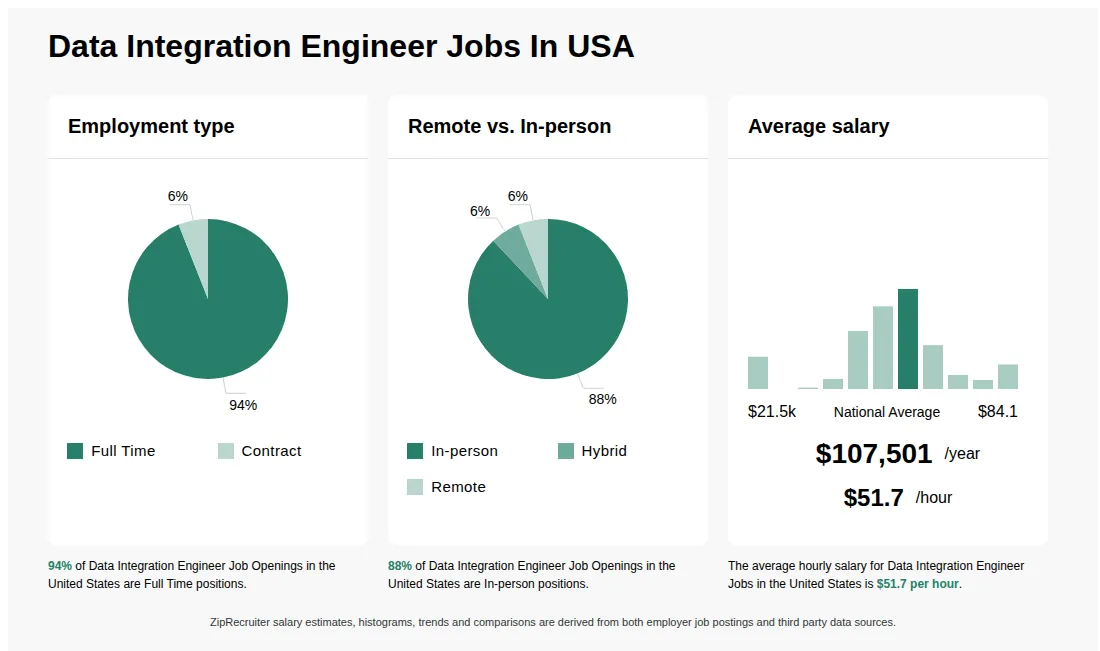
As of Jul 12, 2026, the average hourly pay for data integration engineer in the United States is $51.68, according to ZipRecruiter salary data. Most workers in this role earn between $43.51 and $58.17 per hour, depending on experience, location, and employer.

What are some common challenges Data Integration Engineers face when working with multiple data sources?

Data Integration Engineers often encounter challenges such as handling inconsistent data formats, resolving data quality issues, and ensuring seamless data flow between disparate systems. Integrating legacy databases with modern cloud platforms can require creative problem-solving and careful planning. Additionally, maintaining data security and compliance across various sources demands a strong understanding of protocols and best practices. Collaboration with data architects, developers, and business analysts is crucial to address these challenges effectively and deliver reliable integration solutions.

What are Data Integration Engineers?

Data Integration Engineers are IT professionals who design, build, and maintain systems that combine data from multiple sources into a unified view. They develop and manage data pipelines, ensuring data flows smoothly between databases, applications, and storage solutions. Their work enables organizations to access accurate and consistent information for analytics, reporting, and business decision-making. Data Integration Engineers often use ETL (Extract, Transform, Load) tools, APIs, and custom scripts to achieve seamless data integration.

What are the key skills and qualifications needed to thrive as a Data Integration Engineer, and why are they important?

To thrive as a Data Integration Engineer, you need strong skills in data modeling, ETL (extract, transform, load) processes, and experience with database management, often supported by a degree in computer science or a related field. Familiarity with integration tools like Informatica, Talend, or Microsoft SSIS, and knowledge of programming languages such as SQL and Python, are typically required. Excellent problem-solving abilities, attention to detail, and effective communication help you collaborate with cross-functional teams and resolve integration challenges. These skills are critical for ensuring seamless data flow, system interoperability, and the delivery of reliable, actionable business insights.

What engineers make $200,000 a year?

Data Integration Engineers with extensive experience, advanced skills in data pipelines, and proficiency in tools like ETL platforms and cloud services can earn $200,000 or more annually. High salaries are often associated with senior roles, specialized expertise, and working in industries such as finance, technology, or consulting.

What is the difference between Data Integration Engineer vs Data Engineer?

AspectData Integration EngineerData Engineer
Primary FocusDesigning and implementing data pipelines for integration and ETL processesBuilding and maintaining data infrastructure, including storage and processing systems
Skills & CertificationsSQL, ETL tools, data warehousing, cloud platformsSQL, programming (Python, Java), big data technologies, cloud services
Work EnvironmentData teams, analytics departments, data warehousesData engineering teams, infrastructure, data lakes
Industry UsageUsed across industries for data integration tasksUsed for creating scalable data pipelines and infrastructure

While both roles involve working with data, Data Integration Engineers focus on connecting and transforming data from various sources, whereas Data Engineers build the underlying systems and infrastructure to support data storage and processing. Both roles often collaborate but serve different core functions within data teams.

What engineers make $500,000 a year?

Senior data integration engineers with extensive experience, advanced skills in ETL tools, cloud platforms, and programming languages can reach or exceed a $500,000 annual salary, especially in high-cost-of-living areas or executive roles. Such compensation often includes bonuses, stock options, or other incentives and typically requires a strong track record of complex project management and technical expertise.

What engineers make $300,000 a year?

Senior data integration engineers with extensive experience, advanced skills in ETL tools, cloud platforms, and programming languages can earn $300,000 or more annually. High compensation is often associated with roles in large organizations, specialized expertise, and leadership responsibilities.

What does a data integration engineer do?

A data integration engineer designs, develops, and maintains systems that combine data from multiple sources to ensure accurate and efficient data flow within an organization. They work with tools like ETL (Extract, Transform, Load) processes, databases, and data pipelines, often requiring knowledge of programming languages and data modeling. Their role supports data analysis, reporting, and decision-making by ensuring data consistency and accessibility.
More about Data Integration Engineer jobs
What cities are hiring for Data Integration Engineer jobs? Cities with the most Data Integration Engineer job openings:
What states have the most Data Integration Engineer jobs? States with the most job openings for Data Integration Engineer jobs include:
What job categories do people searching Data Integration Engineer jobs look for? The top searched job categories for Data Integration Engineer jobs are:
Infographic showing various Data Integration Engineer job openings in the United States as of July 2026, with employment types broken down into 1% As Needed, 84% Full Time, 12% Part Time, and 3% Contract. Highlights an 88% Physical, 2% Hybrid, and 10% Remote job distribution, with an average salary of $107,501 per year, or $51.7 per hour.
Data Integration Engineer

Data Integration Engineer

Independent Living Systems

Miami, FL • On-site

Full-time

Re-posted 4 days ago


Independent Living Systems rating

6.5

Company rating: 6.5 out of 10

Based on 8 frontline employees who took The Breakroom Quiz


Job description

We are seeking a Data Integration Engineer to join our team at Independent Living Systems (ILS). ILS, along with its affiliated health plans known as Florida Community Care and Florida Complete Care, is committed to promoting a higher quality of life and maximizing independence for all vulnerable populations.

About the Role:

The Data Integration Engineer will play a crucial role in enhancing the efficiency and effectiveness of our health care services by ensuring seamless data flow between various systems. This position is responsible for designing, developing, and implementing data integration solutions that facilitate accurate and timely access to critical health information. ILS, along with its affiliated health plans known as Florida Community Care and Florida Complete Care, is committed to promoting a higher quality of life and maximizing independence for all vulnerable populations. The successful candidate will collaborate with cross-functional teams to identify data requirements and create robust integration processes that support clinical and operational needs. By leveraging advanced data integration techniques, this role aims to improve patient outcomes and streamline workflows within the organization. Ultimately, the Engineer, Data Integration will contribute to the overall mission of delivering high-quality health care services through innovative data solutions.

Minimum Qualifications:

  • Bachelor's degree in Computer Science, Information Technology, or a related field.
  • Proven experience in data integration, ETL processes or data warehousing.
  • Strong knowledge of SQL and database management systems.
  • Relevant experience may substitute for the educational requirement on a year-for-year basis

Preferred Qualifications:

  • Experience in the health care industry and familiarity with health care data standards (e.g., X12, HL7, FHIR).
  • Proficiency in programming using SSIS, SSRS and SSAS.
  • Experience with on-prem/cloud-based data integration tools and platforms.

Responsibilities:

  • Design and implement data integration solutions to connect disparate systems.
  • Supporting and fixing production system incidents in a timely manner to reduce the impact of issues, mitigate damages, and ensure that systems and services continue to operate as planned.
  • Monitor and troubleshoot data integration processes to ensure optimal performance and reliability.
  • Develop and maintain documentation for data integration workflows and processes.
  • Stay updated on industry trends and best practices in data integration and health care technology.


What Independent Living Systems employees say

Pay

Benefits

Hours and flexibility

Workplace

Get the full story on Breakroom