1

Cpl Nursing Jobs (NOW HIRING)

next page

Showing results 1-20

Cpl Nursing information

See salary details

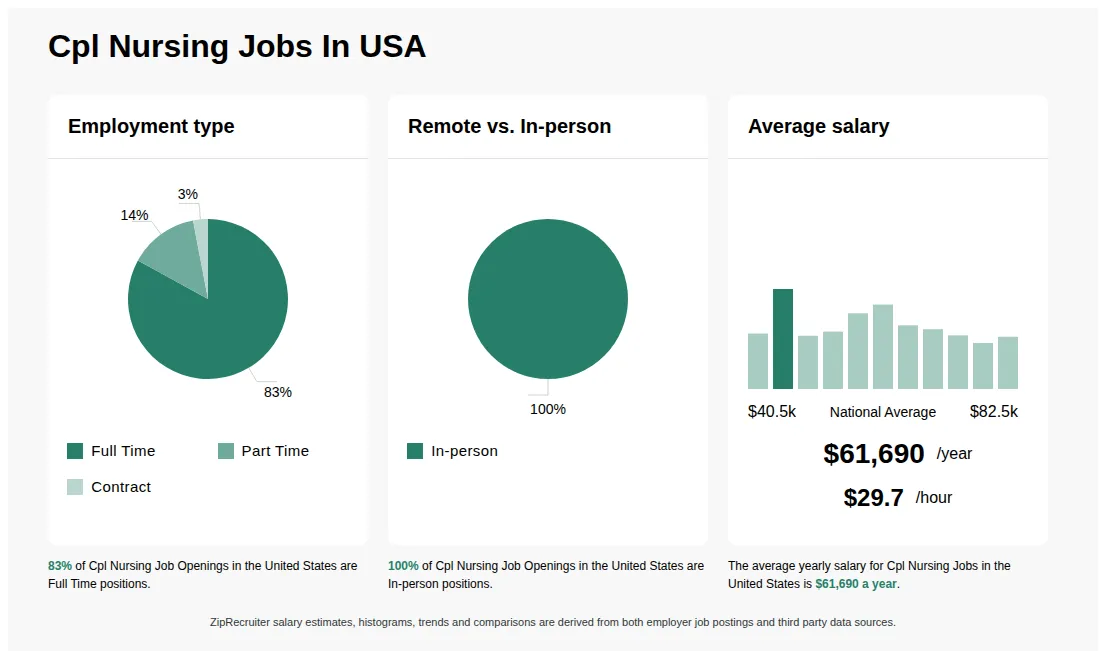
$40.5K

$61.7K

$82.5K

How much do cpl nursing jobs pay per year?

As of Sep 13, 2026, the average yearly pay for cpl nursing in the United States is $61,690.00, according to ZipRecruiter salary data. Most workers in this role earn between $49,500.00 and $71,500.00 per year, depending on experience, location, and employer.

What is a Cpl nurse?

A Cpl Nurse typically refers to a nurse working for CPL Healthcare, a recruitment agency that places nurses in various healthcare settings, or may also refer to a nursing role within the military at the corporal (Cpl) rank. In the context of CPL Healthcare, Cpl Nurses are registered or enrolled nurses assigned to hospitals, clinics, or care homes on temporary or permanent contracts. They provide patient care, administer medications, and support medical teams according to their qualifications and the needs of the facility. In military contexts, a Cpl Nurse holds both a clinical and a leadership role. The specific duties can vary depending on the organization and setting.

What are the key skills and qualifications needed to thrive as a Cpl nurse, and why are they important?

To excel as a Cpl Nurse, you need a recognized nursing qualification, current registration with the relevant nursing board, and solid clinical experience. Familiarity with patient management systems, electronic health records, and compliance with local healthcare protocols is typically required. Excellent interpersonal skills, adaptability, and a strong work ethic help you stand out when working across diverse healthcare settings. These skills and qualifications are essential for delivering high-quality patient care, ensuring regulatory compliance, and adapting to various clinical environments.

What are some common challenges faced by Cpl nursing professionals when working with diverse patient populations?

Cpl Nursing professionals often encounter the challenge of communicating effectively with patients from various cultural and linguistic backgrounds. Adapting care plans to respect different beliefs, traditions, and health practices requires strong cultural competence and adaptability. Additionally, balancing complex caseloads while ensuring personalized care can be demanding, but support from multidisciplinary teams and ongoing training helps nurses provide high-quality care to all patients.

What is the difference between Cpl Nursing vs Staff Nurse?

AspectCpl NursingStaff Nurse
QualificationsRegistered Nurse (RN) with relevant certificationsRegistered Nurse (RN) with relevant certifications
Work EnvironmentHospitals, clinics, community health settingsHospitals, clinics, long-term care facilities
Employer & Industry UsageHealthcare providers, agencies, hospitalsHealthcare facilities, hospitals, clinics
Common Search & ComparisonCpl Nursing vs Staff NurseSimilar roles in healthcare

Both Cpl Nursing and Staff Nurse roles require registered nursing qualifications and work in similar healthcare environments. The main difference often lies in employment arrangements, with Cpl Nursing typically referring to agency or contract work, while Staff Nurses are usually employed directly by healthcare facilities. Understanding these distinctions helps candidates choose the right career path or job opportunity.

What is the easiest Cpl Nursing job that pays well?

A Cpl Nursing role typically involves providing basic patient care under supervision, with entry-level positions often requiring minimal experience and offering competitive pay. Positions such as healthcare assistant or support worker may be considered easier and well-paid within the nursing field, especially with relevant certifications like NVQ or QCF. These roles often involve shift work in hospitals or care homes and can serve as stepping stones for further nursing qualifications.
More about Cpl Nursing jobs

What are popular job titles related to Cpl Nursing jobs?

For Cpl Nursing jobs, the most frequently searched job titles are:

Infographic showing various Cpl Nursing job openings in the United States as of September 2026, with employment types broken down into 4% As Needed, 55% Full Time, 16% Part Time, and 25% Contract. Highlights an 98% Physical, and 2% Remote job distribution, with an average salary of $61,690 per year, or $29.7 per hour.

Service Coordinator - Transfer and Bed Control Center (Days)

Carrollton, GA • On-site

Tanner Health System
Health Care and Social Assistance • 1 - 5K employees

$16.25 - $20.75/hr

Full-time

Posted 9 days ago


Job description

To serve as a resource to the Hub and Spoke model. Centrally coordinates and prioritizes testing and services for patients admitted to the hospital from the Hub. Ensures service area schedules are optimized to meet patient demand and throughput/efficiency initiatives. Communicates and coordinates patient's testing needs with service area departments and nursing units.

Required Knowledge & Skills

Education: High School Diploma plus 1 year vocational school

Experience: Two years of related experience. Requires working knowledge of specialized practices, equipment, and procedures.

Licenses and Certifications

*NONE REQUIRED

Qualifications

* Two years of acute care clinical or healthcare scheduling experience required.

* Must project a professional image.

* Must possess excellent written and verbal communication skills

* Ability to cooperate and work with interdisciplinary teams.

* Ability to handle stress situations or crisis well.

* Must be able to use various software packages. Must be proficient in Word, Excel and SharePoint

* Knowledge of office equipment (copier, fax, scanner and computer) for trouble shooting problems and instructing others.

* Excellent organization skills. Must be accurate and thorough.

* Must exhibit good professional ethics consistently.

* Must be able to function independently and use sound judgment.

* Excellent interpersonal skills for communication with individuals or groups to provide and gather information, provide advice and policy interpretation for employees and managers. Interacts with people of all socioeconomic backgrounds. Represents the organization and Nursing Administration to multiple groups, i.e. employees, and managers.

* Must be able to logically work through a process from conceptualization to implementation.

Statement Of Employment Philosophy

Being a part of Tanner Health System is more than a job, it is a promise we make to treat every patient with exceptional service every time they walk through our doors. Service excellence is the foundation of our organizational culture and the expectations we all set for each other, our patients, physicians and our community. All employees agree to abide by a set of service standards. These standards are the promise we make to provide the best care possible, and represent our beliefs, values and who we strive to become. We each commit to making Tanner Health System a great place for our employees to work, for patients to receive care and for physicians to practice medicine.

Functions

Area of Responsibilities

*COMMUNICATION: Demonstrates ability to understand, communicate, and influence others. The Service Coordinator uses a high degree of diplomacy, confidentiality, and tact. Role models an effective collaborative approach through interactions with other departments. Maintains effective, professional communication with all areas that interact with the hub. Effectively manages situations in a calm, objective manner and coordinates needed change. Communicates with the service area departments, Care Progression Leaders (CPL) and nursing to ensure patient preparedness (pre-procedure requirements -PPR) are complete.

*INTERDISCIPLINARY COLLABORATION: Committed to finding solutions to problems rather than blaming others. Demonstrates knowledge of rules, regulations, policies, and procedures. Serves as a role model for excellent customer service. Contacts CPL, nursing, service departments and or Central Scheduling for additional information needed to schedule patient for service needed. Collaborates with nursing and service departments to optimize the patient's itinerary.

*EFFICIENCY, STANDARDS AND COMPLIANCE: Knowledgeable regarding hospital policy and procedures. Knowledgeable in the functionality of the EMR. Assists director and managers in the identification, coordination and implementation and monitoring of unit specific process improvement opportunities which improve efficiency, maximize resource utilization, and provide a safe work environment. Demonstrates knowledge of own role in care coordination model. Remains current on service departments' specific service management policies and preferences.

*COORDINATION OF CARE: Ensures patients approaching discharge have high scheduling priority. Assists Care Progression Leaders, nursing and service departments with addressing service-related barriers to patient progression. escalates issues as appropriate. Constructs optimal schedule for patients with multiple service requests (complex patients). Continually re-assess prioritization of patients with changing conditions. Centrally prioritizes and schedules service demand for in-house patients.

*WORKQUEUE OPTIMIZATION: Manages service department order queue for both inpatient and outpatient schedules. Creates transport request to pull patients to service departments. Actively adjusts transport requests to ensure on-time service delivery.

Compliance Statement

Employee performs within the prescribed limits of Tanner Health System's Ethics and Compliance program. Is responsible to detect, observe, and report compliance variances to their immediate supervisor, the Compliance Officer, or the Hotline.

Required Knowledge & Skills

Education: High School Diploma plus 1 year vocational school

Experience: Two years of related experience. Requires working knowledge of specialized practices, equipment, and procedures.

Licenses and Certifications

*NONE REQUIRED

Supervision

*None

Qualifications

* Two years of acute care clinical or healthcare scheduling experience required.

* Must project a professional image.

* Must possess excellent written and verbal communication skills

* Ability to cooperate and work with interdisciplinary teams.

* Ability to handle stress situations or crisis well.

* Must be able to use various software packages. Must be proficient in Word, Excel and SharePoint

* Knowledge of office equipment (copier, fax, scanner and computer) for trouble shooting problems and instructing others.

* Excellent organization skills. Must be accurate and thorough.

* Must exhibit good professional ethics consistently.

* Must be able to function independently and use sound judgment.

* Excellent interpersonal skills for communication with individuals or groups to provide and gather information, provide advice and policy interpretation for employees and managers. Interacts with people of all socioeconomic backgrounds. Represents the organization and Nursing Administration to multiple groups, i.e. employees, and managers.

* Must be able to logically work through a process from conceptualization to implementation.

Definitions

To serve as a resource to the Hub and Spoke model. Centrally coordinates and prioritizes testing and services for patients admitted to the hospital from the Hub. Ensures service area schedules are optimized to meet patient demand and throughput/efficiency initiatives. Communicates and coordinates patient's testing needs with service area departments and nursing units.

Position Responsibilities

Contact with Others: Appreciable contacts as regular part of the job with others outside of the department or organization. Requires discretion and tact to give or get specialized information to perform duties of job.

Effect of Error: Probable errors may be serious and involve losses such as improper costs, overpayment, waste of material, damage to equipment, and delay in processing work. Effect usually confined within the organization. Most of work not subject to direct verification or check. Regularly works with some confidential data such as account, salaries, patient medical records, which if disclosed might have adverse internal or external effects.

People Management Responsibilities

Supervisory Responsibility: Occasionally uses assistance of aide or helper in performance of task

Work Environment/Physical Effort

Mental Demands: Work involves a variety of complex problems to be solved under general organization policies. Ingenuity and judgment are required to review facts, plan work, estimate costs, and deal with factors not easily evaluated, interpret results, draw conclusions, and take or recommend action. Solutions to problems often require coordination with other departments.

Working Conditions: Generally pleasant working conditions/normal office environment.

Working Conditions Aspects for Immunizations

Performs tasks involving contact with blood, blood-contaminated body fluids, other body fluids, or sharps (needles): No

Directly works with Patients less than 12 months of age: No

Physical Effort: Light physical effort - Much of work done while sitting but with more than normal standing or walking. Handles light materials intermittently. Office or laboratory work requiring more than normal visual effort.

Physical Aspects

Bending: Occasional = 1% - 33% of the time

Typing: Constant = 67% - 100% of the time.

Manual Dexterity -- picking, pinching with fingers etc.: Occasional = 1% - 33% of the time

Feeling (Touch) -- determining temperature, texture, by touching: Not required

Hearing: Constant = 67% - 100% of the time.

Reaching -- above shoulder: Occasional = 1% - 33% of the time

Reaching -- below shoulder: Occasional = 1% - 33% of the time

Visual: Constant = 67% - 100% of the time.

Color Vision: Constant = 67% - 100% of the time.

Speaking: Constant = 67% - 100% of the time.

Standing: Occasional = 1% - 33% of the time

Balancing: Occasional = 1% - 33% of the time

Walking: Occasional = 1% - 33% of the time

Crawling: Not required

Running - in response to an emergency: Not required

Lifting up to 25 lbs.: Occasional = 1% - 33% of the time

Lifting 25 to 60 lbs.: Not required

Lifting over 60 lbs.: Not required

Handling -- seizing, holding, grasping: Occasional = 1% - 33% of the time

Carrying: Occasional = 1% - 33% of the time

Climbing: Occasional = 1% - 33% of the time

Kneeling: Not required

Squatting: Not required

Tasting: Not required

Smelling: Not required

Driving -- Utility vehicles such as golf carts, Gators, ATV, riding lawnmowers, skid steer, aerial lift: Not required

Driving -- Class C vehicles: Not required

Driving -- CDL class vehicles: Not required

N95 Respirator usage (PPE): Not required

Hazmat suit usage (PPE): Not required

Pushing/Pulling -- up to 25 lbs.: Occasional = 1% - 33% of the time

Pushing/Pulling -- 25 to 60 lbs.: Not required

Pushing/Pulling -- over 60 lbs. : Not required