1

Cosmology Jobs (NOW HIRING)

Lecturer

Troy, AL · On-site

The department is home to the Center for Relativity and Cosmology, and preference will be given to candidates whose research complements and enhances the activities of the center. The successful ...

Be Seen First

Nails , waxing , lashes. We can train if the technicians don't have experience in the salon yet. Company Description We're a beautiful salon with nice people with easy schedules, join our team.

next page

Showing results 1-20

Cosmology information

See salary details

$8

$26

$61

How much do cosmology jobs pay per hour?

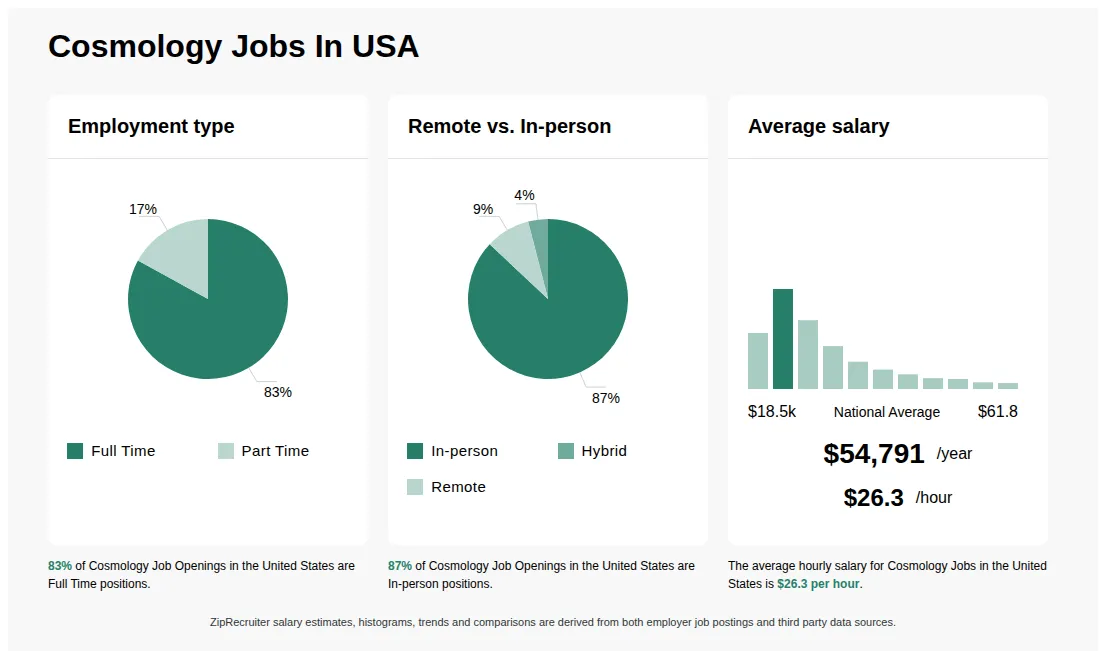
As of Jul 13, 2026, the average hourly pay for cosmology in the United States is $26.34, according to ZipRecruiter salary data. Most workers in this role earn between $15.14 and $30.77 per hour, depending on experience, location, and employer.

What are the key skills and qualifications needed to thrive in the Cosmology position, and why are they important?

To thrive as a Cosmologist, you need a strong background in physics, mathematics, and astronomy, typically supported by a Ph.D. in astrophysics or a related field. Proficiency with data analysis software, programming languages (such as Python or MATLAB), and familiarity with telescope instrumentation are essential. Strong analytical thinking, problem-solving abilities, and effective written and verbal communication skills help distinguish top candidates. These competencies are crucial for advancing scientific understanding, publishing research, and collaborating successfully within the global scientific community.

What jobs pay $500,000 a year in the US?

In the field of cosmology or related high-level scientific research, few roles typically reach a $500,000 annual salary, often limited to senior positions such as university department heads, research directors, or industry executives in tech or aerospace sectors. These roles usually require advanced degrees, extensive experience, and leadership responsibilities, often supplemented by consulting or speaking engagements. Most astronomers or physicists in academia or government agencies earn significantly less, with top industry executives or entrepreneurs in related fields more likely to reach this salary level.

What are 5 jobs for astronomy?

Five common jobs in astronomy include research scientist, observational astronomer, astrophysicist, telescope operator, and data analyst. These roles often require strong analytical skills, proficiency with specialized software, and advanced degrees such as a master's or Ph.D. in astronomy or related fields.

How much money do cosmologists make?

Cosmologists, as research scientists or university faculty, typically earn between $60,000 and $130,000 annually, depending on experience, education, and location. Senior positions or those in private industry can offer higher salaries, especially for those with advanced degrees and specialized skills in data analysis and theoretical modeling.

What is the career path for cosmologists?

A career as a cosmologist typically begins with earning a bachelor's degree in physics, astronomy, or a related field, followed by a master's or Ph.D. in cosmology or astrophysics. Career advancement often involves postdoctoral research, academic positions, or roles in research institutions and government agencies, with skills in data analysis, programming, and theoretical modeling being essential.

What is a Cosmology job?

A cosmology job typically involves researching the origins, structure, and evolution of the universe. Cosmologists, often working as theoretical or observational physicists, analyze cosmic phenomena like dark matter, dark energy, cosmic microwave background radiation, and the expansion of the universe. They use data from telescopes, satellites, and simulations to test and refine scientific theories. Many work in academia, government agencies, or research institutions, contributing to our understanding of the cosmos.

What are typical daily responsibilities for a Cosmologist?

As a Cosmologist, your daily responsibilities often include analyzing astronomical data, developing theoretical models, and conducting simulations to understand the structure and evolution of the universe. You may also collaborate with colleagues on research projects, write scientific papers, and attend seminars or conferences to stay informed about the latest discoveries. Working environments vary, but most Cosmologists are affiliated with universities, research institutions, or governmental agencies and often work as part of interdisciplinary teams. Time may also be spent teaching, mentoring students, or applying for research grants, depending on the role. This variety makes the position both intellectually stimulating and deeply rewarding for those passionate about unraveling the mysteries of the cosmos.

More about Cosmology jobs
What cities are hiring for Cosmology jobs? Cities with the most Cosmology job openings:
What are the most commonly searched types of Cosmology jobs? The most popular types of Cosmology jobs are:
What states have the most Cosmology jobs? States with the most job openings for Cosmology jobs include:
Infographic showing various Cosmology job openings in the United States as of July 2026, with employment types broken down into 25% Full Time, 73% Part Time, and 2% Temporary. Highlights an 27% Physical, and 73% Remote job distribution, with an average salary of $54,791 per year, or $26.3 per hour.
AY Position No. Post Doctoral Position in Cosmology on DESI

AY Position No. Post Doctoral Position in Cosmology on DESI

Southern Methodist University

Dallas, TX • On-site

$48K - $66K/yr

Other

Re-posted 4 days ago


Southern Methodist University rating

7.4

Company rating: 7.4 out of 10

Based on 13 frontline employees who took The Breakroom Quiz

299th of 553 rated colleges and universities


Job description

Description
Position No. 00053766. The Cosmology and Astrophysics group at Southern Methodist University (SMU) seeks to hire an outstanding postdoctoral research fellow in cosmology with the Dark Energy Spectroscopic Instrument (DESI).
The successful applicant will carry out original research and play an important role in the analysis of DESI data. Opportunities to make substantial original contributions are high. DESI science includes a broad and exciting menu of measurements that will collectively provide the most sensitive probe of the expansion history of the universe over the redshift range 0
DESI is a Stage IV dark energy spectroscopic survey utilizing 5000 robotically positioned fibers on the Mayall 4 m at Kitt Peak National Observatory. DESI is currently in Year 3 of an initial 5 year survey which will gather an unprecedented sample of almost 40 million galaxy spectra, each covering 360 - 980 nm. Primary goals are to extract strong cosmological constraints from baryon acoustic oscillation (BAO) and redshift space distortion (RSD) measurements. These are complemented by a host of other sensitive astrophysical and cosmological studies. Survey sensitivity relies on the optimal and efficient operation of the telescope.
The Cosmology & Astrophysics group at SMU is currently strongly involved on DESI in science analysis via the simulations of mock galaxy catalogs to support BAO and RSD measurements. We focus on halo occupation and semi-analytic modeling of emission line galaxies and quasars to produce high fidelity mocks.
More broadly, the SMU astrophysics and cosmology effort also includes CMB cosmology, line intensity mapping at high redshift, supernova cosmology at low redshift, and transient science with Simons Observatory, CMB-S4, COMAP, FYST, ROTSE and others. Our department also hosts a strong experimental and theoretical particle physics effort at LHC, Fermilab and the EIC.
Qualifications
We seek a highly motivated applicant who has obtained, or is about to obtain, a Ph.D. in physics or astronomy or related fields. Experience with cosmology, galactic astronomy and/or spectroscopy is highly valued. Software development experience is a plus.
Application Instructions
For further information, contact Prof. Robert Kehoe (kehoe@physics.smu.edu). Interested applicants should send a curriculum vitae, a list of publications resulting from significant contributions, a description of research interests and skills including a brief description of mentoring experience, and arrange for three letters of recommendation to be sent to Interfolio at http://apply.interfolio.com/138308.
Review of applications will begin on February 20, 2024. To ensure full consideration for the position, the application must be received by March 15, 2024, but the committee will continue to accept applications until the position is filled. Hiring is contingent upon the satisfactory completion of a background check.

What Southern Methodist University employees say

Pay

Benefits

Hours and flexibility

Workplace

Get the full story on Breakroom