1

Control Engineer Postdoc Jobs (NOW HIRING)

Programming experience in a language such as Python or R. * Experience working in a cloud ... Working knowledge of Unix based operating systems and git version control. Other Requirements: This ...

Programming experience in a language such as Python or R. * Experience working in a cloud ... Working knowledge of Unix based operating systems and git version control. Other Requirements: This ...

Showing results 41-60

Control Engineer Postdoc information

See salary details

$36K

$81K

$126.5K

How much do control engineer postdoc jobs pay per year?

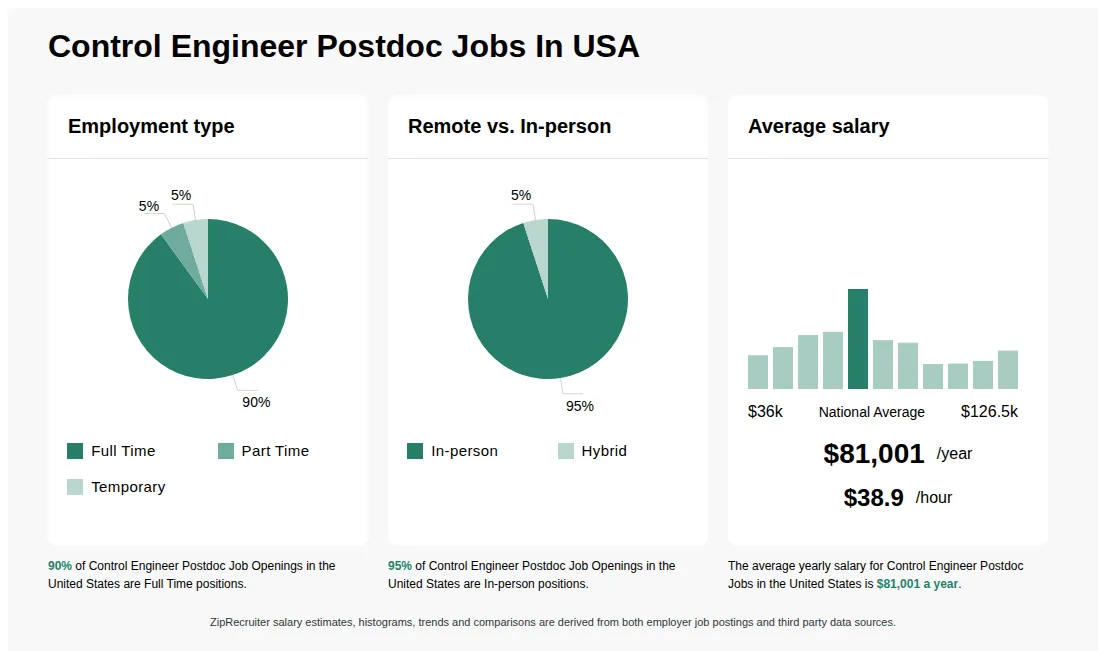
As of Sep 8, 2026, the average yearly pay for control engineer postdoc in the United States is $81,001.00, according to ZipRecruiter salary data. Most workers in this role earn between $60,000.00 and $97,000.00 per year, depending on experience, location, and employer.

What is a control engineer postdoc?

Control Engineer Postdocs are researchers with a Ph.D. who specialize in the design, analysis, and implementation of control systems. They work in academic or industrial research settings, often focusing on advancing knowledge in areas like automation, robotics, or process control. Their responsibilities include conducting experiments, developing new algorithms or methods, publishing research findings, and sometimes mentoring students. This position is typically a temporary role intended to further develop expertise before pursuing a permanent academic or industry position.

What are the key skills and qualifications needed to thrive as a control engineer postdoc?

To thrive as a Control Engineer Postdoc, you need an advanced degree (PhD) in control engineering or a related field, with strong expertise in systems modeling, control theory, and applied mathematics. Proficiency in simulation tools such as MATLAB/Simulink and experience with programming languages like Python or C++, as well as familiarity with hardware-in-the-loop and embedded systems, are typically required. Strong problem-solving skills, effective communication, and the ability to work independently and collaboratively make a candidate stand out. These skills and qualities are critical for conducting advanced research, developing innovative control solutions, and contributing to interdisciplinary projects.

What are some common challenges faced by control engineer postdocs when transitioning from academia to industry-focused projects?

One common challenge for Control Engineer Postdocs moving into industry-oriented projects is adapting to faster-paced development cycles and stricter project deadlines. Unlike academic research, industry projects often require practical, scalable solutions rather than theoretical proofs. Additionally, postdocs may need to collaborate closely with multidisciplinary teams, including software developers, product managers, and hardware engineers, making strong communication and teamwork skills essential. This transition also often involves working with proprietary tools and adhering to industry standards, which may require additional training.

What is the difference between Control Engineer Postdoc vs Control Engineer?

AspectControl Engineer PostdocControl Engineer
Required CredentialsPhD in Engineering or related field, research experienceBachelor's or Master's in Engineering, professional experience
Work EnvironmentAcademic research labs, universitiesIndustrial settings, manufacturing, automation companies
Employer & Industry UsageUniversities, research institutionsManufacturing firms, tech companies
Common Search & ComparisonResearch-focused roles, academic positionsIndustry-focused roles, engineering positions

The main difference between a Control Engineer Postdoc and a Control Engineer lies in their focus and work environment. A Control Engineer Postdoc is primarily involved in academic research, requiring a PhD and working in universities or research labs. In contrast, a Control Engineer typically works in industry, applying engineering principles in manufacturing or automation settings. Both roles require a strong background in control systems, but their career paths and work environments differ significantly.

More about Control Engineer Postdoc jobs

What cities are hiring for Control Engineer Postdoc jobs?

Cities with the most Control Engineer Postdoc job openings:

What states have the most Control Engineer Postdoc jobs?

States with the most job openings for Control Engineer Postdoc jobs include:

What are popular job titles related to Control Engineer Postdoc jobs?

For Control Engineer Postdoc jobs, the most frequently searched job titles are:

Infographic showing various Control Engineer Postdoc job openings in the United States as of September 2026, with employment types broken down into 1% As Needed, 75% Full Time, 20% Part Time, 3% Contract, and 1% Nights. Highlights an 94% Physical, 1% Hybrid, and 5% Remote job distribution, with an average salary of $81,001 per year, or $38.9 per hour.

Postdoctoral Associate, Geography

Buffalo, NY • On-site

University at Buffalo
Colleges, Universities, and Professional Schools • 5 - 10K employees

$55K - $70K/yr

Full-time

Re-posted 14 days ago


Key responsibilities

  • Conduct cross-cutting synthesis research across BioSCape's projects, integrating derived products, manuscripts, and team outputs into cohesive scientific analyses.

  • Identify opportunities for cross-project integration and respond flexibly to emerging science questions as new products and findings become available.

  • Lead the development of two synthesis manuscripts focused on mountain-to-ocean biodiversity patterns and processes.


University at Buffalo rating

7.2

Company rating: 7.2 out of 10

Based on 28 frontline employees who took The Breakroom Quiz

390th of 631 rated colleges and universities


Job description

Posting Details
Position Information
Fiscal Year
2025-2026
Position Title
Postdoctoral Associate, Geography
Classification Title
Postdoctoral Associate
Department
Geography
Posting Number
R260094
Posting Link
https://www.ubjobs.buffalo.edu/postings/63077
Employer
Research Foundation
Position Type
RF Professional
Job Type
Full-Time
Appointment Term
Salary Grade
E.89
Posting Detail Information
Position Summary
BioSCape Postdoctoral Position in remote sensing of biodiversity
BioSCape is an ambitious NASA-led field campaign integrating airborne remote sensing, field ecology, and emerging biodiversity measurements to transform how we observe and understand ecosystems from mountains to oceans. This position offers a unique opportunity to work at the center of a large, collaborative, and high-impact project: synthesizing cutting-edge datasets and helping translate science into real-world environmental solutions. Read more at bioscape.io.
Under the direction of Prof. Adam Wilson, this 16-month postdoctoral position will be based in the Department of Geography at the University at Buffalo (UB), and will be conducted primarily in person in Buffalo, NY, with some travel to conferences and project meetings. The postdoc will conduct cross-cutting integrative research to aggregate and harmonize the campaign's extensive suite of remote sensing and field datasets and use these to answer questions about what determines biodiversity patterns and processes across scales. Following an upcoming team meeting, the postdoc will have flexibility to respond to emerging science questions and identify synergies across the campaign's 19 PI-led research teams. Candidate projects may include synthesizing plant canopy functional traits, structural diversity metrics, intrinsic dimensionality, invasive alien tree mapping, kelp forest condition, acoustic soundscape indices, or biodiversity metrics derived from environmental DNA (eDNA), spanning upland to marine ecosystems. This work will advance scaling relationships between field observations and NASA satellite missions. In support of NASA's Earth Science to Action strategy, the postdoc will also collaborate with conservation and policy partners to translate scientific outputs into decision-ready products for environmental management.
Responsibilities include:
  • Identify opportunities for cross-project integration and respond flexibly to emerging science questions as new products and findings become available.
  • Conduct cross-cutting synthesis research across BioSCape's projects, integrating derived products, manuscripts, and team outputs into cohesive scientific analyses.
  • Lead the development of two synthesis manuscripts focused on mountain-to-ocean biodiversity patterns and processes.
  • Work with conservation managers, policy professionals, and technical staff at partner organizations to help translate scientific outputs into decision-ready products relevant to environmental monitoring, conservation planning, and ecosystem management.
  • Contribute to project coordination activities, including team meetings, reporting, communications, and organization of workshops or training events.

Learn more:
  • Our benefits, where we prioritize your well-being and success to enhance every aspect of your life.
  • Being a part of the University at Buffalo community.

As an Equal Opportunity / Affirmative Action employer, the Research Foundation will not discriminate in its employment practices due to an applicant's race, color, religion, sex, sexual orientation, gender identity, national origin and veteran or disability status.
Minimum Qualifications
  • PhD in Ecology, Environmental Science, Biology, Remote Sensing, Geography, or a related field by the start of appointment
  • Demonstrated experience conducting quantitative research with environmental, ecological, or geospatial datasets
  • Knowledge of a programming language such as R and/or Python
  • Strong written and verbal communication skills, including the ability to lead scientific manuscripts and contribute to collaborative research products
  • Ability to work independently while contributing effectively to a large interdisciplinary team

Preferred Qualifications
  • Experience with ecological or biodiversity synthesis across multiple datasets, projects, or scales
  • Experience with remote sensing products related to vegetation, aquatic systems, or biodiversity
  • Familiarity with reproducible research practices, including version control, documented workflows, and preparation of archive-ready data and code
  • Experience working with open-source geospatial or scientific computing tools
  • Experience engaging with applied partners, agencies, or conservation practitioners
  • Demonstrated interest in translating scientific results into products useful for decision-making or environmental management
  • Experience organizing workshops, collaborative meetings, or multi-institution research activities
  • Experience using AI or computational tools to support project workflows, data analysis, or synthesis

Our University Community
Physical Demands
Driving Requirements
This position does not drive a university owned vehicle
Salary Range
$55,000 - $70,000
Additional Salary Information
The salary range reflects our good faith and reasonable estimate of the possible compensation at the time of posting, the role and associated responsibilities, and the experience, education, and training of the selected candidate.
Work Hours
37.5 hours per week
Campus
North Campus
Posting Alerts
Special Instructions Summary
  • All application materials should be submitted via UB Jobs. Application materials submitted directly to the posting contact will not be acknowledged and cannot be considered.
  • Cover letter describing research interests and relevant experience. Include ideas for possible individual research projects using BioSCape data.

Is a background check required for this posting?
No
Background Check Notification
Contact Information
Contact's Name
Adam Wilson
Contact's Pronouns
Contact's Title
Associate Professor
Contact's Email
adamw@buffalo.edu
Contact's Phone
716-645-0502
Posting Dates
Posted
06/26/2026
Deadline for applicants
Open Until Filled
Date to be filled
References
Number of references required
3
Reference Cutoff Date
Instructions to Applicant

What University at Buffalo employees say

Pay

Benefits

Hours and flexibility

Workplace

Get the full story on Breakroom