1

Control Engineer Postdoc Jobs (NOW HIRING)

POSTDOCTORAL ASSOCIATE

New York, NY · On-site

$62K - $67K/yr

Description POSTDOCTORAL ASSOCIATE New York University Tandon School of Engineering NYU Tandon ... Modeling, monitoring, control, and simulation of power systems; * Innovation and application of ...

Showing results 21-40

Control Engineer Postdoc information

See salary details

$36K

$81K

$126.5K

How much do control engineer postdoc jobs pay per year?

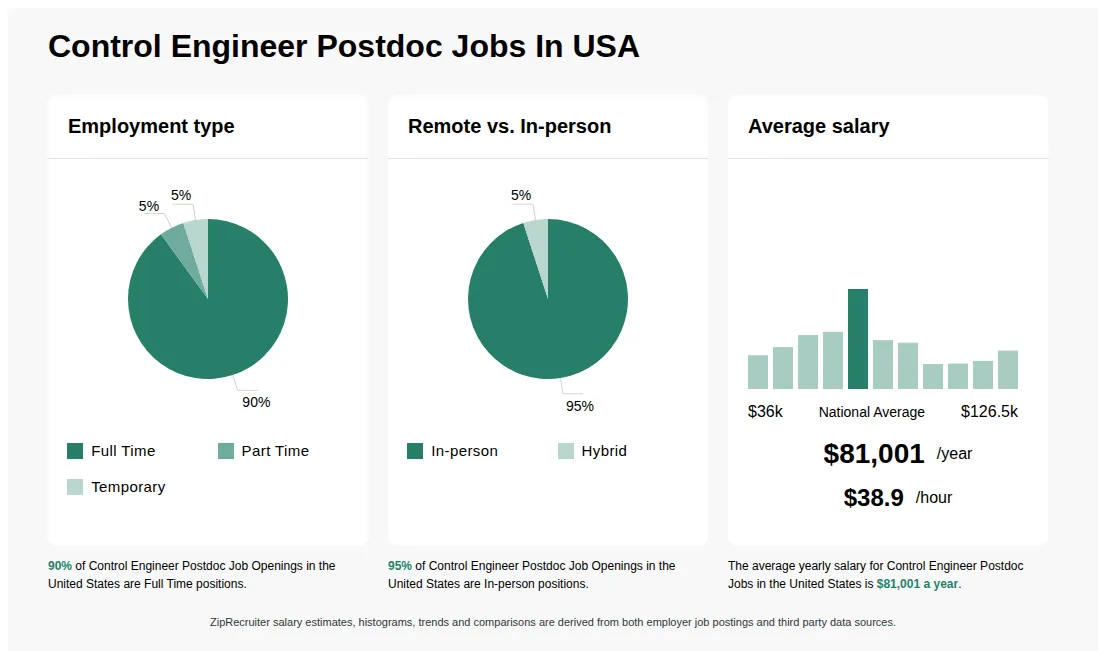
As of Aug 18, 2026, the average yearly pay for control engineer postdoc in the United States is $81,001.00, according to ZipRecruiter salary data. Most workers in this role earn between $60,000.00 and $97,000.00 per year, depending on experience, location, and employer.

What is a control engineer postdoc?

Control Engineer Postdocs are researchers with a Ph.D. who specialize in the design, analysis, and implementation of control systems. They work in academic or industrial research settings, often focusing on advancing knowledge in areas like automation, robotics, or process control. Their responsibilities include conducting experiments, developing new algorithms or methods, publishing research findings, and sometimes mentoring students. This position is typically a temporary role intended to further develop expertise before pursuing a permanent academic or industry position.

What are the key skills and qualifications needed to thrive as a control engineer postdoc?

To thrive as a Control Engineer Postdoc, you need an advanced degree (PhD) in control engineering or a related field, with strong expertise in systems modeling, control theory, and applied mathematics. Proficiency in simulation tools such as MATLAB/Simulink and experience with programming languages like Python or C++, as well as familiarity with hardware-in-the-loop and embedded systems, are typically required. Strong problem-solving skills, effective communication, and the ability to work independently and collaboratively make a candidate stand out. These skills and qualities are critical for conducting advanced research, developing innovative control solutions, and contributing to interdisciplinary projects.

What are some common challenges faced by control engineer postdocs when transitioning from academia to industry-focused projects?

One common challenge for Control Engineer Postdocs moving into industry-oriented projects is adapting to faster-paced development cycles and stricter project deadlines. Unlike academic research, industry projects often require practical, scalable solutions rather than theoretical proofs. Additionally, postdocs may need to collaborate closely with multidisciplinary teams, including software developers, product managers, and hardware engineers, making strong communication and teamwork skills essential. This transition also often involves working with proprietary tools and adhering to industry standards, which may require additional training.

What is the difference between Control Engineer Postdoc vs Control Engineer?

AspectControl Engineer PostdocControl Engineer
Required CredentialsPhD in Engineering or related field, research experienceBachelor's or Master's in Engineering, professional experience
Work EnvironmentAcademic research labs, universitiesIndustrial settings, manufacturing, automation companies
Employer & Industry UsageUniversities, research institutionsManufacturing firms, tech companies
Common Search & ComparisonResearch-focused roles, academic positionsIndustry-focused roles, engineering positions

The main difference between a Control Engineer Postdoc and a Control Engineer lies in their focus and work environment. A Control Engineer Postdoc is primarily involved in academic research, requiring a PhD and working in universities or research labs. In contrast, a Control Engineer typically works in industry, applying engineering principles in manufacturing or automation settings. Both roles require a strong background in control systems, but their career paths and work environments differ significantly.

More about Control Engineer Postdoc jobs

What cities are hiring for Control Engineer Postdoc jobs?

Cities with the most Control Engineer Postdoc job openings:

What states have the most Control Engineer Postdoc jobs?

States with the most job openings for Control Engineer Postdoc jobs include:

Infographic showing various Control Engineer Postdoc job openings in the United States as of August 2026, with employment types broken down into 100% Full Time. Highlights an 92% In-person, and 8% Hybrid job distribution, with an average salary of $81,001 per year, or $38.9 per hour.

High Power Laser & Particle Accelerator Postdoctoral Scholars

Lawrence Berkeley National Laboratory

Berkeley, CA • On-site

$7.9K/mo

Full-time

Posted 11 days ago


Lawrence Berkeley National Laboratory rating

9.5

Company rating: 9.5 out of 10

Based on 5 frontline employees who took The Breakroom Quiz

2nd of 120 rated laboratories


Job description

The Accelerator Technology & Applied Physics (ATAP) Division at Lawrence Berkeley National Laboratory (LBNL) has multiple openings for High Power Laser & Particle Accelerator Postdoctoral Scholars to join the BELLA Center.
In this role, you will help advance laser-plasma accelerator (LPA) technologies for generating high-energy particle beams, developing next-generation light sources, and enabling new radiation applications. Conducted under the direction and supervision of faculty mentors, you will investigate topics such as LPA stabilization, ultra-high-brightness electron beam production for free-electron lasers, AI/ML-based control systems, start-to-end simulations, radiation diagnostics, and proof-of-principle radiation experiments. You will also take part in BELLA-led and collaborative experimental campaigns, including those supported through the LaserNetUS and BeamNetUS networks, while gaining the research experience needed to build an independent academic or research career.
We're here for the same mission, to bring science solutions to the world. Join our team and YOU will play a supporting role in our goal to address global challenges! Have a high level of impact and work for an organization associated with 17 Nobel Prizes!
You will:
  • Assist with the design and execution experiments to optimize the performance of laser plasma accelerators, the particle & photon radiation pulses they produce, and novel applications that can be explored. This includes research on single-stage and multi-stage laser plasma acceleration of electrons, production of proton & muon beams, and generation of UV, EUV, X-ray, and gamma ray radiation.
  • Help maintain and develop rigorous operational procedures to ensure consistent and reliable operation of multi-TW to PW class laser systems.
  • Study and apply feedback control methods to stabilize amplified, ultrashort laser pulses and the radiation output they produce. Explore advanced control concepts, including machine learning and AI integration, for accelerator systems.
  • Assist with the execution of simulation studies to refine approaches to single-stage and multi-stage laser-plasma acceleration of relativistic electron beams.
  • Assist with the execution of simulation studies to refine approaches and identify novel schemes for producing and using high brightness electron beams for radiation production through mechanisms such as free-electron laser gain, plasma-based betatron emission, and Inverse Compton Scattering.
  • Work collaboratively with an interdisciplinary team of scientists, engineers and theorists to efficiently assist with the execution of the above tasks.
  • Document and communicate the results of work in reports and oral presentations, including participation in meetings, reviews, conferences and publications in refereed journals.

We are looking for:
  • PhD in Physics, Engineering, or a related field focused on accelerator physics, lasers, plasmas, or a closely related discipline.
  • Demonstrated experimental experience working in high power laser or particle accelerator facilities.
  • Demonstrated knowledge of standard equipment like motion controllers, pressure controllers, machine vision cameras, power supplies etc.
  • Demonstrated knowledge in one or more of the following: CPA laser systems, accelerator physics, plasma-based accelerators, and accelerator-based generation of secondary radiation (photons and particles).
  • Ability to work closely in a team with other scientists, postdocs, graduate students and technicians but also be self-driven.
  • Demonstrate good verbal and written communication skills.
  • Assist with the execution of regular experimental operations of multi-TW and PW-class laser systems.

Desired skills/knowledge:
  • Knowledge and experience with programming in Python and/or LabVIEW.

Additional information:
  • Application date: Applications will be accepted until the job posting is removed.
  • Appointment type: This is a full-time 2-year, postdoctoral appointment with the possibility of renewal based upon satisfactory job performance, continuing availability of funds and ongoing operational needs. You must have less than 3 years of paid postdoctoral experience. Salary for Postdoctoral positions depends on years of experience post-degree.
  • Salary range: This position is represented by a union for collective bargaining purposes. The salary range for this position is $5,756 - $9,136/month and is expected to start at $7,987/month or above based on a step schedule. Postdoctoral positions are paid on a step schedule per union contract and salaries will be predetermined based on postdoctoral step rates. Each step represents one full year of completed post-Ph.D. postdoctoral experience.
  • Background check: This position is subject to a background check. Any convictions will be evaluated to determine if they directly relate to the responsibilities and requirements of the position. Having a conviction history will not automatically disqualify an applicant from being considered for employment.
  • Work modality: Work will be primarily performed at:Lawrence Berkeley National Lab, 1 Cyclotron Road, Berkeley, CA. A REAL ID or other acceptable form of identification is required to access Berkeley Lab sites (for more information click here).

Want to learn more about working at Berkeley Lab? Please visit: careers.lbl.gov
Equal Employment Opportunity Employer: The foundation of Berkeley Lab is our Stewardship Values: Team Science, Service, Trust, Innovation, and Respect; and we strive to build community with these shared values and commitments. Berkeley Lab is an Equal Opportunity Employer. We heartily welcome applications from all who could contribute to the Lab's mission of leading scientific discovery, excellence, and professionalism. In support of our rich global community, all qualified applicants will be considered for employment without regard to race, color, religion, sex, sexual orientation, gender identity, national origin, disability, age, protected veteran status, or other protected categories under State and Federal law.
Misconduct Disclosure Requirement: As a condition of employment, the final candidate who accepts an offer of employment will be required to disclose if they have been subject to any final administrative or judicial decisions within the last seven years determining that they committed any misconduct; or have filed an appeal of a finding of substantiated misconduct with a previous employer. For additional information, click here.

What Lawrence Berkeley National Laboratory employees say

Pay

Hours and flexibility

Workplace

Get the full story on Breakroom