1

Commercial Fishing Jobs (NOW HIRING)

Commercial fishing dates back hundreds of years. Today commercial fishing continues to be possible due to cooperation between fishermen and fisheries management scientists like yourself. In order to ...

Commercial fishing dates back hundreds of years. Today commercial fishing continues to be possible due to cooperation between fishermen and fisheries management scientists like yourself. In order to ...

Commercial fishing dates back hundreds of years. Today commercial fishing continues to be possible due to cooperation between fishermen and fisheries management scientists like yourself. In order to ...

Commercial fishing dates back hundreds of years. Today commercial fishing continues to be possible due to cooperation between fishermen and fisheries management scientists like yourself. In order to ...

Commercial fishing dates back hundreds of years. Today commercial fishing continues to be possible due to cooperation between fishermen and fisheries management scientists like yourself. In order to ...

Cook - Fishing Vessel - Daily

AK · On-site

$16 - $20/hr

Job Type Full-time Description United States Seafoods is a Commercial Fishing Company with factory trawlers out of Alaska. We are looking for entry level and experienced crew members to work on board ...

Showing results 21-40

Commercial Fishing information

See salary details

$11

$23

$44

How much do commercial fishing jobs pay per hour?

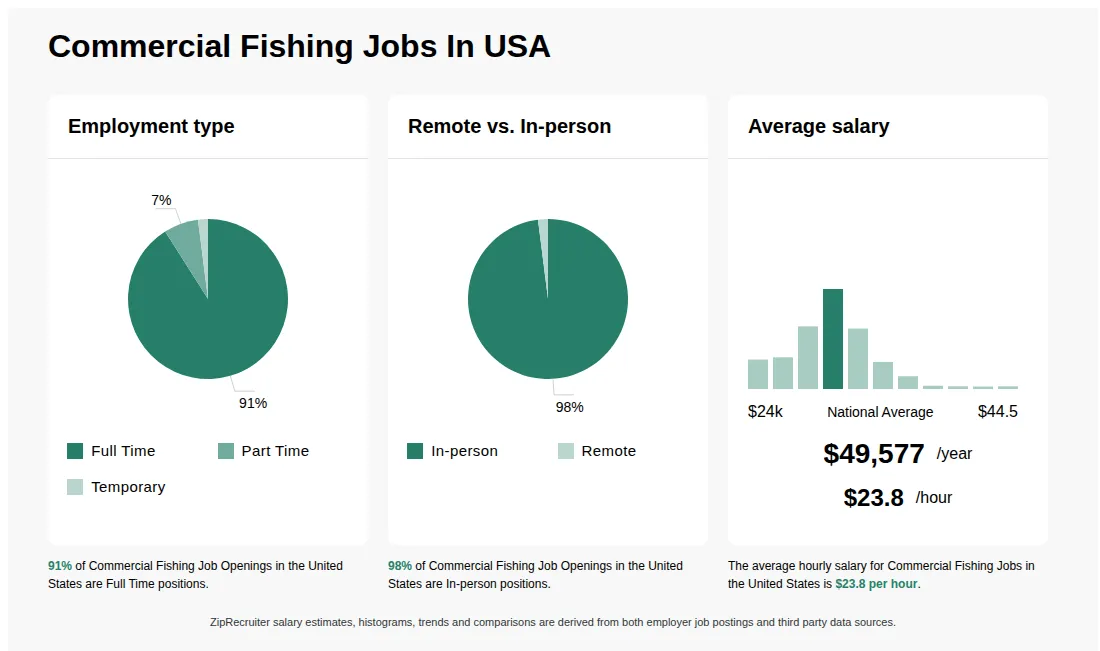
As of Aug 10, 2026, the average hourly pay for commercial fishing in the United States is $23.84, according to ZipRecruiter salary data. Most workers in this role earn between $19.23 and $25.48 per hour, depending on experience, location, and employer.

How much do commercial fishermen make?

Commercial fishermen's earnings vary based on factors such as location, experience, and the type of fishing. On average, they earn between $25,000 and $50,000 annually, with skilled fishermen or those working in high-demand fisheries potentially earning more. Many also receive tips or bonuses based on catch quality and volume.

What is a commercial fishing job?

Commercial fishing jobs involve harvesting fish and other seafood from oceans, rivers, and lakes for commercial sale and distribution. Workers in this industry operate boats, cast nets or lines, and handle equipment to catch fish, crab, shrimp, and other seafood. These jobs can be physically demanding and often require working long hours in challenging weather conditions. Commercial fishing is essential for supplying seafood to markets and restaurants around the world.

What are common challenges faced by commercial fishing crews, and how can new hires prepare for them?

Commercial fishing crews often encounter physically demanding work, long hours, and unpredictable weather conditions at sea. New hires should be prepared for extended periods away from home and irregular schedules, especially during peak seasons. Building physical stamina, learning safety protocols, and developing strong teamwork skills are essential for success. Many crews foster a tight-knit environment, so adaptability and good communication will help new members integrate smoothly and handle the challenges of the job.

What is the difference between Commercial Fishing vs Marine Biologist?

AspectCommercial FishingMarine Biologist
CredentialsHigh school diploma or equivalent; specialized training or certifications often preferredBachelor's degree in Marine Biology or related field; advanced degrees for research roles
Work EnvironmentOn boats, in open water, often remote and physically demandingLaboratories, research vessels, or field sites; more controlled environment
Industry UsageFishing companies, seafood industry, maritime sectorsResearch institutions, environmental agencies, academia

Commercial fishing involves harvesting seafood from oceans and lakes, focusing on catching fish and other marine life for commercial sale. Marine biologists study marine organisms and ecosystems, often conducting research and conservation efforts. While both roles relate to the ocean, commercial fishing is primarily about harvesting, whereas marine biology emphasizes scientific understanding and preservation.

How to become a commercial fisherman?

To become a commercial fisherman, you typically need to gain experience through entry-level fishing jobs, obtain necessary licenses or permits such as a commercial fishing license, and learn safety regulations and fishing techniques. Some positions may require specialized skills or certifications, and working knowledge of fishing equipment and local regulations is essential.

What skills and qualifications are needed to thrive as a commercial fisher?

To thrive as a Commercial Fisher, you need knowledge of fishing techniques, vessel operation, and safety procedures, often supported by completion of safety training and relevant licenses. Familiarity with navigation systems, fish-finding sonar, and equipment maintenance is typically required. Strong teamwork, physical endurance, and problem-solving skills help individuals succeed in unpredictable and challenging environments. These abilities are crucial for ensuring safety, maximizing catch efficiency, and adapting to the demanding conditions of commercial fishing.
What cities are hiring for Commercial Fishing jobs? Cities with the most Commercial Fishing job openings:
What are the most commonly searched types of Commercial Fishing jobs? The most popular types of Commercial Fishing jobs are:
What states have the most Commercial Fishing jobs? States with the most job openings for Commercial Fishing jobs include:
Infographic showing various Commercial Fishing job openings in the United States as of August 2026, with employment types broken down into 93% Full Time, 5% Part Time, and 2% Contract. Highlights an 92% Physical, 2% Hybrid, and 6% Remote job distribution, with an average salary of $49,577 per year, or $23.8 per hour.

Fisheries Gear Monitoring Program Manager

Lynker Corporation

Pascagoula, MS

$45K - $57K/yr

Contractor

Medical, Dental, Vision, Life, Retirement, PTO

Posted 13 days ago


Job description

Lynker Corporation is seeking Fisheries Gear Monitoring Program Managers to support NOAA Fisheries’ Southeast Fisheries Science Center (SEFSC) Fisheries Assessment, Technology & Engineering Support (FATES) Division. These proposed roles will manage fisheries gear outreach and compliance activities, coordinate training for commercial fishers and enforcement personnel, oversee inspection data, and support research vessel and gear operations. Hiring for this position will be contingent on contract award.

The SEFSC Gear Monitoring Team works with commercial fisheries, fishing associations, marine law enforcement organizations, and state agencies to promote the proper use and inspection of federally required fishing gear. The program supports bycatch reduction, sea turtle protection, selective fishing gear research, and technical outreach across Gulf of Mexico fishing communities.


Duties of the Gear Monitoring Program Manager will include the following:
  • Manage and coordinate Gear Monitoring Team outreach, training, inspection, and reporting activities.
  • Communicate with commercial shrimp fishers, fishing associations, and state agencies to plan and conduct workshops, industry meetings, and dockside training.
  • Communicate Turtle Excluder Device construction requirements to an ethnically diverse commercial fishing sector.
  • Coordinate training for federal and state marine law enforcement personnel on fishing gear inspection procedures.
  • Coordinate and conduct at-sea and dockside inspections of Turtle Excluder Devices.
  • Manage data collected through compliance inspections and prepare comprehensive monthly and biannual reports.
  • Construct, repair, and maintain Turtle Excluder Devices, Bycatch Reduction Devices, and related selective fishing gear.
  • Read technical trawl-construction diagrams and perform trawl sewing and repair.
  • Provide gear expertise for research evaluating modified fishing gear and bycatch-reduction technologies.
  • Operate and maintain Class A, Class I, and Class II research vessels.
  • Trailer vessels and other large or heavy loads across rural and interstate highways.
  • Develop technical presentations, instructional materials, and printed information.
  • Deliver oral and hands-on demonstrations to commercial fishers and marine law enforcement personnel.
  • Attend industry and government meetings and present information on gear technology, Gear Monitoring Team activities, and observed Turtle Excluder Device compliance.
  • Assist with oil-spill or emergency events affecting sea turtles in coordination with NOAA and state partners.
  • Maintain equipment, vessels, warehouse areas, shop spaces, and related work areas.

The Gear Monitoring Program Manager should have the following:
  • At least five years of experience working in a commercial fishery or net shop.
  • At least five years of experience managing a fisheries-related project.
  • Experience with net construction and repair.
  • Experience operating and maintaining small boats and associated equipment.
  • Experience using common word-processing and database-management programs.
  • Demonstrated experience preparing comprehensive reports and delivering oral presentations.
  • Ability to obtain, within one year of beginning work, a United States Coast Guard Operator of Uninspected Passenger Vessels license and a Transportation Worker Identification Credential.
  • Ability to obtain, within two years of beginning work, a United States Coast Guard 100-Ton Master License.
  • Ability to obtain and maintain 40-hour HAZWOPER certification.
  • Ability to obtain and maintain Red Cross CPR and Basic First Aid certifications.
  • Ability to maintain all certifications and training required by the NOAA Small Boat Program.
  • A valid driver’s license to operate a government vehicle.
  • Physical ability to embark and disembark unassisted between a dock and a stationary vessel and between two vessels moving at sea, using both hands and feet.
The ideal Gear Monitoring Program Manager will have the following preferred qualifications:
  • Knowledge of selective fishing methods and commercial fishing technology.
  • Experience conducting public outreach events and public speaking.
  • Ability to read, write, and speak Vietnamese.
Work Environment

The position is based in Pascagoula, Mississippi, and involves office, warehouse, net-shop, dockside, small boat, and at-sea work. Employees will interact directly with commercial fishing communities, enforcement organizations, government agencies, and fisheries partners. Emergency-response support may be required. Facility access is generally available from 6:00 a.m. to 6:00 p.m., Monday through Friday. Travel and overtime must be authorized in accordance with contract requirements.

About Lynker

Lynker is a growing, employee owned business, specializing in professional, scientific and technical services. Our continually expanding team combines scientific expertise with mature, results-driven processes and tools to achieve technically sound, cost effective solutions in hydrology/water sciences, geospatial analysis, information technology, resource management, conservation, and management and business process improvement.

We focus on putting the right people in the right place to be effective. And having the right people is critical for success. Our streamlined organization enables and empowers our talented professionals to tackle our customers' scientific and technical priorities – creatively and effectively.

Lynker offers a team-oriented work environment, and the opportunity to work in a culture of exceptionally skilled professionals who embrace sound science and creative solutions. Lynker's benefits include the following:

  • Comprehensive healthcare for the employee at no monthly cost
  • Healthcare benefit covers medical, prescription drug, dental, and vision
  • Personal Time Off (PTO) Policy plus paid holidays
  • Highly competitive compensation plan regularly calibrated against industry and location benchmarks
  • 401(k) retirement plan with company-matching
  • Employee Stock Ownership Plan (ESOP) – we're all company owners!
  • Flexible spending accounts
  • Employee assistance program (EAP)
  • Short- and long-term disability insurance
  • Life and accident insurance
  • Tuition assistance/Training/Workforce improvement reimbursement per year
  • Spot bonuses for exceptional performance
  • Annual Employee Recognition Awards with bonuses
  • Employee Referral Program
  • Free centralized, self-directed Learning Management System to learn at your own pace
  • Personalized career growth plans for every employee

Lynker is an E-Verify employer.

* This position is not currently funded and is contingent upon contract award. Employment is subject to successful completion of any required background checks and security processing required by the customer.

Lynker is an equal opportunity employer and makes all employment decisions based on merit, qualifications, and business needs. We do not discriminate on the basis of race, color, religion, sex (including pregnancy, sexual orientation, or gender identity), national origin, age, disability, genetic information, marital status, veteran status, or any other legally protected status under federal, state, or local laws.