1

Cerner Test Analyst Jobs (NOW HIRING)

Support and test HL7 integrations between EMR and imaging applications to ensure data integrity ... Cerner RadNet / RIS * Experience building and optimizing custom templates to streamline reporting ...

Must have EMR/LIS lab interface experience, including Epic, Meditech, Cerner, eCW, and others ... Develop, implement, and test high complexity production enhancements for existing HUB vendors and ...

OR · On-site

$53K - $88K/yr

... Cerner system. * Develop and maintain test cases, test scripts, and test data based on system ... Collaborate with developers, business analysts, and other stakeholders to understand system ...

Manual Tester

$53K - $88K/yr

... Cerner system. * Develop and maintain test cases, test scripts, and test data based on system ... Collaborate with developers, business analysts, and other stakeholders to understand system ...

OR

$53K - $88K/yr

... Cerner system. * Develop and maintain test cases, test scripts, and test data based on system ... Collaborate with developers, business analysts, and other stakeholders to understand system ...

Lab Med Tech

Peridot, AZ · On-site

$1K/wk

Unknown per dept · EMR (Epic, Cerner, etc): RMPS 1. Performs a variety of laboratory tests and ... and data analysis 4. Prepares solutions, stains, reagents and other equipment and supplies as ...

next page

Showing results 1-20

Cerner Test Analyst information

See salary details

$11

$39

$60

How much do cerner test analyst jobs pay per hour?

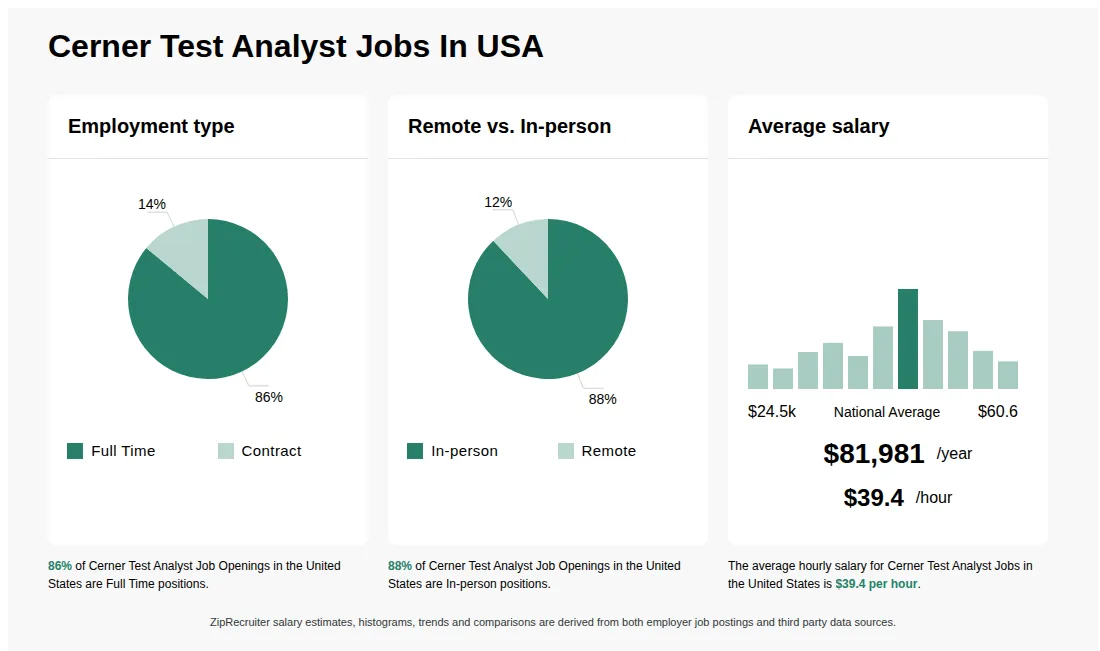
As of Jun 8, 2026, the average hourly pay for cerner test analyst in the United States is $39.41, according to ZipRecruiter salary data. Most workers in this role earn between $30.05 and $47.84 per hour, depending on experience, location, and employer.

What are the key skills and qualifications needed to thrive as a Cerner Test Analyst, and why are they important?

To thrive as a Cerner Test Analyst, you need a solid background in healthcare IT systems, software testing methodologies, and a relevant degree or certification in computer science or health informatics. Familiarity with Cerner Millennium applications, test management tools like HP ALM or Jira, and scripting languages is often required. Attention to detail, analytical thinking, and strong communication skills are critical for identifying issues and collaborating with cross-functional teams. These competencies ensure accurate system validation and seamless delivery of healthcare technology solutions.

What are some common challenges faced by Cerner Test Analysts, and how can they be addressed?

Cerner Test Analysts often encounter challenges such as testing complex healthcare workflows, ensuring interoperability with other systems, and managing tight project deadlines. These challenges can be addressed by maintaining clear communication with cross-functional teams, staying updated on Cerner’s latest modules and testing tools, and prioritizing test cases based on patient safety and regulatory requirements. Additionally, leveraging automation where possible and participating in continuous learning can help analysts effectively manage workload and deliver high-quality results.

What are Cerner Test Analysts?

Cerner Test Analysts are professionals who specialize in testing Cerner healthcare software systems to ensure they function correctly and meet user requirements. They design, execute, and document test plans and cases, identify software defects, and work closely with implementation teams to resolve issues. Their role is crucial in maintaining the quality and reliability of Cerner solutions in healthcare environments. Cerner Test Analysts often have experience in healthcare IT, software testing methodologies, and knowledge of electronic health record (EHR) workflows.

What is the difference between Cerner Test Analyst vs Cerner QA Tester?

AspectCerner Test AnalystCerner QA Tester
CertificationsISTQB, Certified Software TesterISTQB, Certified Software Tester
Work EnvironmentHealthcare IT projects, clinical systemsHealthcare IT, clinical applications testing
Employer & IndustryHospitals, healthcare providers, IT vendorsHospitals, healthcare organizations, IT firms
Primary FocusTest planning, execution, and reporting for Cerner systemsTesting and quality assurance of Cerner applications

The Cerner Test Analyst primarily focuses on test planning, execution, and reporting within healthcare IT projects involving Cerner systems. The Cerner QA Tester concentrates on testing and ensuring the quality of Cerner applications. Both roles require similar certifications and work in healthcare environments, but the Test Analyst often handles more comprehensive testing processes and documentation, while the QA Tester emphasizes hands-on testing activities.

More about Cerner Test Analyst jobs
What job categories do people searching Cerner Test Analyst jobs look for? The top searched job categories for Cerner Test Analyst jobs are:
Infographic showing various Cerner Test Analyst job openings in the United States as of May 2026, with employment types broken down into 75% Full Time, and 25% Contract. Highlights an 100% In-person job distribution, with an average salary of $81,981 per year, or $39.4 per hour.
Imaging Application Analyst II (PACS Admin)

Imaging Application Analyst II (PACS Admin)

Prosum Inc.

CA • On-site

$51 - $60/hr

Full-time

Posted 23 days ago


Job description

Job Description
Imaging Applications Analyst II (PACS Administrator)Pay Range: $51/hour to $60/hourPosition Summary
The Imaging Applications Analyst II (PACS Administrator), under minimal supervision, is responsible for the design, implementation, validation, optimization, and ongoing support of multiple clinical imaging applications and related ancillary systems. These include RIS, Radiology PACS, Cardiology PACS, Voice Dictation, Advanced Post-Processing, Radiation Oncology EMR, EKG/EEG, GI systems, and related integrations.
This role ensures that the design, configuration, integration, and overall user experience of imaging applications meet business and clinical objectives. The analyst partners with clinicians, operational staff, IT teams, and vendors to configure systems, perform testing, troubleshoot issues, lead upgrades, and support both new implementations and existing environments.
Key ResponsibilitiesOperational Support (75%)
  • Troubleshoot, configure, validate, upgrade, and support enterprise-wide clinical imaging applications.
  • Provide off-hours, on-call support as required to maintain 24/7 system availability.
  • Apply expertise and independent judgment to resolve complex technical and workflow issues.
  • Participate in assigned projects independently and collaboratively.
  • Perform root-cause analysis and implement sustainable solutions.
  • Support and test HL7 integrations between EMR and imaging applications to ensure data integrity.
  • Maintain imaging systems functionality and optimize clinical workflows.
  • Develop training plans and materials; deliver training to faculty, staff, and students.
  • Travel to multiple service locations as needed.
Design & Implementation (25%)
  • Design and lead new implementations, upgrades, and system conversions.
  • Ensure application stability, functionality, and compliance with organizational standards.
  • Analyze and recommend enhancements and software upgrades using standard change management processes.
  • Collaborate with IT teams to maintain secure, compliant, and high-performing imaging systems.
  • Meet regularly with users and vendors to define system specifications and resolve or escalate issues in a timely manner.
Minimum Qualifications
  • Bachelor's degree in Computer Science, Healthcare Science, Business, Finance, or a related field OR equivalent work experience.
  • Minimum three (3) years of experience in the design, configuration, maintenance, troubleshooting, upgrading, testing, and support of clinical imaging applications (e.g., Cerner RadNet, Fuji PACS/CV, PowerScribe 360, Varian Aria, Natus Xltek, Provation), or equivalent combination of education and experience.
Additional Required Experience
  • Experience managing, implementing, and supporting Cardiology IT systems, including:
    • Fuji Synapse Cardiovascular PACS
    • GE/Merge Hemo
    • Epiphany ECG Management
    • Cerner RadNet / RIS
  • Experience building and optimizing custom templates to streamline reporting and clinical documentation.
  • Comprehensive knowledge of DICOM imaging standards including image acquisition, archiving, retrieval, and integration with PACS and EHR systems.
  • Local candidates preferred (on-site for the first six months, followed by a hybrid schedule).
Knowledge, Skills, and Abilities
  • Working knowledge of DICOM, HL7, and IHE standards.
  • Experience supporting imaging informatics system interfaces.
  • Knowledge of imaging modalities including XR, US, MRI, CT, Nuclear Medicine, Mammography, and EKG.
  • Strong analytical skills to troubleshoot complex application and workflow issues.
  • Ability to evaluate system change feasibility, time requirements, and business impact.
  • Excellent documentation skills.
  • Ability to communicate technical concepts and system impacts in clear business language.
  • Detail-oriented with strong organizational and multitasking skills.
  • Strong problem-solving ability and business acumen.
  • Ability to work independently and meet deadlines in a fast-paced environment.
  • Strong written and verbal communication skills.
  • Demonstrated ability to build collaborative relationships with clinicians, patients, vendors, peers, staff, and leadership.
  • Professional telephone etiquette.
  • Ability to respond quickly during emergencies.
  • Flexibility to support 24/7 operations.
Work Environment
This position supports a 24x7 clinical imaging environment and requires availability for after-hours and weekend support as needed. Travel to multiple locations may be required.
Please view our Privacy Policy.