1

Cadaver Dissection Jobs (NOW HIRING)

Anatomist

Anderson, SC ยท On-site

... the Anatomist for the Cadaver Lab. Anderson University is affiliated with the South Carolina ... The Anatomist will be expected to focus on teaching human anatomical sciences with dissection;

$19.91 - $26.88/hr

Sets up dissection area with instruments and specimen containers. Retrieves autopsy consent and ... Prepares and expedites cadaver for delivery to funeral director. * Maintains equipment, including ...

Teaching responsibilities will include a human gross anatomy dissection course for medical students, graduate students, and advanced undergraduates, other cadaver-based anatomy courses at the ...

... cadaver surgical skills workshops. * Participate in medical society meetings and Arthrex product ... dissection instruments, applying sutures, and hand and instrument knot tying is required. Education ...

next page

Showing results 1-20

Cadaver Dissection information

See salary details

$8

$19

$56

How much do cadaver dissection jobs pay per hour?

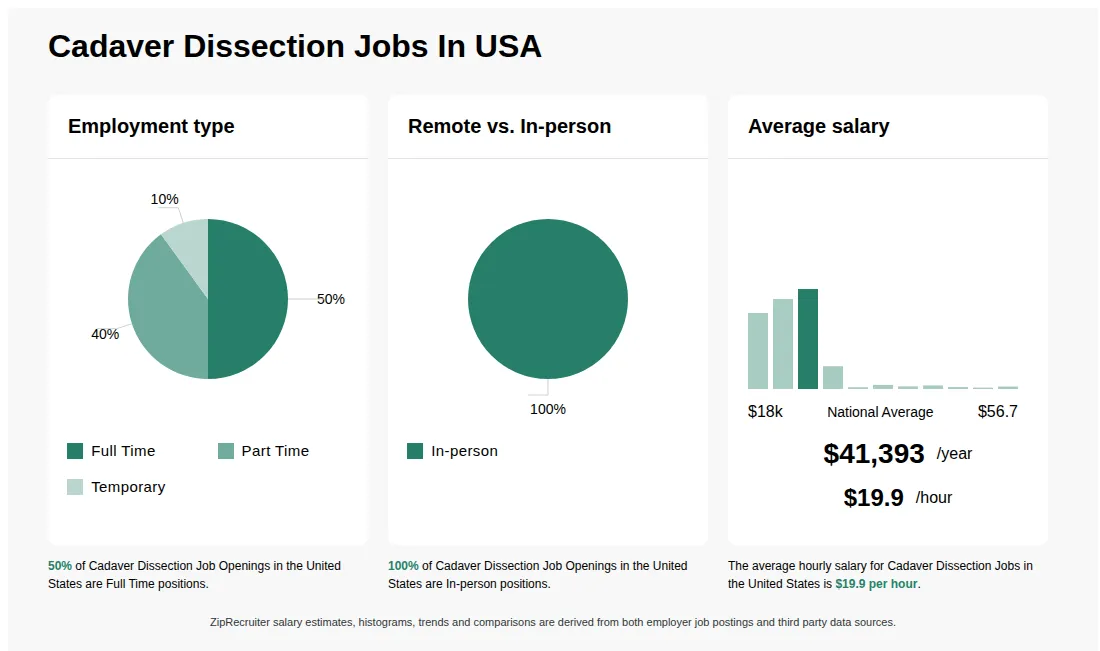
As of Jun 11, 2026, the average hourly pay for cadaver dissection in the United States is $19.90, according to ZipRecruiter salary data. Most workers in this role earn between $13.46 and $20.67 per hour, depending on experience, location, and employer.

What are 5 potential jobs for anatomy?

Potential jobs for anatomy include medical examiner, forensic anthropologist, surgical technician, physical therapist, and anatomy instructor. These roles require knowledge of human anatomy, often involving cadaver dissection, and may require relevant certifications or advanced degrees. They are typically found in healthcare, education, or research settings.

What jobs pay 2000 a day?

Jobs related to cadaver dissection, such as specialized medical or forensic roles, typically do not pay $2000 a day regularly. High-paying medical consulting, surgical specialization, or forensic pathology positions may reach such daily rates, especially with advanced skills, certifications, and experience. These roles often require extensive training and work in high-stakes environments like hospitals or research institutions.

What is a Cadaver Dissection job?

A Cadaver Dissection job involves preparing, dissecting, and studying human cadavers for educational or research purposes. This role is commonly found in medical schools, research institutions, and forensic labs, where it aids in teaching anatomy, improving surgical techniques, or advancing medical research. Responsibilities may include preserving cadavers, precise dissection, and assisting students or professionals in anatomical studies. Attention to detail, respect for human remains, and knowledge of anatomy are essential for this role.

What does a typical day look like for someone working in cadaver dissection?

A typical day in cadaver dissection involves preparing and maintaining specimens, performing precise dissections, and carefully documenting anatomical observations for educational or research purposes. You may work independently or as part of a team in settings such as medical schools, research institutions, or teaching laboratories. Collaboration with faculty, researchers, or students is often required, particularly during teaching sessions or when assisting with anatomical demonstrations. The role requires strict adherence to safety and ethical standards, and you may also be responsible for maintaining laboratory cleanliness and preparing materials for upcoming dissections.

What jobs work with cadavers?

Jobs that work with cadavers include roles such as anatomical technician, medical examiner, forensic scientist, and anatomy instructor. These positions often require knowledge of human anatomy, dissection skills, and adherence to safety and ethical standards in environments like medical schools, research labs, or morgues.

Do they still dissect cadavers in medical school?

Yes, cadaver dissection remains a fundamental part of medical education, allowing students to learn human anatomy firsthand. It helps develop practical skills and a deeper understanding of the body's structure, often using preserved human specimens in anatomy labs.

What are the key skills and qualifications needed to thrive in the Cadaver Dissection position, and why are they important?

To thrive in cadaver dissection, you need a solid background in human anatomy, hands-on laboratory experience, and often a degree in biological sciences or a related field. Familiarity with dissection instruments, safety protocols, and sometimes certification in laboratory procedures are important technical aspects. Attention to detail, manual dexterity, and the ability to maintain professionalism and respect in sensitive settings are valuable soft skills. These competencies ensure accurate anatomical study, safety, ethical handling, and successful collaboration in educational or research environments.

More about Cadaver Dissection jobs
What are the most commonly searched types of Cadaver Dissection jobs? The most popular types of Cadaver Dissection jobs are:
What states have the most Cadaver Dissection jobs? States with the most job openings for Cadaver Dissection jobs include:
Infographic showing various Cadaver Dissection job openings in the United States as of June 2026, with employment types broken down into 33% Full Time, 50% Part Time, and 17% Temporary. Highlights an 100% In-person job distribution, with an average salary of $41,393 per year, or $19.9 per hour.
Anatomist

Full-time

Posted 20 days ago


Job description

Anderson University and the College of Health Professions invite applications for a full-time faculty position in Medical Simulations as the Anatomist for the Cadaver Lab. Anderson University is affiliated with the South Carolina Baptist Convention, and is a Christ-centered, people-focused, student-oriented, quality-driven, and future-directed learning environment.
The Anatomist position fulfills a unique role within the College of Health Professions by managing Human Anatomy Laboratory resources to provide excellence in human anatomy education for Anderson University and the local medical community at large.
The Anatomist will be expected to focus on teaching human anatomical sciences with dissection; Collaborate with faculty to provide educational support for courses utilizing the Human Anatomy Lab; Maintain all equipment while performing and documenting routine inspections to meet certifications; Maintain accurate and up-to-date scheduling for determining lab utilization and clinical education; Ensure commitment to professional excellence in clinical education and maintains working relationships with internal and external learners within the local community; Develop course content with a strong focus in pedagogy, educational outcome evaluations and educational research.
Qualified candidates should hold a Professional Doctorate (MD, DO, Ph.D., DPT, DVM) with anatomy teaching experience; documented experience with innovative teaching methods including team-based teaching, interactive large group presentations, interprofessional education and problem-based learning; documented teaching experience in both dissection and prosection clinical anatomy courses.
About our Commitment to Fairness in Employment
Anderson University does not unlawfully discriminate on the basis of race, color, national or ethnic origin, sex, disability, age, religion, genetic information, veteran or military status, or any other basis on which the University is prohibited from discrimination under the local, state, or federal law, in its employment or in the provision of its services, including but not limited to its programs and activities, admissions, educational policies, scholarship and loan programs, and athletic and other University-administered programs. As a Christian institution of higher education, Anderson University is entitled to certain religious accommodations under federal and state law, including Title IX of the Education Amendments Act and Title VII of the Civil Rights Act. For questions or concerns contact the Office of Human Resources at hr@andersonuniversity.edu.