1

Bunkering Jobs (NOW HIRING)

... bunkering and transfer of bunkers when required; · Maintenance, testing and efficient operation of fire-fighting and life-saving equipment assigned to the Engineering Department as per the PM ...

... bunkering. Compensation: $17.50 - $18.50 BOE Key Responsibilities of the Greenskeeper: * Performs general landscape maintenance using handheld equipment * Rakes and maintains sand bunkers. * Operates ...

Boarding Agent

Beaumont, TX · On-site

$14.75 - $20/hr

Orchestrate movements of vessels to include but not limited to pilots, tugs, lines, and bunkering. * Generate necessary government forms. * Use Agency operating system as appropriate to perform job ...

Deckhand

New York, NY · On-site

$25/hr

... water, bunkering fuel, unloading black water, connecting and disconnecting shore power as directed * Perform cleaning and custodial tasks of the vessels and property, including maintenance and ...

Greenskeeper - Full-Time

Galloway, NJ · On-site

$17.50 - $18.50/hr

... bunkering. Compensation: $17.50 - $18.50 BOE Key Responsibilities of the Greenskeeper: * Performs general landscape maintenance using handheld equipment * Rakes and maintains sand bunkers. * Operates ...

next page

Showing results 1-20

Bunkering information

See salary details

$34K

$68.3K

$108.5K

How much do bunkering jobs pay per year?

As of Jul 23, 2026, the average yearly pay for bunkering in the United States is $68,326.00, according to ZipRecruiter salary data. Most workers in this role earn between $53,500.00 and $78,500.00 per year, depending on experience, location, and employer.

What jobs pay $500,000 a year in the US?

In the field of bunkering, high-paying roles such as senior marine managers, chief engineers, or specialized consultants can reach or exceed $500,000 annually, especially with extensive experience, certifications, and leadership responsibilities. These positions often require advanced technical knowledge, industry expertise, and sometimes involve managing large-scale operations or international logistics.

What is a bunker job?

A bunker job involves the fueling of ships by delivering fuel oil, known as bunkers, to vessels at ports or anchorage. Workers in this role operate specialized equipment, follow safety protocols, and often require certifications such as STCW to handle hazardous materials. The job typically requires physical labor and adherence to environmental regulations.

What are the key skills and qualifications needed to thrive in the Bunkering position, and why are they important?

To thrive in a Bunkering role, you need strong knowledge of maritime operations, fuel types, and supply chain logistics, often backed by relevant maritime or logistics education. Familiarity with bunker delivery notes, fuel measurement systems, and applicable ISM and MARPOL regulations is essential. Excellent negotiation, communication, and problem-solving skills set top candidates apart in coordinating with vessel operators, suppliers, and port authorities. Mastering these skills ensures safe, efficient, and compliant fuel transfer operations within the fast-paced shipping industry.


What jobs pay well on an oil rig?

On an oil rig, jobs such as drilling engineers, toolpushers, and crane operators tend to pay the highest wages due to their specialized skills and responsibilities. These roles often require technical certifications, experience, and working in challenging environments, with compensation reflecting the demanding nature of the work.

What are the typical daily responsibilities of a professional working in bunkering?

Professionals in bunkering are responsible for coordinating the supply and delivery of marine fuel to vessels, monitoring fuel quality and quantity, and ensuring all operations comply with international maritime regulations. A typical day involves liaising with ship owners, fuel suppliers, surveyors, and port authorities, handling documentation, and addressing any unexpected delays or operational issues. This role requires constant attention to safety and environmental procedures, as well as proactive communication to keep all stakeholders informed. The variety and pace of the work make strong organizational skills and adaptability especially important.

What jobs pay 4000 a week without a degree?

In the bunkering industry, high-paying roles such as offshore vessel managers, experienced marine surveyors, or specialized logistics coordinators can earn around $4,000 or more weekly, often requiring extensive experience, certifications, and technical skills. These positions typically involve working in challenging environments and may require maritime licenses or safety training but do not always mandate a college degree.

What is a Bunkering job?

A bunkering job involves the supply and transfer of fuel (bunker fuel) to ships for their operations. This role includes overseeing fuel quality, ensuring proper documentation, and complying with safety and environmental regulations. Professionals in this field may work onshore or onboard vessels, coordinating with suppliers, ship crew, and port authorities. The job requires knowledge of fuel types, transfer procedures, and industry standards.

What cities are hiring for Bunkering jobs? Cities with the most Bunkering job openings:
What are the most commonly searched types of Bunkering jobs? The most popular types of Bunkering jobs are:
What states have the most Bunkering jobs? States with the most job openings for Bunkering jobs include:
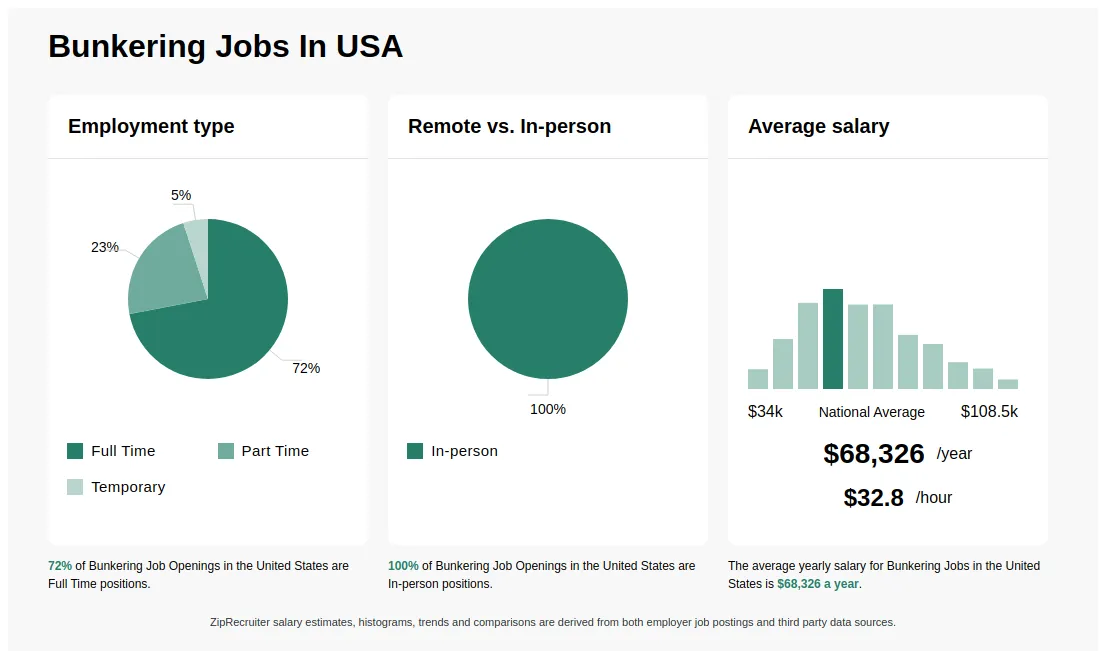
Infographic showing various Bunkering job openings in the United States as of July 2026, with employment types broken down into 76% Full Time, 13% Part Time, 8% Temporary, and 3% Summer. Highlights an 97% Physical, and 3% Remote job distribution, with an average salary of $68,326 per year, or $32.8 per hour.
Deckhand/ Tank Barge PIC- Florida Bunkering

Deckhand/ Tank Barge PIC- Florida Bunkering

Kirby Corporation

Channelview, TX

Other

Posted 8 days ago


Job description

Overview

The Primary function of the Tank Barge PIC is to prepare the barges that are assigned to their boat for safe and complete loading and discharging of oil, refined and petrochemical cargoes.

Tank Barge PIC normally work a 12-hour day schedule (some watch-standing may be required), are occasionally required to work additional hours, but not to exceed 15 consecutive hours without rest. The schedule is equal time; 14 days on, 14 days off.  During the 14 days on the Tank Barge PIC will live and work on the vessel.

Responsibilities
  • Make certain that any and all federal and state required documents that must accompany the barges are onboard and in proper order.
  • Communicate with dock personnel and insure that each person participating in the transfer of product understands what the product is and how it should be transferred and/or protected.
  • Participate in the maintenance of the boat and barges; assist with the training of newly hired employees aspiring to become Tankerman.
  • Handle lines and rigging during tow building, locking/docking activities.
Qualifications

WORK CONDITIONS

  • Must be able live and work in close quarters and able to spend a length of time away from family.
  • Work schedule and hours determined by boat.  Typical work schedule is 14 on, 14 off
  • Must be able to work in inclement weather outdoor, heat and cold.
  • Must be willing and able to attend paid required training on and off scheduled work time.
  • Must have reliable transportation and be able to drive to/from company defined hub cities.

EDUCATION

  • High School or GED preferred

QUALIFICATIONS, COMPETENCIES AND CERTIFICATION REQUIREMENTS

  • Florida residents required
  • Must possess a valid Merchant Mariner's Credential (MMC) with a Tank Barge PIC (Person-In-Charge)
  • AB endorsement preferred, not required
  • Must be able to complete a USCG physical and satisfy all United States Coast Guard Chemical Drug Testing Programs for Vessel Personnel as found in 46 CFR Part 16
  • Must be able to satisfy all United States Coast Guard physical requirements (CG-719K) and as found in 46 CFR Part 10
  • Must hold a valid USCG Medical Certificate
  • Must posess a valid TWIC
  • Must possess a valid driver's license
  • Must present a valid social security card
  • Must not have a DWI or DUI in the last three years
  • Must not have more than 2 moving violations in the last 3 years
  • Cannot have any criminal charges pending, or be on probation
  • Must be 18 years of age
  • Must be a U. S. Citizen or provide proof of eligibility to work in the US.
  • Must be able to meet standards of Criteria Skill Assessment (online)
  • Must be able to read and write English
  • Ability to understand written and verbal orders

PHYSICAL REQUIREMENTS

  • Walk - Must be able to walk 2-3 miles per day
  • Step - Must be able to step 2ft vertical and 2ft horizontal
  • Reach - Must be able to extend arms fully throughout a normal range of motion both in a horizontal and vertical plane (i.e., throwing and catching lines)
  • Climb - Must be able to climb a 90 degree vertical ladder 25-30 feet, and carry weight while climbing
  • Grip/Hold/Pull - Must be able to grip, hold and pull 50lbs
  • Lift - Must be able to lift 75lbs.
  • Lift & Carry - Must be able to lift and carry 50 lbs for approximately 350 feet
  • Vision - Color vision and eyesight must be sufficient to pass an eye test as required to obtain a merchant mariners credential. This requires an uncorrected vision of at least 20/200 in each eye corrected to 20/40 in each eye
  • Hearing - Must meet minimum standards, as per USCG requirements
  • Speech - Must be able to verbally communicate in the English language both in delivery and ability to be understood using handheld radios or other devices, as required
  • Smell - Must possess a sense of smell to be able to detect the presence of potentially dangerous vapors
  • Pulmonary Functions - Must pass a pulmonary function test with a minimum score of 75%
  • General - Must be able to enter and exit hatches/doorways quickly in case of emergency.
  • Equipment - Must be able to wear  PVC foul weather gear, personal flotation device, rubber gloves and boots. 
  • Ability to use firefighting / spill containment equipment
Employment Type: OTHER