1

Blockchain Analyst Jobs (NOW HIRING)

Our primary focus is around data analytics, testing automation and end-to-end delivery of Data ... We're seeking a strong hands on developer experienced with Ethereum and Blockchain architecture to ...

next page

Showing results 1-20

Blockchain Analyst information

See salary details

$33K

$76.3K

$124K

How much do blockchain analyst jobs pay per year?

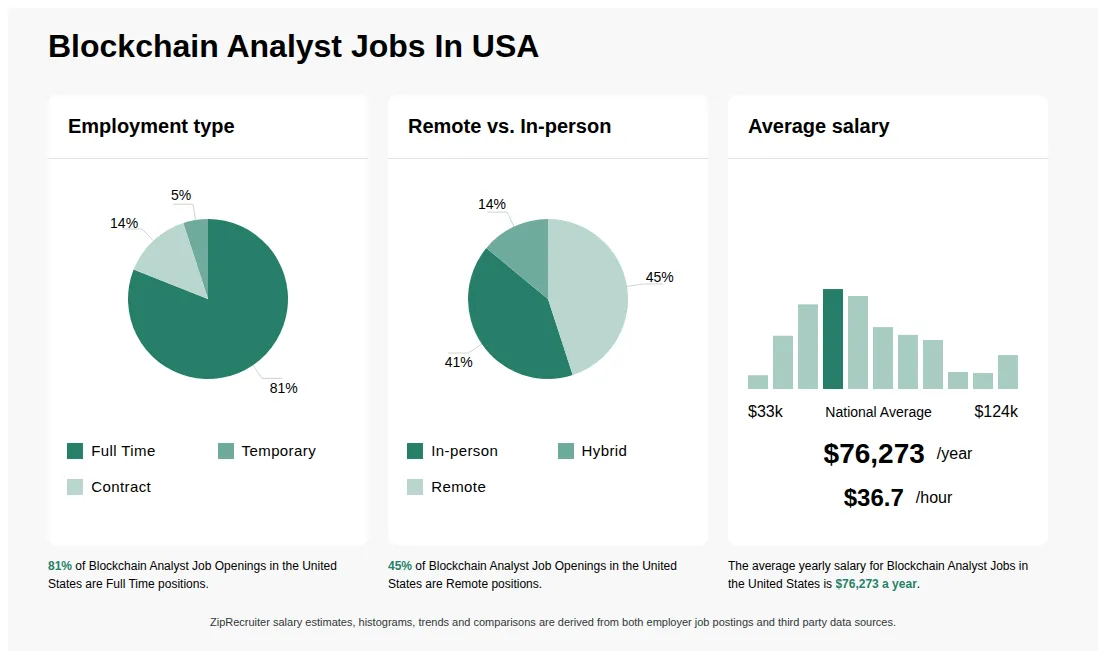
As of Jun 5, 2026, the average yearly pay for blockchain analyst in the United States is $76,273.00, according to ZipRecruiter salary data. Most workers in this role earn between $57,500.00 and $90,000.00 per year, depending on experience, location, and employer.

What Does a Blockchain Analyst Do?

A blockchain is a data-keeping ledger that can be distributed among a group but has safeguards to prevent data manipulation. Blockchain analysts examine the data in and usage of these ledgers to determine the effectiveness of the blockchain, identify areas for improvement, and develop strategies for implementing changes. This is still a relatively new position, and many companies are still determining both if and how to use blockchain analysis as part of their overall business strategy, so your daily responsibilities could vary greatly, depending on your employer. This job title currently refers to analyzing blockchain performance and should not be confused with roles that work with the programming or security of different blockchain systems.


What are the key skills and qualifications needed to thrive as a Blockchain Analyst, and why are they important?

To thrive as a Blockchain Analyst, you need a strong understanding of blockchain technology, cryptography, data analysis, and a relevant degree in computer science, finance, or a related field. Familiarity with blockchain platforms (such as Ethereum and Hyperledger), smart contracts, analytical tools, and sometimes certifications like Certified Blockchain Professional are valuable. Analytical thinking, problem-solving, and effective communication help you interpret complex blockchain data and present findings clearly. These skills and qualities are crucial for providing actionable insights, ensuring security, and supporting informed business decisions in a rapidly evolving technological landscape.

What are some typical challenges faced by Blockchain Analysts when working with cross-functional teams?

Blockchain Analysts often collaborate with developers, business strategists, and compliance professionals to design and implement blockchain solutions. A common challenge is bridging the gap between highly technical blockchain concepts and the business requirements of non-technical stakeholders. Effective communication and the ability to translate technical insights into actionable business recommendations are essential. Additionally, analysts must stay updated on rapidly evolving technologies and regulations, which can add complexity to cross-team projects.

What is a Blockchain Analyst?

A Blockchain Analyst is a professional who studies, monitors, and interprets data on blockchain networks. They analyze blockchain transactions, assess the performance of decentralized applications, and identify trends or irregularities within blockchain systems. Their work often involves ensuring compliance with regulations, detecting fraudulent activities, and generating reports for decision-makers. Blockchain Analysts may work with financial institutions, regulatory bodies, or technology firms to help them understand and utilize blockchain technology effectively.

What is the difference between Blockchain Analyst vs Blockchain Developer?

AspectBlockchain AnalystBlockchain Developer
Primary RoleAnalyzes blockchain data, trends, and security risks to inform business decisionsDesigns, develops, and implements blockchain applications and smart contracts
Required SkillsData analysis, blockchain fundamentals, security protocolsProgramming languages (e.g., Solidity, JavaScript), smart contract development
CertificationsBlockchain certifications, security certificationsProgramming certifications, blockchain development courses
Work EnvironmentFinancial institutions, consulting firms, blockchain analytics companiesTech startups, blockchain development firms, financial services

While both roles work within the blockchain industry, Blockchain Analysts focus on analyzing blockchain data and security, whereas Blockchain Developers are responsible for creating blockchain applications and smart contracts. The roles complement each other but require different skill sets and focus areas.

What cities are hiring for Blockchain Analyst jobs? Cities with the most Blockchain Analyst job openings:
What are the most commonly searched types of Blockchain Analyst jobs? The most popular types of Blockchain Analyst jobs are:
What states have the most Blockchain Analyst jobs? States with the most job openings for Blockchain Analyst jobs include:
What job categories do people searching Blockchain Analyst jobs look for? The top searched job categories for Blockchain Analyst jobs are:
Infographic showing various Blockchain Analyst job openings in the United States as of May 2026, with employment types broken down into 2% Locum Tenens, 2% As Needed, 22% Full Time, 45% Part Time, and 29% Contract. Highlights an 69% Physical, 5% Hybrid, and 26% Remote job distribution, with an average salary of $76,273 per year, or $36.7 per hour.

Digital Assets Risk Manager - Crypto & Blockchain

Fidelity Investments

Woonsocket, RI • On-site

$80K - $153K/yr

Other

Medical, Retirement, PTO

Posted 5 days ago


Fidelity Investments rating

8.7

Company rating: 8.7 out of 10

Based on 264 frontline employees who took The Breakroom Quiz

14th of 138 rated financial services


Job description

Job Description:

Manager, Asset Management Risk (Crypto)

Note: Fidelity is not providing immigration sponsorship for this position.

The Role

The Manager, Asset Management Risk (Crypto) is responsible for delivering operational risk oversight for Fidelity Digital Asset Management and its related businesses. In this role, you will work across business, technology, product, legal, compliance, and operations to assess operational readiness for launching innovative crypto and blockchain products. You will evaluate, communicate, and manage operational risks associated with digital-asset initiatives and emerging regulatory developments, while developing tools and analytics to monitor operational risks across Fidelity’s digital‑assets ecosystem.

The ideal candidate brings experience shaping end‑to‑end product operating models, identifying control gaps early, and partnering closely with product teams to embed strong risk and control practices throughout the product lifecycle. They possess deep technical and business expertise across blockchains, token standards, cryptocurrency products and services, and the broader DeFi ecosystem, paired with exceptional communication, presentation, and writing skills. We are seeking a strategic problem solver with a consulting mindset, creativity, analytical rigor, outstanding organizational skills, and meticulous attention to detail. The candidate should also demonstrate an entrepreneurial mindset—proactively seeking answers, driving resolution in ambiguous environments, and navigating novel blockchain‑related risk concepts with confidence. They must be comfortable operating amid uncertainty, independently exploring solutions, and shaping frameworks where established guidance may not yet exist.

  • Support the development and launch of innovative new products involving crypto and blockchain technology in a risk-managed way

  • Perform proactive and targeted data analysis and risk assessments to identify risks for management.

  • Protect Fidelity by demonstrating and furthering standards related to process/risk/control frameworks and risk assessments as they relate to crypto products.

The Expertise and Skills You Bring

  • 5+ years of relevant work experience, ideally building crypto/blockchain products and services

  • Deep understanding of blockchain features and capabilities, including but not limited to:
    - Blockchain transactions and the ability to conduct blockchain analysis, with experience in trade execution, settlement, and reconciliation processes for crypto assets
    - Blockchain Architecture (L1s, L2s, cross-bridges, and oracles)
    - Crypto market structure (trade execution venues, derivatives market, regulatory frameworks, and liquidity providers)
    - Tokenization (on-chain asset creation, token standards, use cases, operational considerations)
    - Smart Contracts (vulnerabilities, permission structure, interpreting audit reports)
    - Staking (e.g., delegation models)
    - Crypto custody (hot/cold wallets, private key management, and working knowledge of multi-signature vs multi-party computation arrangements)

  • Strong interpersonal skills, with a demonstrated ability to partner and influence across the organization and collaborate in an interdisciplinary fashion

  • Dexterity in cultivating close working relationships with business, technology, operations, legal, and compliance teams

  • Comfort navigating ambiguity and working in a high-growth, fast-paced environment

  • Demonstrated ability to operate autonomously to achieve results in a dynamic organization where priorities shift to meet evolving business needs

  • Executive level presentation skills

  • Natural intellectual curiosity, initiative, and love for learning new skills and capabilities, with a desire to stay abreast of the latest innovations across the industry

  • Financial services experience, in combination with the skills mentioned above, is preferred

  • Project management experience a plus

  • Experience with data analysis techniques and visualization tools (e.g., Tableau), a plus

  • Experience with common data science tools & programming languages, a plus

  • CFA and/or FRM certifications a plus

  • Bachelor’s degree required

The Team

Asset Management Risk, part of Fidelity’s Risk organization and aligned with Asset Management’s Compliance Risk and Business Operations Group (CRBO), provides guidance to management and business units by proactively identifying and monitoring risks to protect the interests of the firm, its clients, and associates. To execute this goal, Asset Management Risk is responsible for identifying, analyzing, aggregating, and reporting on significant and emerging risks to assist management in strengthening their controls and processes.

The base salary range for this position is $80,000-$153,000 per year.

Placement in the range will vary based on job responsibilities and scope, geographic location, candidate’s relevant experience, and other factors.

Base salary is only part of the total compensation package. Depending on the position and eligibility requirements, the offer package may also include bonus or other variable compensation.

We offer a wide range of benefits to meet your evolving needs and help you live your best life at work and at home. These benefits include comprehensive health care coverage and emotional well-being support, market-leading retirement, generous paid time off and parental leave, charitable giving employee match program, and educational assistance including student loan repayment, tuition reimbursement, and learning resources to develop your career. Note, the application window closes when the position is filled or unposted.

Please be advised that Fidelity’s business is governed by the provisions of the Securities Exchange Act of 1934, the Investment Advisers Act of 1940, the Investment Company Act of 1940, ERISA, numerous state laws governing securities, investment and retirement-related financial activities and the rules and regulations of numerous self-regulatory organizations, including FINRA, among others. Those laws and regulations may restrict Fidelity from hiring and/or associating with individuals with certain Criminal Histories.

Certifications:Category:Risk

What Fidelity Investments employees say

Pay

Benefits

Hours and flexibility

Workplace

Get the full story on Breakroom