Currently pursuing a Master's degree in Biostatistics, Epidemiology, Health Services Research ... the internship * Cumulative 3.0 GPA or above (verified at time of hire) * Must be legally ...
Currently pursuing a Master's degree in Biostatistics, Epidemiology, Health Services Research ... the internship * Cumulative 3.0 GPA or above (verified at time of hire) * Must be legally ...
Currently pursuing a Master's degree in Biostatistics, Epidemiology, Health Services Research ... the internship * Cumulative 3.0 GPA or above (verified at time of hire) * Must be legally ...
Currently pursuing a Master's degree in Biostatistics, Epidemiology, Health Services Research ... the internship * Cumulative 3.0 GPA or above (verified at time of hire) * Must be legally ...
Currently pursuing a Master's degree in Biostatistics, Epidemiology, Health Services Research ... the internship * Cumulative 3.0 GPA or above (verified at time of hire) * Must be legally ...
Currently pursuing a Master's degree in Biostatistics, Epidemiology, Health Services Research ... the internship * Cumulative 3.0 GPA or above (verified at time of hire) * Must be legally ...
Summer 2027 Internship - RWE Data Scientist - Virtual
Detroit, MI · On-site
$35/hr
Currently pursuing a Master's degree in Biostatistics, Epidemiology, Health Services Research ... the internship * Cumulative 3.0 GPA or above (verified at time of hire) * Must be legally ...
Summer 2027 Internship - RWE Data Scientist - Virtual
Detroit, MI · On-site
$35/hr
Currently pursuing a Master's degree in Biostatistics, Epidemiology, Health Services Research ... the internship * Cumulative 3.0 GPA or above (verified at time of hire) * Must be legally ...
Currently pursuing a Master's degree in Biostatistics, Epidemiology, Health Services Research ... the internship * Cumulative 3.0 GPA or above (verified at time of hire) * Must be legally ...
Currently pursuing a Master's degree in Biostatistics, Epidemiology, Health Services Research ... the internship * Cumulative 3.0 GPA or above (verified at time of hire) * Must be legally ...
Summer 2027 Internship - RWE Data Scientist - Virtual
Nashua, NH · On-site
$35/hr
Currently pursuing a Master's degree in Biostatistics, Epidemiology, Health Services Research ... the internship * Cumulative 3.0 GPA or above (verified at time of hire) * Must be legally ...
Summer 2027 Internship - RWE Data Scientist - Virtual
Nashua, NH · On-site
$35/hr
Currently pursuing a Master's degree in Biostatistics, Epidemiology, Health Services Research ... the internship * Cumulative 3.0 GPA or above (verified at time of hire) * Must be legally ...
Summer 2027 Internship - RWE Data Scientist - Virtual
Auburn, ME · On-site
$35/hr
Currently pursuing a Master's degree in Biostatistics, Epidemiology, Health Services Research ... the internship * Cumulative 3.0 GPA or above (verified at time of hire) * Must be legally ...
Summer 2027 Internship - RWE Data Scientist - Virtual
Auburn, ME · On-site
$35/hr
Currently pursuing a Master's degree in Biostatistics, Epidemiology, Health Services Research ... the internship * Cumulative 3.0 GPA or above (verified at time of hire) * Must be legally ...
Currently pursuing a Master's degree in Biostatistics, Epidemiology, Health Services Research ... the internship * Cumulative 3.0 GPA or above (verified at time of hire) * Must be legally ...
Currently pursuing a Master's degree in Biostatistics, Epidemiology, Health Services Research ... the internship * Cumulative 3.0 GPA or above (verified at time of hire) * Must be legally ...
Summer 2027 Internship - RWE Data Scientist - Virtual
Edison, NJ · On-site
$35/hr
Currently pursuing a Master's degree in Biostatistics, Epidemiology, Health Services Research ... the internship * Cumulative 3.0 GPA or above (verified at time of hire) * Must be legally ...
Summer 2027 Internship - RWE Data Scientist - Virtual
Edison, NJ · On-site
$35/hr
Currently pursuing a Master's degree in Biostatistics, Epidemiology, Health Services Research ... the internship * Cumulative 3.0 GPA or above (verified at time of hire) * Must be legally ...
Summer 2027 Internship - RWE Data Scientist - Virtual
Tacoma, WA · On-site
$35/hr
Currently pursuing a Master's degree in Biostatistics, Epidemiology, Health Services Research ... the internship * Cumulative 3.0 GPA or above (verified at time of hire) * Must be legally ...
Summer 2027 Internship - RWE Data Scientist - Virtual
Tacoma, WA · On-site
$35/hr
Currently pursuing a Master's degree in Biostatistics, Epidemiology, Health Services Research ... the internship * Cumulative 3.0 GPA or above (verified at time of hire) * Must be legally ...
Currently pursuing a Master's degree in Biostatistics, Epidemiology, Health Services Research ... the internship * Cumulative 3.0 GPA or above (verified at time of hire) * Must be legally ...
Currently pursuing a Master's degree in Biostatistics, Epidemiology, Health Services Research ... the internship * Cumulative 3.0 GPA or above (verified at time of hire) * Must be legally ...
Currently pursuing a Master's degree in Biostatistics, Epidemiology, Health Services Research ... the internship * Cumulative 3.0 GPA or above (verified at time of hire) * Must be legally ...
Currently pursuing a Master's degree in Biostatistics, Epidemiology, Health Services Research ... the internship * Cumulative 3.0 GPA or above (verified at time of hire) * Must be legally ...
Summer 2027 Internship - RWE Data Scientist - Virtual
Bronx, NY · On-site
$35/hr
Currently pursuing a Master's degree in Biostatistics, Epidemiology, Health Services Research ... the internship * Cumulative 3.0 GPA or above (verified at time of hire) * Must be legally ...
Summer 2027 Internship - RWE Data Scientist - Virtual
Bronx, NY · On-site
$35/hr
Currently pursuing a Master's degree in Biostatistics, Epidemiology, Health Services Research ... the internship * Cumulative 3.0 GPA or above (verified at time of hire) * Must be legally ...
Summer 2027 Internship - RWE Data Scientist - Virtual
Augusta, GA · On-site
$35/hr
Currently pursuing a Master's degree in Biostatistics, Epidemiology, Health Services Research ... the internship * Cumulative 3.0 GPA or above (verified at time of hire) * Must be legally ...
Summer 2027 Internship - RWE Data Scientist - Virtual
Augusta, GA · On-site
$35/hr
Currently pursuing a Master's degree in Biostatistics, Epidemiology, Health Services Research ... the internship * Cumulative 3.0 GPA or above (verified at time of hire) * Must be legally ...
Summer 2027 Internship - RWE Data Scientist - Virtual
Boone, NC · On-site
$35/hr
Currently pursuing a Master's degree in Biostatistics, Epidemiology, Health Services Research ... the internship * Cumulative 3.0 GPA or above (verified at time of hire) * Must be legally ...
Summer 2027 Internship - RWE Data Scientist - Virtual
Boone, NC · On-site
$35/hr
Currently pursuing a Master's degree in Biostatistics, Epidemiology, Health Services Research ... the internship * Cumulative 3.0 GPA or above (verified at time of hire) * Must be legally ...
Currently pursuing a Master's degree in Biostatistics, Epidemiology, Health Services Research ... the internship * Cumulative 3.0 GPA or above (verified at time of hire) * Must be legally ...
Currently pursuing a Master's degree in Biostatistics, Epidemiology, Health Services Research ... the internship * Cumulative 3.0 GPA or above (verified at time of hire) * Must be legally ...
Summer 2027 Internship - RWE Data Scientist - Virtual
Greeley, CO · On-site
$35/hr
Currently pursuing a Master's degree in Biostatistics, Epidemiology, Health Services Research ... the internship * Cumulative 3.0 GPA or above (verified at time of hire) * Must be legally ...
Summer 2027 Internship - RWE Data Scientist - Virtual
Greeley, CO · On-site
$35/hr
Currently pursuing a Master's degree in Biostatistics, Epidemiology, Health Services Research ... the internship * Cumulative 3.0 GPA or above (verified at time of hire) * Must be legally ...
Currently pursuing a Master's degree in Biostatistics, Epidemiology, Health Services Research ... the internship * Cumulative 3.0 GPA or above (verified at time of hire) * Must be legally ...
Currently pursuing a Master's degree in Biostatistics, Epidemiology, Health Services Research ... the internship * Cumulative 3.0 GPA or above (verified at time of hire) * Must be legally ...
Currently pursuing a Master's degree in Biostatistics, Epidemiology, Health Services Research ... the internship * Cumulative 3.0 GPA or above (verified at time of hire) * Must be legally ...
Currently pursuing a Master's degree in Biostatistics, Epidemiology, Health Services Research ... the internship * Cumulative 3.0 GPA or above (verified at time of hire) * Must be legally ...
Currently pursuing a Master's degree in Biostatistics, Epidemiology, Health Services Research ... the internship * Cumulative 3.0 GPA or above (verified at time of hire) * Must be legally ...
Currently pursuing a Master's degree in Biostatistics, Epidemiology, Health Services Research ... the internship * Cumulative 3.0 GPA or above (verified at time of hire) * Must be legally ...
Biostatistician Internship information
See salary details
$11.30 - $19.93
0% of jobs
$19.93 - $28.56
1% of jobs
$28.56 - $37.19
14% of jobs
$40.82 is the 25th percentile. Wages below this are outliers.
$37.19 - $45.83
24% of jobs
The median wage is $50.36 / hr.
$45.83 - $54.46
22% of jobs
$61.88 is the 75th percentile. Wages above this are outliers.
$54.46 - $63.09
17% of jobs
$63.09 - $71.72
8% of jobs
$71.72 - $80.35
3% of jobs
$80.35 - $88.99
4% of jobs
$88.99 - $97.62
5% of jobs
$97.62 - $106.25
2% of jobs
$11
$57
$106
How much do biostatistician internship jobs pay per hour?
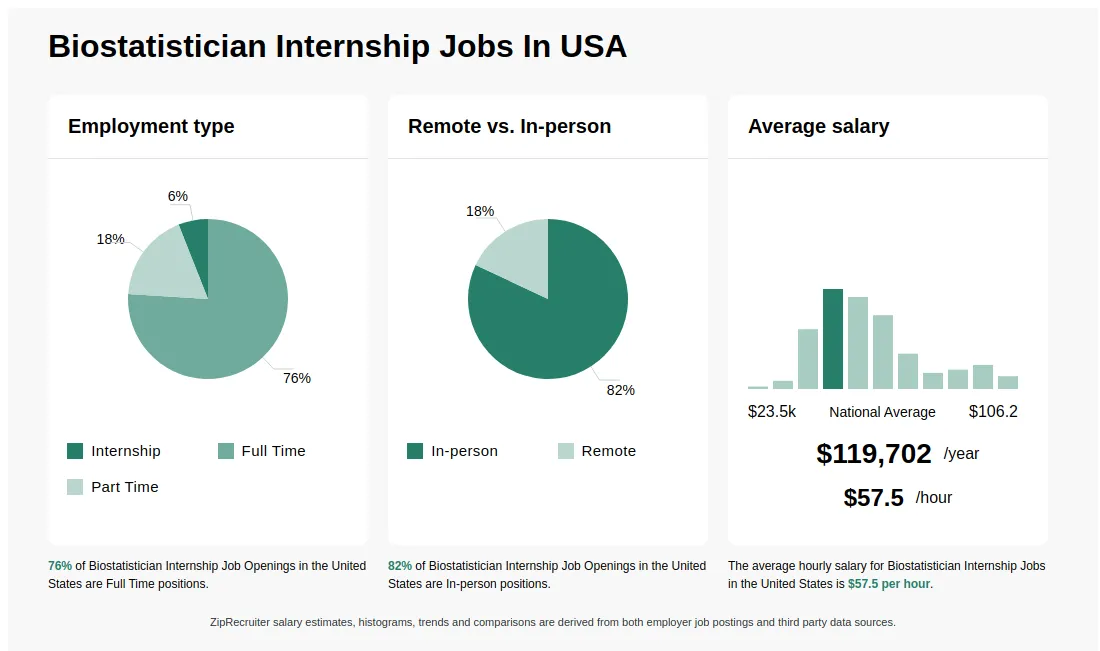
As of Sep 6, 2026, the average hourly pay for biostatistician internship in the United States is $57.55, according to ZipRecruiter salary data. Most workers in this role earn between $40.62 and $64.42 per hour, depending on experience, location, and employer.
What is a biostatistician internship?
A Biostatistician Internship is a temporary, practical training position for students or recent graduates interested in applying statistical methods to biological, medical, or public health research. Interns work under the supervision of experienced biostatisticians, gaining hands-on experience in data analysis, study design, and interpreting research findings. This internship helps individuals develop technical skills with statistical software, understand real-world research processes, and build a foundation for a career in biostatistics or related fields.
What are internship opportunities working with biostatisticians?
Internships for those seeking a career in biostatistics train students in a variety of common responsibilities, like performing research, developing plans for studies, selecting sample sizes, reporting findings, and analyzing and reporting on other research. As a biostatistics intern, you work with a professional biostatistician as a mentor to learn how to study and record living organisms and related data, usually in tandem with further studies within your degree program. Internships typically last anywhere between a few weeks to a few months, and are valuable ways of garnering both on-the-job experience as well as professional contacts.
What types of projects and collaborations can I expect during a biostatistician internship?
As a Biostatistician Intern, you'll typically work on projects involving the analysis of clinical or public health data under the supervision of experienced statisticians. You can expect to collaborate closely with research scientists, epidemiologists, and data managers, contributing to study design, data cleaning, and statistical analysis. Interns often participate in regular team meetings, present findings, and may even co-author reports or publications. This hands-on experience provides valuable exposure to real-world applications of biostatistics and helps develop teamwork and communication skills essential for career growth.
What are the key skills and qualifications needed to thrive as a biostatistician intern, and why are they important?
A Biostatistician Intern typically needs a solid background in statistics, mathematics, and data analysis, often with progress toward or completion of a relevant degree such as biostatistics or public health. Familiarity with statistical software like R, SAS, or SPSS, and experience handling large datasets, are commonly required. Strong problem-solving abilities, attention to detail, and effective communication skills help interns collaborate with research teams and present findings clearly. These competencies are crucial for accurately analyzing biomedical data and supporting evidence-based decision-making in research projects.
What is the difference between Biostatistician Internship vs Biostatistician?
| Aspect | Biostatistician Internship | Biostatistician |
|---|---|---|
| Required Credentials | Typically pursuing or recent graduate with a degree in statistics, biostatistics, or related field | Bachelor's, Master's, or Ph.D. in statistics, biostatistics, or related field; often requires professional certification |
| Work Environment | Internship programs in research institutions, pharmaceutical companies, or healthcare organizations | Full-time roles in research, healthcare, government agencies, or academia |
| Employer & Industry Usage | Used for training and gaining experience in biostatistics within industry settings | Full professional role conducting data analysis, modeling, and research |
The main difference is that a Biostatistician Internship is an entry-level, temporary position designed for gaining experience, while a Biostatistician is a full-time professional role requiring more advanced credentials and responsibilities.
More about Biostatistician Internship jobs
What cities are hiring for Biostatistician Internship jobs?
Cities with the most Biostatistician Internship job openings:
What are the most commonly searched types of Biostatistician jobs?
The most popular types of Biostatistician jobs are:
What states have the most Biostatistician Internship jobs?
States with the most job openings for Biostatistician Internship jobs include:
What job categories do people searching Biostatistician Internship jobs look for?
The top searched job categories for Biostatistician Internship jobs are:

$35/hr
Other
Posted 4 days ago
Stryker rating

8.2
Based on 112 frontline employees who took The Breakroom Quiz
134th of 499 rated machine equipment manufacturers
Job description
What You Get Out of the Internship
At Stryker, we believe that developing the next generation of talent is just as important as developing life-changing medical technologies. As an intern, you won’t just observe — you’ll contribute to meaningful projects, gain exposure to leaders who will mentor you, and experience a culture of innovation and teamwork that is shaping the future of healthcare. As an intern, you will:
- Apply classroom knowledge and gain experience in a fast-paced and growing industry setting
- Implement new ideas, be constantly challenged, and develop your skills
- Network with key/high-level stakeholders and leaders of the business
- Be a part of an innovative team and culture
- Experience documenting complex processes and presenting them in a clear format
Who We Want
Challengers. People who seek out the hard projects and work to find just the right solutions.
Teammates. Partners who listen to ideas, share thoughts and work together to move the business forward.
Charismatic networkers. Relationship-savvy people who intentionally make connections with both internal partners and external contacts.
Strategic thinkers. Interns who propose innovative ideas and consistently exceed their performance objectives.
Customer-oriented achievers. Individuals with an unparalleled work ethic and customer-focused attitude who bring value to their partnerships.
Game changers. Persistent interns who will stop at nothing to live out Stryker’s mission to make healthcare better.
Opportunities Available
As a Real-World Evidence Data Science intern at Stryker, you will:
- Work cross functionally with different departments including Clinical Affairs, Health Economics & Outcomes Research (HEOR), Regulatory Affairs, and Marketing to support real-world evidence generation programs
- Assist in the design and execution of observational studies using claims (e.g., Premier PINC AI, NIS) and other real-world data sources
- Support data extraction, cleaning, and analysis of structured and unstructured healthcare data, including applying NLP techniques to unstructured billing/clinical data
- Prepare literature review summaries and evidence syntheses to support publication and regulatory submission efforts
- Build and refine statistical models (e.g., propensity matching, survival analysis) under the mentorship of the RWE Research team
- Shadow cross-functional team meetings to gain exposure to how RWE informs regulatory, reimbursement, and commercial strategy
What You Need
Required:
- Currently pursuing a Master’s degree in Biostatistics, Epidemiology, Health Services Research, Health Economics and Outcomes Research (HEOR), Health/Biomedical Informatics, Data Science, or a related quantitative field; must remain enrolled in a degree-seeking program after the internship
- Cumulative 3.0 GPA or above (verified at time of hire)
- Must be legally authorized to work in the U.S. and not require employment-based sponsorship now or in the future
- Proficiency in SQL and at least one statistical/analytical programming language (Python or R)
- Coursework or applied project experience with observational/real-world data (claims, EHR, or registry data)
- Strong written and verbal communication skills, with proven ability to collaborate and build relationships
- Demonstrated leadership, problem-solving, and organizational skills with the ability to manage multiple priorities
- Proficiency in Microsoft Office (Excel, Word, PowerPoint) and eagerness to learn in a dynamic environment
Preferred:
- Prior exposure to claims databases (Medicare, MarketScan, Premier PINC AI, Optum) or EHR data structures
- Familiarity with causal inference methods (propensity score matching, instrumental variables) and/or survival analysis
- Experience with NLP applied to unstructured healthcare text
- Prior coursework, thesis, or practicum work in a medtech, pharma, or payer setting
$20 min hourly wage – $35 max hourly wage, sign-on bonus, 11 paid holidays annually, and either paid corporate housing or a living stipend, dependent upon hiring location
Stryker is a global leader in medical technologies and, together with its customers, is driven to make healthcare better. The company offers innovative products and services in MedSurg, Neurotechnology, Orthopaedics and Spine that help improve patient and healthcare outcomes. Alongside its customers around the world, Stryker impacts more than 150 million patients annually.

About Stryker
Sourced by ZipRecruiter
Industry
Medical equipment and supplies manufacturing
Company size
10,000+ Employees
Headquarters location
Kalamazoo, MI, US