
Perform physiological signal processing, waveform analysis, and interpretation of biosensor and ... Bachelor's degree in Engineering, Biomedical Engineering, Electrical Engineering, Computer Science ...
Perform physiological signal processing, waveform analysis, and interpretation of biosensor and ... Bachelor's degree in Engineering, Biomedical Engineering, Electrical Engineering, Computer Science ...
Clinical Research Engineer
Pleasanton, CA · On-site
Perform physiological signal processing, waveform analysis, and interpretation of biosensor and ... Bachelor's degree in Engineering, Biomedical Engineering, Electrical Engineering, Computer Science ...
Clinical Research Engineer
Pleasanton, CA · On-site
Perform physiological signal processing, waveform analysis, and interpretation of biosensor and ... Bachelor's degree in Engineering, Biomedical Engineering, Electrical Engineering, Computer Science ...

Biomedical Equipment Technician III
Los Angeles, CA · On-site
$40.50 - $48.50/hr
Must consistently be able to visually process documents, digital displays, equipment, and supplies ... signals, and surrounding traffic conditions. Frequent engagement with providers, team members ...
Biomedical Equipment Technician III
Los Angeles, CA · On-site
$40.50 - $48.50/hr
Must consistently be able to visually process documents, digital displays, equipment, and supplies ... signals, and surrounding traffic conditions. Frequent engagement with providers, team members ...
Biomedical Equipment Technician III
Los Angeles, CA · On-site
$40.50 - $48.50/hr
... visually process documents, digital displays, equipment, and supplies, and evaluate customer ... signals, and surrounding traffic conditions. • Frequent engagement with providers, team members ...
Biomedical Equipment Technician III
Los Angeles, CA · On-site
$40.50 - $48.50/hr
... visually process documents, digital displays, equipment, and supplies, and evaluate customer ... signals, and surrounding traffic conditions. • Frequent engagement with providers, team members ...
Biomedical Equipment Technician III
Los Angeles, CA · On-site
$40.50 - $48.50/hr
Must consistently be able to visually process documents, digital displays, equipment, and supplies ... signals, and surrounding traffic conditions. * Frequent engagement with providers, team members ...
Quick apply
Biomedical Equipment Technician III
Los Angeles, CA · On-site
$40.50 - $48.50/hr
Must consistently be able to visually process documents, digital displays, equipment, and supplies ... signals, and surrounding traffic conditions. * Frequent engagement with providers, team members ...
Senior Algorithm Scientist
San Francisco, CA · On-site
$107K - $147K/yr
Contribute to the research, development and deployment of signal processing and machine learning ... biomedical engineering, electrical engineering, neural engineering or a related field * 3+ years of ...
Senior Algorithm Scientist
San Francisco, CA · On-site
$107K - $147K/yr
Contribute to the research, development and deployment of signal processing and machine learning ... biomedical engineering, electrical engineering, neural engineering or a related field * 3+ years of ...

Partnership Business Development Manager (Global - Medical Imaging & Embedded Systems)
Santa Clara, CA · Hybrid
... Biomedical Engineering or related field * 5-10 years of hands-on experience in: * Embedded systems design * Semiconductor or SoC platforms * Imaging / Image Signal Processing (ISP) or Computer Vision
Quick apply
Partnership Business Development Manager (Global - Medical Imaging & Embedded Systems)
Santa Clara, CA · Hybrid
... Biomedical Engineering or related field * 5-10 years of hands-on experience in: * Embedded systems design * Semiconductor or SoC platforms * Imaging / Image Signal Processing (ISP) or Computer Vision
Senior Algorithm Scientist
San Diego, CA · On-site
$97K - $132K/yr
Contribute to the research, development and deployment of signal processing and machine learning ... biomedical engineering, electrical engineering, neural engineering or a related field * 3+ years of ...
Senior Algorithm Scientist
San Diego, CA · On-site
$97K - $132K/yr
Contribute to the research, development and deployment of signal processing and machine learning ... biomedical engineering, electrical engineering, neural engineering or a related field * 3+ years of ...

Head of Engineering, Ultrasound Systems
Sunnyvale, CA · On-site
$150 - $200/hr
Write production‑quality code in Python, MATLAB, or C/C++ for signal processing, image ... MS or PhD in Biomedical, Electrical, or Mechanical Engineering, Physics, or related field * 8-10+ ...
Head of Engineering, Ultrasound Systems
Sunnyvale, CA · On-site
$150 - $200/hr
Write production‑quality code in Python, MATLAB, or C/C++ for signal processing, image ... MS or PhD in Biomedical, Electrical, or Mechanical Engineering, Physics, or related field * 8-10+ ...
Partnership Business Development Manager (Global - Medical Imaging & Embedded Systems)
Santa Clara, CA · Hybrid
$150K - $190K/yr
... Biomedical Engineering or related field * 5-10 years of hands-on experience in: * Embedded systems design * Semiconductor or SoC platforms * Imaging / Image Signal Processing (ISP) or Computer Vision
Partnership Business Development Manager (Global - Medical Imaging & Embedded Systems)
Santa Clara, CA · Hybrid
$150K - $190K/yr
... Biomedical Engineering or related field * 5-10 years of hands-on experience in: * Embedded systems design * Semiconductor or SoC platforms * Imaging / Image Signal Processing (ISP) or Computer Vision
Partnership Business Development Manager (Global - Medical Imaging & Embedded Systems)
Santa Clara, CA · On-site
$150K - $190K/yr
... Biomedical Engineering or related field * 5-10 years of hands-on experience in: * Embedded systems design * Semiconductor or SoC platforms * Imaging / Image Signal Processing (ISP) or Computer Vision
Partnership Business Development Manager (Global - Medical Imaging & Embedded Systems)
Santa Clara, CA · On-site
$150K - $190K/yr
... Biomedical Engineering or related field * 5-10 years of hands-on experience in: * Embedded systems design * Semiconductor or SoC platforms * Imaging / Image Signal Processing (ISP) or Computer Vision
Partnership Business Development Manager (Global - Medical Imaging & Embedded Systems)
Santa Clara, CA · Hybrid
$150K - $190K/yr
... Biomedical Engineering or related field * 5-10 years of hands-on experience in: * Embedded systems design * Semiconductor or SoC platforms * Imaging / Image Signal Processing (ISP) or Computer Vision
Partnership Business Development Manager (Global - Medical Imaging & Embedded Systems)
Santa Clara, CA · Hybrid
$150K - $190K/yr
... Biomedical Engineering or related field * 5-10 years of hands-on experience in: * Embedded systems design * Semiconductor or SoC platforms * Imaging / Image Signal Processing (ISP) or Computer Vision
Biomedical Equipment Technician III
Glendale, CA · On-site
$40.50 - $48.50/hr
Must consistently be able to visually process documents, digital displays, equipment, and supplies ... signals, and surrounding traffic conditions. * Frequent engagement with providers, team members ...
Quick apply
Biomedical Equipment Technician III
Glendale, CA · On-site
$40.50 - $48.50/hr
Must consistently be able to visually process documents, digital displays, equipment, and supplies ... signals, and surrounding traffic conditions. * Frequent engagement with providers, team members ...

Extensive knowledge and experience in the system level design and development of multi processor based medical instruments containing biomedical signal acquisition and processing electronics and ...
Extensive knowledge and experience in the system level design and development of multi processor based medical instruments containing biomedical signal acquisition and processing electronics and ...

Principal Algorithms Engineer
Irvine, CA · On-site
$124K - $205K/yr
Strong experience in digital signal processing, mathematical modeling and algorithm development. Preferred Skills: * Experience working with biomedical time series data (arterial blood pressure, ECG ...
Principal Algorithms Engineer
Irvine, CA · On-site
$124K - $205K/yr
Strong experience in digital signal processing, mathematical modeling and algorithm development. Preferred Skills: * Experience working with biomedical time series data (arterial blood pressure, ECG ...
Principal Algorithms Engineer
Irvine, CA · On-site
$124K - $205K/yr
Strong experience in digital signal processing, mathematical modeling and algorithm development. Preferred Skills: * Experience working with biomedical time series data (arterial blood pressure, ECG ...
Principal Algorithms Engineer
Irvine, CA · On-site
$124K - $205K/yr
Strong experience in digital signal processing, mathematical modeling and algorithm development. Preferred Skills: * Experience working with biomedical time series data (arterial blood pressure, ECG ...

Founding Sensing Research Engineer
San Francisco, CA · On-site
$150 - $200/hr
You might be a great fit if you have deep expertise in RF engineering, antennas, radar, electromagnetics, biomedical sensing, applied physics, signal processing, or a related area. We are especially ...
New
Founding Sensing Research Engineer
San Francisco, CA · On-site
$150 - $200/hr
You might be a great fit if you have deep expertise in RF engineering, antennas, radar, electromagnetics, biomedical sensing, applied physics, signal processing, or a related area. We are especially ...
New
... biomedical engineering or related areas * Solid coding skills with prototyping experience in AI model development, data science, and machine learning * Experience in physiological signal processing ...
... biomedical engineering or related areas * Solid coding skills with prototyping experience in AI model development, data science, and machine learning * Experience in physiological signal processing ...

Ultrasound Engineer
San Francisco, CA · On-site
Develop software and algorithms for signal processing, beamforming, holography, and imaging About ... Strong understanding of biomedical applications of ultrasound * A PhD in a relevant engineering ...
Ultrasound Engineer
San Francisco, CA · On-site
Develop software and algorithms for signal processing, beamforming, holography, and imaging About ... Strong understanding of biomedical applications of ultrasound * A PhD in a relevant engineering ...
Ultrasound Engineer
San Francisco, CA · On-site
Develop software and algorithms for signal processing, beamforming, holography, and imaging About ... Strong understanding of biomedical applications of ultrasound * A PhD in a relevant engineering ...
Quick apply
Ultrasound Engineer
San Francisco, CA · On-site
Develop software and algorithms for signal processing, beamforming, holography, and imaging About ... Strong understanding of biomedical applications of ultrasound * A PhD in a relevant engineering ...
Biomedical Signal Processing information
See California salary details
$15.18 - $17.30
0% of jobs
$17.30 - $19.41
3% of jobs
$19.41 - $21.52
8% of jobs
$21.52 - $23.64
10% of jobs
$24.14 is the 25th percentile. Wages below this are outliers.
$23.64 - $25.75
19% of jobs
The median wage is $27.09 / hr.
$25.75 - $27.86
16% of jobs
$27.86 - $29.98
13% of jobs
$31.08 is the 75th percentile. Wages above this are outliers.
$29.98 - $32.09
12% of jobs
$32.09 - $34.21
9% of jobs
$34.21 - $36.32
6% of jobs
$36.32 - $38.43
4% of jobs
$15
$28
$38
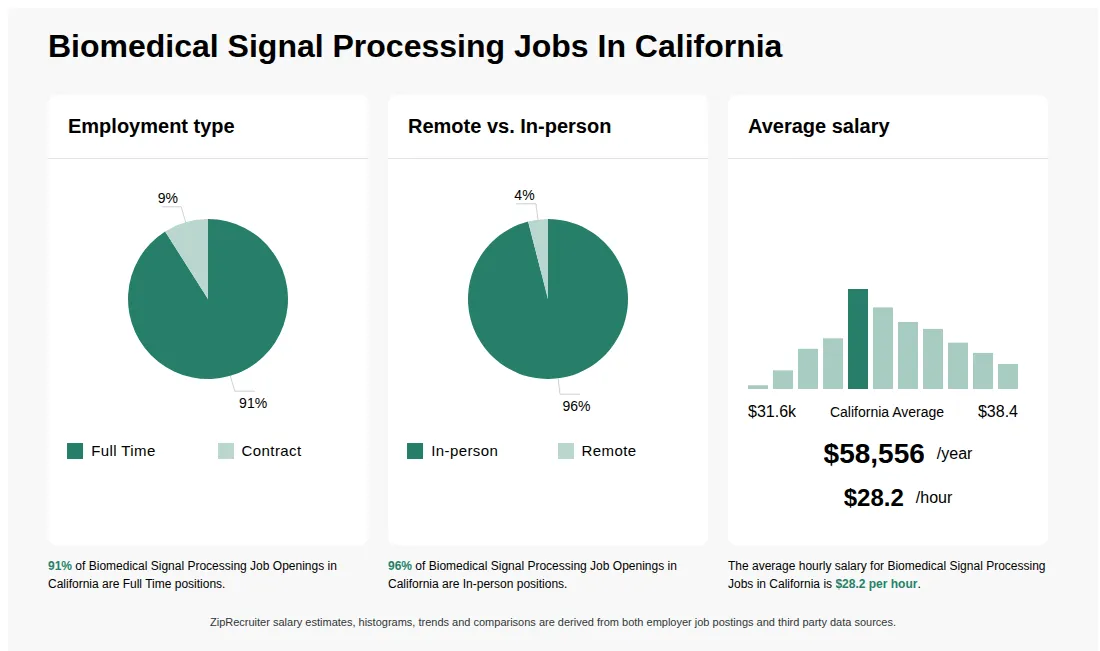
How much do biomedical signal processing jobs pay per hour?
As of Sep 7, 2026, the average hourly pay for biomedical signal processing in California is $28.15, according to ZipRecruiter salary data. Most workers in this role earn between $23.94 and $31.78 per hour, depending on experience, location, and employer.
What is biomedical signal processing?
A Biomedical Signal Processing job involves analyzing physiological signals, such as ECG, EEG, and EMG, to extract meaningful information for medical diagnosis, treatment, and research. Professionals in this field use mathematical models, algorithms, and machine learning techniques to improve healthcare technologies. They work in hospitals, research institutions, medical device companies, and academia to develop and optimize signal processing methods for clinical applications.
What does someone working in biomedical signal processing do?
Professionals in Biomedical Signal Processing often spend their days analyzing physiological signals such as EEGs, ECGs, or EMGs, designing algorithms to interpret data, and validating systems to ensure accuracy and reliability. They collaborate closely with clinicians, researchers, and software developers to translate clinical needs into effective technical solutions. Tasks may also include testing prototypes, troubleshooting data acquisition systems, and preparing reports or research publications. This role can be a mix of independent analytical work and cross-functional teamwork, offering both technical and collaborative challenges.
What are the key skills and qualifications needed to thrive in biomedical signal processing?
To thrive in Biomedical Signal Processing, you need a solid background in biomedical engineering, signal analysis, and quantitative methods, typically supported by a relevant degree or advanced coursework. Familiarity with MATLAB, Python, LabVIEW, and signal processing toolboxes, as well as knowledge of regulatory standards like FDA or ISO, is essential. Critical thinking, attention to detail, and strong communication skills help professionals collaborate effectively with multidisciplinary teams. These competencies are crucial for developing accurate, reliable solutions that support patient care and medical research.
What are popular job titles related to Biomedical Signal Processing jobs in California?
For Biomedical Signal Processing jobs in California, the most frequently searched job titles are:
- Remote Radar Signal Processing Engineer
- Internship Biomedical Signal Processing Engineer
- Work From Home Digital Signal Processing Engineer
- Phd Signal Processing
- Remote Fpga Engineer
- Digital Signal Processing Engineer
- Computational Neuroscience Phd
- Medical Image Processing Engineer
- Signal Processing Engineer
- Biomedical Signal Processing Engineer
What job categories do people searching Biomedical Signal Processing jobs in California look for?
The top searched job categories for Biomedical Signal Processing jobs in California are:
What cities in California are hiring for Biomedical Signal Processing jobs?
Cities in California with the most Biomedical Signal Processing job openings:
Job description
Noctrix Health is redefining the treatment of chronic neurological disorders with clinically validated therapeutic wearables. Our team of medical device specialists, neuroscientists, and consumer electronics engineers is dedicated to delivering prescription-grade therapy with an outstanding user experience. We have pioneered the world's first drug-free wearable therapy, clinically proven to alleviate symptoms in adults with drug-resistant Restless Legs Syndrome (RLS). Be part of our mission to transform healthcare, improve lives, and drive meaningful change with Noctrix Health.
We are seeking a versatile and highly motivated Clinical Research Engineer to support research, development, testing, and data analysis initiatives within Noctrix Health's Clinical Research organization. This role sits at the intersection of engineering and clinical science, contributing to software and firmware development, physiological signal processing, clinical data analysis, device characterization, verification and validation, and clinical research activities.
The ideal candidate is a strong technical generalist who enjoys solving complex problems across multiple disciplines and can quickly adapt to new technical challenges. This individual will work closely with Clinical Research, Engineering, Quality, Regulatory Affairs, and Product teams to generate clinical insights, evaluate device performance, and support the development of next-generation wearable medical technologies.
This position reports to the Chief Scientific Officer.
This is a full-time, hybrid position located in our Pleasanton, CA office, with a minimum of three days per week onsite.
Responsibilities:
- Develop Python-based tools, algorithms, analysis pipelines, and automation frameworks to improve research efficiency, engineering productivity, and data quality
- Analyze small- and large-scale clinical, physiological, and device datasets to identify trends, generate insights, and support product and clinical decision-making
- Perform physiological signal processing, waveform analysis, and interpretation of biosensor and device-generated data
- Develop and execute verification and validation protocols for software, firmware, algorithms, and medical device systems
- Contribute to the design, development, and testing of firmware components and embedded systems used within Noctrix medical devices
- Support device characterization, use-case testing, performance evaluations, and root cause investigations
- Develop automated testing and data analysis workflows to improve the efficiency and repeatability of research and engineering activities
- Apply statistical methods to experimental and clinical datasets and interpret results in support of clinical research and product development
- Support algorithm and machine learning model development, evaluation, and testing where applicable
- Collaborate with cross-functional teams to define technical requirements, design experiments, develop and test systems, and solve complex technical problems
- Support clinical research studies through data collection, analysis, technical troubleshooting, and interpretation of study results
- Prepare clear technical documentation, including research findings, technical specifications, test protocols, test reports, and engineering records
- Ensure technical and research activities are appropriately documented in accordance with applicable Quality System and regulatory requirements
- Partner closely with Clinical Affairs, Regulatory Affairs, Quality Assurance, Product Management, and Engineering to advance safe, effective, and patient-centered solutions
Requirements:
- Bachelor's degree in Engineering, Biomedical Engineering, Electrical Engineering, Computer Science, or a related technical discipline with 5+ years of relevant industry experience, or a Master's degree with 3+ years of relevant experience
- Experience developing, testing, or supporting medical devices, wearable health technologies, or similar regulated products
- Experience working across multiple technical domains, including software development, data analysis, testing, and embedded systems
- Experience supporting research or product development activities from concept through commercialization within a Design Control environment
- Hands-on experience developing and executing verification and validation testing within a regulated product development environment
- Experience analyzing physiological signals, biosensor data, device data, or similar time-series datasets
- Strong proficiency in Python for data analysis, algorithm development, automation, or software development
- Experience with statistical analysis and interpretation of experimental and clinical datasets
- Understanding of signal processing and digital signal analysis methodologies
- Familiarity with algorithm and machine learning model development and testing methods
- Strong technical writing skills with experience producing protocols, reports, specifications, and other controlled documentation
- Strong analytical and troubleshooting skills with the ability to investigate and resolve complex technical problems
- Ability to independently manage multiple projects and priorities in a fast-paced, cross-functional environment
- Excellent communication skills with the ability to clearly communicate technical findings to both technical and non-technical stakeholders
Preferred Qualifications:
- Experience supporting clinical research studies, clinical data analysis, or human subjects research
- Experience with C++, SQL, Git, and modern software development workflows
- Experience developing automated test systems, data processing pipelines, or research tools
- Experience developing or evaluating algorithms and machine learning models using physiological or clinical data
- Experience with embedded firmware development and testing
- Strong understanding of software development principles and version control practices
- Familiarity with FDA Design Controls and medical device Quality Management Systems
- Knowledge of Good Clinical Practice (GCP), HIPAA, patient data privacy requirements, and healthcare data security best practices
- Experience working with wearable medical devices, neurostimulation technologies, biosensors, or other connected health products
Compensation:
- Base Pay: $130,000-$150,000 per year
- Annual Bonus Eligibility

About Noctrix Health, Inc`.
Sourced by ZipRecruiter
Industry
Medical equipment and supplies manufacturing
Company size
1 - 10 Employees
Headquarters location
Pleasanton, CA, US
Year founded
2018