1

Bioinformatics Computational Biology Jobs (NOW HIRING)

PhD in Bioinformatics, Computational Biology, Genomics, or a related field with 3+ years of relevant experience in industry. * Extensive hands-on experience processing and analyzing bulk and/or ...

Ph.D. in Bioinformatics, Biostatistics, Computational Biology, or related discipline * Minimum of SIX (6) years of experience in bioinformatics, computational biology, or a related scientific ...

Analyzes biological data using computational tools to extract meaningful insights and patterns for research and development purposes. Essential Functions: * Analyzes biological data to identify ...

Showing results 21-40

Bioinformatics Computational Biology information

See salary details

$49K

$203.5K

$400K

How much do bioinformatics computational biology jobs pay per year?

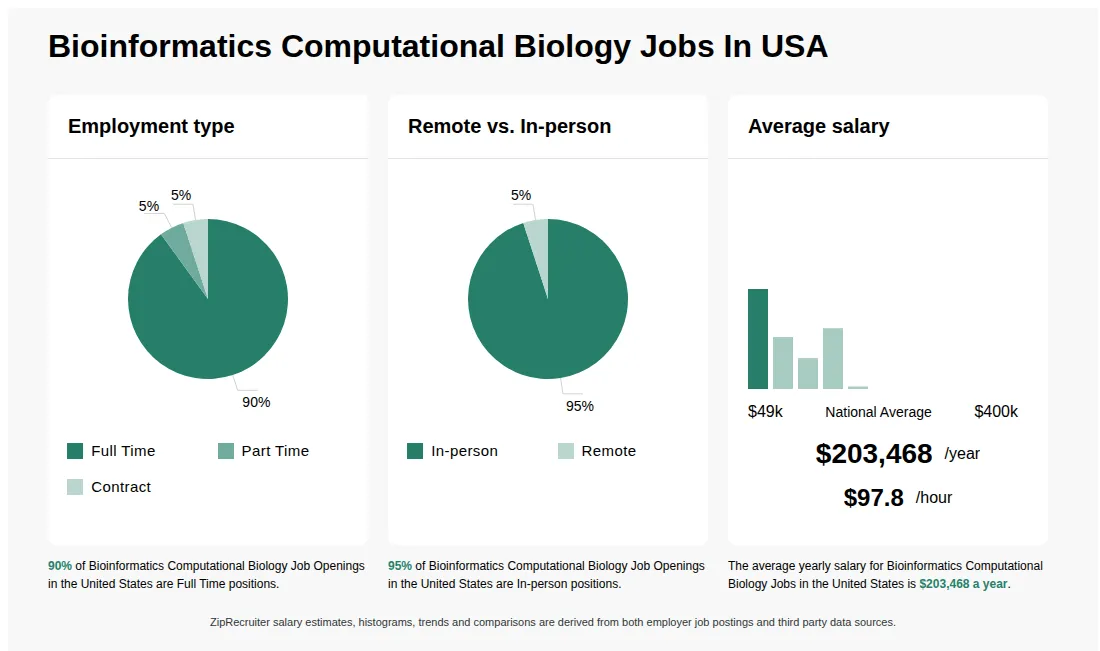
As of Aug 11, 2026, the average yearly pay for bioinformatics computational biology in the United States is $203,468.00, according to ZipRecruiter salary data. Most workers in this role earn between $78,500.00 and $400,000.00 per year, depending on experience, location, and employer.

What is the difference between Bioinformatics Computational Biology vs Bioinformatics Analyst?

AspectBioinformatics Computational BiologyBioinformatics Analyst
Required CredentialsBachelor's or Master's in Bioinformatics, Computational Biology, or related fieldsBachelor's or Master's in Bioinformatics, Biology, or related fields
Work EnvironmentResearch labs, academia, biotech companies, computational research settingsHealthcare, research institutions, biotech firms, data analysis roles
Employer & Industry UsageResearch-focused roles in academia, biotech, pharmaData analysis and interpretation in healthcare and biotech sectors

Bioinformatics Computational Biology involves developing and applying computational models to understand biological systems, often focusing on algorithm development and data simulation. In contrast, Bioinformatics Analysts primarily interpret biological data, perform data analysis, and generate reports. Both roles require strong computational skills and biological knowledge but differ in their focus on research versus data interpretation.

How do bioinformatics computational biologists typically collaborate with wet lab researchers in a research setting?

In a research environment, bioinformatics computational biologists work closely with wet lab scientists to design experiments, interpret large-scale biological data, and validate computational findings. Collaboration often involves regular meetings to discuss project goals, data quality, and analysis strategies, ensuring that computational approaches align with biological questions. This partnership is crucial for integrating experimental and computational workflows, which helps accelerate discoveries and improves the accuracy of results. Effective communication and a willingness to learn from each other are key to successful interdisciplinary teamwork.

What are the key skills and qualifications needed to thrive as a bioinformatics computational biologist?

To thrive as a Bioinformatics Computational Biologist, you need a strong background in molecular biology, statistics, and computer science, often supported by an advanced degree in bioinformatics or a related field. Expertise in programming languages (such as Python, R, or Perl), experience with high-throughput sequencing data, and familiarity with bioinformatics tools and databases are essential. Strong analytical thinking, problem-solving abilities, and effective communication skills help you interpret complex data and collaborate with research teams. These skills are crucial for extracting meaningful biological insights from large datasets and advancing scientific discovery.

What are bioinformatics computational biology jobs?

Bioinformatics and computational biology jobs involve the application of computational biology and other methods to analyze biological data. As a biologist in bioinformatics and computational biology, you create datasets to test and validate each stage of new product development. Industries that utilize bioinformatics professionals include agriculture, health sciences, academics, and genetics. In this role, your responsibilities include overseeing technology development, analyzing statistics on new products, running research experiments, and documenting test results. Scientists and assistants who work in labs prepare experiments, collaborate with groups of other scientists and laboratory assistants, and use computer programs and spreadsheets to track and document results.


What are bioinformatics and computational biology?

Bioinformatics and computational biology are interdisciplinary fields that use computer science, mathematics, and statistics to analyze and interpret biological data. Bioinformatics focuses primarily on developing methods and software tools for understanding biological data, especially large datasets such as genomic sequences. Computational biology involves creating mathematical models and computational simulations to study the behavior of biological systems. Both fields play a crucial role in advancing research in genomics, drug discovery, and personalized medicine.
What cities are hiring for Bioinformatics Computational Biology jobs? Cities with the most Bioinformatics Computational Biology job openings:
What are the most commonly searched types of Bioinformatics Computational Biology jobs? The most popular types of Bioinformatics Computational Biology jobs are:
What states have the most Bioinformatics Computational Biology jobs? States with the most job openings for Bioinformatics Computational Biology jobs include:
What job categories do people searching Bioinformatics Computational Biology jobs look for? The top searched job categories for Bioinformatics Computational Biology jobs are:
Infographic showing various Bioinformatics Computational Biology job openings in the United States as of August 2026, with employment types broken down into 63% Full Time, 32% Part Time, 1% Temporary, and 4% Contract. Highlights an 80% Physical, 2% Hybrid, and 18% Remote job distribution, with an average salary of $203,468 per year, or $97.8 per hour.

Senior Bioinformatics Software Engineer

Morpheus Group

Houston, TX

Full-time

Posted 13 days ago


Job description

We are seeking an experienced Senior/Staff-Level Bioinformatics Software Engineer to provide technical leadership in the design, development, and enhancement of advanced bioinformatics software solutions. This role combines software engineering, computational biology, and data science expertise to support genomic data analysis, next-generation sequencing (NGS) workflows, and the development of scalable analytical platforms.
Key Responsibilities
  • Architect and develop innovative bioinformatics applications, analytical tools, and data processing solutions.
  • Lead the creation and optimization of genomic analysis pipelines focused on sequence interpretation, variant detection, and complex biological data analysis.
  • Partner with scientists, researchers, and cross-functional stakeholders to design studies, analyze results, and translate biological requirements into software solutions.
  • Drive technical strategy and contribute to architectural decisions for current and future software platforms.
  • Improve development processes through automation, best practices, and modern engineering methodologies.
  • Mentor engineering team members and serve as a technical resource across projects. Desired Qualifications
  • Strong background in bioinformatics software development with expertise in NGS data analysis and genomic workflows.
  • Experience working with common bioinformatics formats and tools, including sequencing alignment, variant analysis, and quality control frameworks.
  • Advanced programming skills in Python, R, or similar languages used in scientific computing.
  • Proficiency with Linux environments, cloud computing platforms, and workflow orchestration tools.
  • Experience with software development best practices, source control, testing methodologies, and containerized environments.
  • Excellent communication, leadership, and collaboration skills with the ability to work effectively across scientific and technical teams.

Background
  • Bachelor's degree in Computer Science, Bioinformatics, Data Science, Statistics, Mathematics, or a related field required; advanced degrees preferred.
  • Approximately 7+ years of experience in software engineering, bioinformatics, computational biology, or a related discipline, including demonstrated technical leadership.

This opportunity is ideal for a bioinformatics professional who enjoys leading complex technical initiatives, building scalable genomics solutions, and working at the intersection of software engineering and life sciences