1

Aviation Weather Observer Jobs (NOW HIRING)

AND High school diploma or general education degree (GED) and a minimum of two (2) years of experience as a qualified weather observer for surface observations at an aviation weather facility.

... observation data. Our Weather division fuses AI and NWP forecasts - initialized with Spire ... Its proprietary data and algorithms provide the most advanced maritime, aviation, and weather ...

next page

Showing results 1-20

Aviation Weather Observer information

See salary details

$14

$38

$61

How much do aviation weather observer jobs pay per hour?

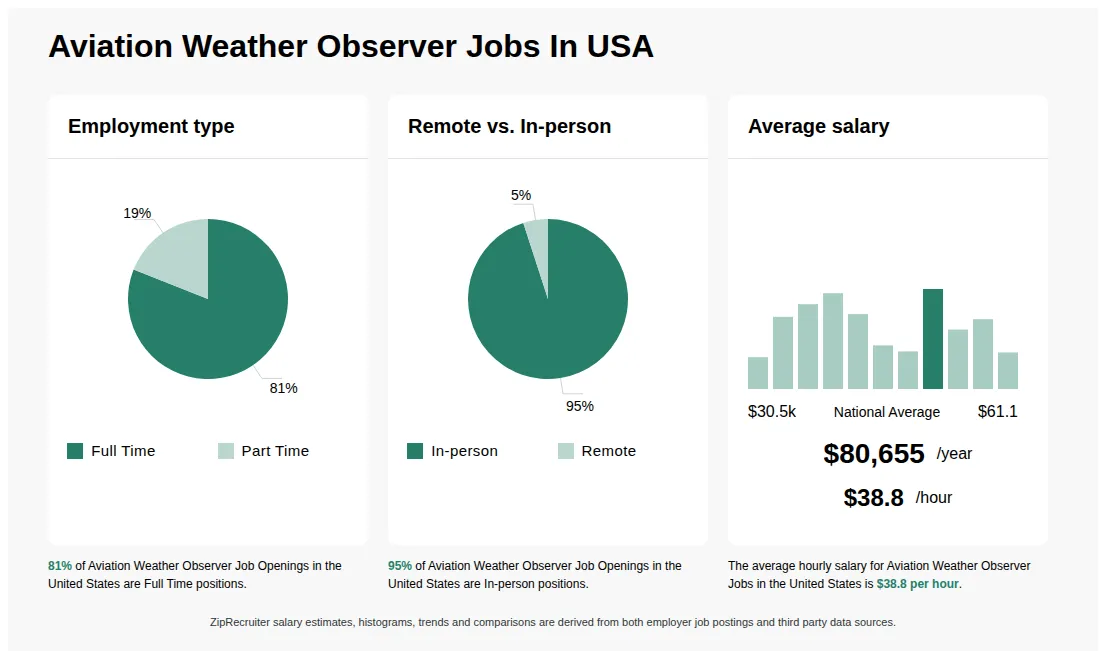
As of Jun 6, 2026, the average hourly pay for aviation weather observer in the United States is $38.78, according to ZipRecruiter salary data. Most workers in this role earn between $26.68 and $49.04 per hour, depending on experience, location, and employer.

What are some of the common challenges faced by Aviation Weather Observers during shifts, especially in rapidly changing weather conditions?

Aviation Weather Observers often face the challenge of monitoring and reporting rapidly changing weather, especially during storms or severe weather events. Maintaining accuracy and timeliness under pressure is essential, as pilots and air traffic controllers rely on their reports for flight safety. Observers must stay alert throughout their shifts, quickly identifying and recording subtle weather changes, and collaborating closely with meteorologists and airport operations teams. Adaptability and attention to detail are key skills needed to manage these dynamic situations effectively.

What does an Aviation Weather Observer do?

An Aviation Weather Observer is responsible for monitoring, recording, and reporting weather conditions at airports or weather stations. Their main duties include observing atmospheric phenomena such as cloud cover, visibility, wind speed and direction, temperature, and precipitation. They provide critical weather data to pilots, air traffic controllers, and meteorologists to ensure flight safety. Observers use specialized instruments and follow strict protocols to ensure the accuracy and reliability of weather reports. Their work is essential for safe and efficient aviation operations.

What are the key skills and qualifications needed to thrive as an Aviation Weather Observer, and why are they important?

To thrive as an Aviation Weather Observer, you need a solid understanding of meteorology, observational techniques, and typically a relevant degree or specialized training. Familiarity with weather monitoring instruments, METAR/SPECI coding, and aviation weather reporting systems is essential. Strong attention to detail, analytical thinking, and effective communication skills help ensure accurate reporting and collaboration with air traffic and pilots. These skills are vital to provide reliable weather data that supports flight safety and efficient aviation operations.

What Does an Aviation Weather Observer Do?

Aviation weather observers detect and track weather conditions and provide real-time weather forecasts, which you use to augment and backup the Automated Surface Observing System (ASOS). ASOS is a nationwide network used by the National Weather Service, the Federal Aviation Administration (FAA), and the Department of Defense (DoD) to monitor weather activity and help with aviation, climate, and other weather-related research operations. Weather measurements include wind speed and direction, temperature, visibility, precipitation, and air pressure. Your findings as a weather observer allow airlines to select a safer flight pattern to avoid weather conditions or make appropriate decisions such as delaying or canceling a flight. They also help NASA and other governmental agencies determine different atmospheric conditions for various research projects. If ASOS experiences an outage due to extreme weather conditions, you are responsible for manually documenting your observations until ASOS is operational again.

What cities are hiring for Aviation Weather Observer jobs? Cities with the most Aviation Weather Observer job openings:
What are the most commonly searched types of Aviation Weather Observer jobs? The most popular types of Aviation Weather Observer jobs are:
What states have the most Aviation Weather Observer jobs? States with the most job openings for Aviation Weather Observer jobs include:
Infographic showing various Aviation Weather Observer job openings in the United States as of May 2026, with employment types broken down into 50% Full Time, and 50% Part Time. Highlights an 100% In-person job distribution, with an average salary of $80,655 per year, or $38.8 per hour.
Air Traffic Control Specialist - Walla Walla, WA (ALW) Jobs

Air Traffic Control Specialist - Walla Walla, WA (ALW) Jobs

ClearanceJobs

Walla Walla, WA โ€ข On-site

Full-time

This job post hasย expired today.ย Applications are no longer accepted.


Job description

Air Traffic Controller Opportunity

Serco has a great opportunity for an Air Traffic Controller located in Walla Walla, WA! Serco is one of the largest non-government Air Navigation Service Providers (ANSP) in the world. We deliver air traffic control (ATC) services for small and medium regional airports as well as the largest commercial air hub on the globe. Serco is also the only commercial ANSP to provide all the three ATC disciplines: Terminal Tower, Terminal Approach Control, and Enroute Center. No wonder we are one of the largest non-government employers of Air Traffic Controllers in the world!

Air Traffic Control Specialists (ATCS) control air traffic on and within the vicinity of the airport according to established procedures and policies to prevent collisions and minimize delays arising from traffic congestion. They are responsible for the safe, orderly, and expeditious movement of air traffic through the nation's airspace. As a member of the Air Traffic Control team, you can expect to:

  • Answer radio calls from arriving/departing aircraft
  • Issue landing/takeoff instructions
  • Issue information such as runway usage, wind velocity/direction, visibility, taxiing instructions, and pertinent data on other aircraft operating in vicinity
  • Issue air traffic clearances
  • Perform critical weather observations as a Limited Aviation Weather Reporting Station (LAWRS) observer, and to disseminate timely weather information to pilots, other air traffic control facilities and other users of the National Airspace System.
  • Transfer and receive control of aircraft
  • Operate equipment such as: radios, telephones, interphones, computer systems, radar, recording systems, weather equipment, light guns, airport/runway lighting systems, backup equipment, etc.
  • Alert Aircraft Rescue Fire Fighters and other first responders to aircraft experiencing emergency situations
  • Coordinate with and issue instructions to airport vehicles/personnel
  • Maintain and disseminate records of daily operations
  • Perform on-the-job training instructor duties as required

Requirements to join the team:

  • US Citizenship
  • An FAA Second Class Medical Certificate
  • A Control Tower Operator (CTO) rating or a Credential with a Tower Rating and 6 months of practical experience in accordance with 14 CFR Part 65.39
  • Eligibility to work for Serco under Federal Immigration Laws
  • Verification of education and employment references from previous employers including the release of drug and alcohol records
  • Passing a pre-employment drug screen
  • Receiving an FAA Security clearance (interim and final suitability)
  • Proof of identity and eligibility to work in the United States

Here at Serco, professional development is a top priority. We help our team develop their skills and grow in their careers. If you are an experienced Air Traffic Controller with a prior tower certification or credential who wants to be part of a professional, customer service and safety-oriented organization, please submit your application today!