1

Automotive Performance Engineer Jobs (NOW HIRING)

Performance Engineer Individual to provide technical support in the development of Tier 4 Aftertreatment urea injection hardware and software strategies. Specific responsibilities will be developing ...

OR

$122.40K - $161.30K/yr

We are in search of a remarkable Automotive Performance Senior Software Engineer to join our energetic team. You will participate in groundbreaking projects that drive technology and innovation ...

... Automotive, Life Science, Insurance, legal, healthcare, among others. It also offers outsourcing ... Job Title: Sr. Performance Engineer (with Retail Domain and Rational Performance Testing experience ...

next page

Showing results 1-20

Automotive Performance Engineer information

See salary details

$11

$60

$98

How much do automotive performance engineer jobs pay per hour?

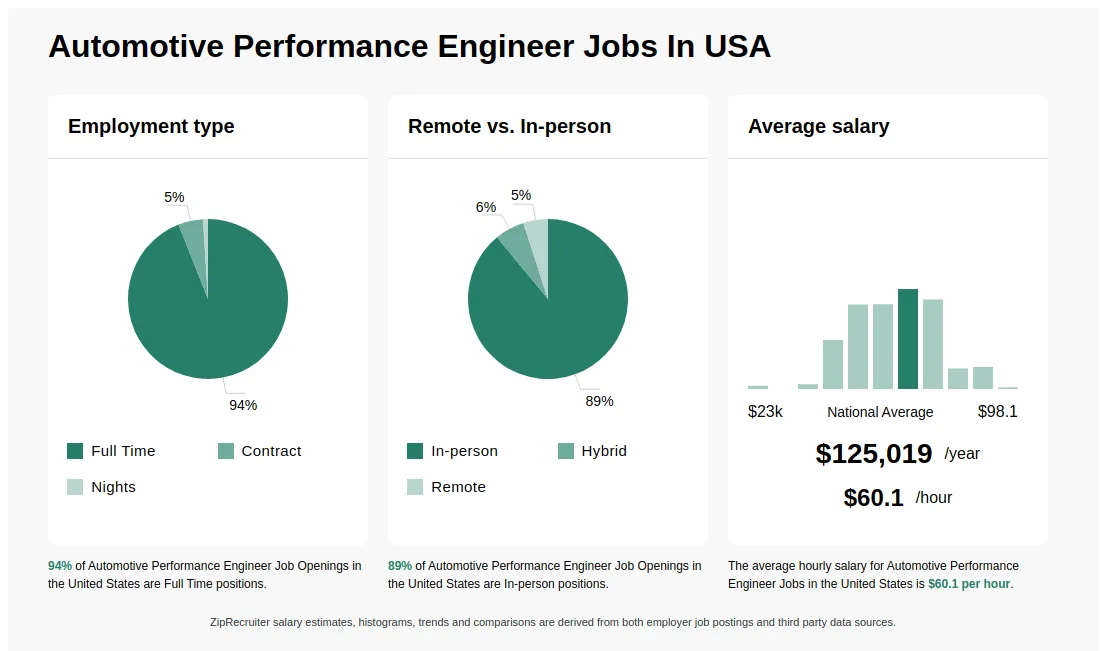
As of May 29, 2026, the average hourly pay for automotive performance engineer in the United States is $60.11, according to ZipRecruiter salary data. Most workers in this role earn between $49.28 and $68.03 per hour, depending on experience, location, and employer.

What does an Automotive Performance Engineer do?

An Automotive Performance Engineer focuses on optimizing vehicle performance, including engine power, handling, aerodynamics, and fuel efficiency. They conduct tests, analyze data, and collaborate with design teams to enhance speed, durability, and overall driving experience. Their work involves using simulation tools, dynamometers, and real-world testing to fine-tune components. These engineers often work in motorsports, high-performance vehicle manufacturing, or research and development.

What are the key skills and qualifications needed to thrive in the Automotive Performance Engineer position, and why are they important?

To thrive as an Automotive Performance Engineer, you need a solid background in mechanical or automotive engineering, with expertise in vehicle dynamics, engine tuning, and data analysis. Familiarity with tools such as dynamometers, simulation software (like MATLAB or Simulink), and industry certifications such as ASE or similar are often required. Strong problem-solving abilities, clear communication, and teamwork are essential soft skills for this role. These skills ensure that performance engineers can optimize vehicle systems effectively, collaborate with multidisciplinary teams, and drive innovation in a competitive automotive environment.

What are the typical daily responsibilities of an Automotive Performance Engineer?

Automotive Performance Engineers typically spend their days conducting vehicle tests, analyzing performance data, and developing strategies to enhance powertrain, suspension, and overall vehicle performance. They collaborate closely with design, testing, and manufacturing teams to implement improvements and troubleshoot issues. The role also involves using simulation software and diagnostic tools to validate engineering changes and ensure compliance with safety or emissions standards. This mix of hands-on testing, data analysis, and teamwork makes the job dynamic and rewarding for those passionate about automotive innovation.
What cities are hiring for Automotive Performance Engineer jobs? Cities with the most Automotive Performance Engineer job openings:
What states have the most Automotive Performance Engineer jobs? States with the most job openings for Automotive Performance Engineer jobs include:
What job categories do people searching Automotive Performance Engineer jobs look for? The top searched job categories for Automotive Performance Engineer jobs are:
Infographic showing various Automotive Performance Engineer job openings in the United States as of May 2026, with employment types broken down into 54% Full Time, 43% Part Time, and 3% Contract. Highlights an 100% Physical job distribution, with an average salary of $125,019 per year, or $60.1 per hour.
Performance Engineer - NASCAR

Performance Engineer - NASCAR

Penske Racing South

Mooresville, NC โ€ข On-site

Full-time

Posted 22 days ago


Job description

Job Description

The Performance Engineer directly contributes to the performance of our race cars by working closely with the race engineers, engineering staff, and crew chiefs, while also working independently to identify, test, organize, analyze, validate, and communicate areas of improvement and ways in which these improvements can be realized. Using data, research, internal and external resources, as well as other staff, the performance engineer role will develop items and help to understand and optimize configurations that will aid in the performance of the race car. The qualified person will be organized, self-motivated, and able to work with minimum supervision and under extreme pressure to make quick, calculated decisions. A strong interpersonal and communication skillset is required, along with an exceptional team mentality. Performance Engineers are encouraged to challenge established thinking and share their ideas to create an environment where everyone can contribute to our shared success.

This position requires occasional weekday and weekend travel for testing and race events. During race weekends, Performance Engineers will support track activities remotely from our Mooresville, NC shop.

Roles & Responsibilities:

  • Assist race teams in setup development for each event
  • Simulation support & analysis of NexGen setup parameters
  • Interpret tire models & deliver tire condition recommendations
  • Driver In Loop (DIL) testing & analysis
  • Optimize suspension systems during 7-Post testing
  • Conduct on track testing, data analysis, & performance reporting
  • Collaborate with Performance Engineers & Race Engineers to develop & refine engineering tools
  • Provide live race support โ€” monitor timing & scoring, track performance trends, and communicate clear, actionable observations to race teams.
  • Develop, standardize, and maintain engineering reports and performance documentation

Qualifications:

  • Bachelorโ€™s degree in Engineering (Mechanical, Automotive, or related discipline)
  • Minimum 3 years of motorsports experience
  • Strong knowledge of vehicle dynamics, high-performance vehicle physics, and applied engineering mathematics
  • Ability to work under pressure and to tight deadlines with minimal errors
  • Strong levels of IT skills, including MS Office, Excel, Word, PowerPoint
  • Experience with data analysis software (MoTeC/PiToolbox/Atlas)
  • Familiarity with NASCAR Next Gen platforms, regulations, and operational procedures is an advantage